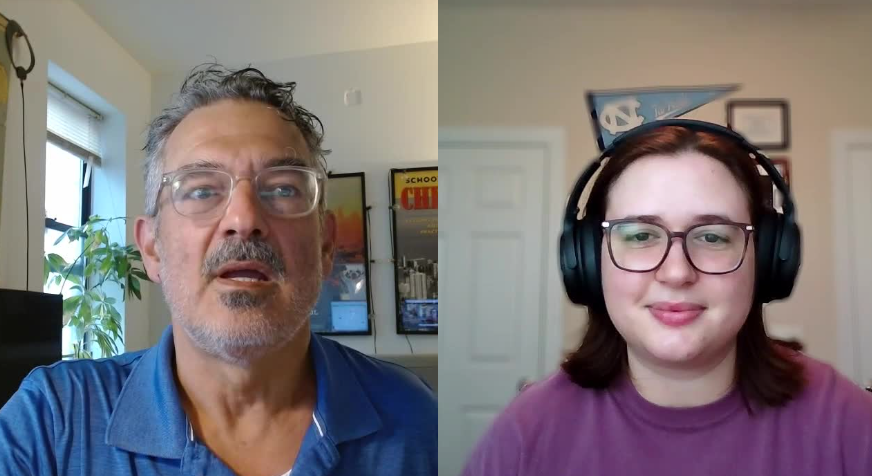
An interview with EdNC’s Anna Pogarcic about making “community-based journalism” more than just empty words. Part of The Grade’s series on innovations and alternative approaches.
If you know about EdNC, then you know.
Longtime readers of The Grade have heard about the outlet several times over the years — including a 2022 piece by co-founder Mebane Rash, ‘Why we built EdNC so differently from other outlets.’
Innovative and nontraditional approaches to covering the news are increasingly necessary, as illustrated by the recent success of the Baltimore Banner. As the recent collapse of the Houston Landing reminded us, good intentions, talent, and nonprofit status aren’t enough anymore (if they ever were).
I had the chance to talk with EdNC’s Anna Pogarcic about how the outlet makes community engagement real.
When it comes to community engagement, Pogarcic says the question is completing the engagement loop that is critically important: “It’s easy to sit and say you’re listening to people,” says Pogarcic, who was the youngest Poynter media transformation challenge fellow ever selected and is now headed to law school. “But what are you doing with it once you’ve listened to them?”
Some of the other topics discussed include helpful ways to cover school choice, finding ways to make sure stories aren’t too wonky, and the importance of newsrooms figuring out what not to do. Some of the outlets and organizations that come up in the discussion include Chalkbeat, The 74, Open Campus, and KQED’s Curious City:
Watch the video above or feel free to read the transcript below.
Related pieces from The Grade
Make room for non-traditional education journalism
Urgency, experimentation, & expansion at the Baltimore Banner
In San Diego, an alternative approach to education news
Making education news more useful at the AL.com Education Lab
Community-based solutions will deepen your reporting
7 tips for improving news coverage of private school choice
Covering choice in the Trump 2.0 era
Taped in late June, the conversation that generated this automated transcript has been lightly edited.
Alexander Russo (00:03.222)
Hi, it’s Alexander Russo with The Grade. I’m here today to talk with Anna Pogarcic about EdNC.
Anna, great to have you on the podcast. Why don’t you start out by telling folks who you are and what EdNC is?
Anna Pogarcic (00:18.631)
Hi, yes, so I’m the director of content for EdNC, which is pretty similar to a managing editor role in some more traditional newsrooms. I work with all of our different content teams on the daily to organize what we cover, how we’re going to publish it and distribute it. And it’s a lot of great fun.
EdNC, for those who don’t know, we are a nonprofit news website based in North Carolina. We cover public schools all through the education continuum, starting in pre-K and child care all the way through attainment and postsecondary education.
Alexander Russo (00:48.238)
Excellent. And before we jump in, I always like to ask people a little bit about them personally — or at least on the line between personal and professional. Do you have a TV show or movie or song that you particularly like that connects you and pop culture and education? My go-to is Season 4 of the Wire, the HBO show that had a season in a school. What’s yours, if any?
Anna Pogarcic (01:16.719)
Well, I think right now it has to be Abbott Elementary. I think that’s the only answer. For those who don’t know, I think it’s on its third season now. It follows a public school in Philadelphia and all the teachers,and it’s kind of a workplace sitcom. Really, it’s obviously very funny and also does a really great job of bringing some of the topics around education to the forefront in a very light way.
Alexander Russo (01:38.028)
Everybody loves Abbott Elementary! Tell us a little bit about where EdNC fits in the ecosystem of education news outlets. There are a lot of education news outlets. There are a lot of nonprofits. For folks who don’t know, where does EdNC sort of fit, or how does it compare?
Anna Pogarcic (01:59.353)
Yeah, absolutely. I think it has a very special role in North Carolina specifically. We are the only education outlet that solely focuses on North Carolina schools. So we work a lot with local newsrooms across North Carolina, often partnering or augmenting their coverage or doing things like that. And obviously we pull a lot on some national trends that other outlets cover. But what really makes us special is that we focus on North Carolina and we’re the only ones doing it across the state.
And that’s really what makes EdNC special, is that we focus on all 100 counties in North Carolina, urban and rural. North Carolina has 100 different counties with very different issues and topics that matter to people across all of them. And we work hard to travel to all 100 every single year and really highlight those issues that are happening at the local level, bringing them to a statewide audience.
Alexander Russo (02:47.639)
Who else is out there, if you guys are unique in serving the whole state and getting to all the counties, which is an impressive thing to try to do, who else is out there in North Carolina covering education whose work you complement or compete with?
Anna Pogarcic (03:02.991)
Yeah, absolutely. Of course, there’s local outlets all across our state. We have public radio, TV, newspapers, and even some other startup or digital initiatives like newsletters that are happening across the state. And so we often will partner with them or republish their coverage or they’ll republish us. We don’t try to necessarily compete head to head with anybody, I would say. So there’s a fairly robust local news landscape in North Carolina, and there are other statewide outlets as well that maybe don’t necessarily specifically cover education, maybe politics or travel or other things like that. So there’s definitely a lot going on in North Carolina, but we are the main voice for public schools in terms of news coverage.
Alexander Russo (03:43.222)
And how would I map — if I’m not from North Carolina, but I know a little bit about education and journalism, how would I — are you the Alabama Education Lab? Are you the Texas Tribune? Where do you fit or how would you compare yourself to other outlets that folks may know?
Anna Pogarcic (04:00.783)
I mean, we’re EdNC, we’re definitely our own thing, I would say. I think what makes us really special is that we try to do a blend of both news as well as policy analysis and really community on-the-ground work to get our readers and the North Carolina population more broadly involved in talking about these issues. So we’re not just sitting in an office writing articles every day – like I said, we’re going out in community.
At any given point in the week, have a reporter who’s either in a school or in a community college or a child care center trying to really elevate these stories. And we’re trying to facilitate community conversations that way as well. So [we’re] not just writing articles about people, we’re really trying to be by and for people across North Carolina.
Alexander Russo (04:44.149)
Nice, and we’ll talk a little bit more about the coverage in a minute. Are there other folks in other states who are doing the add-and-see approach, emulating some or all of what you do in other places?
Anna Pogarcic (04:59.119)
Yeah, I mean, absolutely. I think we’ve definitely seen (that) across the journalism industry, especially in the last decade or so, as we’ve seen some of the rise of digital media as well as all the different things that we have to do as journalists to get people’s attention. There definitely is a broader focus, I would say, on that community engagement aspect that we value at EdNC. So we’re certainly not the only ones doing it. Even within the education space, I know Chalkbeat especially, they have a whole community engagement team and things like that – I’ve spoken to some of the people on their staff. So we’re certainly not the only ones doing it. And it’s definitely becoming more popular, which is really great to see because at EdNC we believe that’s what makes journalism really special and sustainable in the future. So I love to see that other outlets are adopting that as well and simultaneously as we are.
Alexander Russo (05:45.633)
Community engagement, that’s the approach you’re saying that you’re seeing other people go and do?
Anna Pogarcic (05:50.969)
Yeah, I’ve definitely seen within North Carolina and across the country, it seems that news outlets are all kind of understanding that we need to get out in communities and meet our readers where they are in order to continue to grow and be sustainable. And so it definitely seems that that’s becoming at least a popular thing to talk about and try to implement across newsrooms.
Alexander Russo (06:11.021)
It certainly is a popular thing to talk about. For folks who might not know or just in the interest of specificity and concreteness, what is community engagement? What does it look like? Why is it so important? I feel like education journalism, and journalism in general, is full of buzzwords that may or may not mean things outside of conferences. What is community engagement?
Anna Pogarcic (06:33.871)
Yeah, that’s a great question and definitely looks like a lot of different things. I think if you really want to boil it down, it is going out and meeting real people, not just covering meetings or places where people in power have command of the room. So speaking for at least at EdNC, what that looks like is traveling across the state, perhaps visiting specific schools or talking with people on the ground, one-on-one about what they care about and then how to get it to them.
And so that could look like hosting a community event, perhaps partnering with a local organization to get people in a one room and talk about the issues that matter to them. It could even look like running targeted Facebook ads, which we do in certain areas to try to get people’s attention there. So it can look like a wide variety of things. It doesn’t necessarily have one exact form that it can take, but it really just gets to how can we directly convene with people who are our readers or could be our readers and make sure that we keep them in our orbit going forward?
Alexander Russo (07:36.024)
So if I’m an outlet and I do a monthly office hours at Starbucks, that sounds like it’s a community engagement, but maybe not robust enough. Does a monthly office hour at Starbucks qualify by the EdNC standard as community engagement, or would I need to do something more robust?
Anna Pogarcic (07:59.099)
I mean, I think that certainly could be community engagement. It really just depends on your own audience that you serve. Obviously, for a statewide audience, if we wanted to do something like that, we would have to do it a lot of times. But for a local, maybe a city paper, that certainly counts. Giving your reporters time and space to meet with community members directly, understanding that it doesn’t always lead to a story in that moment, but just building that trust is the key thing and making sure that you are accessible.
Those are the two things that are really important to keep in mind, so I would say that definitely counts.
Alexander Russo (08:31.917)
Sure, but is it enough? It sounds like EdNC’s vision of community engagement is bigger and bolder than the average outlet’s. Sometimes what I sense or see from you all is in the heroic category. What’s the community engagement at 100? What does that look like?
Anna Pogarcic (08:57.691)
I think the vehicle in which you get to it matters less than what the end result is. So what I would say is if you are taking people’s time and perhaps meeting with them or having an office hour like you said once a month, the question is then what are you doing with that information? Are you writing a story based off of it? Are you following up? Then if you follow up and write a story, are you going back to that person and saying, ‘Hey, you told me you had this question. I took the time to answer and publish an article about it.’
It’s really you completing that engagement loop that I think is what the measure should be of, is it bold enough? Are you actually doing anything with it? Because it’s easy to sit and say you’re listening to people, but what are you doing with it once you’ve listened to them and you’re trying to build that trust?
“It’s easy to say you’re listening to people.”
Alexander Russo (09:42.977)
I like that: the engagement loop. Because otherwise everyone, the reporters and the community members feel like it’s a waste of time if there’s no end result.
Anna Pogarcic (09:54.021)
Yeah, absolutely.
Alexander Russo (09:55.776)
Let’s take a second to talk about you personally, professionally if you don’t mind. How did you find EdNC? How did EdNC find you — and what attracted you to the organization?
Anna Pogarcic (10:08.195)
Absolutely, I’m happy to talk about this. So I’ve been at EdNC now full time for four years. Next month is my anniversary. I found them when I was an undergraduate student in the journalism school at UNC Chapel Hill. It was my junior year, I was the city editor on my school paper, and that was the year where the 2020 presidential election was coming up. And so we were trying to talk about what we wanted to do for election coverage. And I came into it knowing that I wanted to have a more engagement-focused citizen agenda, if you will, kind of style to it.
And my newspaper advisor connected me with someone on EdNC’s team, Nation Hahn, who was a founding member of EdNC and just recently left the team, but has been instrumental in developing us. She connected me with him to kind of pick his brain about how to do this, because I had no idea what I was doing. Because at the time, that wasn’t a huge focus still in my journalism curriculum.
And so I really just had a chance to sit down with him at coffee and learn, and I just loved doing it so much. We ended up having a student town hall where we asked people what issues they cared about with the election and things like that and that really went on to guide our coverage, and I just really fell in love with it. So when I was looking for a summer internship I reached back out to him and asked if they happened to be hiring anybody.
That was the summer 2020, I think I reached out to them before the pandemic hit. So obviously that changed everything, but I was able to intern with them for summer and cover how schools were adapting in this time and just really fell in love with EdNC’s ethos of engagement and decided that that was what I wanted to do. And so when I was graduating, I reached back out and asked if they were hiring and got lucky and here I am. So it has been a real pleasure to be a part of the team and to work for a place that I think really shows a lot of positives of what journalism can be, especially in the education space.
Alexander Russo (12:05.559)
That’s a great story. I love hearing that. I have a very positive vibe about EdNC. And yet if someone asked me to put my finger on it — a story or an approach that really distinguished the outlet — I’m not sure that I could. I think I’d tell people about the “going to every county” thing, which I’ve heard about before. We ran a piece about EdNC not too long ago. So I’m sort of a fanboy from afar. What do you tell people? Or, what do people know if they know about EdNC? What’s the calling card or the viral moment or the signature thing that people would associate EdNC with so far?
Anna Pogarcic (12:49.657)
Yeah, if you ask about a viral kind of calling card, those might be two different answers. I think what makes EdNC special is our ability to go deep. We definitely benefit from being a nonprofit and having foundation funding that helps us, we can kind of plan years in advance and don’t necessarily have to worry about playing the advertising game as some outlets have to. And so we really have the ability and the funding and the space to go deep on issues.
I believe it was two years ago now, we had been hearing one-off things about the role of community colleges in North Carolina. North Carolina has an attainment goal where we want to have a certain number of North Carolinians with a degree or credential by 2030. And community colleges are playing a huge role in that, but nobody was really talking about how, why, and what could be done to help them even more?
And so we leveraged our entire team to visit all 58 community colleges in North Carolina in the span of a few months to conduct really in-depth research on the role community colleges play in workforce development, in providing child care, and being employment engines in their local communities, and did a whole bunch of research and wrote articles about all 58 community colleges. And that ended up kind of framing the argument for them going forward in how they wanted to advocate for themselves.
And so just the ability to leverage a team and dedicate time to travel and go deep on subjects that people might, on the surface, not find as interesting in a more traditional newsroom. We really have the ability to dedicate time and resources to do that and serve as a voice for those things on the state level.
Alexander Russo (14:32.127)
It sounds valuable. It also sounds exhausting. When I hear you talk about EdNC, I think a lot about Open Campus. I don’t know if you know the Open Campus folks or the Open Campus approach. Where does EdNC fit in with the Open Campus ideas? Are they in the office next door or are they doing something very different from what EdNC does? It just sounds similar to me.
Anna Pogarcic (15:02.811)
I can’t say I’m super familiar with any of the people at Open Campus. I will say, we obviously look to people across the country and state who are doing things in journalism or not even necessarily within journalism specifically, it’s something we can learn from. But I will say we are guided by our audience and by the people who need us. We don’t necessarily pick one model and stick with it. We really try to be flexible year to year, and we look at what our priorities are internally, what are the priorities externally, and how can we manage our team to meet those things and do our best work? And so that’s really what guides us, I would say.
Like every year as part of our annual review process, budget process, all of these things, we talk to people both in the community and within our team about what they think the most important stories are, and just try to go based off of those kinds of things – not necessarily sticking to one model all the time without necessarily being adaptive.
Alexander Russo (16:00.045)
That’s so interesting. So much of what happens in journalism is based on people finding and joining others who are doing a certain kind of a model or a certain kind of approach. This is the first time that I’m hearing about, it’s probably not the first time it’s ever happened, but it’s certainly the first time I’m hearing about an outlet that is really sort of reader or community focused. What does that look like in practice? Can you give me an example during the time that you’ve been with EdNC or before that you’ve heard about where the community said we need X and not Y, and EdNC evolved or adapted? You mentioned the community college idea. Is there anything else that illustrates this idea of finding community need and interest, rather than picking a policy and then doing it sort of top down?
Anna Pogarcic (16:58.745)
Yeah, absolutely. I think the biggest example and one that is ongoing, when I first joined EdNC four years ago, we were embarking on this, we called it the 100 County Project. As I mentioned, we’ve always prioritized traveling, but we really, this was like six or seven years into EdNC, we decided we really needed to have some sort of formal framework to keep track of all the things that we were learning. And so we did a survey of all of our audiences across counties to see where they got their news, what they find trustworthy, what they care about, and took that information to do dedicated distribution guides county by county.
So for example, if there was a place in rural North Carolina where maybe there isn’t a local newspaper anymore, but people there primarily get their news from Facebook, we would say, we should make sure that we run targeted Facebook ads in that county for articles they say they care about to make sure that we can get it to them. Or if there’s a certain trusted community member, having them be an EdNC brand ambassador [to] kind of share out our content locally and things like that. So that’s more on the distribution side of our model. But then almost every day or week, we are getting feedback from our readers about what questions they have and what things they care about that they maybe aren’t seeing enough coverage about. And that informs our assignments week in and week out in terms of the news that we’re covering.
Alexander Russo (18:14.103)
So, and just to make it concrete, what’s an example of a thing that you heard about that you turned the organization’s attention to that wasn’t on your list necessarily, but proved to be a successful and important coverage area?
Anna Pogarcic (18:32.687)
This might seem like a small thing, but it ended up being really huge in the end. So this was maybe two years ago in North Carolina. Our budget process, it’s a biennial budget process. So (lawmakers) meet on odd years to set the budget for the next two years. That’s super wonky. I’ll just move on past that. But basically they were meeting in 2022 to set the budget. And there was essentially an error in the text that they had written and approved that would drastically change how principals were paid in North Carolina and essentially lower their pay. And one of these principals that’s our source pointed this out to one of our reporters and he ended up writing an article about this, highlighting it, and that ended up getting it fixed.
And that is such a small demographic of people. There’s only 2,500 principles in North Carolina, but obviously this is something that matters to those people and it’s something that we are in a very good position to elevate and bring to people’s attention because nobody wrote about that at the time. But our article highlighting that ended up getting it fixed in the final budget and restoring their pay to how it was supposed to be in the original term. And so that’s one example to me that really shows how having the source relationships and building trust with people where they feel comfortable just calling up a reporter and saying, ‘I noticed this error,’ and knowing that we’re going to do something with it really kind of goes back to the engagement loop and why that’s so important.
Alexander Russo (19:57.806)
It sounds like a great example, but it also reminds me of this issue of trade journals and readership. Trade education news outlets understandably end up being very well-sourced with educators, educators, administrators, policymakers, academics. And sometimes it has felt to me at least like there’s a sort of a captive audience kind of situation there. And then the trade journal ends up focused on adult system educator needs as opposed to parent, student, community needs.
Is there an example, and if there isn’t off the top of your head, we can come back and add it later. But if there was an example that’s resembled the one you just described but involves community as opposed to system representative or member? That’s the kind of journalism that I’m always looking for and hoping for because, frankly, the administrators and the teachers and the legislator people all have jobs that allow them to or encourage them to make their experiences known in the system — the journalistic system. Are there things where at NC has surfaced a parent or community or student issue and where EdNC’s been able to jump in?
Anna Pogarcic (21:26.405)
Absolutely. And I will also point out that those interests aren’t necessarily mutually exclusive, especially speaking for our audience in North Carolina. Even if they have different ideas, everybody wants what’s best for either their kid or the kids in their community or in their school. And that might manifest differently, but I will say those are not necessarily always mutually exclusive.
There’s two examples that come to mind. I’ll start off with maybe a smaller lift one. We had a very similar scenario as what I just described with the principal pay last year. North Carolina just went through an expansion of our private school voucher program called Opportunity Scholarships. They removed income requirements and a couple other previous requirements for the program that opened it up to anybody in the state. And there was a lot of interest in it. We had a lot of input from parents who were applying for these vouchers who had a lot of questions that they couldn’t find answers to online or by the representative. And so we spent a lot of time doing what we call Ask & Answers, where we literally take people’s questions and answer them. And so we did several guides on kind of walking people through the process to help them get the information they need about how to apply, what to know, and things like that.
“We spent a lot of time doing what we call ‘Ask & Answers,’ where we literally take people’s questions and answer them.”
So that’s kind of one small example, but a larger example that I think is more of a kind of community event type example, back in the 2020 race for state superintendent, we had a huge field of candidates at the time, I think there were like seven or eight. And so we noticed that issues directly from students were not necessarily always being elevated. And so someone on our team – her name is Alli Lindenberg, I should give her a shout out – worked to have a student town hall where we brought those candidates in and had, gave space for students to ask them questions directly and see where they stood on issues that matter directly to them. And then of course we ended up writing about the issues that they surfaced and doing all of our other coverage documenting how the candidates stood on those different issues.
But really giving students a platform –we got out of the way. We obviously moderated the event, but we let them directly ask superintendents questions. And so those are a couple examples that come to mind.
Alexander Russo (23:34.542)
Those are great examples. Thank you. I talked a year or two ago to a great education editor named Ruth Servin Smith. Do you know Ruth? She’s at the Alabama Ed Lab. And she said that one of the challenges, and I’m paraphrasing here, so apologies to Ruth, was directing journalists towards stories that the community was interested in rather than stories that the reporter was interested in.
Alexander Russo (24:04.341)
And I’m curious how, and again, those aren’t always different, but as a former reporter myself, I can say we get ideas in our heads. We think we’ve found something really interesting. Does that issue ever come up at EdNC, either in terms of who you hire or how you pick and assign stories where there’s a very strong reporter interest?
Anna Pogarcic (24:29.883)
Yeah, I will say I think we’re very lucky at EdNC to have a lot of space to give our reporters time to do work that they think is important. It might help for me to back up a bit and kind of explain our structure in terms of how we do our weeks.
On Mondays, we do all of our organizational meetings kind of in one go with the idea that people can then take their Tuesday through Friday and be out in community and reporting and all of those things. And so each content team has a meeting with their editor and the other reporters on their team. We are segmented by early childhood, K-12, and postsecondary. And that’s really a space for people to talk about what they’re working on and for people like me or their immediate editor to ask, ‘Well, who’s the audience for this? How are you going to get this to people who need to read it?’ Like, what are we thinking about here before they sit down and start writing or doing the reporting to have that in the back of their mind?
Because there might seem to be an issue that a reporter cares about that maybe is a little wonky, like policy wonky or maybe a little more narrow. And then it’s my job and their editor’s job to work with them to talk about how can we broaden this? Is there an angle here that might make this, reach a broader audience? And so we obviously try to give our reporters a lot of space to work about what they care about. And then it’s on me and other people on our team to make sure that it’s packaged in the best way and can reach the broadest audience possible.
“There might seem to be an issue that a reporter cares about that maybe is a little wonky… or maybe a little more narrow.”
Alexander Russo (25:50.53)
I should have asked this at the outset and maybe you said it and I missed it, but how big are you now? Are we talking about three or four reporters per team or one or two reporters per team?
Anna Pogarcic (26:02.361)
Yeah, so we have 12 people full-time on our staff now, and that’s I think about 10 reporters total. And so yeah, we have about two or three on each team covering the different areas. And we have specific beats within all of that. We have an attainment person who covers attainment. We have people who cover rural schools specifically, and arts and things like that. So we try to go broad.
Alexander Russo (26:26.219)
I talked to a journalist in California not too long ago who’d gotten involved in a project, a very community-oriented project that was sort of connected to the NPR model called Curious City, in which community members ask questions about the city that they’re interested in and then journalists go out and get the answers. And this sounds very much like some of what you all are doing.
The journalist that I was talking to said that it was amazingly difficult work to do, that it felt like it was sometimes replicating what the district or the system should have been doing in forming the public, and that it was both not as glamorous as anyone might want, who was an ambitious journalist who went to J-school and wanted to make a big impact to the world, but it also wasn’t particularly well-read, that people said they wanted something answered, but then when it came time to read it, the audience wasn’t there. Have you all encountered any of this dynamic, either on the journalist side (‘I don’t want to do this’) or on the reader side (‘Actually, I don’t want to know what the pickup schedule is for next year’)? Have you encountered any of these challenges that were described to me?
Anna Pogarcic (28:00.149)
I won’t say that I’ve had any personal experience with this on the team. I will say we put a lot of thought into the Ask & Answers articles that we do. And often I would say we get multiple questions about something before we really sit down and do an article about it. But the thought is that, if you are familiar with the engagement funnel where the top is kind of one-time readers who come to your website and at the very bottom might be donors or subscribers or things like that.
We view these articles as a way to get people in the door. Maybe they’re not as familiar with EdNC, they just came across an article and had a question. It might end up helping people who are more loyal readers, but that’s kind of our thought, is it’s a top-line article because obviously reading an Ask & Answer about how much our teachers are paid is very different than sitting down to read a 2,000-word article about the budget or something like that. So we view these as articles to get people in the door and we see very good readership on them.
Obviously that plays a lot into what the distribution tactics are for that article, but we did one a couple of years back about why do students take so many standardized tests, I think was the question that we got. And so we broke down all the different tests students take in North Carolina and what they do and all of those things. And that pops up still to this day as an article that people are reading. So I will say it definitely comes back to being really in tune with your audience and the engagement loop. Sorry to keep saying it, but just are you going back to the same people who asked the question and are they finding it valuable? I will say, we wouldn’t exist without our readers.
EdNC started with zero readers literally in 2015 and now we’ve had over 1 million users for the past four years in a row. And we wouldn’t be able to do the work we do without people coming to us. It’s on us as journalists and as reporters to be going to them and serving their needs in the way that best suits them.
“It’s on us as journalists to be going to [readers] and serving their needs.”
Alexander Russo (29:45.9)
Right. I love the way you talk about that. I mean, congratulations on the success. And I also love the way EdNC people talk about the obligation to readers. It doesn’t sound just like lip service. It sounds like something that’s actually operationalized. And there’s a big challenge for journalism writ large. I’ve got a couple more questions, but thank you so much already for doing this.
Any organization as it goes along, especially in the world in which we’re in, has to adapt, learn some hard lessons. We thought we were going to fly planes, but trains turn out to be better than planes. Are there any major shifts that EdNC has had to make from the original conception or from five years ago or four years ago when you were arriving that it might be helpful for other people to learn the lessons that you learned?
Anna Pogarcic (30:43.483)
Absolutely. I will say, I think the biggest thing we’ve learned across our 10 years now is knowing when to stop doing things. Like, if somebody has a great idea and it does sound great and is something we want to do, but either we just logistically don’t have the team time to put into it, maybe we don’t have the funds or something. So knowing when to stop doing things is really important.
And we did struggle with that for the first few years that we existed. And so in around, I think, 2020, we sat down and had a person on our team who created what we call the playbook for EdNC. And so they literally just made a huge spreadsheet, laying out all the things we do literally to make EdNC work across (our) website, audience, operations, everything.
And every year people on our leadership team sit down with our editor in chief and we go through it and we say, ‘What are we still doing? What is not working anymore? What can we stop doing?’ We just go through and at this point, now that we’ve been doing it for a few years, it’s definitely not huge, it’s not like killing your darlings or anything like that at this point.
Like we all understand that we need to sometimes stop doing things in order to do all the things that really do work and bring people on our team fulfillment. And so operationalizing that and learning how to kind of build that muscle was definitely a challenge that I would recommend. We talk a lot more about that in our annual report from this past year.
“Knowing when to stop doing things is really important.”
Alexander Russo (32:06.925)
I’ve heard that this is a major challenge, especially if you want to do new things, you have to not do other things. Can you give an example of a thing that you did, you, the organization did, that you decided to stop doing, even if it had been successful for a time?
Anna Pogarcic (32:25.049)
Yeah, I might have to go back and look at it to find an exact example off the top of my head. Because like I said, it’s so just, we just sit down and we go through it and move on pretty quickly from it. So I’m trying to think of a good example.
Alexander Russo (32:35.03)
Was there anything that you found particularly difficult to stop doing that you’re now past and glad you’re not doing anymore?
Anna Pogarcic (32:45.978)
Yeah. I will say there’s one thing that it’s kind of on pause now. We were inspired by The 74 originally. I think they were the ones who inspired us to have all articles have share buttons at the top, (where) you could email it or tweet it or post it on an X or anything like that. But we were inspired by how they had automatic things on the side of the articles that had share text with the article as well so you could maybe pre-pull out a quote for somebody if there’s something you wanted them to highlight on social media.
And we thought that was super cool and so we worked really hard to build the code into our website and had all of our reporters doing that on every article and I think it probably got used five times maybe in the time that we were doing it over the course of the year. And so we just decided one day like we’re just gonna stop, we’re not gonna make our reporters do this anymore. Like if they feel inclined to do it, we’ll let them. We’ll keep the feature but we’re not gonna require it anymore just because we weren’t seeing the payoff from it. And obviously that was a little disappointing given the time it took to set it up, but you know, it wasn’t paying off. We didn’t think it was super important to keep taking up people’s time and to continue it.
Alexander Russo (34:00.311)
That’s a great example. I’ve read a few articles about this and it is a big challenge. On the content side, and I think this is going to be my last question for now, — thank you again — on the content side, especially in the current environment, education news outlets and education journalists are struggling to figure out how much to get involved in school culture wars, coverage, political coverage, coverage related to the current administrations, education initiatives. Some are going all in or going in in a heavy way, and others are staying away. Where is EdNC? How did you decide, how have you decided how much or how little to cover education politics in 2025?
Anna Pogarcic (34:56.667)
Yeah, absolutely. And I will say this is certainly evolving for us. Like I mentioned, we have these weekly meetings with our content team and we talk exactly about this kind of question, kind of seeing how things are going week to week. But I will say it’s definitely something our audience is interested in. We follow our audience and we really prioritize the fact that we can go deeper and spend time with these issues. And so we try to prioritize doing just the facts articles about what these policies being proposed do and what they would mean and kind of staying focused on that lens.
And so we’ve noticed a lot of appreciation from our audience for that because a lot of articles that we were seeing weren’t even necessarily linking to the original executive orders and things like that. And we had a lot of people coming to us just like, ‘I want to find the things I can read it myself.’ And so we don’t want to inundate people, but making sure that people who read us are informed about the changes that are being proposed at a surface level is kind of one of the priorities. And then as always, we’re going to be talking to people who are in schools or have kids in schools or however they come to education. We want to talk to them about what they care about and what questions they have and have that be the primary thing that guides our coverage.
“We follow our audience.”
Alexander Russo (36:14.157)
And would it be you or someone else who sort of kept tabs on the overall mix of political versus nuts and bolts coverage?
Anna Pogarcic (36:23.577)
Yeah, I would say it’s primarily me and our editor in chief who sit down and I’m the one who works with all the teams and makes the content schedule for the week or the day or however the news cycle is. And so we sit down and we try to make sure that we have a balance of news articles about either politics or policies being proposed at the state or local level. And also feature articles about what our reporters are finding as they actually are traveling and what they’re seeing in schools and community colleges and other education spaces throughout the state. So we try to make sure we have a balance of those things for sure.
Alexander Russo (36:56.493)
So interesting. Thank you so much for your time. I think EdNC is a really interesting and distinctive in some ways education outlet out there. And I think there are a lot of lessons for the rest of education journalism to learn about. And The Grade is all about education journalists learning from each other. Its been a great pleasure. This is Anna Pogarcic from EdNC. Anna, thank you so much.
Anna Pogarcic (37:22.873)
Yeah, thank you for having me. This was fun.
Note: Be sure to check out EdNC’s most recent annual report, its “Ask and answer” articles on North Carolina’s expanded private school choice program (here, here, here), the recent Blue Engine case study about it, and its playbook for growth and engagement.