Happy Friday! This is the complete version of the newsletter. To see the short version, go here.
In this week’s newsletter: Schools struggle to help kids recover from the pandemic. A takeover in Houston and a strike in LA. One district’s massive increase in instructional time makes you wonder why more aren’t doing the same. The critical meetings most classroom aides aren’t invited to attend. Tabloid-style education stories are all the rage. The new head of the Education Writers Association hopes to take things in a new direction.
STALLED RECOVERY
The big story of the week
The big education story of the week is the inadequate, stalled-out pandemic recovery effort most school systems seem to be making.
Relatively free of COVID interruptions and flush with federal COVID cash, schools were thought to be in a position to mount a heroic comeback in 2022-23. But with a handful of exceptions, efforts to help kids recover from the pandemic seem to be falling short so far (Oregon Public Broadcasting, Newsbreak Denver). Tutoring isn’t getting to the kids who need it (Chalkbeat). Schools are struggling just to provide normal services for disabled kids, much less re-engaging kids who got sidetracked (CT Public Radio, Voice of San Diego).
It’s a mess — and it doesn’t seem like folks in positions of power are paying attention. In New York, where kids lost enormous ground during remote learning, the state has announced it’s lowering standards (NY Post, Times Union).
Other big stories this week:
📰 STRIKES AND TAKEOVERS: LAUSD teachers and staff plan to strike for three days next week and close down schools — impacting nearly half a million students and their families (LA Times, USA Today, LAist). In Texas, the state’s education agency has taken over Houston ISD, the state’s largest district, worrying parents who fear it will deepen inequities and drain funding (Houston Chronicle, NBC News, WSJ, Texas Tribune).
📰 MAYOR’S RACES & CLOSURES: Former Chicago Public Schools CEO Paul Vallas and Chicago Teachers Union organizer Brandon Johnson have (not surprisingly) starkly opposing views on how they would lead the city (Washington Post, WBEZ Chicago). And in Denver, amid the news that three schools are slated to close, some mayoral candidates are pushing for more power over the state’s largest school district (Chalkbeat CO, Denver Gazette).
📰 FREE LUNCH: Universal free school breakfast and lunch is one step closer to reality in Minnesota after the state senate passed a bill backing it (AP, Star Tribune). Wisconsin and Rhode Island are considering the same (WPR, Providence Journal). This comes shortly after the federal benefits for free school meals expired (New York Times) and as the COVID-era SNAP expansion ends, leaving many kids hungry (Boston Globe, AP). When free meals were universally available in the pandemic, school lunch participation rose more than 50% (K-12 Dive).

WHAT PARAS DO
The best education journalism of the week
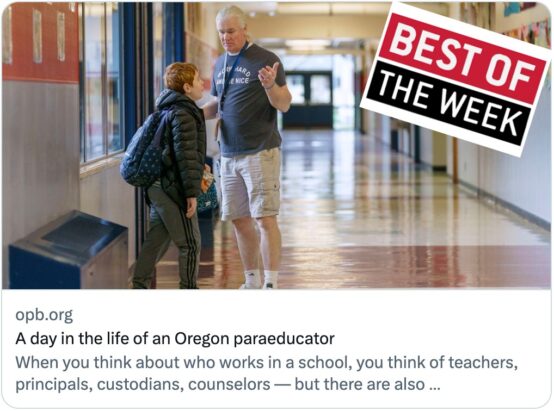
The best education story of the week is OPB education reporter Elizabeth Miller’s A day in the life of an Oregon paraeducator, the third in a series on special education.
What makes this story stand out is both how well it’s reported and written and also how it takes us into the daily lives of school staff whose roles aren’t very well covered or understood, showing us how essential paras are — and how much more helpful they could be if they were given better training and support and invited to participate in IEP meetings.
Miller’s piece features three different special ed paraprofessionals (called “paras” or classroom aides in some places). Some work with groups of students, while others are assigned to a single child. As you might expect, working with kids is rewarding and challenging. But it’s also difficult, delicate work — and it can be dangerous. The pay is low and the turnover is high. And, in the extremely hierarchical world of schools, paras — who often spend more time with disabled kids than anyone else in the building — are often excluded from meetings about a student’s individualized education plan. This seems like a shame (and a worthy topic for more reporting).
Want to know more about paras? Check out recent pieces in the LA Times, SF Standard, and the Boston Globe.
Other notable stories we saw this week:
🏆 A Tampa teen was racially harassed by her teacher. He’s bullied students for years. (TB Times)
🏆 Oregon public schools hemorrhaged students during pandemic (Oregonian)
🏆 Do Sacramento County school boards reflect student diversity? (CapRadio) Followup here
🏆 ‘I got pulled away’: Amid COVID disruptions, some states see dropout rates rise (Chalkbeat)
🏆 5 charts tracking D.C.’s schools rocky road to recovery (Washington Post)
🏆 Parents Challenge Lottery Systems Used to Diversify Elite High Schools (Wall Street Journal)
🏆 How “Abbott Elementary” Takes On the Charter-School Movement (New Yorker)

TABLOID-STYLE EDUCATION COVERAGE
Our latest columns and commentary
Above: A sampling of the stories posted to the New York Times education page since the start of the year.
The major challenges facing K-12 schools right now include pandemic recovery, improving literacy instruction, and expanding parental school choice.
However, major national news outlets like the New York Times and Washington Post are focused instead on terrifying but rare incidents of school violence and outrage-inducing culture war debates over books, courses, gender, and race.
School shooting. Culture war. Off-campus murder. Culture war again. The Times and Post are producing tabloid-style education news.
LONGER DAYS IN CENTRAL FALLS
Coverage of promising school innovations & signs of progress
💡 Using federal aid, a Rhode Island district where nearly half of students are multilingual learners is addressing gaps in English proficiency with two hours of voluntary class time added to each school day (The 74). Why aren’t other districts doing the same?
💡 An alternative to high-dosage tutoring called “short-burst” tutoring might be easier to pull off and has shown promising results, according to a new study (Hechinger Report/KQED). See also this EdWeek piece about implementing effective tutoring programs.
💡 Elementary students in Alaska learn about climate change and pollution through a state-conceived program that involves raising Coho salmon from egg to fry (NPR, March 4). Meanwhile, from the Seattle Times, a teenage environmental activist rallies other young people to the cause.
💡 Programs in Wyoming and Pennsylvania are tackling teacher shortages through retention and recruitment (Hechinger Report, Pittsburgh Post-Gazette).
Read more about the importance of covering promising innovations and preliminary successes.

PEOPLE, JOBS
Who’s going where and doing what
Above: WPRI Providence’s Steph Machado introduces her latest investigation.
🔥 Hidden gems: Last week, WPRI’s Steph Machado put out a must-read story on how dozens of Rhode Island students with special needs are not receiving an education. Since then, state lawmakers have called for special ed reform and the story has drawn federal scrutiny. The Virginian Pilot’s Nour Habib and Kelsey Kendall produced a two–part series about the pandemic’s effects on Virginia kids, with great dataviz from Hannah Eason. Realizing an opportunity when they saw one, the savvy folks at the AL.com education lab jumped onto an “Everything Everywhere” Oscars moment — and struck Instagram gold.
🔥 New leadership: In what was a pleasant surprise to me at least, the Education Writers Association announced Asian American Journalists Association head Kathy Chow as the organization’s new executive director. (You can listen to an in-house EWA Radio segment with her, but I’m told she’s not yet available for an external interview.) Meantime, the Baltimore Banner has a new education and health editor: Rachel Cieri Mull, who came from the Chronicle of Higher Education.
🔥 More career moves: Tennessean breaking news reporter Rachel Wegner is now the children’s reporter covering education, health, and welfare. If you haven’t already, say hi to NPR’s newest ed team member, Janet Woojeong Lee, who was on a keynote panel at SXSW EDU with NPR education executive producer Steve Drummond recently. Memphis schools reporter Laura Testino is moving from the Commercial Appeal to Chalkbeat Tennessee.
🔥 New follows: Sacramento Observer and Cap Radio K-12 reporter Srishti Prabha recently wrote a great two-part series on school board diversity. Dominic Anthony Walsh is covering education and families for Houston Public Radio. The Times Union’s Kathleen Moore has been covering education in Albany. Chattanooga Times Free Press reporter Carmen Nesbitt has been covering big education issues in Tennessee, including the recent rejection of an amendment to the third-grade retention law. Pittsburgh Post-Gazette education reporter Andrew Goldstein is on strike with several of his colleagues since October but Megan Tomasic is still covering education in the suburbs. ABC News reporter, producer, and podcaster Arthur Jones II has been covering a slew of education stories, including the shortage of Black male educators. Give them all a follow!
🔥 In the news: Former NPR education reporter Anya Kamenetz posted — then took down — a COVID anniversary post about educators rethinking their school shutdown positions, but you can read an archived version here. WIRED contributor David Zweig was interviewed about his controversial writing on school shutdowns, social distancing requirements, and mask mandates. And the LA Times’ Teresa Watanabe penned a deeply personal essay about her family’s experience with what the LA Times used to call “internment.”
APPEARANCES, EVENTS, & NEW RESOURCES
What’s happening and new research
⏰ Media appearances: Anya Kamenetz was back at her old stomping grounds on NPR Morning Edition to talk about how the pandemic has impacted kids three years out. The 74’s Mark Keierleber is scheduled to appear on Twin Cities PBS today to talk about the data breach at Minneapolis Public Schools. Also in Minnesota, MPR education reporter Elizabeth Shockman was on All Things Considered to talk about her profile of the first Black man to lead the state’s education department.
⏰ New outlets: Two new ventures in New England will amp up education coverage in the region. Rhode Island Current, part of the multi-state States Newsroom, launched this week with its first education story on a university expanding higher education access to Indigenous students. And the new Massachusetts-based Brookline.News — which has a schools section — has been announced, but isn’t up and running yet. Click here for more info.
⏰ New resources: New York Times reporters Eliza Shapiro and Brian Rosenthal share tips in The Journalist’s Resource about how they covered their big Hasidic schools investigation. I’m told that Early Literacy Matters is a good resource for tracking states’ efforts to address ineffective reading instruction. (EdWeek’s Sarah Schwartz also rounded up which states have passed “science of reading” laws as of last July.) Thirty-three states have now proposed laws that would create or expand tax-funded programs that help cover the cost of private education, according to Future Ed — and a handful have already been enacted.
⏰ Language matters: Educator Kareem J. Weaver gets heated when he sees progress in Mississippi described as a “miracle.” That language is “straight from the slop-trough of disconnected elitism,” according to Weaver. After explaining how school effectiveness is no longer a focal point in education last week, Vox founder-turned-Substacker Matt Yglesias is back this week explaining why there’s so much less talk about the achievement gap. Both concepts have also fallen out of use in education journalism, for better and worse.
⏰ Books & podcasts: Joe Nocera and Bethany McLean’s book “The Big Fail,” which critiques the left’s opposition to opening schools in the pandemic, will be out in October. And for “Sold a Story” fans, there’s some good news: Emily Hanford says there will be a bonus episode coming out next month.
THE KICKER

“Cannot wait to read,” tweeted Colorado Public Radio’s Jenny Brundin about Elizabeth Hernandez’s Denver Post story on a clown school. “Clown, but first mime school, has been a dream of mine.”
ABOUT THE AUTHORS

The Grade
Launched in 2015, The Grade is a journalist-run effort to encourage high-quality coverage of K-12 education issues.

Alexander Russo
Alexander Russo is founder and editor of The Grade, an award-winning effort to help improve media coverage of education issues. He’s also a Spencer Education Journalism Fellowship winner and a book author. You can reach him at @alexanderrusso.
Visit their website at: https://the-grade.org/