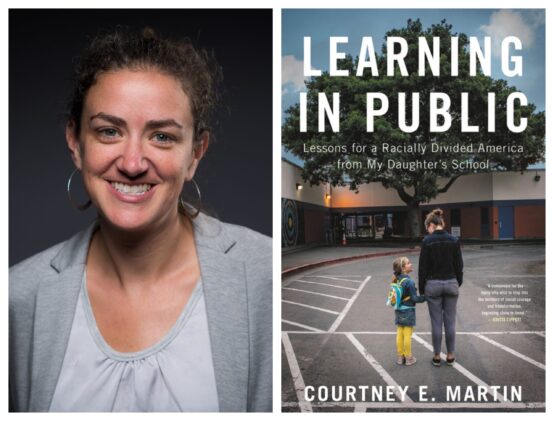
Media coverage of Black schools too often over-focuses on deprivation and unintentionally contributes to racial segregation, according to author and parent Courtney Martin. And covering school board meetings can be “soul-crushing” work.
By Alexander Russo
Courtney Martin’s new memoir, Learning in Public: Lessons for a Racially Divided America from My Daughter’s School, has generated a healthy amount of attention. It’s been reviewed in the Washington Post, featured in a New Yorker radio segment, and critiqued in The Atlantic.
It’s not hard to understand why. Martin’s book chronicles her unusual decision to send her daughter to a neighborhood school in Oakland rather than to one of the other schools considered more popular among other white parents – and what happens next.
Referring to last year’s hit podcast about white parents and school integration, Martin describes her book as picking up “where Nice White Parents leaves off.”
In the following interview, which has been edited for clarity and length, Martin describes how white parents often rely on non-journalistic sources of information and how writing the book affected some of those she depicted. She explains how unhelpful school board coverage can be, the limitations of past education writers like Jonathan Kozol — and how education coverage can unintentionally exacerbate perceptions about schools serving vulnerable kids.
“When formal media outlets cover Title I schools, it is almost exclusively in a crisis,” says Martin. “In this way, the media narrative largely matches white parents’ bias that bad schools are Black and Brown schools and they are largely to be pitied.”
When formal media outlets cover Title I schools, it is almost exclusively in a crisis. In this way, the media narrative largely matches white parents’ bias that bad schools are Black and Brown schools and they are largely to be pitied.
What thoughts or beliefs did you have about school integration before you started the book?
CM: My baseline was probably a lot like most white moms who haven’t thought a ton about school equity issues. I knew Brown v. Board. I knew Ruby Bridges. (Or thought I did.) I didn’t know much beyond that until I read Nikole Hannah-Jones in the New York Times Sunday Magazine and then listened to the This American Life episodes that followed.
How does your book compare to last year’s Nice White Parents podcast series?
CM: I think of it as where Nice White Parents leaves off. What happens if the white people in a neighborhood actually stick around and try to join a community rather than re-making it in their own image? I think Nice White Parents very accurately and movingly portrays just how disruptive white people can be, even and maybe especially when well-intentioned. My book also wrestles with this theme, no doubt, but also insists that it’s still worth pursuing the White moral life, even if it’s elusive.
To what extent does media coverage of schools come up in your book? Do local schools you’re involved with get much media attention?
CM: I write a lot about the whisper network of white parents — in my city of Oakland, but really in any place where white parents gather — that says some schools are good and some are bad with a preposterous amount of certainty. Where do white parents get those impressions? I think less through formal media outlets and more through GreatSchools.org and socialization, conversations with neighbors, chats at the birthday party and playground.
When formal media outlets do cover Title I schools, it is almost exclusively in a crisis – a lead paint scandal or a school closure trauma. In this way, the media narrative largely matches white parents’ bias that bad schools are Black and Brown schools and they are largely to be pitied.
I also wrote a bit about the Jonathan Kozol’s of the world, who do us a service by documenting inequity, but also tend to seek out very particular narratives of deprivation and depravity, rather than looking for the nuances within low-income communities and the corruption, hoarding, and moral wound at the center of wealthy communities. It’s an incomplete picture.
The Jonathan Kozol’s of the world do us a service by documenting inequity, but also tend to seek out very particular narratives of deprivation and depravity.
You’ve said that you wished education coverage gave readers a stronger sense of what’s going on inside classrooms. Is there a moment in the book where you were able to depict some of those realities, or a story from an admired journalist that gives readers that inside look you think would be helpful?
CM: I write about some very specific exchanges between teachers and students, and between students and each other in my book. I was lucky enough to volunteer during my kid’s library hour each week, for example, and observed some really telling moments. I also got to spend every morning in my kid’s class, as was her teacher’s ask at the time, so lots of texture came from those mornings. I think Eve L. Ewing does a beautiful job of giving an inside look in Ghosts in the Schoolyard, as does Kristina Rizga in Mission High (her journalism, generally, is fantastic) and I really admired Lauren Markham’s The Faraway Brothers.
What’s the reaction been among parents and the school community? How have the people you depicted felt about the experience?
CM: Those who are featured in it (with pseudonyms) either saw it in advance, and reacted then, or have responded after reading it more recently. It was really really hard to write such an intimate book. I was fully aware that people may feel betrayed and it kept me up at night. On the other hand, I believe there are a dozen great books on integration that simply won’t be read by most people because they’re not story-driven enough. I tried to do as much as I could to be ethical with the material and the humans whose lives are intertwined with mine as I could–an imperfect, but earnest quest.
Are there any insights you can share about the media response to your book and its conclusions, in terms of reviews and reactions from media outlets?
CM: It was one thing to write this book, but it’s been a whole different thing to put it out into the world and watch what journalists do with it. White interviewers, for example, have often said, “Just to be clear, this is two white people talking about race…” Which is, on the one hand, sort of an interesting and earnest attempt to give people a heads up, but on the other hand, strikes me as really telling about how few conversations two white people have about race in mainstream media, as if it’s not really our business. None of the Black journalists that interviewed said, “Just to be clear, I’m Black and I’m interviewing a white woman about race.”
In what ways (if any) has your experience caused you to reconsider school integration efforts, parent-driven or otherwise?
CM: I don’t think integration is a magic bullet. And I certainly don’t think it is simple. But I do remain convinced that, as Dr. Rucker C. Johnson writes, “The medicine that is integration works.” So would Afrocentric, fully funded schools where Black children are made to feel fully loved and their excellence is mirrored to them through incredible Black teachers and culturally relevant pedagogy but making that happen is also an uphill battle for so many reasons. Ultimately, I don’t think it’s an either/or situation. My goal with this book is to wake white parents up to our own responsibility in standing in the way of either good thing for kids of color.
What’s next for you, now that the book is out?
CM: CM: I’m actually cooking up a piece right now on something that I’ve been obsessed with since writing the book: why do school board meetings have to be so badly structured? Watching community members scream into the mic for 60 seconds, projecting all of their shit on school board members, and then watching school board members begrudgingly say “thank you” and then give little to no response on the contents of what was said is maddening. I think a lot of reporters spend time covering them, play by play, and that’s time consuming and soul crushing in and of itself. It doesn’t give them time to step back and go, “Why the heck are we running these incredibly important meetings this way?”
Where are you sending your daughter this year? Is she still at the same school?
CM: Of course! Not only is my daughter at the same school — in 2nd grade now, her 4th year at the school, but now her little sister is a proud Emerson Cheetah as well.
Previously from The Grade
Nice white journalist (Chana Joffe-Walt interview)
Nikole Hannah-Jones, the Beyoncé of education journalism (2017)
Putting parents front and center
ABOUT THE AUTHOR

Alexander Russo
Alexander Russo is founder and editor of The Grade, an award-winning effort to help improve media coverage of education issues. He’s also a Spencer Education Journalism Fellowship winner and a book author. You can reach him at @alexanderrusso.
Visit their website at: https://the-grade.org/