|
Though it’s often overstated, education’s potential role in the upcoming November elections is the big story of the week:
 Opponents of critical race theory seek to flip school boards (AP) Opponents of critical race theory seek to flip school boards (AP)
Energizing Conservative Voters, One School Board Election at a Time (New York Times)
Critical Race Theory a catalyst for rise of conservative school boards (USA Today)
How One Governor’s Race Has Channeled Anger Over Schools (Education Week)
G.O.P. Attack Involving Toni Morrison Novel Inflames Virginia Contest (New York Times)
Atlanta School Board Election Focuses on Equity (The 74)
Minneapolis Weighs Police Dept’s Fate, Records Show School Cops Had Lengthy History of Discipline, Civil Rights Complaints (The 74)
‘All Political’: SF Board of Education President Gabriela López on the Recall Effort Against Her, 2 Other Board Members (KQED
Critical race theory roils school board race in Guilford, a town long open to a study of slavery (Connecticut Mirror)
Did someone forward you this newsletter? You can sign up here.
|
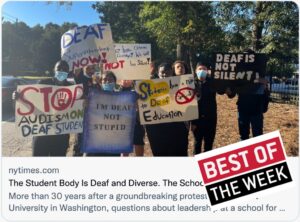
DIVERSITY AT A SCHOOL FOR THE DEAF
Best education journalism of the week.
|
|
 BEST: The best story of the week is The Student Body Is Deaf and Diverse. The School’s Leadership Is Neither. by Amanda Morris, a disability reporting fellow for the New York Times. Morris writes about a school for the deaf in the Atlanta area that serves mostly Black and Hispanic students, but which hired a white hearing superintendent. The backlash has prompted questions about whether a school’s leadership should reflect the student population. While many education reporters have written about the impact of the pandemic on students with disabilities, Morris writes from the perspective of a disability reporter, not an education reporter — and it shows. The story is deeply empathetic and nuanced and doesn’t reduce students to their disability alone. I’m looking forward to seeing more from her. BEST: The best story of the week is The Student Body Is Deaf and Diverse. The School’s Leadership Is Neither. by Amanda Morris, a disability reporting fellow for the New York Times. Morris writes about a school for the deaf in the Atlanta area that serves mostly Black and Hispanic students, but which hired a white hearing superintendent. The backlash has prompted questions about whether a school’s leadership should reflect the student population. While many education reporters have written about the impact of the pandemic on students with disabilities, Morris writes from the perspective of a disability reporter, not an education reporter — and it shows. The story is deeply empathetic and nuanced and doesn’t reduce students to their disability alone. I’m looking forward to seeing more from her.
RUNNER-UP: This week’s runner-up is Why California’s Universal Transitional Kindergarten Plan Poses a Threat to Some Early Childhood Ed Providers by former KPCC early childhood education reporter Deepa Fernandes in KQED. The move toward universal transitional kindergarten has been largely applauded in California, but there’s a catch for currently existing private preschools, many of which are run by women of color: They might not be able to survive financially if their 4-year-old students move to the free transitional kindergarten programs that will be created. Now an early childhood reporting fellow at Pacific Oaks College, Fernandes asks the right questions and this story serves as a good reminder to dig into the impact of policies that seem too good to be true.
BONUS STORIES:
The Federal Government Gave Billions to America’s Schools for COVID-19 Relief. Where Did the Money Go? (ProPublica)
In Cleveland, Chronic Absenteeism Is More Than Double Pre-Pandemic Levels (The 74)
Parents Reported to Child Services for Keeping Unvaccinated Kids Home (The Intercept)
Learning with COVID: How educators and students are finding a ‘new normal’ (WBUR)
A Chicago High School Reopens, with Fears of Gun Violence (New Yorker)
How Minnesota’s lack of teachers of color hurts students, and what reform could look like (PBS)
Quarantining students is an educational nightmare. Is it still worth it? (North Country Public Radio)
WHITE PARENT, BLACK SCHOOL
New from The Grade |
|
|
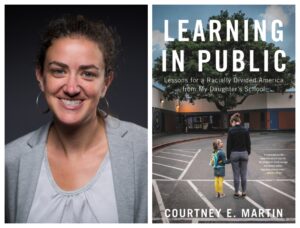
Parent and writer Courtney Martin (above) learned a lot about media coverage of Black schools in the process of sending her daughters to a local school that’s not among those selected by most of her white peers.
And in a new interview, Martin describes how little white parents seem to find professional news stories useful, how the stories she sees often create a sense of deficit and distress around Black schools, and how well-intended efforts to depict school realities reinforce negative perceptions.
“When formal media outlets cover Title I schools, it is almost exclusively in a crisis,” says Martin. “In this way, the media narrative largely matches white parents’ bias that bad schools are Black and Brown schools and they are largely to be pitied.”
Big thanks to educator Steven Evangelista, who praised the recent 8 Black Hands episode I was on as “a master class in analyzing the narratives.” Much appreciated.
MEDIA TIDBITS
Thought-provoking commentary on the latest coverage. |
|
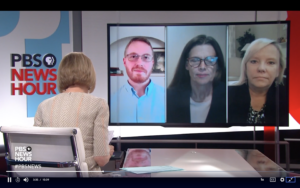
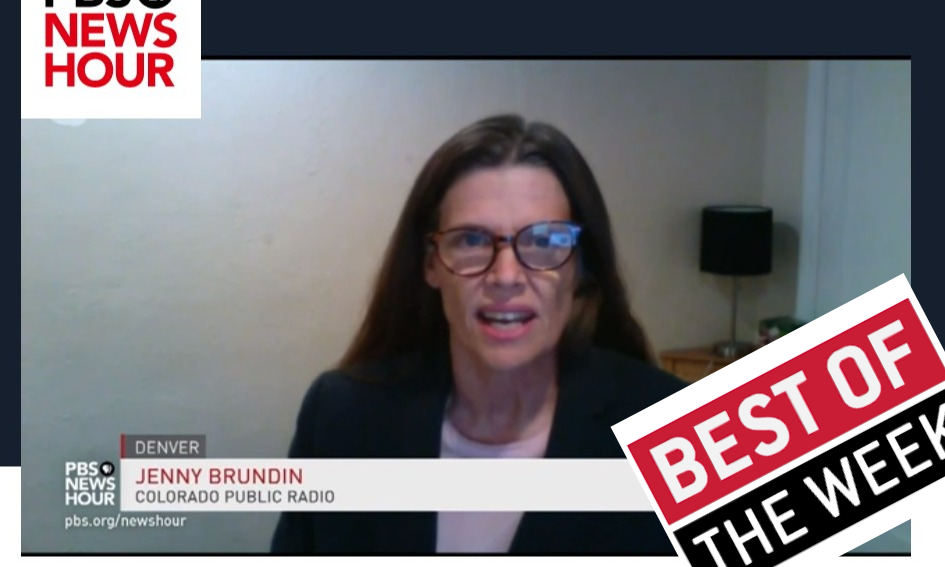
| Above: Colorado Public Radio’s Jenny Brundin (center) was on the PBS NewHour to talk about heated school board races with host Judy Woodruff , Grant Gerlock of Iowa Public Radio (left), and Jo Ingles of Ohio Public Radio (right).
 ADDING CONTEXT TO SCHOOL BOARD PROTEST COVERAGE: Kudos to Colorado Public Radio education reporter Jenny Brundin, who repeatedly added context in her answers about school board protests in a recent segment with PBS NewHour host Judy Woodruff. In a 10-minute segment, the education reporter reiteratef that most school board meetings she’s seen have been focused on traditional board topics, and that support for equity efforts has been present along with opposition. “For the most part, the traditional issues — that is, student achievement, how to close the achievement gap, school budgets — those are the main issues,” Brundin told Woodruff. ADDING CONTEXT TO SCHOOL BOARD PROTEST COVERAGE: Kudos to Colorado Public Radio education reporter Jenny Brundin, who repeatedly added context in her answers about school board protests in a recent segment with PBS NewHour host Judy Woodruff. In a 10-minute segment, the education reporter reiteratef that most school board meetings she’s seen have been focused on traditional board topics, and that support for equity efforts has been present along with opposition. “For the most part, the traditional issues — that is, student achievement, how to close the achievement gap, school budgets — those are the main issues,” Brundin told Woodruff.
IS SCHOOL BOARD CONFLICT ENDEMIC? There are so many people on the left and right and in the media who have bought into the notion that school board conflicts have grown widespread enough that they threaten to transform public education. I don’t even know where to start. I don’t doubt school board members’ fears are real. However, there’s a long history of fear-mongering protesters and media amplification of dangers. And I have questions about the actual amount and intensity of school board protests taking place, historically and nationally. The largest number I’ve seen is from NBC News, which counted 220 districts with backlash against equity initiatives, out of 14,000 school districts. Once again, a handful of frightening and dramatic anecdotes are being strung together to create a story. High emotions (and politics) are being given the lion’s share of attention.
Looking for media commentary and analysis all day, every day? Follow me at @alexanderrusso.

|
PEOPLE, JOBS, EVENTS
Who’s going where & doing what?
|
|
|
Above: Last weekend’s 8 Black Hands was the first time in a while that I’ve gotten to discuss education news’ strengths and weaknesses in a group setting. Thanks to all who made it possible. I learned a lot.
 Media appearance: Des Moines Register reporters Samantha Hernandez and Melody Mercado were on EWA Radio to talk about covering contentious school board meetings. Media appearance: Des Moines Register reporters Samantha Hernandez and Melody Mercado were on EWA Radio to talk about covering contentious school board meetings.
Kudos to Chalkbeat’s Matt Barnum for digging into the pros and cons of U.S. News’ new elementary school rankings. The Hechinger Report also published Aaron Pallas’ critique, Why school ratings can backfire, and veteran journalist James Fallows discussed the problems with the new rankings on NPR and in his newsletter.
Jobs! WBUR, Boston’s public radio, is hiring a new education editor. The Wall Street Journal is hiring an education beat reporter to cover K-12 schools nationwide. WLRN, South Florida’s NPR member station, is looking for a Miami-based education reporter. The Minneapolis Star-Tribune is hiring a metro reporter to cover statewide K-12 education. The Atlanta Journal Constitution is hiring an education reporter. The Seattle Times Ed Lab is hiring a reporter. Any new job opening out there that folks might want to know about? Let us know.
Washington Post intern Vanessa Sánchez has been covering local education lately, with her latest story about Loudoun County students walking out to protest the school district’s handling of alleged sexual assaults. We don’t know if it’s a formal assignment, but Nicole Asbury has been writing about DCPS in the absence of Perry Stein.
ICYMI: Chalkbeat Chicago and City Bureau teamed up for an event Oct. 28 about how COVID delayed plans for students with disabilities, featuring Chalkbeat’s Samantha Smylie and others. And EWA hosted a webinar Oct. 26 about how learning in quarantine is going, featuring Honolulu Civil Beat education reporter Suevon Lee as moderator.
THE KICKER
|
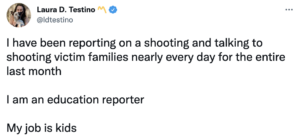
The Commercial Appeal’s Laura Testino on the sobering reality of education journalism today.
|
|
|
That’s all, folks. Thanks for reading!
Reply to this email to send us questions, comments or tips. Know someone else who should be reading Best of the Week? Send them this link to sign up.
Using Feedly or FlipBoard or any other kind of news reader? You can subscribe to The Grade’s “feed” by plugging in this web address: http://www.kappanonline.org/category/the-grade/feed/.
Read more about The Grade here. You can read all the back issues of The Grade’s newsletter, Best of the Week, here.
By Alexander Russo with additional writing from Colleen Connolly. |
|
|
|
|
|
|
|
|
|
|



 Do you have lots of things to say about how news outlets cover education? We’re looking for writers. Send story pitches to thegrade2015@gmail.com with “OPINION” in the subject line. No journalism degree or beat experience required!