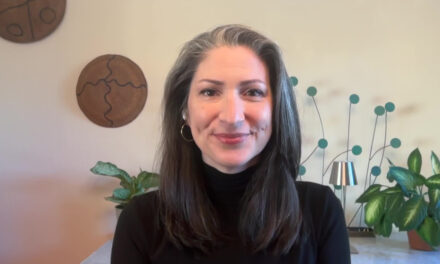
Journalists should transform their coverage by treating parents, students, and community members like the experts they are, says “Here & Now” public radio co-host Deepa Fernandes.
By Alexander Russo
In case you hadn’t noticed, mid-day national public radio show “Here & Now” features a lot of stories about education issues.
Somehow, despite the firehose of breaking news and wide range of issues clamoring for attention, the joint production of WBUR and NPR manages to spend more time on education stories than one might expect.
Curious about why that might be, I reached out to show co-host Deepa Fernandes for some insight.
An award-winning radio and print journalist, Fernandes has worked in Sydney, New York City, and Los Angeles.
Some of you may recall that she also founded the early childhood education beat at KPCC Los Angeles.
As you’ll see from the interview below, the show’s focus on education issues comes in part from Fernandes’ deep history in early childhood education issues.
The education-related coverage is also an expression of her interest in broadening journalism’s definition of expert sources to include more so-called “real people,” including students, parents, and community members.
“I think there’s this tendency in journalism to narrow down who we consider experts,” Fernandes told me. “But if we just expanded the person who has the problem into the person who might have solutions to the problem, it would change the frame of how we reported education.”
“I think there’s this tendency in journalism to narrow down who we consider experts.”
This interview has been edited for clarity.
What’s the story behind all the education segments you’ve broadcast on “Here & Now?”
Deepa: When I came to “Here and Now,” it was important to me to build upon my decade of early childhood coverage. The team was excited to really spotlight this little-covered area of education. Together with my smart and creative producer, Ashley Locke, we tackled early education head on. You can see our regular coverage here.
We also cover education with an equity focus, something that is very important to me. It’s a powerful lens to bring to our millions of daily listeners. Most recently my interview with Jonathan Kozol spotlighted how low-income Black and brown children are still dealt an unequal education. And thanks to visionary editor Catherine Welch and stellar producer Hafsa Quraishi, we have regularly had high school seniors telling us about their education, hopes, and dreams.
We don’t just talk about education — we talk to those receiving it!
How do you manage to cover early childhood and other education stories in a breaking news environment?
Deepa: Early childhood is not breaking news, but Ashley is able to plan feature coverage on a regular basis. We don’t have a producer focusing just on education, but we partner with Chalkbeat, so they bring us important stories each week.
We also tried something this year, where Cat and Hafsa did this really great reach-out and found a whole group of diverse high school seniors. We called them our Class of 24, and we checked in with them periodically over the year about what was going on in their lives in the classrooms and also bigger things in the world.
I enjoyed that it was just a different way of “covering” education. We got to look at student mental health issues. We got to look at the impact of preparing for college. We heard about all the pressures seniors face — from seniors directly. I feel like that was probably the biggest thing we’ve done on education. It wasn’t your standard education story.
“We don’t just talk about education — we talk to those receiving it!”
Do you have any reflections on your time covering early childhood?
Deepa: No matter what I cover, I’ve always done it in an equity lens. That language came along after 2020, but reporting with an equity lens is what I’ve been doing going back to when I started in journalism. And KPCC allowed me to do it. When I said to my editor I wanted to spend some time going into a California prison where women are pregnant and giving birth and look at the outcomes for those children, the first response was, well, that’s not early childhood education. No, it’s not a straight line, but the start these children will get will impact them later, and these children will be part of an education pipeline very quickly. My editor went with me on a lot of these stories.
When I first talked about segregation in early education, no one thought it was an issue. But I was seeing it in every classroom I reported from across California. It took me years, but I finally built up the body of interviews to be able to do serious reporting on this.
What was it like being one of the only reporters on that beat?
Deepa: I was one of the first reporters in the country to actually have early childhood as my beat. That was good because no one else was doing it. So it was just a wide open field. Now there are so many more reporters on the topic. Sometimes I hear these stories that I did 10 years ago. Nothing’s changed. It’s not a critique of the reporters. I think that really speaks to the fact that the issues then still remain. They have not been solved. This is why we need more reporting.
How did your coverage change when you went freelance?
Deepa: What we need more in early childhood is more enterprise and investigative stuff. When I started working as a freelancer, I was able to work in a more enterprise and investigative capacity so I could spend time on stories. I received a fellowship from Pacific Oaks College that allowed me to really dive deep and spend the time on these longer projects.
For example, the child welfare system is something I could never crack at KPCC. That requires so much time, and so many young children are lost in that system and harmed in that system. LA County has the biggest child welfare system in the country, but it’s shrouded in secrecy. Everything is protected by a privacy regulation.
As a daily reporter, when you ask the question and you get “no, we can’t tell you because of privacy,” you just turn to the next thing. But as a freelancer when I could get a grant and spend some time really investigating things, I was actually able to wrap my head around it, to start to get sources inside the system, and get documents and put in FOIA requests and wait the months it takes to get answers. So it takes a lot of time. But what I was able to report exposed deep flaws in the system and the families who were the victims.
“Nothing’s changed. This is why we need more reporting.”
Is there anything that you wish education journalism did differently?
Deepa: I think there’s this tendency in journalism to narrow down who we consider experts. The people we consider experts are the ones who get to opine on the topic and impact policy. But I think we need to rethink that a bit because quite often the people who are living the experience have some solutions to these problems. They can also be experts and not just someone whom we quote, telling us what the problem is.
I think that the busy mother — to make up an example — probably also talks to other parents. She sees the problems, experiences them firsthand. She’s the kind of informal expert that I wish we would look to more in kind of a trickle up idea of how to solve issues. Community organizations help people solve problems every day, but sometimes they are so grassroots or informal that we discount them. They are actively working on solutions.
However, I feel like we tend to go to the same people for solutions. And in my experience of just being in communities, especially low-income communities and communities of color, there are creative solutions to some of these problems that if we just expanded the person who has the problem into the person who might have solutions to the problem, it would change the frame of how we reported education.
What would that look like, changing the frame of how we reported education?
Deepa: We go to reporters as experts. We go to academics as experts. We go to policymakers as experts. But then we have this other group of people who we call “real people” telling us how they’re impacted by something. Part of our role should be to go further with these community members and ask them, “How do you solve this problem?” Maybe it means we have to spend a bit more time with them. We should also talk more to community organizers who are people from communities that are working actively to solve problems.
In a way, we got that with our Class of 2024 stories, where we talk to students about the full range of questions. We didn’t just ask them, “How do you feel when you’re having a mental health crisis?” We asked them how they dealt with their problem and what they needed. We should just keep going a little more and see what so-called “real people” have to suggest.
“We should just keep going a little more and see what so-called ‘real people’ have to suggest.”
Has your own life experience shaped your thinking about who gets asked questions and who doesn’t?
Deepa: I grew up with grandparents who lived without legal papers in Australia because they just wanted to be with their children and grandchildren who had mostly left India. My gentle grandfather was always so afraid of deportation. It impacted his physical and mental health. I watched my mum petition, plead, and fight the immigration battles to help get them status to stay. My grandfather died undocumented. It haunted him to be called an “alien” and he would talk to me about that as a kid because he and I shared a room.
I see him in so many of the people I have met covering immigration. That doesn’t make me biased, it gives me direct insight into how people who are at the center of immigration fights are real people, not political footballs. And no reporter ever asked my immigrant mother about the problems of the immigration system, but she knew them so well. No reporter ever interviewed my grandfather about what it felt like to live without documentation. They were experts, they should have been part of the public discourse on immigration.
How could reporters make this shift even if they don’t have it in their personal experience?
Deepa: I think we should be training journalists more in things that have always been kind of taboo, and that’s to show empathy and have empathy for the people in your stories, to get them to trust you and to open up to you. I’ve been told, “You have too much empathy,” as if that’s a bad thing. But that’s also why people talk to me. I think it’s part of a skill set that diversifying journalism has never really talked about. It’s not that we bring a biased perspective, but it’s that we bring in lived experience, which is really useful in bringing in voices to stories that are not usually brought in.
We don’t tell the business reporter whose father works at a big financial company that he is biased; news bosses see this as being steeped in the industry he will cover. The same should apply to the journalists you bring in who have a disability or come from lower income or LGBTQ+ or other historically undercovered community. We are not biased, we bring our full selves and lived experience to the job to help us better cover these communities.
I had an editor once even tell me he didn’t believe a quote I had from a childcare provider and that she was just wrong. I had the quote on tape. It wasn’t wrong. But it didn’t comport with that editor’s idea of what a childcare provider should be saying. He then told me to get an expert in the story to back up what she said.
Why is that necessary? Why can’t the woman of color childcare provider be my expert? I was freelancing then, so I took the story elsewhere. But pushing for these kinds of voices in a story when you are centering them as an expert can be a fight, and there’s a power imbalance between reporter and editor. Are you really going to throw down with your editor over putting in something like that?
Previously from The Grade
Putting parents front and center
Improving source diversity in education journalism
Schools coverage should serve parents’ needs, says journalism researcher
Making education journalism more accessible and inclusive
5 key elements of community-driven education coverage
An open letter to education writers