Covering newcomer students requires rethinking newsroom practices and overcoming deeply-held beliefs.
By Jo Napolitano
One of the greatest journalistic disservices of our era is that we have allowed politicians and other outside influences — alongside our own prejudice — to so badly color our reporting on immigration.We write and talk about immigrants, including children, with open xenophobia and in a tone that would be unacceptable for any other group.
The language we use and the assumptions we make explain how and why we play along when others cast newcomers as a burden to schools and society at large.
We assume and expect these students to come from poverty and to have little to offer our schools. And the poorer their setting — a mud-soaked encampment, government detention, a hotel-turned-shelter — the more feeble-minded we assume them to be.
They don’t speak English. One demerit.
They spent months in a south-of-the-border camp. Two demerits.
They missed some schooling back home because it was too dangerous to walk to campus. Three demerits.
They spent their initial months here in government housing. Four demerits.
We write and talk about immigrants in a tone that would be unacceptable for any other group.
One after one, these demerits mount until we start to assume, wrongly of course, that some of these children are not worth educating at all.
We overlook the fact that many newcomers bear precious gifts:
They often arrive speaking more than one language — sometimes several, including those we seek to protect.
And if given a chance to enroll, even at an older age, many move on to college.
Their arrival helps offset enrollment decreases that are hurting many schools and school districts.
Yet I have seen few stories highlighting the strengths and contributions of newcomer students: the genius of multilingualism, and the tenacity it takes to stay in school day after day, unable in those early weeks to speak more than a few words of English.
Or, conversely, how quickly a newcomer can pick up the language, becoming conversational in months and fluent in just a few years.
To the astonishment of the unimaginative, some of these students, just like any other group, arrive here quite advanced academically. Non-verbal tests can spot their talents and place these children in gifted classes, but it’s too rare an occurrence now.
And no one is checking on — or demanding — its use.
It’s up to our schools to erase the language barrier to uncover newcomers’ talents.
And it’s up to us, as journalists, to constantly question why these students are denied the education they deserve — or why they are so often placed in subpar settings that do not yield diplomas.
Because we have been so trained to accept these children as deficient, we don’t question school officials who call these students a drain.
We don’t ask education administrators to spell out whether they cost more money to educate — a debatable point — or if they somehow take away from native English speakers. (They don’t.)
Instead, we double down on newcomers’ perceived deficits and vulnerabilities and applaud the schools that honor their educational rights as if they are doing these children a favor rather than abiding by the law — and living up to the American promise.
It’s up to us to constantly question why these students are denied the education they deserve.
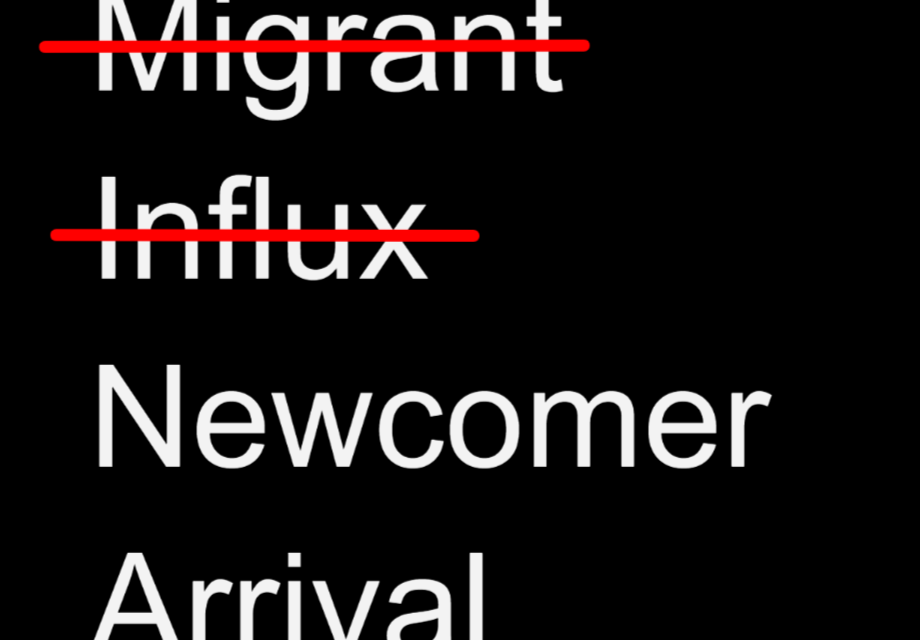
I’ve written before about the widespread use of loaded terms commonly used by journalists to describe newcomer students. I never use “influx,” for example. “Arrival” is far more neutral. But the most problematic word of all might be “migrant.”
I try hard not to use it in my work. I fight it when it’s suggested in headlines to my stories. I get that it’s a quick catchall, that it says so much — but it has a negative connotation.
Ask the average American what image comes to mind when they hear the word “migrant.” It’s not Rhodes Scholar.
Just as we no longer call people “homeless” because it’s a word that has come to so powerfully and permanently define those struggling with unaffordable housing and other challenges, we must kill the word “migrant.”
Imagine if we replaced “migrants” with “people” in each the following headlines:Four migrants die in English Channel crossing attempt, Panama installs barbed wire to block migrants traveling through the Darién Gap, or Migrants say border agents continue to throw away their belongings including baby food and vital medicines.
The use of “migrant” is even more pointed when used to describe children:
Norfolk prepares for influx of migrant students, Migrant students navigate a new reality, or Tukwila schools open doors to 300 new migrant students without warning.
What other student group, by the way, has to come with a warning?
What if several America-born students moved to a different neighborhood? Or several disabled children? Or several children from a poor community?
Would we count them and then say they “came without warning?”
Don’t they have a right to move?
Don’t they have a right to an education?
Why are immigrants seen as exceptional?
The last story, out of Seattle, is particularly biting in its sizing up of new arrivals in its first few paragraphs:
Almost 300 migrant students, and counting, are swelling classrooms in the Tukwila School District this year — the children of the hundreds of asylum-seekers who have sought shelter at Tukwila’s Riverton Park United Methodist Church. Elementary school classrooms are overflowing as teachers accommodate six or seven new students each, in the middle of the school year, raising average classroom sizes. Most of the new students don’t speak either English or Spanish. Some aren’t literate in their home language. Others have been out of school for as long as four years.”
That they are happy and love school — and that the school loves having them — is not revealed until well into the text. The average reader, who might not go beyond the first few paragraphs, wouldn’t know the kids are thriving even amid hardship.
The average reader wouldn’t know the kids are thriving.
Back when I was reporting my book, “The School I Deserve,” I came across a Long Island-based program meant to serve older immigrant students. Of the 200 or so newcomers who had gone through the program in prior years, not a single one had earned a high school diploma.
When I asked the program’s leader how this could be true, she said educators have to be careful not to place “our white people values” on these students. She said these newcomers did not aspire to a New York State diploma — and that most came to the United States to work and send money home to their families.
At the start of this conversation, I introduced myself by name: Josephine Napolitano.
Classic Italian-American. My name is an accurate representation of my upbringing, attitude, and culture. It’s an identity I fully and enthusiastically embrace.
It also hides my country of origin.
I was born in Bogota, Colombia, abandoned at birth, and placed in an orphanage where I was barely fed. I was adopted and raised by a single parent with no college education. I know what it’s like to be prejudged: If you’re counting, that’s seven demerits.
I told this astonished woman, whom I’m sure would have paid $1,000 to erase the previous 30 seconds of her life, that education is not a white value, that she could not possibly understand the dreams and complexities of the hundreds of souls who had passed through her doors.
She stumbled. I looked her up on LinkedIn. She’s since retired from that post.
I’m determined that journalists who are covering schools do better by the kids they’re describing.
I don’t worry for a moment that her departure is a tremendous loss to the students she served.
But I’m determined that journalists who are covering schools do better by the kids they’re describing.
It’s not hard. All you have to do is remain critical.
If a school official said they were surprised by students’ arrival, ask why: People have been moving all over the world for decades, millennia, even.
If they say they don’t have enough Spanish-speaking staff, press further: They’ve had ample time to build one.
If you are writing about young immigrants but do not include them — or their parents — in your story, find them. They should always take center stage.
If an editor wants to use a very stereotypical stock image to go along with your story — that of dirty-faced and unkempt young people pressed helpless against a border fence — push back.
If your story perpetuates a white savior narrative, rework it.
Remember, these new arrivals have agency. They have survived sometimes nightmarish journeys to the States, often alone.
They’ve exhibited incredible bravery, tenacity, and ingenuity in getting here.
Let’s show them some respect.
Jo Napolitano is a long-time education reporter who has written extensively for The New York Times, Chicago Tribune, and Newsday. A two-time Education Writers Association Fellow (and grant recipient), her book, “The School I Deserve” (Beacon Press, 2021), was partly funded by the Fund for Investigative Journalism. A former Spencer Fellow and senior staffer at The 74, she recently completed a 16-month-long, nationwide investigation into enrollment discrimination against newcomer students.You can read her work here and follow her on Twitter/X at @Jo_Napolitano.
Previously from The Grade
Eight reporters share tips on covering immigrant education
Four smart ways to cover immigrant students
My dad was a teenage factory worker
Globe reporters describe how they cover immigrant English learners
Keeping the spotlight on English learners
How a ProPublica immigration reporter profiled a Long Island high school student trying to get out of MS-13