Eight journalists (and one expert) share their best ideas for producing high-quality coverage of newly-arrived children.
By Alexander Russo, Colleen Connolly, and Will Callan
The arrival of immigrant children in U.S. schools is a big story in many parts of the country — and will likely continue to be for much longer.
But how to cover the story the best way possible? We asked some all-star journalists to share their best insights.
Reporters including Melissa Sanchez, Hannah Dreier, Jenny Brundin, Becky Vevea, Bianca Vasquez Toness, Zaidee Stavely, Sophia Qureshi, and Jo Napolitano were kind enough to respond.
As you can see, they tell us it’s important to cover the story without stigmatizing the kids — intentionally or accidentally — and without focusing narrowly on the short-term challenges from the district or school point of view.
How to cover the migrant education story the best way possible? We asked some all-star journalists to share their best insights.
DON’T ASSUME IT’S EASY TO ENROLL
“Don’t assume that it’s easy for new arrivals from Haiti, Venezuela and other Latin American countries to enroll their children in school — or that it’s always their first priority,” says AP’s Bianca Vázquez Toness, who wrote recently about burdensome enrollment obstacles many kids face. Don’t assume they’ll be attending the same schools a month from now, either, she says “At least in the Boston area, families are going where there’s shelter space and then eventually where they can afford to live. I’ve heard of some children attending three different school districts since arriving in the country.”
AVOID STIGMATIZING NEW ARRIVALS
“We’ve had a few pieces where we were very careful in editing not to imply new arrivals were uneducated or helpless or ignorant because they might not have known, for instance, how to fill out the registration packet or that they had a right to bus transportation or a CTA pass,” notes Chalkbeat Chicago’s Becky Vevea, whose bureau put out an explainer with Borderless that laid out student rights in English y Spanish. “Why would they know those things? Many Chicagoans don’t even know what rights they might have in school settings.”
Don’t assume that it’s easy for new arrivals to enroll their children in school — or that it’s always their first priority. – Bianca Vázquez Toness (AP)
BE PREPARED FOR A RANGE OF BACKGROUNDS
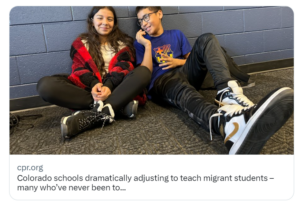 “I’ve noticed a wide range of students – from Colombian students from middle class families seeking more opportunities, to El Salvadoran students escaping gang violence,” notes CPR’s Jenny Brundin, who recently wrote about immigrant children with limited previous experience in schools. She recommends reporters try and educate themselves on what is happening in the countries. WOLA and NACLA are two good sources for Latin America. “This can help give context.”
QUESTION THE SURPRISE — AND THE BURDEN
“We have to stop acting as though the movement of children from one country to another comes as a complete shock,” according to The 74’s Jo Napolitano, who wrote a book about refugee and undocumented children coming to the US.
And we need to question assumptions — including our own — about what their arrival means, she says. “Anyone who treats their arrival as a burden should be made to fully explain exactly how. Do these children actually cost more money to educate? That’s a very debatable point. And if they do, how? Also, studies have shown children who pass through ESL programs and then move out of those programs during their K-12 education sometimes have a higher high school graduation rate than those who have not.”
We have to stop acting as though the arrival of children from one country to another is a complete shock. — Jo Napolitano (The 74)
FIRSTHAND OBSERVATIONS ARE KEY
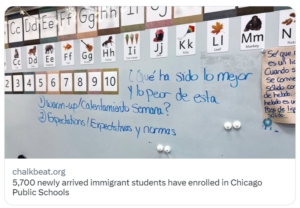 “My biggest tip is super basic Journalism 101: get on the ground and tell the story of what you see,” says Vevea, who has written and edited several pieces on increases in immigrant education in Chicago. “Go to shelters, schools, where buses are dropping off new arrivals. Talk to everyone (volunteers, new arrivals, officials, etc.) Look for details that will put the reader/listener in the front row. Even if there’s a language barrier, you can get a lot of vivid detail about the experience by being present.”
AVOID UNNECESSARILY TRAUMATIZING YOUR SUBJECTS
“If [your story] is strictly on academics, you won’t need to ask kids about their journeys here, which could bring up traumatic memories,” notes Brundin. “If you do need to get a sense of the latter, tell them when you would like and ask their permission to ask the questions. You don’t need to dig deep unless you are doing some kind of deep profile.”
LET THE KIDS TAKE THE LEAD
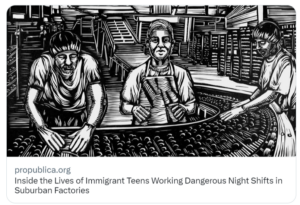 “These are really hard stories to report, as the young people in this situation have a lot of good reasons not to talk to you,” says ProPublica’s Melissa Sanchez, who has written extensively about migrant teenagers working jobs and trying to go to school. “So I would encourage reporters to be extremely careful in getting the trust of the young people you talk to, and really giving them agency in the process.” Kids’ ESL teachers can be a good entry point, says Sanchez, who recommends translating stories into Spanish, producing an audio version for low-literacy readers, and following up afterwards to see what the response has been to the story.
Be extremely careful in getting the trust of the young people you talk to, and really giving them agency in the process. – Melissa Sanchez (ProPublica)
CONSIDER THE WHOLE FAMILY
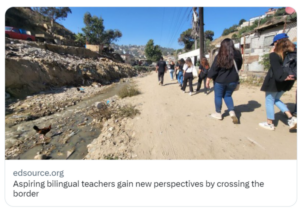 “I think one important thing to remember when covering immigrant experiences is remembering that immigrants don’t live in a bubble,” said EdSource reporter Zaidee Stavely, who covers bilingual education and immigration in California schools. “They have partners, children, siblings, parents, all of whom may be U.S. citizens or have a different immigration status than them. Immigration policy affects everyone in a family.” Her story about the Ruiz family in Los Banos, California, is a great example, focusing on how the unexpected denial of the father’s green card application led to his oldest daughter dropping out of college and the younger siblings changing their future plans.
CONSIDER BOTH THE PROS AND CONS OF IDENTIFYING KIDS
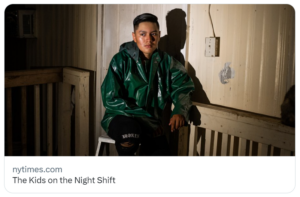 While many journalists recommend using first names only or otherwise anonymizing vulnerable subjects, being named can result in sources receiving “huge amounts of help” in the form of free legal services, medical care, work permits, and donations, according to the New York Times’ Hannah Dreier, whose stories about immigrant kids working dangerous jobs use names and images in situations where she’s received permission from both their U.S. sponsors and their parents back home. “I think reporters sometimes assume undocumented immigrants, and especially children, will not want to be named in reporting, when really, there are ethical ways to at least give these kids the option of appearing in our stories in the same way native-born children do.”
I think reporters sometimes assume undocumented immigrants, and especially children, will not want to be named in reporting. – Hannah Dreier (NYT)
START WITH KIDS, NOT SCHOOLS
“Try to get an understanding of what kids are going through and then go backwards from there to kind of understand how the school might be connected,” advises Sophia Qureshi, whose Atlanta-area newsletter is dedicated to covering immigrant and refugee communities. She cites her story about halal meat being offered in schools, which is centered around a Muslim student who was fed up with eating peanut butter and jelly sandwiches every day but couldn’t eat cinnamon rolls because they were on the same plate as the non-halal chicken tenders. “That story came out of understanding what his frustrations were as a kid and what he wished, which was just more options for him to eat.”
DON’T COVER IT AS JUST A CRISIS
“My hope is for journalists to pay attention to the experiences of immigrant students all the time and over time,” says Sarah Dryden-Peterson, a professor at the Harvard Graduate School of Education and director of Refugee REACH, an organization devoted to creating quality education for displaced students and migrants.
“When we focus only on moments of shock and crisis, we miss the long-term nature of what it means for kids to learn and become part of new schools,” Dryden-Peterson said. “We also misrepresent what migration is all about – not only the moment of arrival but the building of a future.”
These ideas aren’t comprehensive or in depth. We’re planning a series of follow-up pieces that will go much deeper. But they’re a good start.
As the migrant education story heats up, let’s hope education reporters and editors bring care and thought to their coverage.
Previously from The Grade
My dad was a teenage factory worker (Melissa Sanchez, republished)
Globe reporters describe how they cover immigrant English learners (Jenna Russell & Bianca Vázquez Toness)
Keeping the spotlight on English learners (Barbara Gottschalk)
Not just any high school story: How a ProPublica immigration reporter profiled a Long Island high school student trying to get out of MS-13 (interview with Hannah Dreier)
Hechinger Report crowdfunding immigrant education coverage (2015)
ABOUT THE AUTHORS

Colleen Connolly
Colleen Connolly is a freelance journalist who covers New England for The Grade. Her work has also appeared in the Columbia Journalism Review, The Guardian, The New Republic, Smithsonian magazine, and the Chicago Tribune. You can follow her on Twitter @colleenmconn or find out more on her website: https://colleenmaryconnolly.com/.
Alexander Russo
Alexander Russo is founder and editor of The Grade, an award-winning effort to help improve media coverage of education issues. He’s also a Spencer Education Journalism Fellowship winner and a book author. You can reach him at @alexanderrusso.
Visit their website at: https://the-grade.org/Will Callan
Will Callan is a freelance journalist based in Los Angeles. After freelancing as a print journalist in the Bay Area, he moved to Ann Arbor, Mich., and covered the first year of the pandemic at Michigan Radio. He’s since worked on podcasts, radio documentaries, and investigations at APM Reports. He can be reached at wacallan@gmail.com.