|
|
|
REOPENING CALIFORNIAThe best education journalism of the week |
|
ABOUT THIS YEAR’S EWA AWARDS
New from The Grade |
|
| ABOVE: The Boston Globe’s Bianca Vázquez Toness, the Washington Post’s Hannah Natanson, and New York Magazine’s Marianne McCune.On Tuesday, the Education Writers Association announced the winners of its national awards for 2020, recognizing the “top education journalism in the United States” from among 350 entries.
Sadly missing are some of last year’s biggest stories, including Chana Joffe Walt’s breakout hit podcast “Nice White Parents” and Alec MacGillis’ masterful “Children Left Behind By Remote Learning” for ProPublica.
But the 15 winners include some breakout stars like the Boston Globe’s Bianca Vázquez Toness, some surprise winners like the Washington Post’s Hannah Natanson, and much-deserved recognition for Marianne McCune’s amazing “Two Schools in Marin County” podcast.
Congrats to all. You can read my take here. |
|
| HOW TO COVER REMOTE LEARNING EFFECTIVELY |
|
| Creating smart, useful coverage of remote learning is no easy task, given the large variations in remote programs across districts and states and the lack of data to show trends.But remote learning is here to stay, and The Grade contributor and longtime ed tech reporter Wayne D’Orio writes this week about how to cover remote learning effectively.
“The best stories I’ve seen are the ones that illuminate a small aspect of a technology-aided instructional effort rather than attempt to cover the entire endeavor superficially,” D’Orio writes, citing stories in the Seattle Times, The 74, and USA Today.
Read remote learning coverage insights from D’Orio and other reporters here. |
|
| MEDIA TIDBITSThought-provoking commentary on the latest coverage. |
|
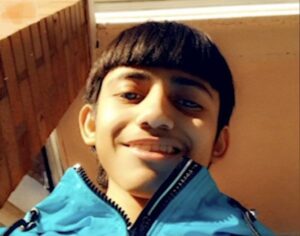
| ABOVE: Chicago 7th grader Adam Toledo, who was shot and killed last month by police. He was enrolled at a CPS elementary school.📰 AN IMPORTANT ROLE FOR EDUCATION JOURNALISTS: What can education journalists do when there are police shootings, most of which take place far away from schools? “Think of what comes BEFORE cops kill an Adam Toledo or any Brown or Black boy in Chicago,” tweeted Injustice Watch EIC Adeshina Emmanuel on Thursday, following the release of the body camera footage showing the 7th-grader’s death at the hands of Chicago police. “How many institutions are they already failed by that set the table for their dehumanization, criminalization and suffering?” Emmanuel recommends that journalists “commit to investigating the institutional failures, systemic traps, and BAD LEADERSHIP that combine to snare victims some people seem so set on blaming for their own harm.” So far, all we know about Adam’s education is that he went to a Chicago elementary school and may have had an IEP. But surely there’s a larger story to tell.
📰 DEFINING TERMS IN EDUCATION JOURNALISM: In response to the Marshall Project’s new Language Project examining the words used to describe people behind bars, the Boston Globe’s Sarah Carr tweeted, “This kind of deconstruction of language would be very useful on the education beat as well. Consider the commonly used: ‘emotional impairment,’ ‘at risk,’ ‘drop out,’ and so many more.” Carr’s right. One big issue has been the use of the word dropout to describe kids who aren’t attending or participating in school. Another has been the phrase learning loss, which some feel stigmatizes kids and overemphasizes standardized testing. Most of all, we need more careful use of the phrase “school reopening,” perhaps by specifying whether it’s full time, in-person, live instruction, five days a week. Often it’s not.
📰 WHEN THE LA TIMES FOLLOWS THE 74: This week the LA Times’ Howard Blume wrote about LAUSD’s slow, cautious reopening shows the influence of the teachers union. The story follows The 74’s coverage of the inside negotiations between LAUSD and the teachers union, Court Documents Reveal How L.A. Teachers Union Gained Upper Hand. Both versions highlight parent opinions, but the LAT leans more on the opinions of parents who are hesitant to send their kids back. The 74 focuses on parents who filed a lawsuit for the slow reopening.
📰 “SOME PERSONAL NEWS”: It’s hard to get a handle on how many journalists are leaving the education beat, voluntarily or otherwise. The circumstances aren’t always clear, along with whether the position is going to be filled by someone else or closed permanently. But Poynter has just launched a new series called Some Personal News, which tells the stories of the people who left a newsroom job during the pandemic. And one of the first stories is about a journalist who worked at Diverse Issues in Higher Education. Even closer to home, just this past week Virginia-based education reporter Claire Mitzel announced that she was laid off from the Roanoke Times. “It was such an honor to work for my hometown newspaper for a year, tweeted Mitzel. “I’m mad and sad — not for myself, but because the community deserves better than this.” Higher ed reporter Henri Gendreau also announced his departure from the paper along with several other colleagues. He tweeted, “I’m devastated for them and the community, and grateful to @TimeslandGuild for delaying the inevitable + for securing notice + more generous severance.” |
|
 |
PEOPLE, JOBS
Who’s going where & doing what? |
|
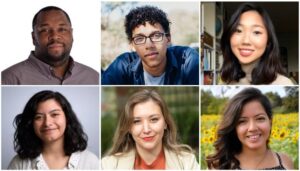
| Above: Clockwise from top left: Marlon A. Walker, Gabe Schneider, Juliana Kim, Catherina Carrera, Lee Gaines, and María Méndez.🔥 Who’s going where: Big congrats to former education reporter Marlon A. Walker, who was named executive editor of the Clarion Ledger in Jackson and the Mississippi editor for the USA Today Network. Gabe Schneider, editor of the media criticism newsletter The Objective, will be editing student journalists from around California for CalMatters. Schneider tells us he got his start in journalism at the newspaper he cofounded at UC San Diego, The Triton, covering college campuses and the “buried history of racism” there.
🔥 Also: Juliana Kim says she’s moving from the New York Times metro desk, where she reported education stories (including a memorable piece about remote schooling for English learners), and moving to Nashville to be an education reporter for public radio station WPLN. Newsday alum and NJ native Catherine Carrera is heading to Newark to be Chalkbeat’s first bureau chief. Lee Gaines is leaving Illinois Public Media to join WFYI’s new education team. She’ll be joined by Dylan Peers McCoy, who is leaving Chalkbeat Indiana.
🔥 But that’s not all! Texas Public Radio alum María Méndez will be the new K-12 reporter at the Austin American-Statesman. Méndez tweeted that “education has been vital to my success as a first gen. immigrant and college grad, but I know that’s not always the case for others. I hope to look at access, equity and help others navigate the often complex education system.”
🔥 Looking for more education writers to follow? Try Christina Veiga at Chalkbeat NY, Linh Tat at LA Daily News, and Asher Lehrer-Small at The 74. Veiga had a surge of strong stories on early childhood education this week, including examinations of a de Blasio childcare program that is under enrolled and over budget and the racial and economic gaps in NYC’s free pre-K programs. Tat came on last August, replacing Ariella Plachta, and the Daily News’ coverage is a helpful complement to the LA Times and KPCC. Lehrer-Small wrote a great story (with a personal connection!) about an educator fellowship in Rhode Island that’s elevating paraprofessionals and diversifying the teacher workforce. He’s got Emily Richmond’s vote for #tellEWA: “Asher may be a New to the Beat rookie, but he knows how to craft a snappy read.”
Did someone forward you this newsletter? You can sign up here. |
|
EVENTS
What just happened & what’s coming next? |
|
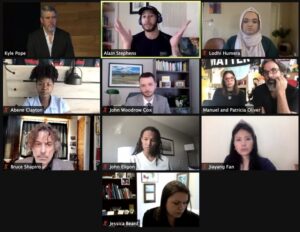
| Above: The Washington Post’s John Woodrow Cox was on the recent CJR Gun Violence News Summit, along with the New York Times’ John Eligon and the Dart Center’s Bruce Shapiro. Scroll to the bottom of the CJR page to watch the recap.⏰ Appearances: KPCC’s Kyle Stokes was on PBS SoCal last week to talk about the parent group suing LAUSD for the district’s slow reopening. His colleague Mariana Dale was on to talk about young students transitioning back to the classroom. WAMU’s Debbie Truong joined the station’s Politics Hour to talk about the untimely passing of Washington Teachers Union president Elizabeth Davis. Jill Tucker was on the SF Chronicle’s podcast to talk about the first day back at school in San Francisco. The 74 hosted an event this week about how students are navigating the social-emotional challenges of the pandemic, featuring Bekah McNeel. It’s available on their YouTube channel. And the NYT’s Erica Green discussed her approach to journalism and her drive to tell stories that might otherwise go untold at a Yale School of Management event. The replay isn’t up yet, but we’ll tweet it out as soon as it is.
⏰ Upcoming: The Globe has an event on April 19 called How Can Schools Better Reach Their Most Vulnerable Students This Spring?, featuring some of the student and teacher sources in Bianca Vázquez Toness and Jenna Russell’s stellar yearlong project on a class of immigrant students trying to stay caught up during the pandemic.
⏰ The deadline to apply for an EWA reporting fellowship — you could get up to $8,000! — is today. You can apply here. |
|
 THE KICKER THE KICKER |
|
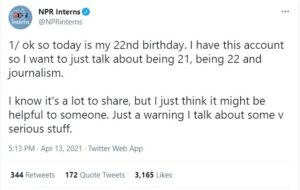
| “I love this thread,” tweeted EdWeek’s Evie Blad about a viral series of tweets from @NPRinterns describing the struggles of being a young journalist these days. “And the answer isn’t ‘don’t worry that you don’t work at Important Outlet X or you didn’t win Important Award Y because you probably will some day.’ The answer is ‘maybe what you’re doing right now matters more than you think.’” |
|
| By Alexander Russo with additional writing from Michele Jacques and Colleen Connolly. |
|
| That’s all, folks. Thanks for reading! |
|
|
|
|
|
|