In this week’s newsletter:
📌 Everybody wants to cover the story of dismal reading and math scores.
📌 Struggling kids, teacher-administration conflict, and a clueless district office.
📌 Schools spend enormous amounts on ineffective safety measures.
📌 How one outlet is making “community engagement” a reality.
📌 Here comes season 2 of Hulu’s ‘English Teacher.’
DISMAL SCORES, BROAD COVERAGE
The big education story of the week:
The big education story of the week is the release of new National Assessment of Education Progress (NAEP) scores, which showed historically low results for 12th grade math and reading scores. (AP, Washington Post, New York Times, Wall Street Journal, NPR, K-12 Dive, Chalkbeat, The Hill, CS Monitor).
The NAEP declines started well before the COVID-19 pandemic, with scores dropping since 2013 in both reading and math. Seniors had the lowest reading score since 1992, when the assessment began. Eighth grade science scores, tested separately, also fell significantly. (The 74, Chalkbeat, EdSource).
These dismal results — and the wall-to-wall media coverage they received — are a stark reminder of schools’ increasing struggles to educate kids and ongoing interest among journalists and their readers. It’s hard to imagine any substantial response in the short term, but perhaps these are the seeds of future efforts?
Other big stories of the week include variations among cellphone bans (NBC News, San Antonio Express News, NYT, WBUR), threats to Head Start funding (AP, The Guardian, New York Times), and the state of school vaccine mandates (LA Times, KFF, PBS).
DISMAL SCORES, BROAD COVERAGE
The big education story of the week:
The big education story of the week is the release of new National Assessment of Education Progress (NAEP) scores, which showed historically low results for 12th grade math and reading scores. (AP, Washington Post, New York Times, Wall Street Journal, NPR, K-12 Dive, Chalkbeat, The Hill, CS Monitor).
The NAEP declines started well before the COVID-19 pandemic, with scores dropping since 2013 in both reading and math. Seniors had the lowest reading score since 1992, when the assessment began. Eighth grade science scores, tested separately, also fell significantly. (The 74, Chalkbeat, EdSource).
These dismal results — and the wall-to-wall media coverage they received — are a stark reminder of schools’ increasing struggles to educate kids and ongoing interest among journalists and their readers. It’s hard to imagine any substantial response in the short term, but perhaps these are the seeds of future efforts?
Other big stories of the week include variations among cellphone bans (NBC News, San Antonio Express News, NYT, WBUR), threats to Head Start funding (AP, The Guardian, New York Times), and the state of school vaccine mandates (LA Times, KFF, PBS)
LOST STUDENTS, SCHOOL DYSFUNCTION, & DEPORTATION DISRUPTION
Top education journalism of the week:
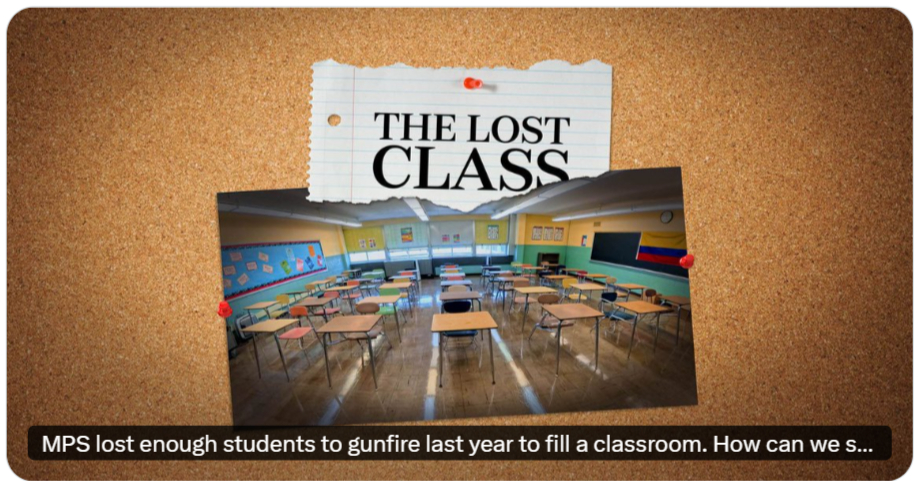
🏆 MPS lost enough students to gunfire last year to fill a classroom. How can we stop the violence? is a devastating look at how kids in Milwaukee lose their lives to gun violence outside of the classroom. Amid the coverage of horrific but thankfully rare school shootings, it’s a good reminder of where the real dangers to children are. (David Clarey and Cleo Krejci / Milwaukee Journal Sentinel)
See also: The school shooting industry is worth billions — and it keeps growing (Meg Anderson, NPR)
🏆 As post-COVID absenteeism rates fall, high numbers still plague this Paterson school details how leadership failures, adult infighting, and lack of accountability have exacerbated systemic challenges in getting kids back to school. (Mary Ann Koruth / NorthJersey.com)
🏆 Trump’s immigration crackdown upends life at Austin elementary school examines the ripple effects through a school community of deportations, including behavioral problems and even hunger. This vividly written story shows how the presence of law enforcement on and near campus is ratcheting up anxiety for students and teachers alike. (Emiliano Tahui Gómez / Austin American Statesman)
Other stories we like include The $96M boondoggle (NJ.com), Can China See What Your Kid Is Read? (The Free Press), and This California town was ravaged by a wildfire. Seven years later, schools are still recovering (AP).
Thanks for reading Alexander Russo’s The Grade, where we take a closer look at education news. Subscribe for free to receive new posts and support my work!
COMMUNITY ENGAGEMENT, MADE REAL
Our latest columns and interviews:
Pretty much everyone in journalism says that they are community-oriented these days, but the decade-old EdNC has gone further than most to make that a reality.
This week’s interview with EdNC’s Anna Pogarcic gets into the details.
“It’s easy to sit and say you’re listening to people,” says Pogarcic. “But what are you doing with it once you’ve listened to them?”
You can read the transcript here.
Coming next week: My interview with freelance investigative reporter Matt Drange about his efforts to bring more attention to the pervasive problem of school sexual predators.
In case you missed it: Teachers aren’t the only ones who’ve fallen prey to misguided beliefs and ineffective practices: Journalism’s ‘Sold a Story’ problem.
Thanks for reading Alexander Russo’s The Grade! This post is public so feel free to share it.
PEOPLE, EVENTS, & INSIGHTS
Who, what, when, where, and why:
📰 Recognition: Big congrats to The 74’s Jo Napolitano, who won an award from INN for her investigation, ‘Unwelcome to America,’ which one judge describes as “extraordinary example of persistent, methodical, and deeply researched reporting.” All hail former education reporter Claudia Rowe who’s been longlisted for the National Book Foundation Nonfiction award for her book on the foster care system. (You can read an excerpt from the book at The Grade.)
📰 People: Former Insider investigative reporter Matt Drange is back with a new CalMatters piece about a proposal to reduce school sexual abuse introduced in response to his coverage. (California is one of just 16 states that lack comprehensive legislation to prevent districts from passing predatory teachers to other districts.) Erin Gretzinger is the new education reporter at Madison’s Capital Times. The AP’s Cheyanne Mumphrey is temporarily covering wellness. Searchlight New Mexico’s Alicia Inez Guzmán and the Chicago Tribune’s Nell Salzman are new NYT local investigations fellows.
📰 Investigations: The Louisville Courier Journal’s Krista Johnson reported a major story about the recent effort to revamp the district’s student assignment plan to better serve families in west Louisville. “Two years in the education world is rarely enough time to fully see the results of a policy change,” Johnson tells me. “But some issues have already arisen that have community leaders concerned.”
📰 Research and reports: The neighborhood where a child grows up turns out to matter much less than what their parents do for a living (WSJ). The importance of college has plummeted from 75 to 35 percent (Gallup). It’s become easier and easier to graduate high school in the US (FIFTYCAN). The first randomized study of school cellphone bans yields a ringing endorsement (The Economist). You can track the lawsuits filed in response to the Trump administration’s K12 initiatives (Brookings).
📰 Quotes:
“We interrupt the shooting at a college to bring you news of a shooting at a high school.”
“From interactive whiteboards to iPads, it’s been an expensive and repetitive waste of time.”
“Many parents told me that they feel torn about how to reconcile their views on parental rights with their responsibilities as citizens.”
“You should feel bad for using AI.”
KICKER
Always save the best for last.
Season 2 of Hulu’s ‘English Teacher’ premiers September 25th. Season 1 was my ‘Abbott Elementary.’
That’s all, folks. Thanks for reading!