New data suggests that remote learning time is minimal, live instruction is rare — and that news coverage has been slow to capture the realities.
By Alexander Russo
On Tuesday, the national trade outlet Education Week created a certain amount of outrage when it published the results of its latest COVID-19 survey under the headline Teachers Work an Hour Less Per Day During COVID-19: 8 Key EdWeek Survey Findings.
A small but vocal number of critics, most of them educators, believed the focus on the decreased number of hours educators reported working was unfair, yet another example of media teacher bashing. Some questioned the accuracy of the findings.
However, the kerfuffle surrounding the EdWeek story had two unfortunate effects: It once again centered the discussion on teachers rather than kids. And it eclipsed another even more striking finding: Broadly defined, the total number of hours of instruction students are receiving has been cut in half since the COVID-19 crisis began, from six hours to three.
“For students in the highest-poverty schools, that figure drops to two hours per day,” according to EdWeek.
For anyone who cares about kids, these numbers are not a pretty sight. Three hours a day doesn’t seem nearly enough. Two hours for low-income kids seems woefully insufficient. And it’s taken far too long for these kinds of numbers to come out.
To a certain extent, we know school systems’ remote learning requirements: not much. But we don’t know nearly enough about what’s actually being provided, much less if it is helping kids learn.
Three hours a day doesn’t seem nearly enough. Two hours for low-income kids seems woefully insufficient. And it’s taken far too long for these kinds of numbers to come out.
For much of the past two months, the fundamental reality of remote learning for most kids hasn’t been very clear.
We knew that lots of kids needed meals, devices, and Internet hot spots, and that especially vulnerable kids were struggling. We knew that some districts took longer to launch remote learning programs than others, and that engagement and attendance were issues. Some kids liked it. Many didn’t. How to grade kids was a big topic of discussion, along with relentless coverage of When School Was Going To Reopen and What It Might Look Like.
In terms of covering remote learning itself, the most common storylines I have been seeing were about how hard school systems were working to serve kids, how hard it was for teachers to provide instruction remotely, and how hard it was for parents to supervise. It was chaotic, overwhelming, disruptive. There was too much remote learning, not too little.
But those impressions may turn out to have been woefully mistaken.
In recent weeks, just how limited remote learning often is, in terms of instructional time being delivered to kids, has slowly become apparent.
A handful of news outlets indicated that remote learning work agreements with teachers unions set boundaries on how much time teachers could spend working with kids.
Contributor Jenny Manriques rounded up these reports and added some additional information in her piece, Four hours a day; how teacher contracts are shaping remote learning.
In an April 21 story headlined Online School Demands More of Teachers. Unions Are Pushing Back, the New York Times’ Dana Goldstein described strict limits some unions had negotiated on remote instruction, live and otherwise.
Her follow-up story The Class Divide: Remote Learning at 2 Schools, Private and Public compared the extensive offerings of one private Chicago school with the much more limited offerings at a traditional Philadelphia school where students didn’t see their teachers on video until late April because the district was training staff and where students currently receive an hour of live instruction per day.
Late last week, economist Susan Dynarski wrote that remote learning was a failure, that school had effectively ended in March for most kids, once they were no longer in the classroom. Over the weekend, New York Times reporter Nikole Hannah-Jones described the lack of live instruction her child and others were receiving under remote learning.
And then the Education Week survey results came out — the first time EdWeek has reported teachers’ responses about student learning time, according to research director Holly Kurtz.
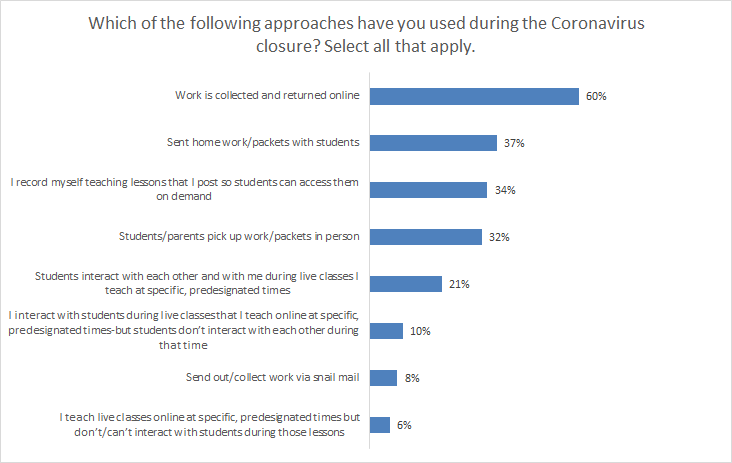
Above: This EdWeek data is from the March 25th online survey, showing that roughly 20 percent of teachers use live instruction as part of remote learning.
Live (synchronous) instruction, in which students and teachers work together at the same time over the internet, is one of the many ways schools are providing remote learning.
Under ideal conditions, it comes the closest to approximating the classroom experience, allowing students and teachers to see and communicate with each other as they would in a physical classroom.
According to the EdWeek write-up of its survey, live instruction has “taken off” since the shutdown of school buildings. And, according to the EdWeek survey it’s the approach that educators feel is most effective.
However, it isn’t the most common form of remote learning. Just over 20 percent of teachers reported live instruction with full classroom participation. According to EdWeek’s survey, the most common form of remote instruction is asynchronous recorded lessons for students.
These results align with what we know from research tracking systems responses to the crisis. Just two dozen of the 100 school systems CRPE has been tracking require it for some grades. Fewer than a dozen require it for all grades, according to CRPE, whose database is built on district plans. Though individual schools and teachers may act on their own, several of the largest systems in the nation don’t appear to require live instruction at all.
Even among those who are listed as providing live instruction, it’s not entirely clear from the CRPE database just how much is being provided. In Broward County, for example, “students attend school virtually for around three hours a day, with teachers using video conferencing, prerecorded videos, and assignments posted to the Canvas platform.”
The fact that we still don’t know more about what’s required and provided is a serious coverage problem.
Students now spend three hours per day learning, down from six hours per day prior to the coronavirus closures. For students in the highest-poverty schools, that figure drops to two hours per day. – Education Week survey results.
To be sure, units of time are a crude proxy for effort, much less learning. Some of us can accomplish much more than others in the same amount of minutes.
According to NCTQ, which has been tracking remote learning agreements, teacher availability requirements range widely, from Boston (Up to 15 hours a week of synchronous time, plus an additional five asynchronous) to Broward (No less than three hours a day of “office hours” to be available to students. Interactions can be via email, phone, or Canvas) to Fresno (No minimum time. Connect with students once a week). The LAUSD agreement states that, “On average, unit members shall provide 240 minutes of instruction and student support to students per day” including planning, office hours, etc.
However, there are wide variations in how much time teachers are working and kids are being provided instruction, which aren’t entirely captured in remote learning agreements or survey responses. The research on the effectiveness of live instruction is mixed and inconclusive, based on this March EdWeek write-up.
And classroom teachers aren’t the only ones who may prefer to avoid live instruction, which has been disastrous in a few districts like Fairfax County, VA, where the first week of remote learning led to several crashes and the resignation of a top district official. Live instruction is a high-wire act for everyone, including administrators, parents, and even students.
Live instruction is a high-wire act for everyone, including administrators, parents, and even students.
Perhaps it will turn out that three hours of instruction per day is enough, and that live teaching isn’t as effective as it might seem to be at the moment. If so, I’m fine with that. People used to think that TV melted kids’ brains, and that daycare would result in generations of failed adults.
However, I’m not OK with the lack of media scrutiny and rigor that’s been applied to some of the basic elements of COVID-19 remote learning, like instructional time.
My hope is that media coverage of remote learning going forward can focus on what’s happening to kids in the present, what their experiences and realities are, and avoid looking for new, novelty angles or resorting to coverage of the future. Parents, educators, and policymakers desperately need to know the nuts-and-bolts parameters of remote learning. It’s education reporters’ jobs to report them.
ABOUT THE AUTHOR

Alexander Russo
Alexander Russo is founder and editor of The Grade, an award-winning effort to help improve media coverage of education issues. He’s also a Spencer Education Journalism Fellowship winner and a book author. You can reach him at @alexanderrusso.
Visit their website at: https://the-grade.org/