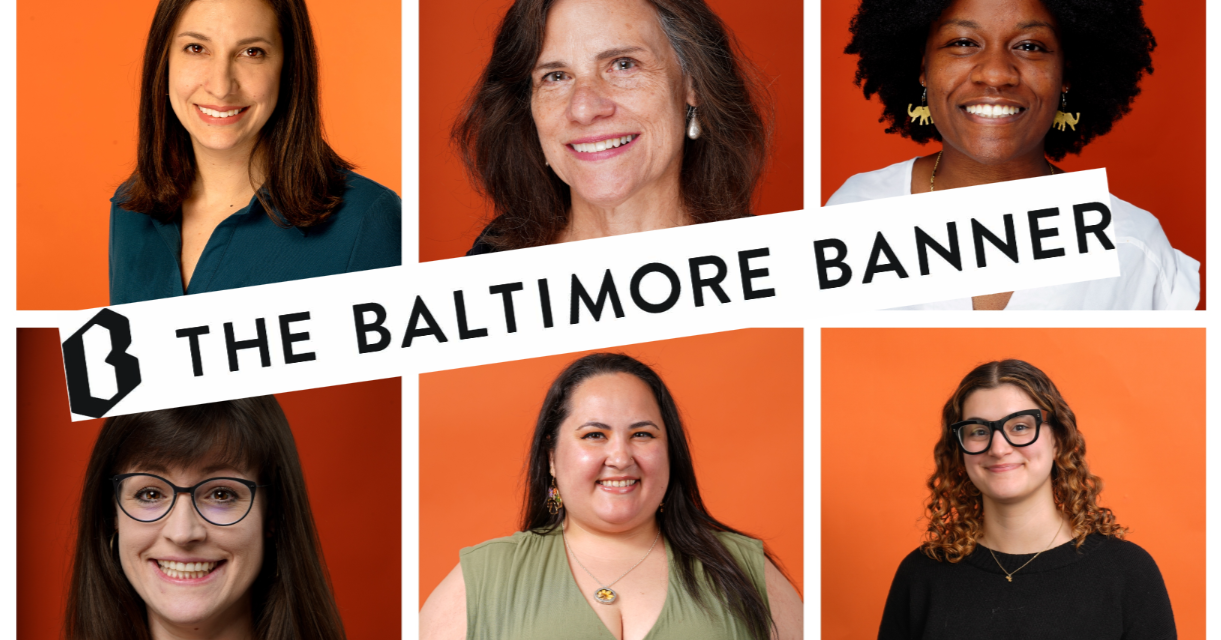
The Banner’s fast-growing education team is rethinking regional assignments and focusing on stories that convert readers into subscribers.
By Rachel Cieri Mull, Banner education editor
What would you do if you could break every convention of education journalism and start anew?
That was the question facing me two years ago, as the incoming education editor at The Baltimore Banner, a nonprofit news startup launched in June 2022.
Blessed with $50 million from our founder, the newsroom was charged with building a self-sustaining local news operation in five years, and that means everything was on the table.
It was a once-in-lifetime opportunity for me, a former Baltimore Sun editor mourning the slow decline of Maryland’s news ecosystem. I jumped at the chance to be back in my beloved city and help create a model for local news that today’s readers would pay for.
It was a once-in-lifetime opportunity for me… I jumped at the chance.
As one editor put it, education coverage is the sweet spot in our Venn diagram of missions — it’s a public service, a major audience driver, and a magnet for philanthropic and advertiser support. Our philanthropy team thought they could build a pool of donors to fund that work in the form of an education hub, similar to the groups that support education labs in for-profit newsrooms across the country.
It was a prime opportunity to rethink the way we cover education.
My pitch: Create a hub for information-hungry parents that arms them with the tools to make better decisions about their children’s education. Stop covering local school systems as isolated fiefdoms, and connect the dots for families across the region.
Hold people in power responsible for giving all children a high-quality education, and break down what’s working and what’s not. Produce coverage so indispensable that it wins readers and subscribers.
Revolutionary? Maybe not. A grand experiment? Definitely. Leadership went for it.
Education coverage is a public service, a major audience driver, and a magnet for philanthropic and advertiser support.
Over the past year, we’ve worked with departments across the company to build one of the largest education teams in local news, growing from two reporters to five, covering early childhood through college.
Our ranks include rising stars who are still early in their careers and veteran journalists with long lists of accolades.
Our beats are structured around issues instead of geography, and we’re leaning hard into journalism that helps families sort out what information is useful, misleading, or just plain wrong.
Naturally, there’s been a lot of trial and error in this experiment. Sometimes our grand plans flop, while the stories we write on a whim are our greatest hits. Other times, we’ve missed opportunities in pursuit of the “big story.” And, of course, we’re a start-up with start-up problems (ask me why I didn’t have a desk for three weeks), which means we can never get too attached to our plans.
Here are a few lessons we’ve learned along the way:
Issue-focused beats still need boots on the ground.
When I joined the Banner in January 2023, each education reporter was assigned to cover one school district, and they often did what’s commonplace at a legacy paper – write stories off of school board meetings, no matter how banal.
Few people would read that kind of coverage, let alone pay for it. I know because I’m a parent of a kindergartener; our education audience is full of my peers.
So I encouraged my team to scale back on school board meeting coverage. If there was capital-N News, cover it. Business as usual, no need. Tuck away what you’ve learned for later, and use it to build a deeper, more interesting story.
It took a few months to hit our stride. On the first day of school in fall 2023, one district’s bus system had an epic meltdown that we instantly recognized as big news, even though no one was assigned to Howard County schools. We covered it as an extreme example of innovation gone wrong amid a national bus driver shortage, capturing the attention of readers around the region and building a burgeoning audience in Howard County — one that is now a major growth market for us.
Later that fall, reporter Kristen Griffith picked up on a Moms for Liberty book-banning campaign making waves in another school district we don’t regularly cover. She did what no other local reporter had — break down what made the group’s strategy successful there and bring statewide attention to the threat facing school libraries. State legislators passed the Freedom to Read Act last spring.
For the most part, I stand by that approach. I still turn down pitches every day — often traditional newspaper stories on donations or awards — that won’t resonate with our readers. What a luxury, I know.
But I’ve also seen us slide too far toward issue-based coverage, missing opportunities because we’re more focused on the big picture. We started to realize the value of board meetings is rarely what’s on the agenda, but rather the gossip you hear on the side and the relationships you build in the process.
Those boots-on-the-ground relationships have proven absolutely crucial over and over again. They’re the reason we broke the national news story on the teacher who used AI to smear a principal’s reputation, got access to records that exposed a school board candidate’s history of sexual misconduct, and scooped everyone on leadership shake-ups.
I still turn down pitches every day that won’t resonate with our readers.
Today, we use a team approach to keep track of what’s going on in each region, with one reporter assigned to monitor a school system or group of institutions, even if they don’t write every story on it. We’re learning to embrace the dichotomy of breaking news and ambitious enterprise work.
Which brings me to our next lesson:
We can’t be everything to everyone, but we can be indispensable.
Unlike many nonprofit newsrooms, the Banner has a paywall. Our business model is built on multiple revenue streams, and subscriptions are one of them. Every story is pitched with our audience in mind, evaluating who’s likely to read and why. The goal is to be an indispensable resource that’s worth a reader’s money.
It’s a lot of pressure, and we talk about the urgency to figure it out — no exaggeration — every day.
What we’ve learned is that readers are hungry for information on their local schools. Most of what’s available to them — state databases, test scores, the parent rumor mill — is contradictory, hard to find or, frankly, useless. When we make it both useful and easy for them to understand, they’re more likely to pay for our work.
Case in point: When the U.S. education department honored five local Catholic schools with a National Blue Ribbon Award, we published a simple story explaining why that’s unusual and what it says about the quality of those schools.
It was the most-read story on our site for days. It motivated a surprising number of people to subscribe.
We almost didn’t write it.
Translating these kinds of lists into useful information has become bread and butter. When Maryland updates its database of public school ratings — a clunky, jargon-filled website — we publish a sortable, phone-friendly version and explain what the ratings mean in plain English. It draws thousands of readers.
Private school coverage, on the other hand, is still an experiment for us. We’ve learned that any meaningful private school story is a huge time suck to report — these insular communities have no obligation to talk to the media, after all — but there’s a sizable group of readers, likely private school parents and alumni, who are highly invested in their children’s education and have disposable income for a subscription.
My first week at the Banner, we published a scoop on a private school teacher arrested for child sexual abuse that was, at that point, our highest-converting story. His case had a loyal audience through dozens of stories leading up to his conviction a year and a half later.
Earlier this year, we saw similar traction on a handful of stories about another private school’s efforts to shut down conversations about the conflict in Gaza.
The goal is to be an indispensable resource that’s worth a reader’s money.
Even though our labors to open the black box of private education tend to be rewarded, we’ve kept them limited; there are exponentially more public school students whose families have far fewer resources to help them navigate their education.
And no matter how many reporters we hire, we’re always making tough choices about what to spend our limited time on.
By today’s standards, we have an enormous team. But our five reporters are tasked with covering four school districts, the state education department, 55 Maryland colleges, and an untold number of preschools. At the same time, they’re trying to keep their finger on the pulse of a massive effort to expand pre-K, flagging student achievement, turmoil in the educator workforce, and a revolving door of education officials.
There’s a constant push and pull to balance the short-term and long-term work, to be responsive to what people are talking about in the moment versus setting aside the time to uncover what no one’s talking about.
We don’t always get it right. That brings me to the final lesson I’ll share:
Failure is part of the experiment.
The Banner is the only place I’ve ever worked that’ll embrace a wild idea fast — and kill it faster.
We’ve had our fair share of hits, like an interactive math quiz to help readers understand why only 7% of eighth graders were passing a state test.
We’ve also made bets that absolutely flopped. Last fall, we tried to tap into the excitement of the first day of school by asking readers to share their photos of their kids’ outfits — something we know they do on social media anyway — and “rating” them (compliments only) in a video.
I’m embarrassed to admit how many of the kids in that video are Banner staff submissions. As it turns out, parents are (understandably) worried about putting their children’s faces on the internet.
We didn’t do that again.
In the past, I’ve worked in legacy newsrooms where people dragged their feet to try something new or kill something that wasn’t working. That attitude, I think, comes from a fear of failure — and a fear of admitting you failed.
But learning from the occasional failure is the only way to find a sustainable model for local news, the bedrock of education journalism. For our profession to survive, we have to embrace the grand experiment. I hope you’ll join us.
Rachel Cieri Mull is education editor at The Baltimore Banner. She was previously a senior editor at The Chronicle of Higher Education in Washington, D.C., and before that led the features department at The Baltimore Sun.
Previously from The Grade
In San Diego, an alternative approach to education news
How community-based solutions will deepen your reporting
Making education news more useful
Putting a headline on national education news at USA Today