In this week’s newsletter: Teachers fall behind in diversity compared to other college grads — and in stark contrast to the students they teach. An investigation into school sexual predators in Kentucky that could probably be replicated anywhere. Education journalists reflect on the 2024 election and plan for a busy 2025. Brainy glasses can’t disguise the Paul Mescal of the education beat. And a reporter explains the problem of kindergarten absenteeism — with puppets.
NICE WHITE TEACHERS
The big education story of the week
The big education story of the week is a new report from the National Council on Teacher Quality (NCTQ) showing a worrying lack of teacher diversity.
The percentage of teachers from historically disadvantaged racial groups has grown slightly, from 18.3% of the workforce in 2014 to 21.1% in 2022. But the population of those with college degrees has diversified more during that same time — surpassing the teaching workforce for the first time around 2020 (EdWeek, K-12 Dive, Post-Gazette, The 74). And the population of school-age students is only becoming more and more diverse.
There are a few bright spots, however. Texas has the most diverse teacher workforce at 45% (KERA, Newsweek). Southern and Western states have a more diverse teaching workforce than East Coast states. And D.C. teachers are much more diverse than they are in neighboring states Maryland and Virginia (WTOP).
Teacher diversity won’t solve all of education’s woes, but the overwhelming whiteness of the profession is a long-standing issue that should be an ongoing education story. Becoming a teacher is full of bureaucratic and financial obstacles. The experiences of diverse teachers have gone under-reported in the past. A racial mismatch between teachers and students can hinder student achievement and contribute to student experiences of teacher racism.
Other big education stories of the week include continuing lags in pandemic recovery, enrollment-based school closings, and connections between the UnitedHealthcare CEO assassin and the elite institutions he attended. Check out @thegrade_ for each day’s most important education news.
ANOTHER SCHOOL SEX ABUSE SCANDAL
The best education journalism of the week
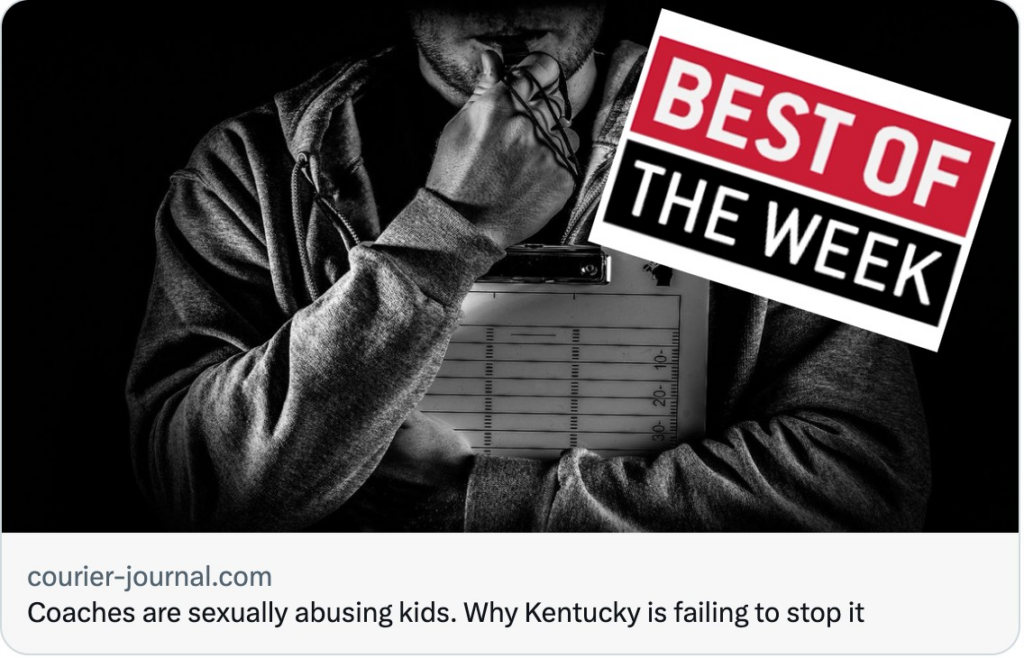
The best education journalism of the week is Silence & Secrets: An Investigation into Child Sexual Abuse by Kentucky Coaches by Stephanie Kuzydym of the Louisville Courier Journal.
An enterprise and investigative reporter who covers health and safety in sports, Kuzydym offers a four-part series that finds multiple Kentucky school districts that have been sued by families alleging an inadequate response to grooming and/or sexual abuse of young athletes. In each of the past 15 years, from two to 11 coaches at the middle- and high-school level in Kentucky have been accused of improper sexual conduct with a minor.
This must-read story dives into the cases themselves and the larger reason why sex abuse of young athletes is so persistent: a culture that looks the other way. She depicts survivors’ experiences, protest efforts, and the obstacles created by non-disclosure and settlement agreements. (Yes, the same documents used to keep special ed parents in the dark.)
The series’ first installment dives deep into recent legislative sessions, finding that state lawmakers have repeatedly failed to pass legislation designed to safeguard kids. The series also includes an FAQ on mandatory reporting of sexual abuse and a “how we reported” piece that details 700 records requests and travel totaling 1,000 miles — a remarkable feat in a time when local newspapers are facing lean times.
Kudos to the Courier Journal for diving into a problem that isn’t going away. Schools, districts, states, and the U.S. Department of Education have all been resistant to making changes that would protect children. K-12 education is still waiting for its #MeToo moment.
Other education stories we liked include a slow recovery from California’s bilingual education ban (CalMatters), how one Philadelphia community is using opioid settlement funds (Kensington Voice), COVID’s long shadow in Ohio (Columbus Dispatch), and a reporter’s query that prompts HISD to rename seven schools (Houston Landing).
JOURNALISM READERS WILL PAY FOR
Our latest columns and commentary
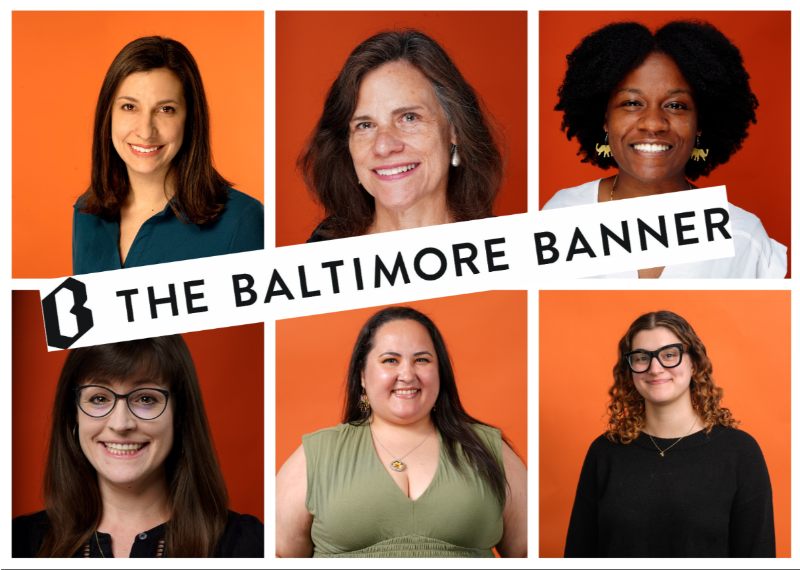
In the past, nonprofit news outlets often relied on foundations and voluntary reader contributions to support their work. But from the beginning, the upstart Baltimore Banner has aimed to turn readers into paid subscribers — creating an exciting urgency and openness to experimentation.
In this week’s latest piece, the Banner’s Rachel Cieri Mull describes how the drive to find readers and convert them into paying subscribers has led the education team to try all sorts of things, including covering private schools and suburban districts not originally on their radar.
“Readers are hungry for information on their local schools,” notes Cieri Mull, who’s leveraged her team’s success into hiring five reporters. “When we make it both useful and easy for them to understand, they’re more likely to pay for our work.”
Note that this is the latest in our series on how education outlets and teams are exploring different approaches, including Voice of San Diego, the Seattle Times, and the Alabama Education Lab. Who else stands out?
👏 Enormous thanks to all-star writer and researcher Colleen Connolly, who has helped report and edit The Grade — and greatly contributed to its growth — over the past four years. I wish her all the best.
LESSONS & PREDICTIONS
What did you learn — and what do you think happens next?
One of the biggest 2024 election surprises to me was the news that educators, parents, and immigrants were concerned enough about immigration and other issues to vote for Trump — a story that was not well told in the media.
One of the many possible things that I think will happen in 2025 is that big stories will include “re-tracking” math and book ban bans in Democratic states, and education journalists will renew their efforts to reach readers on social media and podcasts — with mixed success.
Tell us your 2024 insights and 2025 predictions in our five-question survey? We’d love to know.

Above: Which is the Hollywood heartthrob Paul Mescal? Which is the Houston Landing education reporter Asher Lehrer-Small?
PEOPLE, JOBS, & EVENTS
Who’s going where and what’s happening
📰 Events: EWA hosted its much-anticipated webinar on covering education under the Trump administration yesterday. I appreciate moderator Emily Richmond asking the panelists about post-election lessons. The Boston Globe’s Mandy McLaren moderated a panel on Wednesday about high dosage tutoring as an early literacy intervention. She’s also big on TikTok, in case you hadn’t seen. And don’t miss the AP’s Alia Wong at a USC Center for Health Journalism event next week on the ripple effects of the pandemic on young people.
📰 Appearances, podcasts, & segments: NPR’s Morning Edition featured a new study on the wildly different amounts of time students spend in class. PBS ran a segment about a post-election surge of misogyny on social media and in schools. Columbus Dispatch education reporter Cole Behrens spoke about his data deep dive on the impacts of COVID on education in Ohio five years later.
📰 Sound-off:
- “It should be standard for reporters to include how much time they gave an agency for comment in every story,” notes Houston Chronicle education reporter Megan Menchaca.
- “Journalism as a social service is about helping people and communities become the best versions of themselves,” says The Jersey Bee’s Simon Galperin. “That’s something another 100 years of Pulitzer Prizes will not achieve.”
📰 Research: “The bottom is falling out of U.S. student performance,” writes FiftyCAN CEO Marc Porter Magee, who’s lately been our favorite chart-sharer on social media. A global test of adults’ skills shows that the most educated American adults are getting smarter — and the least educated are falling further behind on basic skills such as reading a thermometer. A story in the Boston Globe notes that private school enrollment is declining in Massachusetts, and Catholic schools are down nationwide. And an analysis of SAT scores shows that students with the lowest scores are increasingly likely to graduate high school.
📰 Resources: Denise-Marie Ordway of the Journalist’s Resource shared 19 higher education databases for reporters to use. Want to know how to use AI in a beneficial way? Take a look at how Chalkbeat used an AI tool to uncover stories hidden in public school board meeting minutes. (Cleveland.com demonstrates an irresponsible way to use AI — to help write education stories that deserve deeper analysis.) And from Ballotpedia, see 20 states’ AI guidance for public schools.
THE KICKER
We saved the best for last
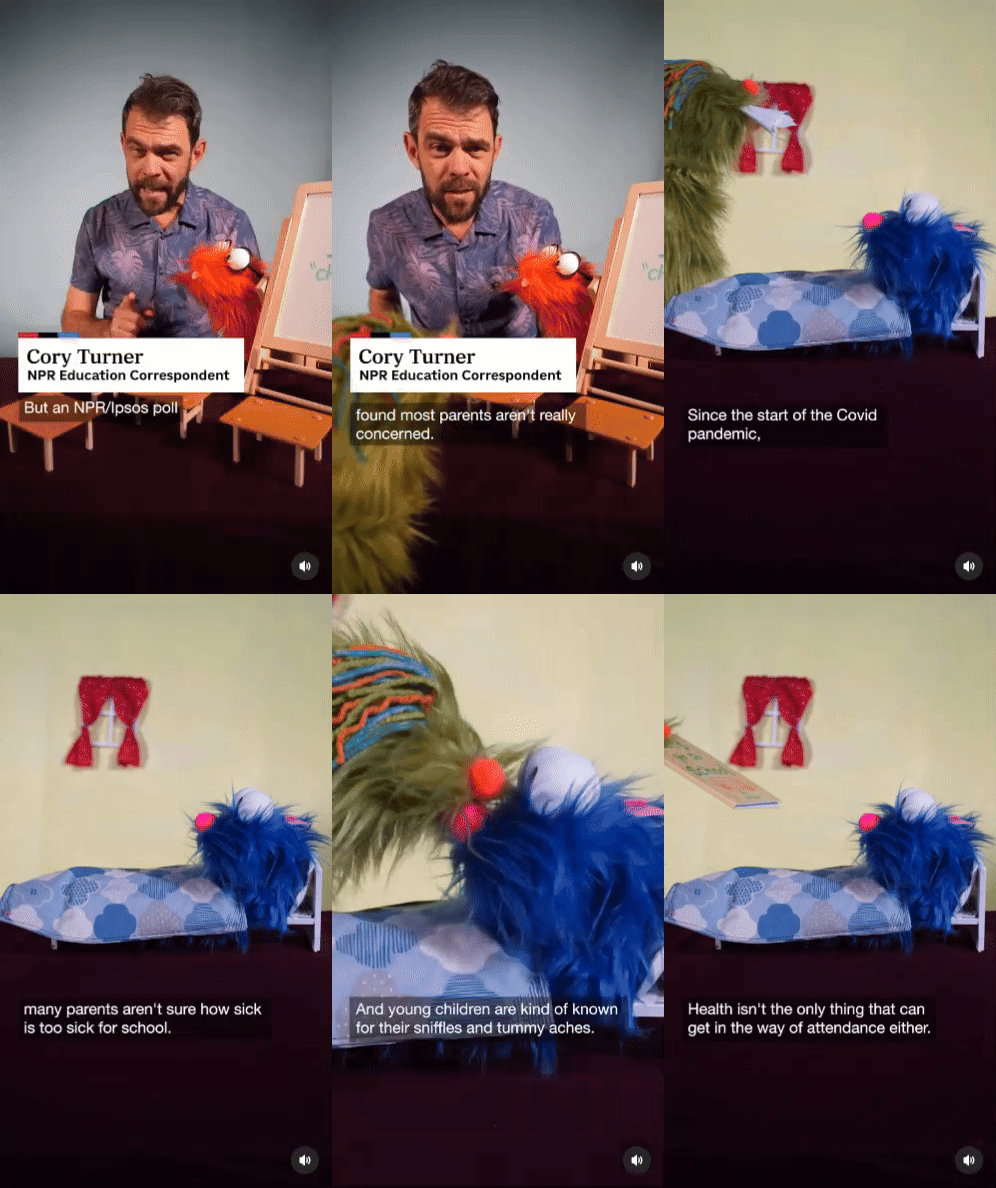
Looking for something fun on a Friday afternoon? Check out NPR’s Cory Turner in this Sesame Street-inspired NPR ed team video on kindergarten absenteeism. He was made for this!
That’s all, folks. Thanks for reading!
Reply to this email to send us questions, comments or tips. Know someone else who should be reading Best of the Week? Send them this link to sign up.
Using Feedly or FlipBoard or any other kind of news reader? You can subscribe to The Grade’s “feed” by plugging in this web address: http://www.kappanonline.org/category/the-grade/feed/.
Read more about The Grade here. You can read all the back issues of The Grade’s newsletter, Best of the Week, here.
By Alexander Russo with additional writing from Colleen Connolly