School districts are scrambling to hire Black educators, and news outlets are covering the story closely. But the author of a new bestseller tells us that mainstream media barely took notice when Black educators were displaced in the aftermath of the Brown decision.
By Leslie Fenwick, PhD
In 1954, the Supreme Court’s Brown decision ended segregated schooling in the United States, but regrettably, as documented in congressional testimony and transcripts, it also ended the careers of generations of highly qualified and credentialed Black teachers and principals.
My book, “Jim Crow’s Pink Slip,” exposes the decades-long repercussions of a little-known result of resistance to the Brown v. Board of Education decision: the systematic and illegal dismissal of 100,000 Black principals and teachers from public schools and their near one-to-one replacement by whites who were less academically credentialed and experienced.
Between 1952 and the late-1970s, this illegal move resulted in some $1 billion in income losses to the Black community. The Black press covered this, but the white press missed the mark.
Desegregation was a national issue that drew national media coverage, but the elimination of Black principals and teachers was not assigned the same urgency in the national press as it was in the Black press.
Yet Black educators’ displacement, an issue of critical and lasting importance to the Black community, would eventually prove to be so to the rest of the nation as well.
The elimination of Black principals and teachers was not assigned the same urgency in the national press.
Historically, the Black press was a partner in the struggle for human and civil rights.
Founded in 1827 (the same year that slavery was outlawed in the state of New York) with the Freedom’s Journal, Black newspapers were champions of equal rights for Blacks, advocating an end to discrimination in employment, education, and voting privileges.
Through opinion pieces and news analyses, the Black press brought a perspective to issues often ignored in the mainstream (white) press, calling attention to race prejudice worldwide.
It is no surprise that even into the 1970s, Black media coverage of Black educators’ displacement exceeded that of the white media in scope, content, and frequency.
Between 1970 and 1972 alone, Black newspapers and periodicals such as the Atlanta Daily, The Philadelphia Tribune, The Washington Afro American, The Baltimore Afro American, Chicago Defender, Los Angeles Tribune, New York Amsterdam News, Pittsburgh Courier, Ebony, Jet, and the NAACP’s The Crisis, published more than 100 articles about Black principal displacement alone.
Black publications hammered for equality and integration, and their extensive reports often read like field research.

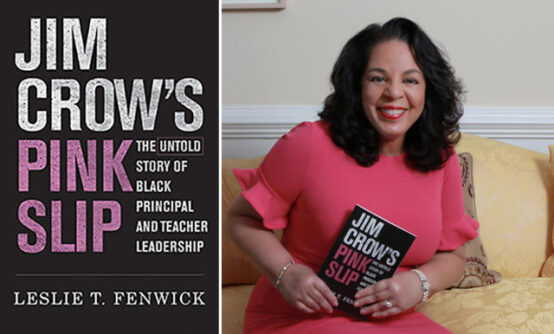
Above: The bestselling book and author Leslie Fenwick.
On one unusual occasion in July 1970, two national weeklies, Jet and TIME, each covered the case of the same illegally demoted Black principal, a Louisiana educator named Fred McCoy, Jr.
How the two covered his case is revealing. Jet provided an in-depth profile of McCoy as a 39-year-old husband, father of two, and a nine-year veteran in the education profession, printing a detailed interview. Here’s an excerpt:
By comparison, TIME devoted far less attention to McCoy’s “appalling case” and reached an off-handed conclusion: In “The Bad Side of Integration,” it reported, “Integration closed his [McCoy’s] school, and he was assigned to teach a fourth-grade class at a formerly all-white school — in the morning. In the afternoon, he was expected to do janitor’s chores in the school latrines. At least McCoy kept busy. A Black former principal in Louisiana has been given a desk to sit at but no title or duties.”
Black publications hammered for equality and integration, and their extensive reports often read like field research.
How did this travesty escape the white press?
It could be attributable to at least two removable causes: First, the lack of racial and ethnic diversity in major newsrooms at the time. This remains a problem today. A February/March 2022 Pew Research Center poll of journalists found that 52% believe their news organization does not have enough racial/ethnic diversity. That narrows the range of what makes the news.
Second, journalistic accounts, research literature, and social commentary about the Black community tend toward a litany of pathology — a constant recitation of negative statistics and information unrelentingly circulated in the news.
Nearly a decade ago, I wrote about data that contradicted commonly held misperceptions about Black people. Regrettably, little has changed.
Americans have been socialized to accept at face value negative data and information about Blacks; we’re conditioned to be skeptical about positive data and information about Black people. This is because the news media (along with popular TV programming) disseminate little positive information of consequence about Blacks and overrepresent them in depictions of violence, crime, and poverty.
The news media disseminate little positive information of consequence about Blacks and overrepresent them in depictions of violence, crime, and poverty.
In 1827, the editors of Freedom’s Journal, the nation’s first Black newspaper, penned a column to patrons outlining the most important reason for publishing it:
Too long has the publick been deceived by misrepresentations in things which concern us dearly, though in the estimation of some mere trifles; for though there are many in society who exercise toward us benevolent feelings, still (with sorrow we confess it) there are others who make it their business to enlarge upon the least trifle, which tends to the discredit of any person of colour; and pronounce and denounce our whole body…
Nearly 200 years later, what has changed?
Deep-tissue analysis about the systemic barriers facing Blacks is still largely absent from our modern media.
As a result, wrongheaded assertions negate accurate and meaningful portrayals of Black people and can stoke racial mistrust and tensions.
Notably, these erroneous and incomplete accounts limit what we understand about our nation’s history — and misdirect social policy formulation.
Erroneous and incomplete accounts limit what we understand about our nation’s history — and misdirect social policy formulation.
So how can journalists overcome these representational disparities and portray fuller accounts of Black life?
Perhaps the most important acts are adjusting the investigational lens and mining national data sets to uncover what has been unseen and unreported about the Black community.
Necessarily, this will mean asking different kinds of questions. For instance, where do Black PK-12 students outperform their white peers on standardized tests? What are the experiences of Black single fathers (the nation’s largest cohort) in raising their children? How did the Woodmore community in Mitchellville, Md., become the nation’s largest seed of Black wealth, with the nation’s highest percentage of college-educated Blacks?
When a pathology-focused operative lens is attached to a keystroke and a byline, it does the most replicable and enduring harm because it reinforces oppressive, race-based power dynamics.
Leslie T. Fenwick, PhD is author of Jim Crow’s Pink Slip: The Untold Story of Black Principal and Teacher Leadership (Harvard Education Press, 2022). She is Dean Emerita and a professor of education policy at Howard University. You can follow her at @ltfenwick.
Previously from The Grade
Why Black teachers really resign (via Chalkbeat)
How student journalists at an HBCU newspaper took on local media — and won
For decades, the Kansas City Star failed to cover district resegregation efforts
New York City 1968 wasn’t a teachers strike; it was a community insurrection
New book exposes flaws in media coverage of Northern integration efforts
Lessons from the media’s coverage of the Ebonics controversy
How insufficient sources (and lack of interest) marred schools coverage in Rochester
A white parent’s perspective on media coverage of Black schools like the one her daughter attends
ABOUT THE AUTHOR

The Grade
Launched in 2015, The Grade is a journalist-run effort to encourage high-quality coverage of K-12 education issues.