By Alexander Russo
Here are seven ideas to guide your reporting on the difficult topic of COVID and schools, inspired by Alec MacGillis’ devastating new New Yorker article, The Students Left Behind by Remote Learning, as well as the recent LA Times self-examination of its past coverage of Black and Latino communities, and the COVID coverage that I’ve seen so far.
Some of these ideas are new. Many of them will be familiar. As always, feel free to agree or disagree. They’re just friendly reminders! But my hope is that you’ll find them useful, even if they’re just telling you things you already know:
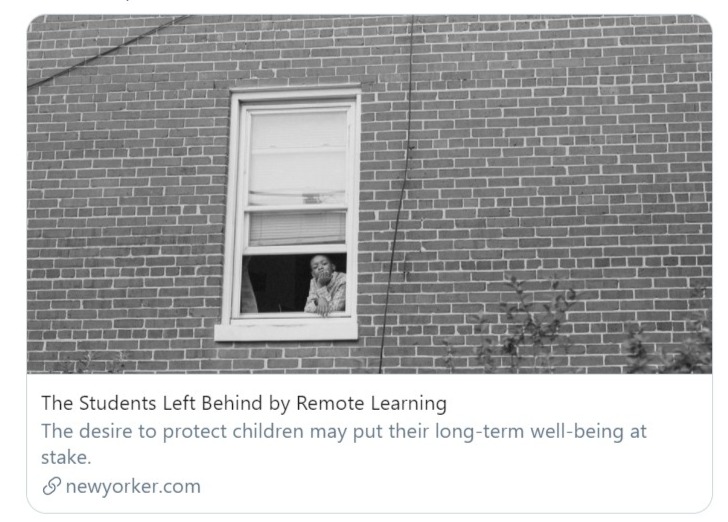
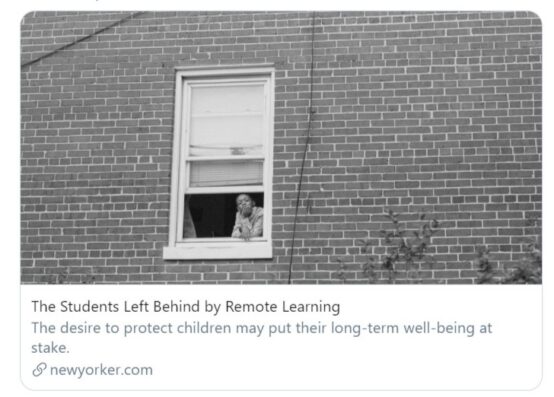
Above: The Students Left Behind by Remote Learning, which details what remote learning can look like for vulnerable students.
Give both sides their due.
Though MacGillis clearly favors reopening campuses, he gives both sides their full due and doesn’t shy away from describing opposing views. For example, he quotes the 4h-grade teacher who believed it wasn’t safe to reopen schools. He doesn’t treat her as a talking head, either. She’s a fully portrayed person with a history, with feelings and with obvious care for her students. He also includes the leaders of both national teachers unions and let them have their say. In some aspects, he pushes back against their arguments. At other moments, he lets their claims stand. Some might argue that he could have done better in this regard, but I don’t think it would be fair to say that the other side is absent from his story.
Previous commentary: The wrong way to write about K-12 COVID-19 cases, How to avoid writing needlessly alarmist school reopening stories
Come back to the experiences of the most vulnerable students.
It’s all too easy to get caught up in the politics and the science of the pandemic, the scary health implications, and the adults who are clamoring about their needs. Everyone deserves coverage, and not every story can focus on kids. But vulnerable students have been the most under-covered and that has to stop. If you bring the focus back to the needs and experiences of vulnerable students, you can’t go too far wrong. Pretty much everyone – teachers, parents, administrators, politicians – has a voice and a way to get their opinions heard. But kids, especially younger ones, have no other voice than yours.
Previous commentary: Reopening coverage should focus on students’ needs, 8 ways to make education journalism more student-centered.
Report raw case numbers with the appropriate caveats.
It’s way too easy to report cases of COVID in ways that make it seem like something big and scary is going on. Headlining the raw numbers is the most obvious way. But recent experience suggests that headlines focused on raw case numbers aren’t that helpful. Often, infections aren’t being transmitted on campus. The quarantine protocols do their jobs and everyone returns to school. So be sure to qualify those raw case numbers by telling readers how many kids and students there are overall (i.e., the denominator), making clear whether the cases come from off campus (i.e., without evidence of transmission), and whether or not there are safety protocols in place (i.e., masks and distancing). That way, if and when there’s a serious outbreak, your readers will know it’s for real.
Previous commentary: Smart ways to report on COVID cases detected in schools, The wrong way to write about K-12 COVID-19 cases, How to avoid writing needlessly alarmist school reopening stories
Fact-check your sources’ statements — even if they’re just statements of feeling.
Given the nature of advocacy groups and the immense amounts of misinformation out there, it’s essential for journalists to clarify for readers whether a source’s statements match up with available information. So if the head of a national teachers union says that 50,000 kids are going to die if we reopen schools, which is the claim Becky Pringle of the NEA made in the New Yorker article, find out where she got that statistic and tell the reader whether it holds up. (In a perfect world, MacGillis would have done so.)
Previous commentary: Smart ways to cover the wrenching debate over reopening schools, The tentative successes of in-person learning deserve more coverage.
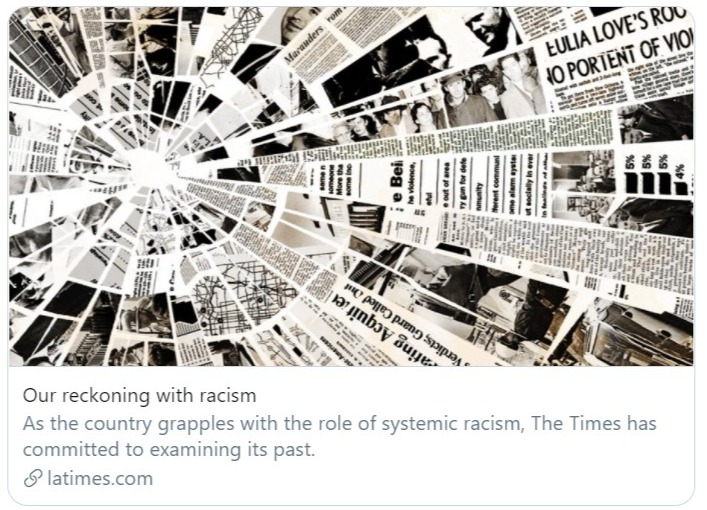
Above: Last week, the LA Times editorial page published An examination of The Times’ failures on race, our apology and a path forward.
Remind readers that “politics” goes both ways.
It’s a common assertion these days that the White House (or the mayor or the governor) are “playing politics” with whatever school reopening plan they’re proposing. And that may well be true. But politics goes both ways, and labeling something as political is way too easy an excuse. Reporters should push for answers that go beyond blaming the other side for playing politics. And your journalism should remind readers of the range of political advantage-seeking that’s going on, not just focus on one obvious source. Trump and DeVos aren’t the only people who could be accused of playing politics.
Previous commentary: No, asking questions about remote learning isn’t ‘teacher bashing’, Four hours a day; how teacher contracts are shaping remote learning
Keep in mind the indifference of school systems toward poor children of color.
Regardless of what you may think about your own educational experience or about the efforts of individual educators you may know, remember that there’s a long, sad history of inadequate education being provided to kids in vulnerable communities. At each step, people in power – usually white, college-educated professionals – made decisions about Black and brown kids that now seem inexcusable. Right now, in some of the most low-infection areas of the country, predominately white, college-educated public employees are resisting the call to leave their homes and provide in-class instruction to students of color in systemically disadvantaged areas.
Previous commentary: The disengaged kids missing from the New York Times’ remote learning coverage, Two hours a day!? Remote learning provides meager offerings for low-income kids
Remember how often journalism has failed Black and Latino communities.
As the LA Times’ recent self-examination reminds us, news outlets have a spotty record at best when it comes to covering historically disadvantaged communities. And education journalism is not exempt. So it’s probably a good idea to remember that good intentions and hard work won’t prevent you from having blind spots that could show up in your coverage, inadvertently making a difficult situation worse.
Previous commentary: Education and race: 9 journalists reflect, Fear, complicity, and guilt get in the way of covering school segregation.
ABOUT THE AUTHOR
Alexander Russo
Alexander Russo is founder and editor of The Grade, an award-winning effort to help improve media coverage of education issues. He’s also a Spencer Education Journalism Fellowship winner and a book author. You can reach him at @alexanderrusso.
Visit their website at: https://the-grade.org/