In the absence of comprehensive public data about COVID cases detected at schools, reporters need to dig hard to get key information and make sure to present it carefully.
By Alexander Russo
Kansas-based drama teacher Alisha Morris appeared on NPR’s Morning Edition on Friday to talk about her much-discussed homemade effort to track COVID cases connected to schools.
As she and several others have noted, there’s been a frustrating lack of national data about school-based COVID cases. The available information is scattered and anecdotal, a patchwork of statistics not readily comparable from state to state or district to district. In many cases, only those in close contact with the infected person are notified when a case is detected at a school.
As a result, “it’s hard to know what to make of individual outbreaks,” noted NBC News’ Benjy Sarlin in a recent piece. But that’s not all. In the absence of comprehensive and reliable data, rumors spread easily and dramatic anecdotes dominate the coverage. Those who are for (or against) in-person school reopening have little trouble convincing voters of their preferred reopening narratives.
For all these reasons, digging out and reporting school-related infection information may be education journalism’s biggest and most important challenge for the start of the 2020-21 school year.
There’s no shying away from it. You’re all health and science reporters now.

Above: Coronavirus is spreading in schools, but the federal government isn’t keeping count. (NBC News)
Initially hard to get, some basic kinds of COVID data down to the county level are now generally available from Johns Hopkins, the New York Times, or other sources.
However, that’s not at all the case when it comes to K-12 school-based cases. Neither the Centers for Disease Control and Prevention (CDC) nor the U.S. Department of Education is involved in collecting or distributing school COVID case information. Nongovernmental efforts to crowdsource the data are limited in what they can accomplish.
Education Week, the nonprofit newsroom that provided the invaluable school closings map last spring, has not yet produced one, though the existence of such a thing “would be very helpful to the field,” EdWeek’s Scott Montgomery told me via email.
States, districts, and schools vary widely in what they report publicly.
As of mid-August, NBC News reported that at least 15 states were publishing data on school-based outbreaks or had committed to doing so. However, at least 16 others either weren’t going to publish the data or hadn’t yet decided what to do. The remaining states didn’t respond.
As of this week, only three states (Mississippi, Hawaii, and Kentucky) produce systemic reports on school-related COVID cases on a regular schedule, according to Rebekah Jones, who runs the nongovernmental tracking effort called the COVID Monitor.
The situation isn’t much different at the district level, according to a recent New York Times piece, much “to the dismay of some anxious parents, concerned educators and public health experts trying to combat the pandemic.”
Journalists are frustrated, too. When a COVID case is detected at a school, notification is provided to those who may be immediately affected.
But that’s about it, notes a recent USA Today story. There’s usually “no notice to others in the school building. No alert to parents. No answers for reporters seeking to confirm or deny local rumors.”
Hoping to fill the information vacuum, newsrooms including The Indy Star and the Arizona Republic have begun producing running lists and trackers.
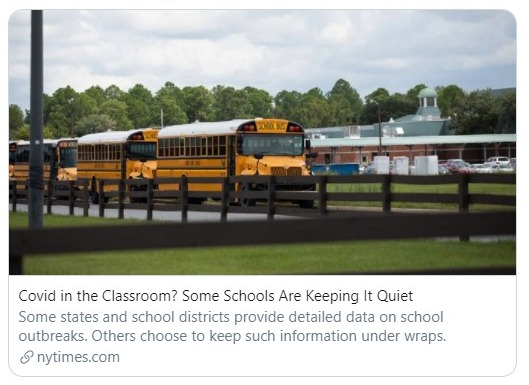
Above: Covid in School? Some Schools Are Keeping It Quiet. (New York Times)
There have already been cases of COVID infection detected by schools, even though the reopening process has just begun. Previous cases in Georgia and Indiana have been widely reported. A new report from Harvard notes that students and school staff have tested positive for COVID in Mississippi and Tennessee.
There will likely be many more, given the 6 million cases and nearly 200,000 deaths so far in this nation, plus high infection rates in some communities where campuses are reopening.
What effect will reopening have on COVID trends? That’s the central question. Based on interviews with journalists and experts, here are some ways reporters can dig up as much reliable information as possible and make their coverage strong and clear:
KEEP PRESSING FOR INFORMATION:
Don’t be put off by official claims of privacy, say reporters and experts who’ve studied the current situation. Federal laws such as FERPA allow schools to release information about numbers of cases as long as individuals aren’t named, according to Fraser and others. Public reporting on nursing home cases did not violate individual privacy. Schools already commonly notify parents about other health risks, such as lice, flu, and TB outbreaks. The U.S. Department of Health and Human Services’ HIPAA guidance regarding schools is here. The U.S. Department of Education guidance regarding COVID and FERPA is here.
CASES, QUARANTINES, OUTBREAKS, & PROTOCOLS:
As much as possible, distinguish isolated cases of infection from outbreaks (usually defined as some sort of transmission among multiple individuals). Distinguish also between the number of people infected and those quarantined, which may be much larger. And, if at all possible, distinguish cases that were known to be acquired at school from those that weren’t. It’s also extremely helpful to note which protocols were or weren’t in place at a school or district, including masks, distancing, open windows, one-way halls, etc. – and whether they were being enforced. “The behavior inside schools is incredibly important to the impact on broader community spread,” USA Today’s Jayme Fraser said in a recent phone interview.
AVOID SINGLE-ANECDOTE STORIES:
One effect of the lack of systematic data is that coverage of school COVID cases is often anecdotal, lacking a broader context. Many news reports focus on cases at one school or in one district, which may be part of a pattern or an outlier. It’s entirely reasonable to report on individual cases and schools with reported outbreaks, notes Brown University economics professor Emily Oster, who’s written about problems with school COVID coverage. But reporters should avoid creating the perception that infections are widespread when that isn’t the case. “Where we get into trouble is when anecdotal information is all we have,” Oster said in a recent phone interview. She proposes that coverage informs readers about both the number of cases and the overall number of students, so that readers understand the rates or percentages that are involved.
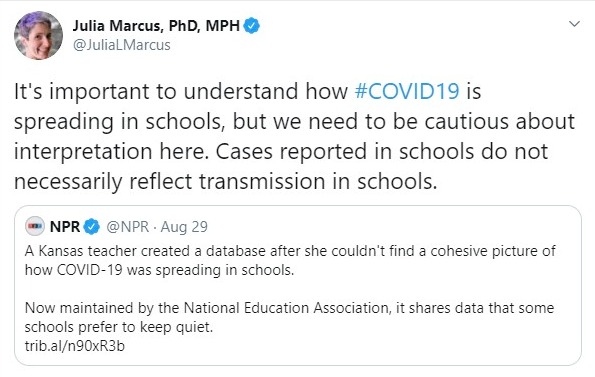
Above: Cases detected at school may not necessarily have been transmitted in schools.
INFECTION VS. TRANSMISSION:
It can often be difficult to determine the specific point of transmission for new infections. School officials may say the transmission occurred at home or in the community. However, “there is no doubt that schools can have a huge impact on the overall level of virus spread in the community,” says USA Today’s Fraser, whose usual beat is health care. “Don’t get so hung up on where kids get COVID that you miss the impact on broader community.” Or vice versa: The New York Times has reported that teachers were “at no greater risk than other professionals” in Sweden, where schools remained open throughout the pandemic. “It’s important to understand how #COVID19 is spreading in schools,” tweeted epidemiologist Julia Marcus in response to a recent NPR segment headlined How Many Coronavirus Cases Are Happening In Schools? “But we need to be cautious about interpretation here. Cases reported in schools do not necessarily reflect transmission in schools.”
CAREFUL ABOUT THOSE LOCAL TESTING NUMBERS:
“No source comprehensively tracks testing at a level more local than the state,” notes science and health writer Betsy Ladyzhets in the August 23 edition of her newsletter, the COVID-19 Data Dispatch. As a result, it’s “impossible to compare percent positivity rates—that crucial metric many districts are using to determine whether they can safely reopen—both broadly and precisely across the country.” The best you can do is what the NYT did, she says, pulling together county-level data on test positivity rates and new cases. At the state level, she praises Iowa’s state dashboard, which allows users to check positive rates for districts based on their surrounding counties. “So far, Iowa is the only state to make such data available in an accessible manner,” according to Ladyzhets. “Other states should follow its lead.”
TREAT CROWDSOURCED INFORMATION CAREFULLY:
In the absence of federal agency coordination, nongovernmental efforts have been mounted to track COVID cases nationally. These efforts include information that is both independently verified and crowdsourced based on a variety of information sources, and should be used cautiously. Now in the process of being taken over by the National Education Association, the Kansas teacher’s tally lists more than 4,200 reported cases at 1,081 schools, with 75 deaths. The COVID Monitor has received 2,002 public reports and is independently tracking cases in 13,442 districts. As of today, they say they’ve verified 16,123 cases across all 13,442 districts. A new nongovernmental effort is coming online soon. “I think that [crowdsourced databases] can be reported, with a certain degree of vetting,” Ladyzhets told me.
FOLLOWING UP IS CRITICAL:
It’s easy to report on dramatic scenarios and then move on, looking for the next outbreak, but doing so can be a disservice to readers. The most recent report from Georgia’s North Paulding HS, which made news worldwide after students shared images of crowded classrooms and were initially punished by the school for having done so, lists 8 cases out of an in-person enrollment of 2,000 students. Cherokee County, Georgia, made national headlines when nearly 1,200 students and staff were quarantined and some schools had to return to remote instruction. Three of those schools are reopening in a hybrid mode this week, and the district now reports 102 cases. “We don’t want to demonize schools unnecessarily,” says Jones, noting that data about schools with low numbers of infections is just as important as schools with outbreaks. “It’s really important that every school report, even the ones that don’t have cases.”

Above: New coronavirus cases are emerging at schools. How much you know depends on where you live. (USA Today)
The situation is fluid and could change quickly.
Tennessee originally wasn’t going to track or report school-based cases but reversed course after reporting by Gannett reporters such as Tennessee statehouse reporter Joel Ebert, according to Fraser.
Two Florida districts – Hillsborough and Polk — published COVID case data earlier this week, in defiance of a state order, according to Jones, and nearly a dozen others have now followed suit.
South Carolina will release its first report of cases in schools Friday, and plans to update the data every Tuesday and Friday.
More districts and states may soon change, as well.
“People want to know,” says Jones about the pressures districts and states face to provide information. She predicts that more states will soon relent and publish the data. “Parents are not going to settle for half measures when it comes to their kids.”
Previous coverage from The Grade
How to avoid writing needlessly alarmist school reopening stories
Smart ways to cover the wrenching debate
ABOUT THE AUTHOR

Alexander Russo
Alexander Russo is founder and editor of The Grade, an award-winning effort to help improve media coverage of education issues. He’s also a Spencer Education Journalism Fellowship winner and a book author. You can reach him at @alexanderrusso.
Visit their website at: https://the-grade.org/