
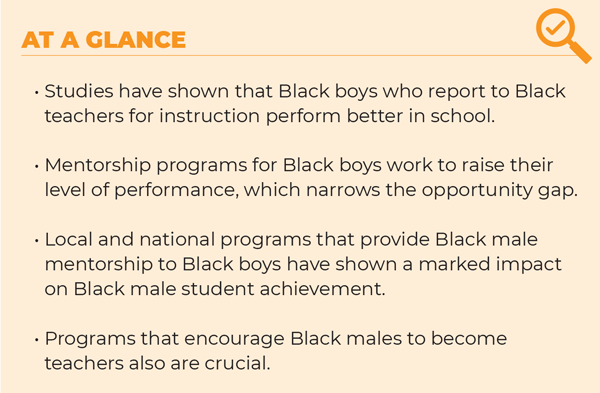
Black boys perform better academically when they have a Black male teacher or other role model in school.
Across the U.S., the academic achievement of Black boys continues to decline on a wide range of measures, including grades, high school graduation rates, and college degree attainment. Meanwhile, achievements for other racialized students, including Latinx students, have seen a steady improvement (Johnson, 2002). We believe that schools can reverse this trend by offering academic supports that support Black boys’ racial and gender identities. How can schools ensure Black boys receive the academic, social, and emotional support they need to close the performance gap? We propose Black male mentorship programs, which have a documented track record of success.
Black male classroom performance
One of the goals of the federal No Child Left Behind Act and its successor, the Every Student Succeeds Act (ESSA), was to eliminate or narrow the achievement gap between minority and non-minority students. Academically, the high school graduation rate of Black students is the lowest of all major racial groups (Lewis & Bryant, 2018).
Black boys have continually performed near the bottom of every statistical category and measure of school failure (Ulrich, 2017) and have higher dropout rates in middle schools and high schools. Of Black boys who drop out, more than half do so by the 10th grade; and 20% leave school by the 8th grade. (Miller, 2014).
In many cases, Black boys who physically drop out of school in the 9th grade emotionally dropped out as early as 4th grade (Hereford, 2012). When their emotional connection to school is lost, so is their desire to learn. Culturally relevant, responsive, and sustaining teaching (CRRST) practices (Ladson-Billings, 1999) would aid greatly in addressing the pedagogical needs of Black boys, including keeping them connected to the school community.
The need for Black male mentors
Teachers are a critical component of academic achievement, in part because they help students feel connected to school. From elementary school through high school, Black students are mostly taught by white female teachers and have few interactions with Black male teachers. The National Center for Education (2020) reports that, in the 2017-18 school year, 79% of teachers in the U.S. were white and only 7% were Black. In 2013, roughly 2% of teachers were Black men (Lewis & Bryant, 2018). Thus, Black male students experience little contact with Black male teachers throughout their educational careers.
The disproportionate number of white female instructors educating Black boys negatively impacts the achievement of these boys because their teachers are less likely to have the cultural competence required to relate to them (Moore, 2018; Redding, 2019; Woods, 2010). Cultural competence enables teachers to nurture Black boys’ abilities to draw on their own backgrounds, languages, histories, customs, and experiences as they gain fluency and facility.
Black men speak the same language and share similar experiences and struggles as those Black boys are going to go through. Black male educators hold Black male students to higher standards and give them the inspiration, aspiration, and accountability they need.
Black boys cannot be what they cannot see. When Black boys come to school, they see very few, if any, men of color who they can interact with. In times past, boys could turn to positive Black male leadership from churches, police departments, fire departments, and recreation centers. Yet in America’s largest metropolitan areas today, there is a low number of Black male leaders or authority figures (De Royston et al., 2017). Given the large numbers of incarcerated males and single mother households, Black boys increasingly struggle to find positive male role models (Miller, 2014).
The urgent need to provide more mentors in the lives of Black boys is clear (Bryan & Ford, 2014). Women can be effective role models for Black boys, but male figures must not be discounted. All students need to see teachers who look like them and who have shared cultural and lived experiences. Black men speak the same language and share similar experiences and struggles as those Black boys are going to go through. Black male educators hold Black male students to higher standards and give them the inspiration, aspiration, and accountability they need.
Recruiting Black male educators
How can schools ensure that boys receive the academic, social, and emotional support they need to succeed? It begins and ends with Black male leadership. Positive teacher-student relations are known to enhance students’ school experiences and encourage their academic success (De Royston, et el., 2017). Black male educators provide a connection to Black boys that other educators do not possess.
Having one Black male educator in elementary school increases the probability of underserved Black boys graduating from high school and contemplating college (Gershenson et al., 2018). The dropout rates from high school for Black male students after an encounter with a single Black male educator decreases by 39%, and their college aspirations increase by 19%. In other words, students of color, and particularly Black boys, respond positively to people who look like them leading classrooms. Black boys who go through schools without a Black male teacher are denied perspectives, guidance, and an understanding that could only come from a Black male teacher (Causey, 2021). For this reason, if the goal is to increase academic achievement and narrow the opportunity gap, then sincere efforts need to be made to include Black male educators as a part of Black boys’ school careers.
Several programs have made efforts to support young collegiate Black men seeking careers in education. For example, North Carolina Central University’s School of Education runs a program called the Marathon Teaching Institute (MTI). MTI is a nationally accredited instructional program dedicated to ensuring Black men are represented in classrooms, particularly those of underserved students. The focus of the program is the recruitment, retention, and mentorship of college-educated Black men to become teachers and administrators. They are poised to address North Carolina’s achievement gap between Black male students and white male students by addressing the need for Black male educators to enter the workforce.
Another source of talented college-educated young Black men seeking to flood the field of education is the Call Me Mister program. Developed by three historically Black colleges and universities (Benedict College, Claflin University, and Morris College), and housed at Clemson University, Call Me Mister is working to address the shortage of Black men teaching in K-8 public elementary school classrooms (Jones, Holton, & Joseph, 2019). To attract and retain young Black scholars, Call Me Mister offers prospective candidates partial tuition assistance scholarships, loan forgiveness options, book allowances, and other student support services.
Creating a community of Black men
Although recruiting and retaining Black male educators is essential, Black men from all walks of life can play a role in the education of Black boys. They can serve as guest speakers, as project mentors, or in other community capacities, visiting schools and classrooms and telling their stories to boys of color. Hosting professional athletes during career day is fantastic, but Black boys need to see other types of career opportunities modeled for them. Several school-based initiatives and community-based support systems demonstrate how a Black male presence impacts Black boys’ achievement.
The Kappa Alpha Psi Fraternity, for example, has a foundation that is committed to Black male achievement from elementary school to and through high school. Part of the foundation’s Diamonds in the Rough College Access and Career Planning Initiative, the Guide Right program seeks to develop the Black boys of the community and devise practical solutions to Black male underachievement and underperformance. The program provides educational and occupational guidance for Black male students in grades 6-12 who need motivation, counseling regarding career choices, mentorship, life skills, and preparation for college, by connecting them to successful Black men. In addition to mentoring, young men can receive scholarships to the prospective college or university of their choice.
Coaching Black boys up to the task of performing and narrowing the achievement gap will need to be intentional. Teacher education programs designed to nurture college-educated Black male educators can help provide the proper representation needed for the success of Black boys.
A quantitative snapshot of results from the Kappa Alpha Psi Fraternity Foundation shows outstanding performance and the narrowing of the achievement gap, with 98.7% of high school seniors who went through the program in 2021-22 graduating from high school. Of that number, 84% attended four-year academic institutions, 12% attended junior colleges and trade schools, and the remaining entered the workforce or joined the military. These results have been consistent for the past five years.
Black male mentors impact Black male performance
A variety of circumstances contribute to Black boys’ underperformance. Addressing it with a culturally responsive pedagogy, through Black male mentorship, would help. Male-to-male racial role-modeling is critical and should be a top priority of educators and policy makers.
Coaching Black boys up to the task of performing and narrowing the achievement gap will need to be intentional. Teacher education programs designed to nurture college-educated Black male educators can help provide the proper representation needed for the success of Black boys. Also, targeted programs that bring in Black male mentors from the community can contribute to a counternarrative that celebrates Black boys’ achievements.
The strategic implementation of mentorship programs that connect Black male students to Black male role models, both inside and outside school, can raise these students’ performance and narrow the opportunity gap. Such programs are a worthy investment for Black boys.
References
Causey, J.E. (2021, November 19). Black male teachers can have a profound impact in the classroom: Unfortunately, they’re a rarity. Milwaukee Journal Sentinel.
De Royston, M.M., Vakil, S., Nasir, N.S., Ross, K., Givens, J., & Holman, A. (2017). He’s more like a brother than a teacher: Politicized caring in a program for African American males. Teachers College Record, 119, 1-40.
Gershenson, S., Hart, C.M.D., Hyman, J., Lindsay, C., & Papageorge, M.W. (2018). The long-run impacts of same-race teachers. National Bureau of Economic Research.
Hereford, T. (2012). Black male high school dropouts: Six perspectives (Publication No. 3591079) [Doctoral Dissertation, Tennessee State University]. ProQuest Dissertations.
Johnson, R.S. (2002). Using data to close the achievement gap: How to measure equity in our schools. Corwin Press.
Jones, R., Holton, W., & Joseph, M. (2019). Call Me Mister: A black male grow your own program. Teacher Education Quarterly, Winter, 55-67.
Ladson-Billings, G. (1999). Preparing teachers for diverse student population: A critical race theory perspective. Review of Research in Education, 24, 211-247.
Lewis, C. & Bryant, A. (2018). Black male students and teachers in K-12 classrooms. In E. Moore, A. Michael, & M.W. Penick Parks (Eds.), The guide for white women who teach Black boys. Corwin.
Miller, E.M. (2014). Education in peril: A comparative study of Black male high school dropouts and graduates [Doctoral dissertation, The Ohio State University]. ProQuest Dissertations Publishing.
Moore, E., Michael, A. & Penick-Parks, M. (Eds.). (2018). The guide for white women who teach Black boys. Corwin.
National Center for Education Statistics. (2020). Race and ethnicity of public school teachers and their students. U.S. Department of Education, Institute of Education Sciences.
Redding, C. (2019). A teacher like me: A review of the effect of student-teacher racial/ethnic matching on teacher perceptions of students and student academic and behavioral outcomes. Review of Educational Research, 89 (4).
Ulrich, P. (2017). Educational leadership and black male student performance (Publication No.10280317) [Doctoral dissertation, Saint Louis University]. ProQuest Dissertations Publishing.
Woods, L.C. (2010). Black male students in the minds of white female teachers a phenomenological examination of how white female teachers construct: Their attitudes about black male students [Doctoral dissertation, California State University, Long Beach]. ProQuest Dissertations Publishing.
This article appears in the April 2023 issue of Kappan, Vol. 104, No. 7, pp. 25-29.

ABOUT THE AUTHORS

Bobby J. Rodgers Jr.
BOBBY J. RODGERS JR. is a 32-year elementary school educator in the Los Angeles Unified School District and a doctoral student at California State University, Long Beach.
Devery Rodgers
DEVERY J. RODGERS is a professor of educational leadership at the California State University, Long Beach.