Future elementary school teachers need help to form positive math identities.
Elementary school teachers are responsible for building math confidence and skills in their students. Unfortunately, many elementary teachers report that they had negative experiences learning mathematics. Addressing this requires supporting their identity development as future mathematics teachers (e.g., Brown & McNamara, 2011; Kaasila, Hannula, & Lane, 2012).
Early intervention at the teacher preparation level can support novice teachers as they move from mathematically struggling students to mathematically confident teachers. Content-focused pedagogy courses have the potential to disrupt the cycle of negative math narratives for these preservice teachers. In these courses, student teachers can reflect on and grapple with their identities as mathematics learners. They can then create the identity they want as future teachers.
Identity refers to both the ways we define ourselves and the ways that others define us (Sfard & Prusak, 2005). Individuals develop mathematics identities through experiences with content and with people (Anderson, 2007; Fernandez et al., 2022). As preservice teachers move from the role of student to teacher, they must “negotiate the discrepancy between their personal and professional selves,” which may require them to start seeing themselves as competent at math and able to transfer their own math knowledge to students (Cross Francis et al., 2018, p. 133). Mathematics education courses can influence preservice teachers’ mathematics identities as they undergo this transition, so it’s important to understand what elements will support the development of positive math identities.
Math autobiographies as a mechanism for reflection
Narratives can help teachers change their view of their math identities. They provide a way for individuals to make sense of themselves and their experiences through storytelling. Corey Drake (2006) describes teacher narratives as a way to “understand teachers’ beliefs, knowledge, and experiences as interconnected and interrelated systems” (p. 583). She designed math autobiographical interviews to help participants better understand the high points, low points, and turning points they experienced as learners that influence their current teaching practices. Sonja Lutovac and Raimo Kaasila (2007) suggest that “intentional reflection via autobiographies … may be particularly meaningful for preservice teachers’ process of change and their evolving teacher identities” (p. 766).
Mathographies, which are the story of a person’s experience with mathematics, can be a useful tool to help preservice teachers reframe their vision of mathematics. Writing mathographies can help preservice teachers uncover contradictory beliefs about how to teach mathematics; who can be mathematically capable; and, perhaps most critical, whether they are up to the task of teaching mathematics effectively.
Influences on math identity
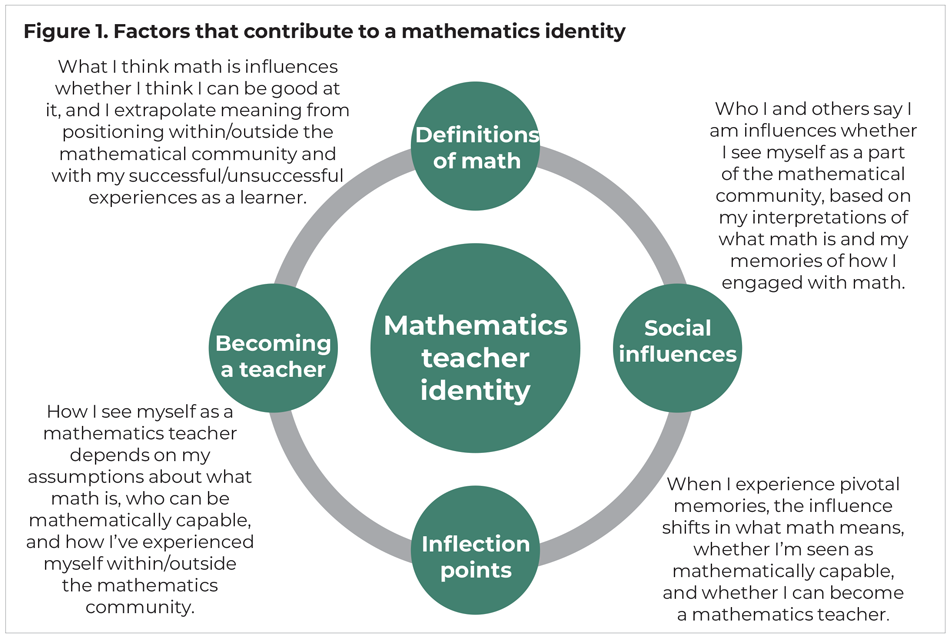
When using narrative to uncover and change peoples’ beliefs about their mathematics identity, it’s important to understand the elements that make up their past and current identities. Figure 1 illustrates the various factors that play into teachers’ experiences with mathematics and shape their self-perceptions about their mathematical abilities.
Identifying these factors gives preservice teachers the chance to reflect on what has contributed to their mathematics identity. It also allows mathematics teacher educators to provide counterpoint experiences through courses and fieldwork that can help them build more positive identities.
Definitions of math
The National Research Council (NRC, 2001) and National Council of Teachers of Mathematics (NCTM, 2014; 2020) define effective mathematics teaching as pairing procedural fluency with conceptual understanding. They note that the former should come from the latter. Further, they say that modeling strategic competence and thinking deeply about mathematics are core elements of doing mathematics.
A preservice teacher’s definition of mathematics influences their beliefs about what it means to be mathematically capable, who can be good at mathematics, and whether they see themselves within those spaces. They may feel tension when they enter teacher preparation programs that push them to teach mathematics in ways that contradict their experiences and internalized notions. They must resolve this cognitive dissonance as they develop their positive identity as a mathematics teacher (Horn et al., 2008).
Oftentimes, autobiographical reflections uncover student teachers’ internalized definitions of mathematical learning. Many have experienced mathematics as rote memorization of content and procedures. Even when they describe learning mathematics in this way as positive, this tendency may indicate potential limits in their approach to understanding mathematics best practices (Association of Mathematics Teacher Educators, 2017; NCTM, 2014; 2020; NRC, 2001).
For example, a student in my program shared a fond memory of how her 4th-grade teacher taught multiplication:
One of the tricks she taught us to remember multiplication was through short rhymes. One rhyme that has always been stuck in my head is for 7×6 and it goes like this “Seven-Even, Trixie-six, went on a date on 42nd Street.” Since I had a teacher that turned learning multiplication into a fun activity, I ended up loving math more because I understood multiplication.
Such remarks are common, particularly when preservice teachers reflect on their elementary experiences. But they reflect a traditional, procedurally based definition of mathematics. Thus, it is vital for mathematics teacher educators to help their students build a more expansive, conceptual understanding of mathematics and effective instruction. They must have new experiences that counter these childhood definitions, so that they can see more possibilities for themselves and their future students.
Social influences
Identity arises from our own self-perception, from others’ perceptions of us, and through our relationships (Anderson, 2007; Lave & Wenger, 1998; Lutovac & Kaasila, 2017; Nasir & Hand, 2008). Our identity reflects both the ways we define ourselves and the ways others define us. As Richard J. Anderson (2007) explains:
In this way, our identity — who we are — is formed in relationships with others, extending from the past and stretching into the future. Identities are malleable and dynamic, an ongoing construction of who we are as a result of our participation with others in the experience of life. (p. 8)
In their mathographies, student teachers reflect on the ways family members attempted to support them with mathematics, often describing a time when the content became too complex for them to help. They also identify family members’ messages about whether they were likely to be “good at math” based on the abilities and performance of their parents or siblings. For example, a student might say, “My parents were never good at math either.” Social pressure from peers also influences whether preservice teachers feel mathematically capable or “seen” in the classroom, as does the underlying messaging of classroom ability grouping.
Teachers, unsurprisingly, play an important role in preservice teachers’ relationships with mathematics and their beliefs about their mathematical capabilities. Teachers provide positive interactions with mathematics; however, teachers also lead some students to feel incapable of doing mathematics. When describing her high school experiences and struggles to understand the content, one of my students reflected:
I would often turn in my math homework late or not fully completed, which is what made my pre-calc teacher nickname me “day late and dollar short.” That was one of the lowest points in my math experiences because I felt like I wasn’t being seen or understood.
It is critical to analyze the ways that the social influence of teachers shapes students’ — including future teachers’ — mathematics identity.
Inflection points
Preservice teachers tell stories so they might come to understand that their experiences and beliefs are contradictory, which can lead them to a process of identity integration (Horn et al., 2008; McAdams, 2001). Reconciling contradictory stories can “help to shape a new more unified sense of self” (Schutz, Nichols, & Schwenke, 2018, p. 50).
Preservice teachers’ mathographies reveal mathematics episodes that were critical to their identity development. Reflecting on their high points, low points, and turning points often brings up strong emotions. These episodes sometimes affirm preservice teachers’ beliefs about their abilities. At other times, they represent inflection points that, on reflection, can shift their perspectives about their mathematics identity. Such shifts in perspectives show that mathematics identity is malleable. If mathematics teacher educators can capitalize on this by providing new, positive points for their students, they can break the cycle of negative self-talk.
Becoming a teacher
Preservice teachers often experience tension between who they see themselves as currently and their future professional identities. This notion of “becoming” involves negotiating current and future goals and beliefs about themselves as teachers (Nasir & Cooks, 2009; Schutz, Nichols, & Schwenke, 2018).
Asking preservice teachers to reflect on their initial mathographies after mathematics education coursework can help them take stock and integrate these new experiences into their identity. Preservice teachers can then create more positive relationships with mathematics from a learner’s perspective and develop confidence in their abilities as math teachers. This frequently coincides with the development of their long-term vision of who they want to be as a mathematics teacher. Especially for preservice teachers who report negative experiences, their goals as future teachers might focus on areas such as:
- Making mathematics accessible for all learners.
- Teaching mathematics from a place of empathy.
- Adjusting their expectations and beliefs about themselves to achieve the first two goals.
These goals illustrate the ways in which preservice teachers’ reflections on their experiences can lead them to come to terms with who they want to become as mathematics teachers. The ability to reflect upon their past experiences and their current reality as mathematics learners results in setting goals to become their “future selves” as mathematics teachers.
Supporting novice teachers’ math teacher identities
Mathematics teacher educators and professional developers can use mathographies to explore the types of strategies, activities, tools, and resources they might use to improve their students’ self-image and confidence.
A team of teacher educators at the University of Nebraska at Omaha has been studying the role that pedagogy courses, field experiences, and learning assistantships can play in fostering growth in preservice teachers’ math identity. Across multiple projects, we have found several commonalities that preservice teachers report as impactful.
Building confidence
Preservice teachers, particularly elementary teacher candidates, often walk into their mathematics and mathematics pedagogical coursework with negative math identities. With this in mind, students identified the importance of fostering a growth mindset and positive classroom culture, creating a safe space to take mathematical risks. They wanted to experience this for themselves as current math learners and as an example of what they would create in their own future classrooms as math teachers.
Students cited specific course structures and activities that fostered their confidence. For example, they found it useful to tie hands-on representations of mathematics to the stages of development that children go through. Engaging with mathematics in a concrete way allowed them to fill in some of their gaps in understanding and to visualize ways to present mathematical content to children.
One example of a useful activity was number talks (Parrish, 2010). The teacher runs a class discussion around a mental math problem (e.g., “How might you solve the problem 7 +5?”). Students discuss how they’d break down and recombine the numbers to arrive at a solution. The goal of these talks is to increase student voice and expose them to a range of strategies to help increase their flexible thinking and number sense (Chapin, O’Connor, & Anderson, 2009). Number talks are typically a short, five-to-10-minute routine, making it feel like an accessible first step in learning how to increase student discourse in the mathematics classroom.
Practice with feedback
Offering student teachers the opportunity to engage in teaching mathematics can be a powerful tool to help increase their sense of self-efficacy and disciplinary identity (Bandura, 1969). When preservice teachers reflect on these opportunities, through writing or coaching conversations, they can figure out how to implement the research-informed practices that they are learning about. Reflection can help them shift their understanding about what it means to teach mathematics effectively. It can offer insights into how students think about mathematics in ways that may be similar to or different from their own experiences (Jakopovic et al., 2023, 2024a, 2024b; Stamatis et al., 2022).
When preservice teachers experience structured teaching simulations, their sense of self-confidence and competence increases, which influences their professional identity (Jakopovic & Gomez Johnson, 2023). For example, leading microteaches or mini-lessons in their teacher education classes provides preservice teachers with a safe, structured space where they can try out new ideas and receive immediate feedback from peers and instructors. Preservice teachers often find that the abbreviated nature of a microteach, presented to a small group of peers, can feel less risky than teaching a group of students.
When preservice teachers can receive targeted peer and instructor feedback, they can grow in their ability to connect pedagogical ideas presented in coursework into their teaching practice. Video reflection can be another powerful tool, particularly when it includes not only self-reflection but also opportunities to discuss with peers and instructors (Lemke et al., 2022). With videos, student teachers can select an episode of their teaching that they especially want feedback on, which can help them set targeted, manageable goals.
What we can learn about shifting mathematics identities
Mathematics teacher educators can move the needle of preservice teacher mathematics identity in a relatively short amount of time given the right structures and professional learning opportunities and supports. These gains can translate directly to student success (Maguire, 2011; Perera & John, 2020).
It is not only up to teacher educators to facilitate these positive identity shifts. Schools and districts need to continue offering coaching, professional development, and other supports to ensure that such teacher identity shifts become long-term and stable. The more positive experiences teachers can add to their mathematics teaching narratives, the better equipped they will be to support the mathematics identity development of their own students.
References
Anderson, R. (2007). Being a mathematics learner: Four faces of identity. The Mathematics Educator, 17 (1), 7-14.
Association of Mathematics Teacher Educators (2017). Standards for preparing teachers of mathematics.
Bandura, A. (1969). Social-learning theory of identificatory processes. In D.A. Goslin (Ed.), Handbook of socialization theory and research (p. 213-262). Rand McNally & Company.
Brown, T. & McNamara, O. (2011). Becoming a mathematics teacher: Identity and identifications. Springer.
Chapin, S., O’Connor, C., & Anderson, N.C. (2009). Classroom discussions: Using math talk to help students learn, grades K-6. Math Solutions.
Cross Francis D., Hong J., Liu J., Eker A. (2018). “I’m not just a math teacher”: Understanding the development of elementary teachers’ mathematics teacher identity. In P. Schutz, J. Jong, & D. Cross Francis (Eds.), Research on teacher identity (pp. 133-143). Springer.
Drake, C. (2006). Turning points: Using teachers’ mathematics life stories to understand the implementation of mathematics education reform. Journal of Mathematics Teacher Education, 9 (6), 579-608.
Fernandez, F., Froschl, M., Lorenzetti, L., & Stimmer, M. (2022). Investigating the importance of girls’ mathematical identity within United States STEM programmes: A systematic review. International Journal of Mathematical Education in Science and Technology, 1-41.
Horn, I.S., Nolen, S.B., Ward, C., & Campbell, S.S. (2008). Developing practices in multiple worlds: The role of identity in learning to teach. Teacher Education Quarterly, 35 (3), 61-72.
Jakopovic, P., Anderson, F., Gomez Johnson, K., & Rech, J. (2024). Accelerating preservice secondary mathematics teachers’ noticing of student needs. Proceedings of the 26th Annual Conference on Research in Undergraduate Mathematics Education. Omaha, NE.
Jakopovic, P. & Gomez Johnson, K. (2023). Examining the Influence of mathematics learning assistantships on undergraduate students’ identity development. In S. Cook, B. Katz, & D. Moore-Russo (Eds.), Proceedings of the 25th Annual Conference on Research in Undergraduate Mathematics Education (pp. 72-81). Omaha, NE.
Jakopovic, P., Karpf, A., Lemke, J., & McGlamery, S. (2023). The impact of microteach experiences on preservice teacher self-efficacy development. Delta Kappa Gamma Bulletin, 90 (1), 28-41.
Jakopovic, P., Lemke, J., Karpf, A., & Stamatis, K. (2024). Reflecting on practice: Effective structures for using video to promote preservice teacher development. The Teacher Educator, 59 (1), 140-174.
Kaasila, R., Hannula, M., & Laine, A. (2012). “My personal relationship towards mathematics has necessarily not changed but…” Analyzing preservice teachers’ mathematical identity talk. International Journal of Science and Mathematics Education, 10, 975-995.
Lave, J. & Wenger, E. (1998). Communities of practice: Learning, meaning, and identity. Cambridge University Press.
Lemke, J., Karpf, A., Jakopovic, P., & McGlamery, S. (2022). Field experience reimagined: Integrating microteaches to foster preservice teachers’ self-efficacy. Delta Kappa Gamma Bulletin, 88 (5), 25-34.
Lutovac, S. & Kaasila, R. (2017). Future directions in research on mathematics-related teacher identity. International Journal of Science and Mathematics Education, 16 (4), 759-776.
Maguire, K. (2011). The role of teacher efficacy in student academic achievement in mathematics (Publication No. 3449809) [Doctoral dissertation, Walden University]. ProQuest Dissertations and Theses.
McAdams, D.P. (2001). The psychology of life stories. Review of General Psychology, 5, 100-122.
Nasir, N.S. & Hand, V. (2008). From the court to the classroom: Opportunities for engagement, learning, and identity in basketball and classroom mathematics. Journal of the Learning Sciences, 17 (2), 143-179.
National Council of Teachers of Mathematics. (2014). Principles to actions: Ensuring mathematical success for all.
National Council of Teachers of Mathematics. (2020). Catalyzing change in early childhood and elementary mathematics: Initiating critical conversations.
National Research Council. (2001). Adding it up: Helping children learn mathematics. National Academies Press.
Parrish, S. (2010). Number talks: Helping children build mental math and computation strategies, grades K-5. Math Solutions.
Perera, H. & John, J.E. (2020). Teachers’ self-efficacy beliefs for teaching math: Relations with teacher and student outcomes. Contemporary Educational Psychology, 61.
Schutz, P., Nichols, S., & Schwenke, S. (2018). Critical events, emotional episodes, and teacher attributions in the development of teacher identities. In P. Schutz, J. Hong, & D. Cross Francis (Eds.), Research on teacher identity: Mapping challenges and innovations (pp. 49-60). Springer.
Sfard, A. & Prusak, A. (2005). Telling identities: In search of an analytic tool for investigating learning as a culturally shaped activity. Educational Researcher, 34 (4), 14-22.
Stamatis, K., Friend, M., & Jakopovic, P. (2022). Becoming a STEM Teacher: Examining teachers’ practice-linked identities through practice-based autobiographies. Proceedings of the International Society of the Learning Sciences 2022 Annual Meeting (virtual event) (pp. 2172-2173).
This article appears in the December 2024 issue of Kappan, Vol. 106, No. 4, p. 20-24.

ABOUT THE AUTHOR
Paula M. Jakopovic
Paula M. Jakopovic is an assistant professor of early childhood and elementary mathematics at the University of Nebraska at Omaha.