
In work-based learning programs, students can apply skills and knowledge from the classroom to their lives.
Geometry can be a challenging subject for many high school students, and the lack of apparent relevance to their daily lives doesn’t help. However, when students who want to do building or carpentry projects find out that they need to understand and use the Pythagorean theorem for their projects to be successful, they find the motivation to study geometry.
Many students learn better through actions than through reading text or from listening to teachers lecture. They need opportunities to learn both theoretical and applied skills at the same time. Work-based learning allows them to accomplish this.
“We teach the theoretical and ask students to trust us that they’ll need to apply the knowledge in the future,” says Elliot Washor, co-founder of Big Picture Learning, an international network of public high schools that focus on interest-based learning. Students at these schools start internships in 9th grade.
“Really being able to learn in a workplace is a kind of pedagogy that works for some people who might not flourish exclusively in the classroom,” says Deborah Kobes, senior fellow at the Policy Center on Labor, Human Services, and Population at the Urban Institute, which has studied youth apprenticeships.
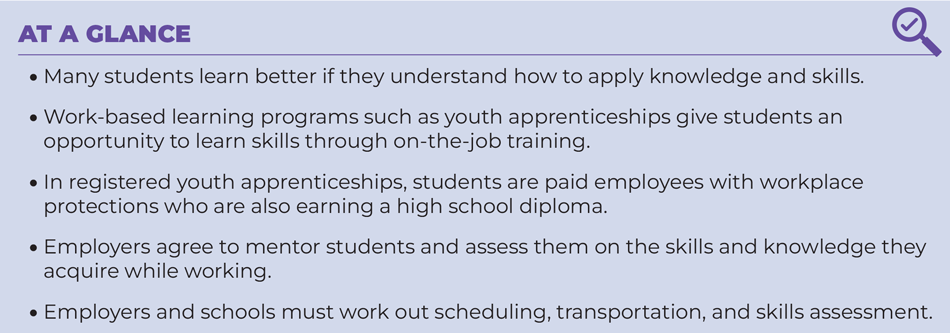
Apprenticeships allow students to learn on-the-job skills that connect with what they are learning in the classroom. Youth apprenticeships are a type of work-based learning, which is based on the concepts of competency-based learning or applied learning — essentially having students learn by doing. Project-based learning is part of this continuum, as are internships, job shadowing, and career and technical education (CTE) pathways.
Youth apprenticeships are more structured than internships and job shadowing and usually involve students becoming employees and getting paid while they learn. For this reason, they are sometimes called learn and earn programs.
Apprenticeships put classroom learning together with learning at a workplace or work site. High school students who participate can end up graduating with work experience, credentials, and skills — and even a permanent job with their employer. Some programs have employers footing the bill for students to take classes at a community college, and some will pay for more training after graduation.
Apprenticeships are not just for students who are not college-bound. In fact, students can apprentice and discover they need to earn a two- or four-year degree or get additional training for a certificate or credential.
History of youth apprenticeships
Youth apprenticeships are common in Europe, with Switzerland and Germany frequently held up as models to emulate. In those countries, apprenticeships are embedded in the school system, with extensive participation from businesses and industries. These countries don’t consider apprenticeships as a separate vocational system for students who want to learn the trades. Instead, apprenticeships are included in traditional academic pathways.
In the U.S., beginning around 1917, comprehensive high schools were established to combine both academic and vocational training in the same building. This tended to supplant many of the work-based apprenticeships that had been developing outside schools.
Those seeing the advantages of the European system of youth apprenticeships have been attempting since then to bring the model to U.S. schools, where it has taken root in many places using different practices to give their students the opportunity to do work-based learning.
Throughout the 1980s and 1990s, the federal government provided funding for career and technical education in public schools, including school-to-work initiatives. States and schools could decide how to use the funding, which contributed to the diversity of programs and models used in U.S. schools.
Employers are required to provide skills training, and other adults monitor the job site and the student’s progress. This ensures that students are learning both the job skills and the traditional content in their classrooms.
U.S. Department of Labor’s registered apprenticeship program started in 1937 as part of President Franklin D. Roosevelt’s New Deal program to create jobs for workers. It is designed for adults and often requires a high school diploma or GED certificate to participate. Youth apprenticeship, where students start in high school, is a newer idea. Students are employed, paid, and trained by a company while they are enrolled in high school and completing coursework to graduate.
“When they are done well, when they are truly high quality and they truly center diversity, equity, inclusion, and accessibility, registered [youth] apprenticeships will provide somebody with really, really clear skill development,” says Vanessa Bennett, director at the Center for Apprenticeship and Work-Based Learning at Jobs for the Future. “So from the moment somebody gets into that program, that young person will know all of the skills that they’re going to walk out the door with, and all of those things that those skills will allow them to do”
Youth apprenticeship model
A main feature of work-based learning models is that students learn skills outside school, most often in the workplace. Internships and job shadowing fall into the category of work-based learning, as do school district CTE programs and pathways. CTE pathways, however, tend to focus on bringing the tools and technical content to the classroom, rather than having students leave school to learn.
“There’s still a lot of confusion around what constitutes a youth apprenticeship and what the best model is. But that conversation wasn’t happening five or six years ago, it’s a step forward that we’re trying to define this thing. It’s proof that it carries a certain appeal for learners and educators and families and increasingly businesses that folks are fighting about how to define the model,” says Taylor White of New America, a Washington, D.C.-based nonpartisan think tank.
Widespread public support for career and technical education is evident in the results of the 2024 PDK Poll, which showed 84% of Americans saying preparing students to enter the workforce should be a priority of the next presidential administration.
High school students often complain about the lack of connection between what they learn in the classroom and the real world. Apprenticeships and other work-based learning options make those connections for students, while giving them outlets to experiment.
New America’s Partnership to Advance Youth Apprenticeship (PAYA) is a multiyear, collaborative initiative that supports states and cities in their efforts to expand access to high-quality apprenticeship opportunities for high school age youth. It has defined youth apprenticeship as a “structured, work-based learning program designed to start when apprentices are in high school.”
Registered youth apprenticeships follow U.S. Department of Labor guidelines. Students in youth apprenticeships are paid. That matters, says White. “Especially for vulnerable young people, the idea that you are engaged as an employee can be important, and really for any young person. There are a lot of young people who are working in parts of our country and in places where they don’t enjoy any protection, and so the opportunity to have those [labor protections] as an apprentice while you’re also learning is important.”
Youth apprenticeship requires two other elements: One is related instruction, which is provided in the classroom and contributes to what the student needs to know in their apprentice occupation. The other is that their job training must include a formal plan of skill and competency development. The training must complement classroom learning. Students must have adult mentors in both their job and their school, with the school monitoring progress.
The combination of those pieces — the on-the-job learning, the related instruction, the mentorship, and the pay — is important, says White. “Apprenticeship is a way to ensure that young people are earning while they’re learning, and that businesses have an opportunity to shape and influence somebody who might someday, hopefully at the end of the apprenticeship, come work for them.”
Some youth apprenticeships are time-based, says Kobes. Others are competency-based, but the competency should still add up to at least a year equivalent of full-time work and 144 hours of related instruction per year.
Advantages of youth apprenticeships
High school students often complain about the lack of connection between what they learn in the classroom and the real world. Apprenticeships and other work-based learning options make those connections for students, while giving them outlets to experiment.
“Teenagers have dopamine-drenched brains that crave new experiences, and that makes them exceptionally well-primed to learn from new situations and new experiences,” says White. “Apprenticeship and other forms of work-based learning are really great ways to tap into that. It’s a chance for young people to explore what it might be like to be a grown up.”
White points out that high schools are structured to “wall young people off from the world they’re preparing to enter. But work-based learning and apprenticeship, which is a longer, sustained, paid experience, is a chance for them to really to do that in a structured and supported way.”
The wages for apprenticeships are outlined in the agreement between the employer and the student. Students start out at a lower wage, and their pay increases as they build skills and progress.
Employers are required to provide skills training, and other adults monitor the job site and the student’s progress. This ensures that students are learning both the job skills and the traditional content in their classrooms. When they graduate from high school, they are prepared to continue on their career path or earn a two- or four-year degree.
In fact, the apprenticeship program helps students earn money to pay for college or additional training. The employer invests the money for training while the student is in high school, “so not all the costs of education and training are borne by the individual,” Kobes says.
Students value being able to earn a two-year or four-year degree debt-free or having an alternative that allows them to buy a car and save for a down payment on a house. “That’s a path that is becoming increasingly difficult for students in traditional systems,” she says.
Youth apprenticeships intentionally link learning and working, says Brent Parton, a former deputy assistant secretary in the office of Employment and Training Administration at the Department of Labor. He is now the executive director of CareerWise USA, a nonprofit that connects employers, schools, and students interested in apprenticeships. Employers have been known to provide scholarships to students when they graduate as well as offer them jobs. “They want to hire you, and they want to support your future goals,” he says.
Challenges to youth apprenticeships
While registered apprenticeships offer many advantages, the programs can be a heavy lift for both school districts and employers. Traditional comprehensive high schools are in many ways not designed for learning to occur outside of their walls. At the same time, employers must do some things not common in the world of work: They agree to mentor the students, train for certain skills, and be monitored by school officials.
Scheduling is challenging for both schools and employers. Some states have more stringent requirements around student seat time, so employers must be flexible about student working hours. Transportation for students to travel from school to work is another barrier and an equity issue for students who don’t have access to cars or other modes of transportation.
Schools need to start putting more value on a postsecondary experience that does not look like the traditional college path. They must look at questions about scheduling and how to protect students in the workplace. They must figure out how to measure success and how to assess progress. Employers must figure out how to build pathways for employees they don’t typically work with: Students who haven’t graduated high school yet.
“There’s sometimes a misalignment between our workforce and education systems,” says Bennett. “It can be difficult to put an apprenticeship into a high school and make the on-the-job training work with the requirements of the course load and the seat time that’s needed for an individual to earn their diploma.”
Some employers think that they can’t employ minors, and they’re very concerned about liability for youth labor laws. It falls upon the schools, often, to educate employers about both federal and state laws and liability. In some cases, there have been creative solutions where schools or a local nonprofit end up serving as the employer of record.
In other cases, nonprofits or community-based organizations can step in to connect schools and employers and work out the sticking points between the two. CareerWise started in Colorado in 2016 to help employers and schools put apprenticeship programs together, and it now does that work nationally. It takes time, capacity, and continuous improvement to help education and industry “move in a different rhythm together,” Parton says.
Youth apprenticeship programs require a change in thinking for schools and employers, Parton says. Schools need to start putting more value on a postsecondary experience that does not look like the traditional college path. They must look at questions about scheduling and how to protect students in the workplace. They must figure out how to measure success and how to assess progress. Employers must figure out how to build pathways for employees they don’t typically work with: Students who haven’t graduated high school yet.
Apprenticeships, Parton says, require “a revolution in valuing learning that doesn’t happen in a classroom, but rather in the workplace.”
Work-based learning in Illinois
Youth apprenticeships and work-based learning models are as different as the states and communities that run them. One long-running and successful work-based program is the Center for Career Discovery at High School District 214, Arlington Heights, Illinois. The district has an enrollment of about 10,000 students. Annually, the center supports 2,500 work-based learning experiences. These include apprenticeships, internships, micro-internships, and supported worksites.
The program started out as a way to provide students with special needs with workplace skills and soft skills training so they could be part of the workforce and the community, says Barbara Kain, the center’s director. The internships and career pathways for all students came next. Apprenticeships grew out of the successful internship program.
The district’s work-based learning experiences are extensions of the career exploration process that includes coursework and extracurricular clubs and activities. However, Kain says, “until you sit in an authentic environment that helps you understand what it feels like to work in that industry, students don’t have the full picture.” Work-based learning allows students to get that picture. They may find that the career is a good fit or that it is not for them.
The district’s yearlong apprenticeship program is for students who have decided that the career path is right for them. Students apply during their junior year and start the summer before their senior year and go all the way through the end of their senior year. “Most of our apprentices will have a very customized and unique senior year schedule where they’re typically in classes with us for about half of the time, and they’re at work with an employer half of the time,” Kain says.
The district uses block scheduling, which allows more flexibility. In addition to high school coursework and work training, they also receive related technical instruction, which can be college-level classes or work certification experience. If the district can’t offer this learning in the school building, students go to community college. Kain explains that students in the internship program “are very special and unique students who are very motivated and very passionate about a particular industry and understand that their senior year is going to look a little different from their friends.”
Employers make a commitment when they bring on student apprentices to not only provide a job, but also to train students on a list of competencies provided by the district. Both the student and the employer know the district will check on them each month to ensure the experience is successful for both students and employers. Students meet with their school advisers monthly as well.
“It’s so important that we give students the tools to be successful when they leave us, and work-based learning allows us to do that,” says Kain. “Not just the basic employability skills, but also the ability to explore those careers while they’re with us, so that they’re making educated decisions when they leave us.”
This article appears in the October 2024 issue of Kappan, Vol. 106, No. 2, p. 20-23.

ABOUT THE AUTHOR

Kathleen Vail
Kathleen Vail is editor-in-chief of Kappan magazine.
Visit their website at: https://pdkintl.org/