Not all disciplines can be easily broken down into sets of straightforward skills for students to master. In writing, self-expression should be the goal.
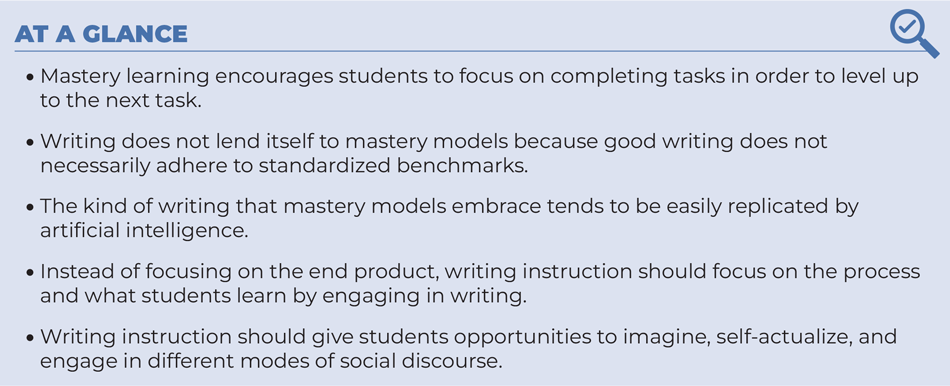
Mastery is a fallacy. In some subjects, like math and sciences, there are concrete objective bodies of knowledge and skills for students to master. And, in all disciplines, mastery-based models have their merits, including a reduction of grading biases, removing behavior from the grade, and an aim to drive intrinsic motivation (Feldman, 2023). But, in the classrooms where we have found ourselves, namely secondary English classrooms, a focus on mastery is a death knell.
In our experience, when the focus of the curriculum and student work becomes mastering a discrete set of skills and knowledge, the learning process becomes much like a game in the worst sense. For students, the goal becomes to “level up,” to complete one task only to move on and up to another more challenging and interesting one. Players strive to complete as many levels as possible, progressing to the ultimate level in order to declare their “mastery” of the game. Some may argue that “gamifying” learning motivates students and makes classrooms more enjoyable. But we worry about framing the goal of learning as “winning.” Even though the aim of mastery is for students to measure themselves against a stated goal, it’s far too easy for the march toward mastery to turn into a competition against others.
To “win” in a mastery-based setting often is to be more efficient at completing the task at hand. Students seek to have their game piece cross the finish line first, as they race against their peers toward some finite, tangible end. It can certainly be fun in the short term to “level up,” to beat other players, and to easily surpass certain challenges. Many students feel good when they complete the worksheet or timed essay faster than the students sitting near them. But some students learn slowly and recursively. In theory, mastery-based learning allows these students to move at their own pace. In practice, these students often are framed as “lagging” or “behind” a standard benchmark of mastery.
Some of these problems with mastery learning can be ameliorated with careful planning and framing. But we believe that, in some disciplines, even the most carefully planned mastery models are doomed. Some learning is too ambiguous, personal, and challenging to be captured by approaches that focus on merely crossing a finish line or completing a level or finishing a worksheet.
The elusiveness of mastery in writing
Too often, in writing classrooms, mastery imagines a gold standard to which all students ought to aspire. It frames mistakes as delays in a march toward mastery rather than foundational to the writing practice. It fails to recognize that a mistake in one context is an innovation in another.
As Kelsey Hammond (2023) argues elsewhere, “all conceptions of ‘good’ writing — are deeply contextualized and socially determined” (p. 34). In other words, there are no objectively good qualities of writing, these are always social constructions. For example, James Joyce’s Ulysses — with his ambiguous antecedents and lack of concision — would certainly be considered “poor” writing by the metrics we currently use, yet we can recognize Joyce as a master of the craft. Who gets to be called masterful, and who is woefully insufficient?
We propose that in a true mastery-based English classroom, learning would be treated as an endeavor in which true mastery is elusive. Reading, writing, and speaking can be conduits for knowing, yet these tasks, even for “expert” writers, still leave much to the unknown. The concept of “mastering” the act of writing is, for this reason, a misnomer.
What does it even mean to master writing? And is that what we want from students? True enough, students can master comma usage and the formulaic five-paragraph essay, but are these the skills we seek to develop in secondary English classrooms? Do we want students to internalize that they are ever truly done with figuring out better ways of developing complex ideas and communicating them to someone else? Even if one piece of writing is done, the next one never is, and the recursive process begins anew.
While writing teachers have been espousing the teaching of writing as a process for decades, we have continued to assess the product. If we continue to frame writing as an activity that’s about building a product that meets certain clearly delineated criteria, we will continue to battle against evolving technology. We cannot aim to develop “good writers” who “master standards” as our ultimate goal. In doing so, we frame writing as a science rather than an art. This is a “science” that is all too easy to replicate with artificial intelligence (AI).
Large language models like ChatGPT can easily produce a structured five-paragraph essay that demonstrates mastery of certain types of writing that happen to be emphasized in school. Knowing that by nature and programming, AI can produce writing that so closely mirrors these types of writing we have deemed “academic,” we must shift efforts away from decontextualized mastery and toward work that is meaningful to students in ways that resist replication by AI.
From mastery to meaning
James Kinneavy (1969/2011) argued that over the history of teaching composition, we have privileged some types of discourse over others with disastrous effects. The Common Core State Standards prioritized argumentative and analytical writing over reflective and narrative writing. Heather Wolpert-Gawron (2011) saw this as a reason for celebration: “For it’s true that in life everything requires persuasion. Therefore, in school, every problem, every subject, and every task should come from that perspective as well.” Her logic was that “better” writing should actively foster persuasive skills because these are necessary for “life.” We believe this is a limited view of writing.
This focus on persuasion contrasts with a practice of writing oriented toward discovery — the practice of figuring out what you want to say, how you want to say it, for whom, and for what purpose. To persuade is not to be curious or to explore; to persuade is to prove and to dominate. The act of real composing involves “putting together” of the self (Moffett, 1983, p. 320). We think most English educators want this for their students, yet we assess student products as published, fixed, and final — as demonstrations of mastery.
Mastery depends on the relentless evaluation of drafts as assessments of improvement and growth — as if growth is a linear process. In this framework, every draft is a final draft with the potential to be assessed for mastery. These constant cycles of assessment disincentivize play because students become focused on demonstrating mastery rather than on exploring, engaging, and experimenting.
Some learning is too ambiguous, personal, and challenging to be captured by approaches that focus on merely crossing a finish line or completing a level or finishing a worksheet.
As Moffett argues, “composing is also playing. The beauty of play is that it licenses the mind to frolic outside the usual constraints set for it by the consciousness-structuring.” Teaching the “correct way” to structure a paragraph or the “right way” to compose a thesis statement limits students’ opportunities to play, to “frolic” in their writing. By celebrating the “leveling-up” of mastery over the wanderings of exploration, we have stripped the joy and play from the process of composing. With a focus on demonstrating the mastery of written skills and standards rather than on playing with ideas and experiences, it is no wonder students turn to generative AI.
Alternative aims of discourse
In our attempts to mass-produce students able to meet factory-like standards and pass one-size-fits-all tests, we are pushing our children away from creative, nuanced thought. Because we cling so desperately to standards, we have too rarely asked students to produce work that feels personally meaningful, transformative, or authentic.
What happens to writing when we remove the frames imposed by a drive to mastery of standards imposed by teachers? Peter Elbow (1973) argued that students often shift from pragmatic writing to more personal, imaginative, and creative writing once they know their thoughts and ideas are being heard and understood. We must recenter this kind of writing as a constructive, contextual, and personally meaningful endeavor (Rosenblatt, 1995). If we continue to teach writing as a series of skills to master, we doom ourselves and our students to miss the entire point of composing — to aid us in our own thinking and reflecting and to communicate what is in our heads and hearts to another human being.
We propose that rather than framing writing as a tool of demonstrating mastery, we embrace it as a tool of imagination, self-actualization, and navigation of social discourses. These aims cannot be replicated or replaced by AI, in part because they center students’ personal growth over their command of competencies.
Writing to imagine
One aim of discourse that we can prioritize in our classrooms is the aim of imagining. In our own classrooms, rather than ask students to persuade their teacher, we ask them to imagine and write responses based on their own experiences with the literary texts we read, using prompts like the following:
- Create an alternate ending to the story based on what you think should have happened; explain your reasoning with something that did happen in the story.
- Explain what you would say or how you would act if you were a character in the story.
- Share how a theme in the story relates to your own life or experiences.
In their responses to these writing prompts, students seem to gravitate toward parts of the text that made them wonder or that made them uncertain. Their responses became more varied and individualized, as every student has a unique and personal response to the literature. Students also seem more excited and open to hearing their fellow students’ ideas. The sense of competition to have the “right” or most persuasive idea is replaced with a tone of inquiry.
Louise Rosenblatt (1995) advocated for young people to have prolonged contact with literature because it might increase their social sensitivity and empathy, both of which she viewed as essential for the well-being of our democracy. Through poems and stories, Rosenblatt argued, students learn to imaginatively put themselves into the place of another. With an understanding of others’ experiences, students may develop an increased ability to imagine the human implications of any situation: “A democratic society, whose institutions and political and economic procedures are constantly being developed and remolded, needs citizens with imagination to see what political doctrines mean for human beings” (p. 176). Imaginative writing gives students the time and space to practice these essential mindsets.
Writing to self-actualize
Another aim of discourse that we can create space for in our classrooms is the aim of self-actualization. In Teaching to Transgress, bell hooks (1994) advised that our classroom practices should emphasize students’ and teachers’ “wholeness,” the union of their minds, bodies, and spirits (p. 14). A wholeness-oriented pedagogy requires both students and teachers to share not only compartmentalized bits of knowledge, but also their complex lives and experiences.
Hooks characterized the process of seeking wholeness — the ongoing practice of bridging the gap between discrete knowledge and personal experiences — as part of a greater journey called “self-actualization” (p. 15), which she defined as an ongoing adventure that seeks true connectedness between one’s private and public life and, further, connectedness between one’s mind and physical body. Recently, much academic work in English education has devoted energy to deconstructing the supposed binary between mind and body. Sondra Perl’s (2004) Felt Sense: Writing with the Body, for example, suggests that writers physically feel their thinking during the composition process.
To facilitate this quest for self-actualization, we propose that teachers actively encourage students to write about their own lives and experiences in relation to any and all “discrete” content knowledge. Prompts similar to those we suggested for imaginative writing invite opportunities for students to be “whole,” as hooks imagined.
When we began to invite students to write about their lives and experiences, fellow teachers asked, “Shouldn’t you be focusing on writing that will prepare students for college? They won’t be asked to write about their lives in college.” But to be accepted to college, many students must write a Common Application essay in response to a given prompt. These prompts ask students to write critically about their lives, experiences, and academic aspirations (Anderson, 2022). Colleges know that the ability to self-reflect and appreciate uncertainty prepares students for engagement in academic life.
Writing to navigate a social discourse
Lastly, we can encourage writing in our classrooms with the aim of students distinguishing and choosing between social discourses. In Social Linguistics and Literacies, James Paul Gee (2015) explained that people engage in “primary” and “secondary” discourses, depending on the social context. A primary discourse refers to language used in early life, especially in family units, whereas a secondary discourse is one that people are “apprenticed” into as part of their socialization within schools and other institutions (pp. 187-188). The movement between primary and secondary discourses reflects how individuals constantly navigate the private and the public, the personal and the formal, and the familial and the institutional.
According to Gee, the primary and secondary discourses can sometimes be at odds. For example, Black students face challenges when others do not recognize their primary mode of speech as a true dialect, but rather define it as “slang” or “improper speech.” All people struggle to choose — to some extent — between their primary and secondary discourses. Some learn to combine them in a given speech, in writing, or in a social situation, but it’s not always clear to what extent we should include private modes of discourse in public spaces.
In rejecting mastery, we reframe English education away from what will become meaningless composition work in the face of AI and instead treat writing as the art that it is.
Mastery-based models are often aligned to standards. Many national and state standards require, for instance, that students use standardized English conventions of grammar, punctuation, and syntax. That expectation alone can exclude many students’ primary discourses from the classroom in the name of mastering the standard. We advocate inviting both primary and secondary discourses into our classroom spaces, often intertwined toward contextualized rhetorical ends. The ability to choose social discourses can never be fully mastered, as they always evolve and shift depending upon context. Language is never stagnant.
Given how challenging it can be for people to discern which discourse to use in any given situation, this discernment process should become a central aim of discourse in our classrooms. We can use our classroom spaces to assist students in their processes of choosing discourses.
From composition to compassion
In rejecting mastery, we reframe English education away from what will become meaningless composition work in the face of AI and instead treat writing as the art that it is. As Maxine Greene (1995) argued, engaging with the arts releases the imagination and “leave[s] us less immersed in the everyday and more impelled to wonder and to question” (p. 135). We have to reframe writing as a process of becoming, of wondering, and of questioning. Educators must value human experience over a final product if we want our students to do the same. By recentering the personal, the internal, the emotional, and the embodied, we can conceptualize a classroom that centers students as humans.
When we become too occupied with what students write rather than how they experience writing, we lose the opportunity to build in them the imagination necessary to build empathy for themselves and for others. The goal of the English classroom must be to shift away from discrete skills of composing analytical paragraphs to the aim of developing ethical, empathetic, imaginative, reflective, and democratic individuals.
References
Anderson, S. (2022, January 27). 2022-2023 common app essay prompts. Common App.
Elbow, P. (1998). Writing without teachers. Oxford University Press.
Feldman, J. (2023). Grading for equity: What it is, why it matters, and how it can transform schools and classrooms. Corwin Press.
Greene, M. (2000). Releasing the Imagination: Essays on education, the arts, and social change. John Wiley & Sons.
Gee, J. (2015). Social linguistics and literacies: Ideology in discourses. Routledge.
Hammond, K. (2023). The writing beliefs Of ChatGPT. California English, 29 (2).
hooks, b. (1994). Teaching to transgress: Education as the practice of freedom. Routledge.
Kinneavy, J. (2011). The basic aims of discourse. In V. Villanueva (Ed.), Cross talk in comp theory (pp. 129-139). National Council of Teachers of English. (Original work published 1969)
Moffett, J. (2022). Teaching the universe of discourse (2nd ed.). The WAC Clearinghouse. (Originally published 1982)
Perl, S (2004). Felt sense: Writing with the body. Heinemann.
Rosenblatt, L. (1995). Literature as exploration. Modern Language Association of America.
Wolpert-Gawron, H. (2011). Argumentative writing is a key focus in Common Core Standards. Edutopia.
This article appears in the October 2024 issue of Kappan, Vol. 106, No. 2, p. 14-18.

ABOUT THE AUTHORS

Kelsey Hammond
Kelsey Hammond is a senior professional development coach and doctoral student at Teachers College, Columbia University, New York.

Chelsey Barber
Chelsey Barber is a writing instructor and doctoral student at Teachers College, Columbia University, New York.