Montgomery County, Maryland, illustrates the opportunity for integration and the risk of segregation found in many suburban school districts.
When the Supreme Court held in Milliken v. Bradley (1974) that federal courts did not have the authority to integrate Detroit’s schools by imposing a desegregation plan that crossed district boundaries, the decision virtually ensured that cross-district segregation would become the most significant, and intractable, form of segregation. In his dissent, Thurgood Marshall argued that any integration plan limited to the city of Detroit would only increase White flight to the suburbs and result in a totally segregated school system. His prediction has held true for Detroit, where schools are among the most highly segregated in the nation (Chambers & MacDonald, 2017), and it continues to be true for many other urban districts. Recent research has cited 1,000 examples in 42 states in which school district boundaries separated students of color from a whiter, more affluent student population — some of whom lived across the street (Belsha & Levin, 2019; EdBuild, n.d.). Milliken v. Bradley hardened district boundaries and facilitated White flight.
But the story has a twist. What Justice Marshall could not have foreseen in 1974 were the dramatic changes in living patterns that occurred in subsequent decades. These changes mean that district boundaries might no longer present such formidable barriers to integration, as the increasing diversity of the suburbs has given rise to new opportunities to integrate schools. In 1970, only 18% of Black people in the United States lived in suburbs; by 2010, the percentage had increased to 40%, with even more growth among Asians and Hispanics (Massey & Tannen, 2018). In the 50 largest metropolitan areas, for example, almost half of the suburban population lives in racially integrated communities, defined as between 20% and 60% non-White (Orfield, 2012).
The United States has, therefore, been given another chance to bring together students of all racial/ethnic groups. But that opportunity is fragile. Even within districts that have significant levels of demographic diversity, some schools have become segregated by race, ethnicity, and income; others have seen their diversity decrease as White and affluent families have left public schools or moved to other districts (Tefera et al., 2011). The question is, how can we preserve and increase the levels of school integration that currently exist in many diverse suburban districts, but that could be lost if those districts divide into segregated enclaves?
Montgomery County Public Schools, a suburban Maryland district in the Washington, D.C., metropolitan area, provides a useful illustration of the opportunities and dangers we face. The district, one of the largest in the country, has both great wealth and significant poverty, a high rate of growth, a strong economy, and a majority Democratic population. While districts vary with respect to these characteristics, many diverse districts share with Montgomery County both the potential for integration and the risk of increased segregation (Frankenberg & Ayscue, 2013; Frankenberg & Orfield, 2012; Orfield, 2012).
In the past several decades, Montgomery County has experienced major demographic changes similar to those in many other suburban districts. In 1970, 91.6% of the students in the district were White (Duffin & McGuckian, 2013). In the years that followed, the district’s student population became highly diverse (Joseph, 2014). These demographic shifts enhanced the opportunities for integrated schools, both for the students entering the district and for those already there. However, many individual schools do not reflect the increasing diversity of the district. This analysis shows how the trends in integration and segregation have played out in Montgomery County and suggests policies that can make a difference in the long-term viability of integration in diverse districts more generally.
Integration and segregation in Montgomery County Public Schools
This analysis draws on data from the district’s annual Schools at a Glance reports, which present demographic data for each of the district’s schools (Montgomery County Public Schools, 2003, 2018). The focus is on the distribution of students across schools; the impact of Montgomery County’s special programs or tracking within schools is not included in the analysis.
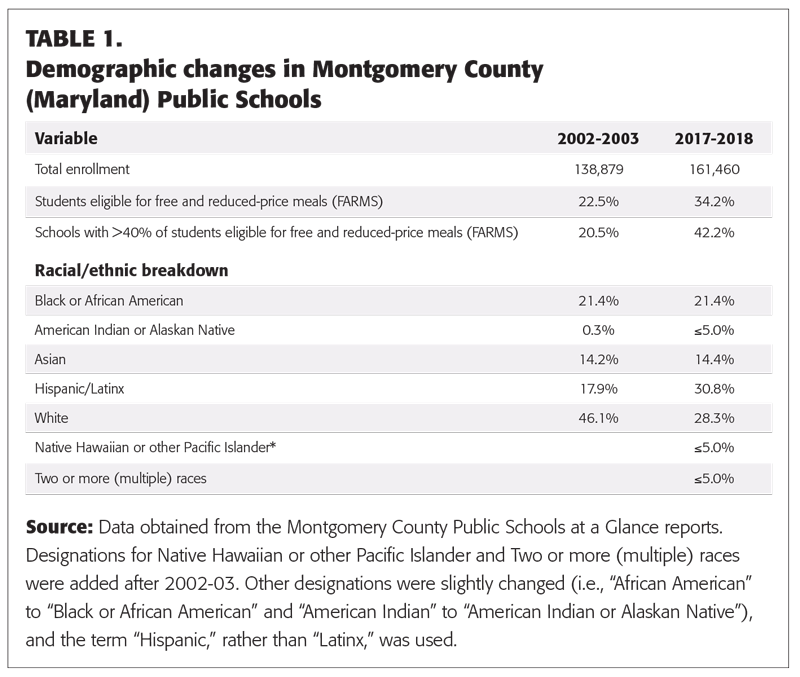
In the 15 years between 2002-03 and 2017-18, the percentage of Latinx students in Montgomery County Public Schools increased from 17.9% to 30.8%, and the percentage of White students declined from 46.1% to 28.3%. At the same time, student poverty rates grew from 22.5% to 34.2%. Described another way, in 2002-03, 20.5% of the schools had poverty rates exceeding 40%; by 2017-18, the percentage of schools with poverty rates exceeding 40% had more than doubled. These demographic changes, shown in Table 1, provide the context for the integration and segregation trends that occurred.
Table 2 shows that district schools with the least diversity tend to be higher-poverty schools with large proportions of Latinx and/or Black students or low-poverty schools with large proportions of White students. Between 2002-03 and 2017-18, the total number of schools in which most students were from one racial/ethnic group declined. During this period, however, the decrease centered on White students. In 2002-03, 32 schools had student populations that were more than 70% White; but by 2017-18, only five schools were more than 70% White and none was more than 75% White. At the same time, racial isolation actually increased for Latinx and Black students and is particulary pronounced for Latinx students. Nine district schools had a Latinx populations of 70.4% to 83.0% by 2017-18, and all of these had high poverty rates. In short, Latinx and Black students attending the higher-poverty schools became more segregated over the years, while White students attending low-poverty schools were in more diverse environments.
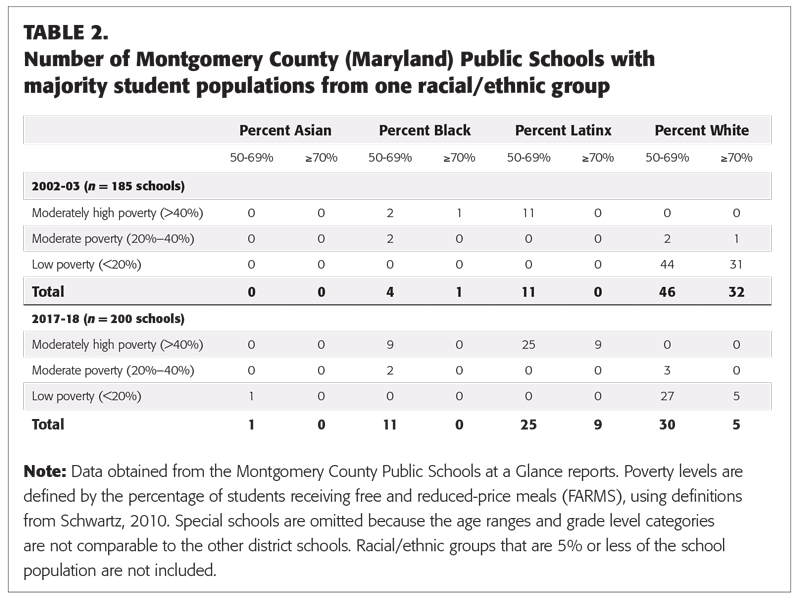
While the measure of isolation indicates the extent to which students attend schools with members of the same racial/ethnic group, it does not show the percentages of students’ peers who are from each of the other racial/ethnic groups. Further exploration of the data shows that some schools’ enrollments were largely accounted for by only two population groups, meaning that some students were exposed primarily to members of their own and one other group. In 2002-03, only 4% of Montgomery County schools had Latinx and Black enrollments of 80% or more, compared to 20% of the schools in 2017-18. These schools were among the highest-poverty schools in the district. In contrast, 25% of the schools had Asian and White enrollments of 80% or more in 2002-03, compared to 3% in 2017-18. All of these schools were in the lowest-poverty category. In other words, Latinx and Black students in high-poverty schools are becoming increasingly isolated from Asian and White students, while Asian and White students in low-poverty schools are becoming less isolated. Schools in the moderate-poverty ranges tended to most closely reflect the demographics of the district.
Overall, although large numbers of students in Montgomery County attend racially and ethnically diverse schools, the demographics in many schools do not match the demographics of the district. In particular, segregation by race, ethnicity, and poverty is a growing problem in the higher-poverty schools, where many students have little opportunity to participate in the diverse environments available to so many other students in Montgomery County.
Suburban differences and similarities
Montgomery County enjoys a large advantage over many urban districts when it comes to strengthening school integration. First, many schools in Montgomery County are already highly diverse compared, for example, to schools in the District of Columbia, where limited racial and ethnic diversity in the overall student population makes it difficult to integrate schools. Second, the poverty rate is much lower — 34.2% in Montgomery County Public Schools, compared to 77% in District of Columbia Public Schools (n.d.). And third, even in the more segregated schools, the degree of segregation in Montgomery County is very different from that in the District of Columbia. Half of the District of Columbia’s public schools from pre-elementary through high school enroll 90% or more Black students (Coffin, 2019). No school in Montgomery County has an isolation index that high for any racial/ethnic group.
Nonetheless, the factors contributing to segregation in Montgomery County are in many ways similar to those in urban districts. These include communities divided by race and poverty, large gaps in income and wealth, neighborhoods that are inaccessible because of high housing costs, and the movement of White students from public to private schools. All of these factors are matters of fundamental importance in assessing a district’s potential for integration.
Policy challenges and solutions
The challenge for diverse districts is to maintain the integration they have while working to expand it. In particular, their decisions about school boundaries, the location of new schools, tracking, and enrollment in special programs and magnet schools will make a difference. So will family decisions about staying in public schools.
In response to protests from parents and students in the higher-poverty communities about the lack of diversity in their schools, Montgomery County’s Board of Education recently announced a policy to increase school integration and commissioned a countywide study of potential school boundary changes (Barthel, 2019; St. George, 2018). Not unexpectedly, the question of boundary changes was controversial and led to debates about race, ethnicity, and income. The controversy raised the possibility that some families would leave the public school system or the district because of concerns about busing and property values (St. George, 2019). As reported by Bethesda Magazine (Peetz, 2019), district officials tried to allay fears by describing the planned study of school boundaries as “merely a study of existing boundaries and potential changes, and the school board will not be required to make any alterations based on the exercise’s findings.”
Thus, Montgomery County illustrates the conflict many districts face as they consider how best to change school boundaries to strengthen integration and, at the same time, ensure that families who can afford it do not abandon the public school system and leave in their wake a district that no longer has the racial and economic diversity to integrate schools — the concern expressed so many years ago by Justice Marshall in the Milliken decision.
But integration of schools is not the responsibility of school districts alone. A variety of government policies that go beyond schools may well affect how well districts can maintain and expand school integration. For example, federal policies on the supply and location of affordable housing can play a major role. The current shortage of affordable housing continues the legacy of segregated neighborhoods and schools and ensures that parts of many school districts are inaccessible to all but the wealthiest families.
At the local level, housing policy is also a key issue that can make or break efforts to integrate schools. Montgomery County, for example, is fairly progressive in this area and has a good base on which to increase the supply of affordable housing. For the past 45 years, it has operated a program that requires real estate developers to sell or rent some of the homes they build at below-market prices. The public housing authority can also purchase a portion of these homes and make them available as federally subsidized public housing for families below the poverty line. The homes are currently located throughout the county, and recent policies are designed to increase the number of these lower-cost homes in affluent areas (Rodgers, 2018; Schwartz, 2010). Hans Reimer, Montgomery County council president, says that the goal of this effort is to “promote economic integration to mitigate against concentrations of poverty and to open the door for attending schools where families of low to moderate incomes just wouldn’t be able to buy a home” (Rodgers, 2018). (The median cost of homes in some areas of Montgomery County approaches $1 million [MoCo Real Estate, n.d.].)
The fate of school integration will also depend on whether public policy choices over the next several decades strengthen the economic well-being of low- and middle-income families. Large gains in civil rights and in education, employment, and housing opportunities in the past 50 years have facilitated moves to integrated communities, but significant gaps remain, exacerbated by the enormous racial wealth gap. Recent proposals have sought to narrow the wealth gap by providing major increases in the supply of affordable housing and other supports such as tax credits and subsidies for down payments and closing costs (Capps, 2019; Ross-Brown, 2019; Siders, 2019). Depending on the location of the housing and the amount of the subsidies, these proposals could potentially increase low- and middle-income families’ access to a wider range of neighborhoods and schools. The effects on school diversity are unlikely to be immediate; however, government housing policies reverberate across generations, and proposals such as these can ultimately have a considerable influence on access and integration.
The effects of charters and secessions
In the meantime, communities can follow the physicians’ adage to “first, do no harm” and reject two trendy initiatives — charter schools and school district secessions — that carry a high risk of dismantling the integration that has already been achieved by intentionally or unintentionally offering opportunities for White flight. While some charter schools are more diverse than the traditional public schools in their communities, a large body of research shows that charter schools and other forms of school choice generally increase segregation (Potter & Nunberg, 2019; Rotberg, 2014). The growth of charter schools has been slower in suburban communities than in urban areas, and some suburban communities have opposed opening these schools, in part because of concern about competition for resources and the potential for increased segregation (Rotberg, 2018). (Montgomery County currently has no charter schools [Maryland Alliance of Public Charter Schools, n.d.].)
A comprehensive overview of the effect of charter schools in suburban communities is not yet available. However, analyses of individual districts show that charter schools, like private schools, can enable families to bypass integration plans (Mickelson et al., 2018). This is what occurred, for example, in the Charlotte-Mecklenburg School District in North Carolina, when a recently passed law permitted four affluent, predominantly White towns in the district to open their own charter schools that can give preference to local students and thereby avoid the diversity of the district in which the towns are located (Fox 46, 2018).
School district secession is a more extreme way of reducing the options for integration (EdBuild, 2019; Jacobson, 2019). In 2013, for example, the City Council of Gardendale, Alabama, voted to split off from the Jefferson County school system and form an independent district (Underwood, 2019). Because Jefferson County is still under a 1971 desegregation order, the secession required court approval. In a 2018 decision, the U.S. Court of Appeals denied the motion to secede and cited the district court’s finding “that the Gardendale Board acted with a discriminatory purpose to exclude black children from the proposed school system and, alternatively, that the secession of the Gardendale Board would impede the efforts of the Jefferson County Board to fulfill its desegregation obligations” (Stout by Stout v. Jefferson County Bd. of Educ., 2018). Gardendale, however, is an exception: Most districts are not under desegregation orders and have fewer constraints if they decide to join the dozens of other secessions that have occurred in recent decades — mostly by communities that are largely White and wealthy (Taylor, Frankenberg, & Siegel-Hawley, 2019).
These secessions add to the considerable fragmentation that already exists. Some states have hundreds of school districts, and many of these districts have only one or two public schools and fewer than 1,000 students. This level of fragmentation poses a major barrier to integration (Boser, 2013).
In the face of charters, secession, housing inequality, and other realities that tend to stymie integration, it becomes even more important to sustain diverse districts like Montgomery County. We know which policies to avoid and which to implement to maintain and strengthen the integration that has already been achieved. The question is whether we have the political will to do so. K
References
Barthel, M. (2019, April 2). How students in Montgomery County are leading the push for redistricting. WAMU.
Belsha, K. & Levin, K. (2019, July 25). 45 years later, this case is still shaping school segregation in Detroit — and America. Chalkbeat.
Boser, U. (2013, August). Size matters: A look at school district consolidation. Washington, DC: Center for American Progress.
Capps, K. (2019, June 5). Why Cory Booker is focusing on affordable housing. CityLab.
Chambers, J. & MacDonald, C. (2017, December 5). Despite gains, Michigan schools among most segregated. Detroit News.
Coffin, C. (2019, February 6). Racial and ethnic diversity over time in D.C.’s schools. Washington, DC: D.C. Policy Center.
District of Columbia Public Schools. (n.d.). DCPS at a glance: Enrollment. Washington, DC: Author. https://dcps.dc.gov/page/dcps-glance-enrollment
Duffin, S. & McGuckian, E. (2013). Desegregation timeline: Montgomery County, Maryland, Public Schools. Rockville, MD: Montgomery History.
EdBuild. (2019, April 16). Fractured: The accelerating breakdown of America’s school districts: 2019 update. Jersey City, NJ: Author.
EdBuild. (n.d.). Dismissed: America’s most divisive borders. Jersey City, NJ: Author.
Fox 46. (2018, June 7). Charter school creation for four North Carolina towns gets final approval. Fox 46.
Frankenberg, E. & Ayscue, J.B. (2013). New faces in suburban spaces: How diversifying districts and schools are responding to marked changes in their racial makeup. School Administrator, 70 (11), 22-27.
Frankenberg, E. & Orfield, G. (Eds.). (2012). The resegregation of suburban schools: A hidden crisis in American education. Cambridge, MA: Harvard Education Press.
Jacobson, L. (2019, September 4). Study: ‘Splinter’ districts increase school segregation in the South. Education Dive.
Joseph, R. (2014). Montgomery County, MD Public Schools: Student performance and achievement of low-income and minority students. Geography & the Environment: Graduate Student Capstones, 52.
Maryland Alliance of Public Charter Schools. (n.d.). Charter schools: Montgomery County. Baltimore, MD: Author.
Massey, D.S. & Tannen, J. (2018). Suburbanization and segregation in the United States: 1970-2010. Ethnic and Racial Studies, 41 (9), 1594-1611.
Mickelson, R.A., Giersch, J., Nelson, A.H., & Bottia, M.C. (2018). Do charter schools undermine efforts to create racially and socioeconomically diverse public schools? In I.C. Rotberg & J.L. Glazer (Eds.), Choosing charters: Better schools or more segregation? (pp. 116-132). New York, NY: Teachers College Press.
Milliken v. Bradley 418 U.S. 717 (1974).
MoCo Real Estate. (n.d.). Walt Whitman cluster. www.mocorealestate.com/schools/walt-whitman-cluster/
Montgomery County Public Schools. (2003). 2002-2003 schools at a glance. Rockville, MD: Author.
Montgomery County Public Schools. (2018). 2017-2018 schools at a glance. Rockville, MD: Author.
Orfield, M. (2012, July 20). How the suburbs gave birth to America’s most diverse neighborhoods. Citylab.
Peetz, C. (2019, July 1). MCPS releases outline for scope of countywide school boundary analysis. Bethesda Magazine.
Potter, H. & Nunberg, M. (2019). Scoring states on charter school integration. New York, NY: The Century Foundation.
Rodgers, B. (2018, July 30). County’s affordable housing program is getting its first major update in more than a decade. Bethesda Magazine.
Ross-Brown, S. (2019, June 26). Democrats get serious about affordable housing. The American Prospect.
Rotberg, I.C. (2014). Charter schools and the risk of increased segregation. Phi Delta Kappan, 95 (5), 26-30.
Rotberg, I.C. (2018). A school system increasingly separated. In I.C. Rotberg & J.L. Glazer (Eds.), Choosing charters: Better schools or more segregation? (pp. 41-60). New York, NY: Teachers College Press.
Schwartz, H. (2010). Housing policy is school policy: Economically integrative housing promotes academic success in Montgomery County, Maryland. New York, NY: Century Foundation.
Siders, D. (2019, July 6). Kamala Harris proposes $100 billion plan for black home ownership. Politico.
St. George, D. (2018, September 25). Boundary struggles: A Maryland school system looks for more diversity. The Washington Post.
St. George, D. (2019, July 7). School boundary questions touch off debates about race, income, equity. The Washington Post.
Stout by Stout v. Jefferson County Bd. of Educ., 882 F. 3d 988 (2018).
Taylor, K., Frankenberg, E., & Siegel-Hawley, G. (2019). Racial segregation in the Southern schools, school districts, and counties where districts have seceded. AERA Open, 5 (3).
Tefera, A., Frankenberg, E., Siegel-Hawley, G., & Chirichigno, G. (2011). Integrating suburban schools: How to benefit from growing diversity and avoid segregation. Los Angeles, CA: The Civil Rights Project/Proyecto Derechos Civiles.
Underwood, J. (2019, February). Segregation and secession. Phi Delta Kappan, 100 (5), 74-75.
Note: Iris Rotberg is a longtime resident of Montgomery County, and her daughters attended Montgomery County Public Schools. Breanna Higgins and Kara Long, graduate research assistants at The George Washington University, contributed to the data analysis for this study.
ABOUT THE AUTHOR

Iris C. Rotberg
Iris C. Rotberg is a research professor of education policy at the Graduate School of Education and Human Development at The George Washington University, Washington, DC. She is the editor, with Joshua L. Glazer, of Choosing Charters: Better Schools or More Segregation?