STEM teachers need professional development and support to implement reading and writing instruction in their classrooms.
Amanda investigated the dangerous presence of nitrates in Des Moines drinking water. She recommended a solution to the problem after finding out why nitrates are dangerous to human health, what forms a watershed, and what farming practices may contribute to runoff.
Kathryn had heard about malaria, but not Zika and the West Nile virus. When she investigated these illnesses, she learned that mosquitos were becoming increasingly resistant to insecticides. She discovered a company that could genetically modify a mosquito gene so that the insect died before it was able to reproduce. She wondered if that could be an effective way to control the mosquito population.
In recent years, flood waters in St. Louis have reached historic highs, closing roadways and damaging property. To form a theory about why the instances of flooding have increased, Jerome read about climate change. He also analyzed graphical data recording local rainfall patterns since 1900 and examined county government data showing property development surrounding the Meramec River Valley.
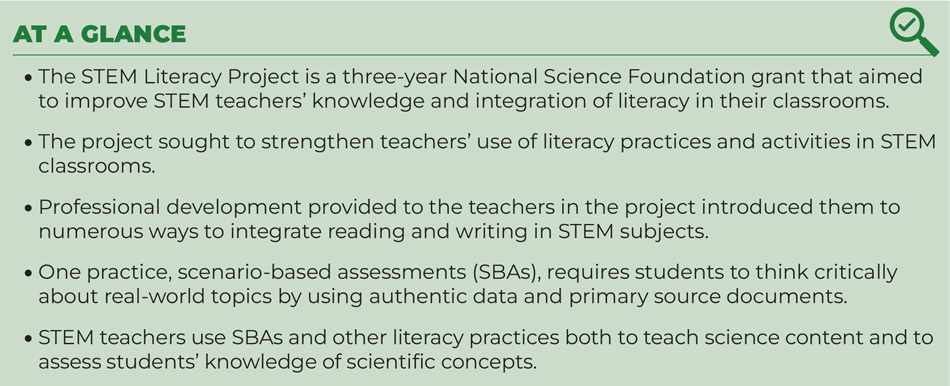
Amanda, Kathryn, and Jerome (pseudonyms) investigated these real-world STEM topics in their high school science classes. Their teachers were part of the STEM Literacy Project (www.stemliteracyproject.org), a three-year National Science Foundation grant that aimed to improve STEM teachers’ knowledge and integration of literacy in their classrooms. Studying topics that affect people and communities helps students see the relevance of what they are learning in school. However, studying a current issue is not enough. We need an approach to equip students with the sense-making skills that emerge through literacy instruction. The STEM Literacy Project sought to enable STEM teachers to bring more literacy activities into their classrooms.
Literacy practices: Scenario-based assessments
One of those activities was a range of scenario-based assessments (SBAs) like the examples above. SBAs require students to think critically about real-world topics by using authentic data and primary source documents. Teachers developed and used socio-scientific topics (issues with both biological and social implications) to engage students in a claim-evidence-reasoning (CER) strategy. The topics are relevant to the students’ local context while adhering to national curriculum standards.
SBAs require students to think critically about real-world topics by using authentic data and primary source documents. Teachers use SBAs both to teach science content and to assess students’ knowledge. Students begin by looking at evidence before making a claim. This involves reading multiple texts (e.g., articles, graphs, datasets). They then decide what claim they want to make and the reasoning based on the evidence for their claim. Finally, they complete a writing task (e.g., a proposal, a letter to the editor) to explain or to persuade others of their position.
To measure student learning and growth during the project, we analyzed pre- and post-SBA writing samples. Student writing was scored for six elements: claim, evidence, reasoning, appropriate use of quantitative data, domain-specific content/vocabulary, written communication, and holistic/overall. In a pre- and post-analysis of the SBA assessments, students showed significant gains in their ability to use written argumentation to negotiate socio-scientific issues. This included the CER practices of making a claim, backing the claim up with evidence, and providing reasoning to tie the evidence to the claim. It also included the underlying communication practices of writing and using discipline-specific vocabulary.
While students’ scores showed growth over the school year, we did not attribute the change only to the use of SBAs. The frequent use of literacy activities prepared students for longer engagement with reading and writing tasks in the STEM classroom. When students were asked to read multiple texts, examine graphical representations, and interpret data for SBAs, they were better prepared to do so.
Incorporating literacy strategies
STEM teachers often feel ill-prepared to embed literacy in their content area (Lannin et al., 2014). Discipline-area teachers need training and experience using literacy strategies in their classrooms. Many teachers involved in the project told us that they often felt they had to comply with whole-school literacy initiatives without being given explicit examples for how that literacy content might look in their own math or science classroom. One teacher said incorporating literacy strategies is “one of those things that for 21 years you always say, ‘I should [do that],’ but with this program there’s a structured process to make that possible.”
Science or math concepts were at the core of each professional development session for our program. We wanted to help teachers embed content literacy activities into classroom routines, instead of having them become just “one more thing” added on top of the rest of their instruction. Table 1 shows a snapshot of the most-used literacy strategies that STEM teachers found to be valuable in their classrooms. Some of these strategies became part of the daily routine, and others were more occasional additions.
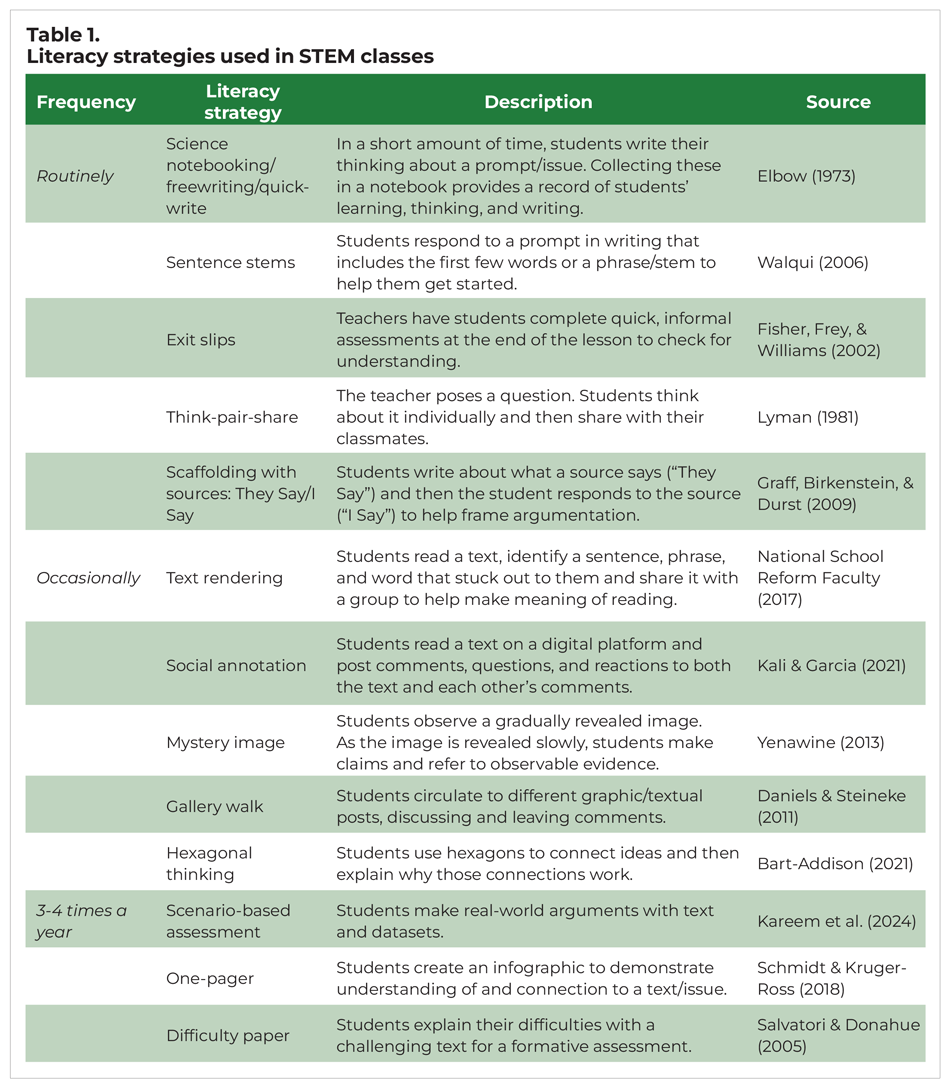
Teachers easily could employ these literacy practices, and they said they did so on a regular or even daily basis. ReLeah Cossett Lent (2016) recommends that teachers using writing within the disciplines “Have students write something related to your content every day (but copying notes does not count as ‘real’ writing)” (p. 64). Participating teachers were quick to take up daily use of low-stakes, informal writing tasks (Fisher, Frey, & Williams, 2002). Such low-stakes writing is often formative in nature. Teachers may collect the writing to check for student understanding, but the writing is rarely graded, beyond a completion grade. These activities included free writing, sentence stems, and exit slips.
Other strategies took more time because they ask students to synthesize information and demonstrate more sophisticated critical-thinking skills. Teachers reported that they used them only occasionally. Many teacher participants found text rendering and science notebooking/quick-writes to be useful ways for students to engage in higher-order thinking to demonstrate their knowledge of the STEM content.
Still other practices — including the SBAs — were lengthier literacy projects that teachers used three or four times during the school year. These included culminating projects, like an SBA, problem-based investigation, or one-page infographic.
Teachers found value in these activities as ways to assess students’ learning. One teacher reflected on the benefits of writing in science:
I think it is important to have students write because it will show you what the students really know. If they can write about concepts in their own words, it will show you how much they really understand. Our traditional ways to measure knowledge sometimes don’t tell us what they know, it just shows us how well a student can guess.
Learning and practicing together
During the program, we worked with 19 teachers from a range of urban, suburban, and rural schools. Participants mostly taught middle and high school mathematics or science, but the group also included two elementary school teachers.
For nearly three years, teachers in our project met virtually or in person to learn literacy strategies, practiced them with other teachers in a supportive environment, and then used these strategies in their individual classrooms. Each professional learning session used effective professional learning principles (Darling-Hammond, Hyler, & Gardner, 2017). This included making sure the sessions were content-focused, active, and job-embedded.
Most importantly, the project provided time for modeling, coaching, and feedback with other professionals to fine-tune lessons. Teachers who may never have experienced literacy strategies like these got the opportunity to engage with the activities firsthand and envision what their students would experience in their STEM classrooms. The professional development provided space for teachers to practice the strategies with supportive peers and then to reflect on how they could adjust their instruction before using the strategies with their own students. “If we, as teachers, are intentional about specific instructional practices,” a high school physics teacher explained, “then we can make gains. This project has allowed us to be intentional.”
Benefits for students
In total, teachers may have included as many as 1,900 students in this work. Those students came to understand that they were expected to read and write in their STEM classes as well as in their English language arts classes. Students could see the benefits of writing in their STEM classes. “It’s not just an assignment that I’ll have to turn in,” said one student. “It shows like I actually did something, like I learned something, and I’m able to explain what it is and how it works…I have an in-depth definition of it.” This student has already gained an understanding of how writing is a tool for thinking and learning (Bean & Melzer, 2021; Emig, 1977).
A high school science teacher in our study summed it up this way:
It is important for us to practice good reading habits and good comprehension skills with our students to help them become more scientifically literate. With the influx of fake news and society’s apparent distrust of the scientific community, it is more important than ever to ensure that our students know how to read scientific literature to verify facts for themselves.
We hope that these real-world, community-oriented topics help foster deeper learning and awareness of the real-world scientific problems of today and tomorrow.
References
Bart-Addison, S. (2021). Hexagonal thinking. Literacy Today, 39 (2), 66-67.
Bean, J.C. & Melzer, D. (2021). Engaging ideas: The professor’s guide to integrating writing, critical thinking, and active learning in the classroom. Jossey-Bass.
Daniels, H. & Steineke, N. (2011). Texts and lessons for content-area reading. Heinemann.
Darling-Hammond, L., Hyler, M.E., & Gardner, M. (2017). Effective teacher professional development. Learning Policy Institute.
Elbow, P. (1973). Writing without teachers. Oxford University Press.
Emig, J. (1977). Writing as a mode of learning. College Composition and Communication, 28 (2), 122-128.
Fisher, D., Frey, N., & Williams, D. (2002). Seven literacy strategies that work. Educational Leadership, 6 (3), 70-73.
Graff, G., Birkenstein, C., & Durst, R.K. (2009). “They say/I say”: The moves that matter in academic writing with readings (1st ed.). W.W. Norton & Co.
Kalir, R. & Garcia, A. (2021). Annotation. The MIT Press.
Kareem, M., Lannin, A., Romine, W., Singer, N., Tyson, M., Kline, K., Kendrick, M., Otten, S. & Apple, S. (2024). Using scenarios to assess student learning. The Science Teacher, 91 (4).
Lannin, A., Kohnen, A., Kline, K., Singer, N., Stokes, V., & Knowles, A. (2014). From English language arts teacher to literacy expert: Reimagining our roles. English Journal, 104 (2), 54-60.
Lent, R.C. (2016). This is disciplinary literacy: Reading, writing, thinking, and doing … content area by content area. Corwin Literacy.
Lyman, F.T. (1981). The responsive classroom discussion: The inclusion of all learners. Mainstreaming Digest, 109, 113.
National School Reform Faculty. (2017). Text rendering experience. https://nsrfharmony.org/protocols
Salvatori, M. & Donahue, P. (2005). The elements (and pleasures) of difficulty. Pearson Education–Longman.
Schmidt, P.S. & Kruger-Ross, M.J. (2018). Reimagining literacies in the digital age: Multimodal strategies to teach with technology. National Council of Teachers of English.
Walqui, A. (2006). Scaffolding instruction for English language learners: A conceptual framework. International Journal of Bilingual Education and Bilingualism, 9 (2), 159-180.
Yenawine, P. (2013). Visual thinking strategies: Using art to deepen learning across school disciplines. Harvard Education Press.
This article appears in the October 2024 issue of Kappan, Vol. 106, No. 2, p. 24-27.

ABOUT THE AUTHORS

Nancy Robb Singer
Nancy Robb Singer is an associate dean in the College of Education at the University of Missouri-St. Louis.

Amy Lannin
Amy Lannin directs the Missouri Writing Project and the Campus Writing Program at the University of Missouri and is an associate professor in English education.

Maha Kareem
Maha Kareem is a faculty member at the University of Baghdad where she teaches composition.

William Romine
William Romine directs the Data Science for Education Laboratory at Wright State University, Dayton, OH.

Katie Kline
Katie Kline directs the Greater Kansas City Writing Project at the University of Central Missouri.