When an art teacher has a creative idea for motivating his students, school leaders take note, the initiative spreads, and the school culture changes.
Demetrius Fuller developed the HOMies to promote a strong work ethic, curiosity, and risk-taking among his students at the Sokolowski Elementary School in Chelsea, Massachusetts. The Sokolowski School is an urban elementary school serving grades 1 through 4. Of its more than 500 students, 70% speak English as a second language, 90% qualify for free and reduced-price lunch, and 85% identify as Latinx.
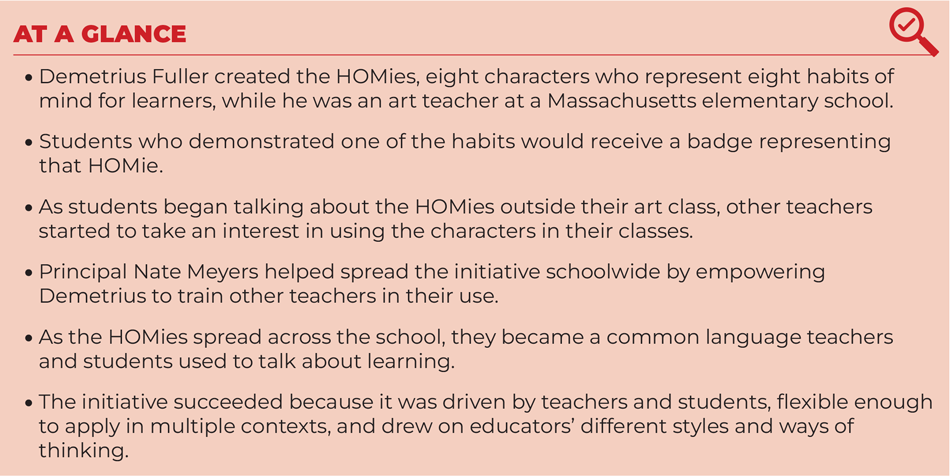
The HOMies are a group of eight characters that each personify a habit of mind successful writers, mathematicians, scientists, artists, and others employ to excel in their field. The HOMies and their habits are:
- The Brave One: taking risks
- Stellar Storyteller: communicating clearly about your subject
- Eagle Eye Detective: looking closely to find nuance
- Captain of the Clouds: visualizing and using mental models
- Inventor Innovator: making novel connections
- Triple Practicer: embodying a growth mindset
- Inspector Reflector: looking back on your work and yourself
- The Maven: learning from the world of ideas
A few years ago, the HOMies spread to the rest of the school, in large part because of the relationship between Demetrius and his principal, Nate Meyers. Nate knew how to support Demetrius and how to help the HOMie project spread to other teachers and classrooms until it became part of the entire school’s culture. Linda Nathan, as Demetrius’ leadership coach, met Demetrius and Nate to talk through how they could further integrate the HOMies into the daily life of the school.
Meet the HOMies
Inspired by the studio habits of mind developed at Harvard’s Project Zero and similar frameworks, Demetrius developed the eight HOMies (www.meetthehomies.com) while he was an art teacher. He began giving out HOMie badges to students engaging in the habits the characters represent. For example, if he saw students doing well at drawing from observation, he might hand them an Eagle Eye Detective badge and say (loud enough for the rest of the class to hear), “You’re really noticing those tiny details. You’re an Eagle Eye Detective.”
Eventually, other teachers who saw the badges began handing them out, too. Students were stopping us (Demetrius and Nate) in the hallway, excitedly saying, “I earned an Eagle Eye Detective badge! I found details in a word problem that helped my group get the answer” or “I got a Stellar Storyteller badge! I explained my science evidence in front of the whole class.” Students loved these characters, and they loved earning HOMie badges.
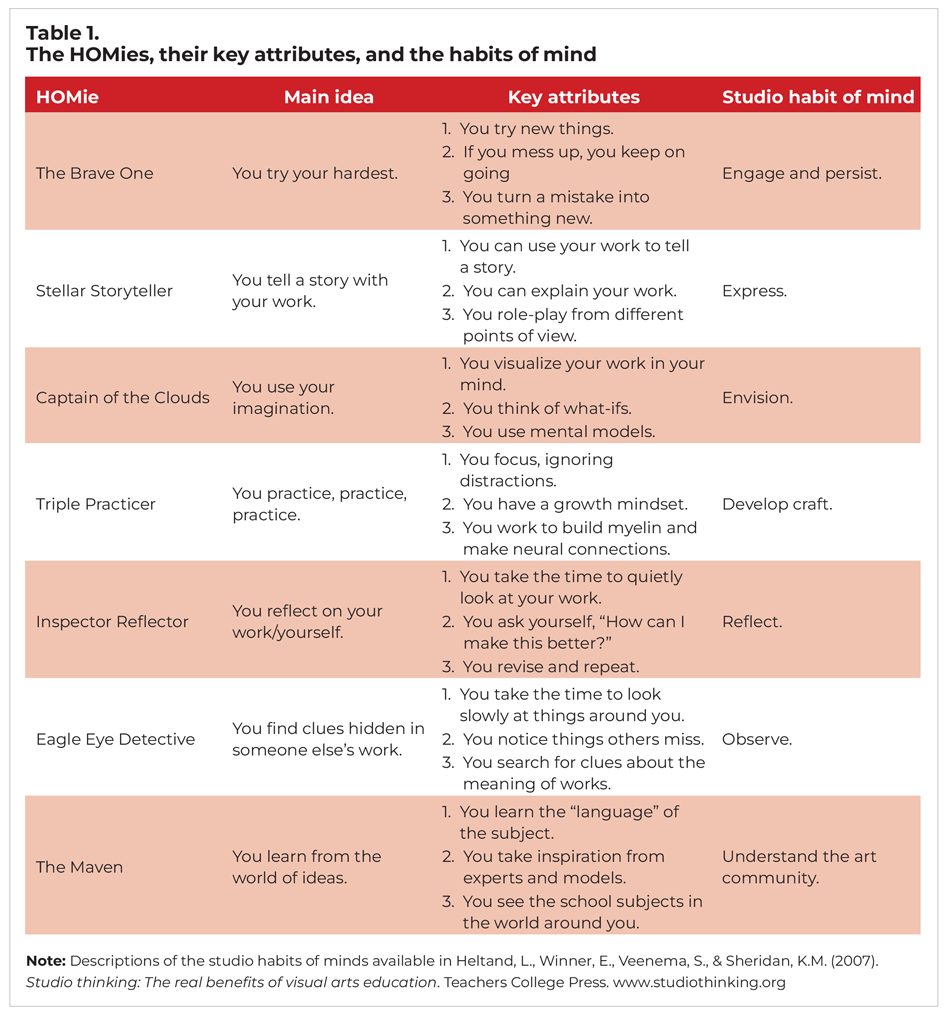
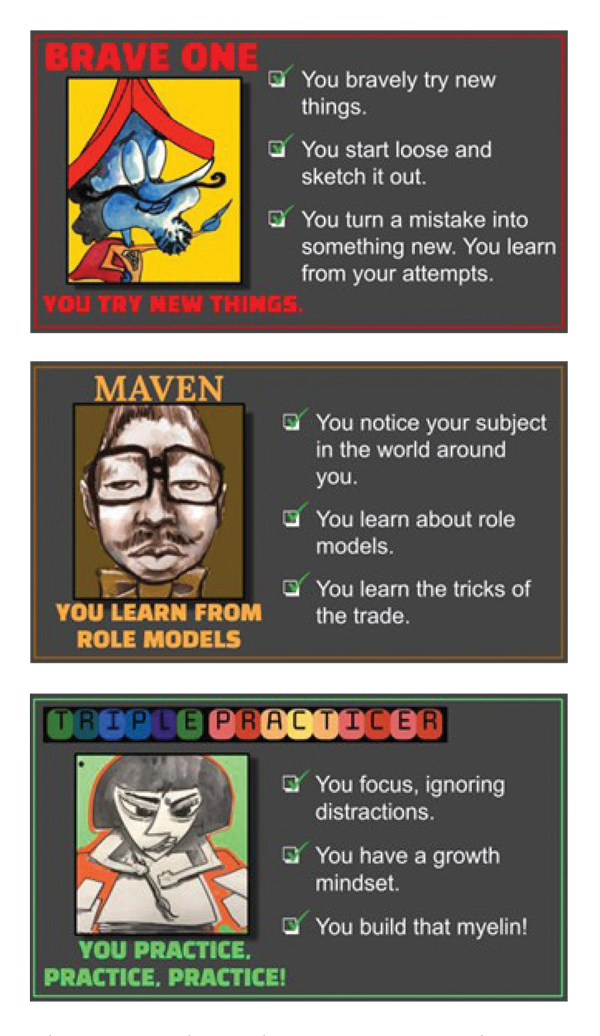
To expand the initiative, we provided direct instruction about the HOMies for teachers in multiple ways. For example, we gave them a slide deck (https://bit.ly/HOMieSlides) with audio for classroom use. Each slide shows the cartoon face of the HOMie, the HOMie’s key three attributes (see Table 1), and an audio file of the HOMie’s chant. (The Stellar Storyteller’s chant is a rap: “Once upon a time there was a Stellar Storyteller, told a story with their work and sent their message interstellar!”) The teachers loved these slides because they could easily copy and drop them into any lesson plan, adapting them as they saw fit.
Formalizing the growth
For the idea of the HOMies to really take hold, we knew we needed to get more teachers involved in leading the effort. Through a carefully worded email designed to drum up excitement, we invited teachers to become HOMie ambassadors. Twelve teachers (out of a total of 45) enthusiastically responded. These teachers resonated with the importance of describing learning through habits of mind. They appreciated highlighting the commonalities across subjects, and they connected with the vibrant and playful style of the HOMies. They became our early adopters, and the initiative took off from there.
The ambassadors met once a month. We discussed ways to bring the HOMies to grade-level teams. We used a branching strategy to great success. Demetrius and Nate connected with the ambassadors. The ambassadors, in turn, shared with their grade-level teams about the HOMies. Grade-level teams spoke to classroom teachers who, to complete the process, introduced the HOMies to students.
Simultaneously, Demetrius was directly teaching the HOMies to students in his art room, who were, in turn, getting other teachers excited about the HOMies. The students were the authentic marketers for a new way of thinking about learning. In effect, we operated from both the top-down and the bottom-up.
We hung HOMie posters throughout the hallways and in classrooms, reminding everyone that these loveable characters were always with us. Students and teachers sang their chants in schoolwide assemblies. Students — and soon all teachers — began to appreciate each HOMie. We held HOMie school meetings, where we focused on two HOMies at a time. We also did HOMie challenges like the 25-Pose Challenge (Be a Brave One and sketch as many stick-figure poses as you can in three minutes) and being a Maven and naming as many role models as you can in each subject. Teachers and students participated, getting everyone up, moving, and creating.
Adding nuance
As more students and teachers got to know the HOMies, questions arose. For example, what’s the difference between being an Eagle Eye Detective and being a Maven? In math, is understanding a problem and using tools to solve it a sign of being an Eagle Eye Detective or a Maven? Through many conversations between Demetrius, the math coach, teachers, and students, the faculty decided a Maven is someone who has internalized the shortcuts and knows which tools to use. You know what to do when you don’t know what to do. You use tools more efficiently, like a pro. The line between each HOMie was usually clear, even for newer teachers. But in some cases, that line was sketched and resketched countless times, through discussion, trial and error, and HOMie mini-lessons by Demetrius.
A 4th-grade teacher recalls:
I would say that when it comes to the harder-to-grasp HOMies, students struggled with being a Maven versus identifying a Maven. A way they often connected to the Maven was by trying to teach something to someone else. For example, presenting to 1st graders. I would have liked to have the space and time to introduce famous Mavens so that they can see Mavens, which like all HOMies, look different at various ages and learning levels.
Another teacher added her thoughts to the development of the HOMies:
A conversation my class engaged in was the difference between the Triple Practicer and the Inspector Reflector. It was hard for them to understand that a Triple Practicer practices, reflects, and repeats over and over again in an effort to master a skill or accomplish a goal; whereas an Inspector Reflector might be given internal or outside feedback and return to strengthen their work.
The discussions about these areas of nuance helped everyone deepen their ownership of the HOMies. Even more important, they helped students and teachers think through the many different ways people might exhibit important habits of mind.
A shared language
The HOMies introduced a shared language in the school. Learning any language initially takes a lot of effort. A new language can, at first, feel clunky. But as fluency increases, the language becomes easier. After a brief learning curve, the HOMies made talking about learning easier for both teachers and students.
To help his colleagues become more fluent, when Demetrius attended any meeting, whether it was a training he was leading or 3rd-grade math planning, he always connected the HOMie language to the agenda. If someone mentioned visualizing a world problem, he would say “That’s the Captain of the Clouds.” In doing this, he was highlighting the common habit of mind — in this case, visualizing — and showing how it applies to any the subject or context.
It was crucial in the growth and spread of the HOMies that teachers felt ease and enjoyment with the characters. That way, the initiative was not merely an extra burden but a simple shorthand that brought extra joy. In one of the first professional learning team meetings focused on the HOMies, Demetrius helped grade-level teams feel at ease by finding ways to add HOMie language to their objectives. For example, “I will be a Stellar Storyteller and describe the way natural disasters affect a community.”
Teachers started to see how adding the HOMies language to the objective increased students’ engagement and output. One 4th-grade teacher said, “In public schools with state-mandated standards and tests, district-aligned learning goals, and teacher-designed lessons activities and lessons, the kids take ownership of their own learning through the HOMies. That is powerful.”
The HOMies cultivated a schoolwide culture around learning, exploration, and self-efficacy. They helped teachers and students begin to ask different questions about data and take risks with teaching and learning.
Making it work schoolwide
The HOMies were an unconventional idea, and some teachers were unsure of its value. Nate, as principal, needed to persevere, with transparency, through faculty criticism and skepticism to protect this emerging idea.
Once teachers realized that this top-down initiative could also be bottom-up, with teachers and students driving the conversation about what being a HOMie looks like, we capitalized on this excitement to set some goals for the 2022-23 school year. Specifically, we asked teachers to use the language of the HOMies to talk about their own classroom practices. By the next year, 2023-24, the HOMies had a firm schoolwide footing, and schoolwide goals incorporated the HOMies. For example, faculty agreed that by the end of the year, all teachers would integrate the HOMies into math and literacy lessons.
As part of the statewide evaluation system to assess yearly outcomes, teachers collaboratively wrote goals that included the HOMies. This allowed the HOMies to deepen their roots in a short time. Teachers were clear about how they wanted to include the HOMies as part of their classroom explorations, and they could easily decide on their own personalized learning landmarks.
Although this initiative was developed by one teacher, as teachers worked together, we saw how it could live in multiple ways in many classrooms. Demetrius developed the HOMies while observing fellow teachers’ practices, and other teachers tuned and refined them together. The HOMies sparked excitement about learning in general, and the HOMie framework gave opportunities for a variety of users to be part of the conversation about how to learn.
One reason the framework took hold schoolwide is because the language is broad and flexible enough to apply to any school subject: “You can explain your work,” (Stellar Storyteller) or “You use mental models” (Captain of the Clouds). At the same time, the language is specific enough to serve as a useful schema for learning. For instance, in the HOMie Ambassador meetings, teachers were able to recount giving out a Stellar Storyteller badge to a student for clearly explaining their math answer. The framework worked on both a general and specific level and easily connected to a 1st-grade writing lesson, a 4th-grade math class, or anything in between.
Leading and following
In the world of education, the principal is often like a conductor, orchestrating a diverse ensemble of talents and personalities. There’s a mix of novice violists and master percussionists, and everyone expects it to sound just right. The stakes are high, with families, staff, peers, district leaders, superintendents, and students all watching closely. And test scores are looming over everyone’s shoulders.
The successful launch of the HOMies proves that the job of the conductor is not about standing at the front; it’s about joining in and creating a safe space for others to follow. The principal needs to inspire others, unlock potential in staff, and create a culture where others can take the lead and make their own unique contributions.
The video by Derek Sivers “First Follower: Leadership Lessons from a Dancing Guy” (http://sive.rs/ff) describes how a single guy dancing alone isn’t a movement. A movement happens when followers join in the dance — the first follower is the one who really starts the movement. A schoolwide movement won’t happen if the principal is the only one dancing. Instead, the principal can observe someone dancing and become the first follower, who invites others to join and create a movement of their own.
It was crucial in the growth and spread of the HOMies that teachers felt ease and enjoyment with the characters. That way, the initiative was not merely an extra burden but a simple shorthand that brought extra joy.
Nate admits that he has led many projects that have failed. One common theme he noticed through those failures was a lack of teacher buy-in. Teacher buy-in fueled the success of the HOMies. This initiative succeeded because teachers had a voice in all aspects of the process. This was a strategic move that put teachers’ voices and feedback first. Through successful iterations of the process, teachers were empowered to think about their practice. As a result, teachers refined and improved their practice while strengthening the implementation of the HOMies.
Leading for change is about listening, iterating, persevering, refining, embracing diversity, and hearing and seeing all the pieces of the whole orchestra. By embracing the ideas of teachers like Demetrius, Nate acknowledges that varied voices and perspectives can spark innovation. As this mindset spreads, the culture of innovation takes root, with new ideas flourishing and spreading through a positive feedback loop. The mantra “Innovation Is Contagious” becomes the driving force, fostering an ecosystem where creativity is valued and encouraged. Each success builds on the last, leading to a vibrant culture of continuous sustainable improvement.
The value of diverse perspectives
A movement is most successful when it embraces multiple ways of being in the world. Linda always says she hates being in a meeting or a gathering without artists. She wants to be sure that multiple ways of knowing and thinking are represented. Artists can often ask interesting questions or see things differently. Nate and Demetrius approach the world and problem solving from different experiences and perspectives, and that helped the HOMies grow.
Demetrius has found that school leaders like Nate tend to emphasize schedules, planning, compliance, and data. Those things are necessary in any organization. But in a room filled only with people who focus on those things, we run the risk of overemphasizing them and neglecting other things, like context and possibility.
When we’re in our meetings and the discussion is around scheduling, the room lights up with contributions and ideas, rapid-fire and laser-focused. When we look at data tables with achievement numbers or observation percentages, the team is fast to calculate and compare. But if, as happened in a recent instructional leadership team meeting, Demetrius notices and questions why the numbers for Depth of Knowledge Level 4 were zeros across the board, the previously animated room falls silent.
In such meetings, it’s easy to value what is easily quantifiable and overlook the need to look deeper than the numbers, to get at the context behind them. We have a hunch this is a common tendency. Without Demetrius’ ability to be the Brave One who will go out on a limb, ask hard questions, and try new things that may not work, his colleagues would miss out on inspiration and vision.
A schoolwide movement won’t happen if the principal is the only one dancing. Instead, the principal can observe someone dancing and become the first follower, who invites others to join and create a movement of their own.
But inspiration without a plan is inconsequential. Therefore, to ensure success, Nate scheduled weekly recurring meetings with Demetrius to discuss, strategize, and respond to the growth of the HOMies. Demetrius knows that he would be lost without someone like Nate helping him focus on the details. He’d be late to work, late to communicate, and slow to finish projects without someone pushing him to pay attention to these things. We need the playfulness of the HOMie mindset as well as the detail-oriented and data-focused mindset of many of our faculty.
The built-in diversity in a school exists not just between colleagues like Demetrius and Nate, but also between teachers and students. The HOMies capitalized on the mindsets of both teachers and students. Students, excited by the vibrancy of the HOMies, held their teachers accountable for giving out HOMie badges. Teachers welcomed the pressure because it made their students more engaged learners. Ultimately, our initiative took root not because of the teachers, or their different intellectual approaches, or the planning, but because of our students. It was the students who owned the HOMies and pushed the teachers to include them in all subjects.
As we look at our progress, we feel proud. We’re excited about the HOMies, but we’re also excited about championing a staff-led initiative. The way this initiative spread shows how celebrating staff and honoring their ideas can inspire team members’ confidence in one another and the collective belief that we can achieve things, big or small, when we work together.
Note: Demetrius Fuller documents the evolution of the HOMies in Fuller, D. (2024). The hope of the HOMies. In L. Nathan, J. Mendonca, & G. Rojas (Eds.), Designing democratic schools and learning environments: A global perspective. Palgrave McMillan.
This article appears in the October 2024 issue of Kappan, Vol. 106, No. 2, p. 28-33.

ABOUT THE AUTHORS

Linda F. Nathan
Linda F. Nathan is a leadership coach and a professor at the Harvard Graduate School of Education, Cambridge, Massachusetts, and Cambridge College-Puerto Rico.
Visit their website at: www.lindanathan.com
Demetrius Fuller
Demetrius Fuller is an assistant principal at Frank M. Sokolowski Elementary School, Chelsea, MA.
Visit their website at: www.meettheHOMies.com
Nate Meyers
Nate Meyers is the principal of Wright Science and Technology Academy, Chelsea, MA.