Creating a classroom that celebrates mathematics for all is a journey worth taking.
As we were traveling by rideshare in 2023, our driver asked us, “What brings you to the city?” We shared that we were mathematics educators presenting at the local mathematics convention. The driver was shocked and repeatedly expressed his frustrations with mathematics, explaining how he was terrible at it in school and still struggles with it today. For the remainder of the ride, the driver shared his admiration for our mathematical abilities and asked us about our journey to a love of mathematics. Once we reached our destination, we thought someone should roll out the red carpet because this guy made us feel like royalty.
This experience led us to wonder how many students in classrooms today would share the same feelings as our driver. What messages do students receive about mathematics? Unfortunately, research has shown that, too often, the messages they hear are discouraging: “Children hear adults saying from early on that math is hard or that they did not like math; this is a big obstacle for some children to overcome” (Small, 2019, p.64). Students get the impression that some people are math people — and some people are not. Some decide that, for them, being a math person is a far-fetched idea.
The messages we send students about mathematics have the potential to build students’ confidence and help them establish their mathematical identity. We have the power to change the narrative about who can do and enjoy mathematics because everyone is — or can be — a math person. Targeted and easy-to-implement approaches that affirm students’ abilities can strengthen students’ mathematical foundations and build their confidence.
Building a strong foundation
In a home construction project, the foundation is the bedrock of your vision. Imagine your dream structure standing tall and proud, supported by a solid, unwavering foundation, the strength you need and want. Any effort to build students into math people must begin with a strong foundation.
According to the National Council of Teachers of Mathematics (NCTM) and the National Association for the Education of Young Children (NAEYC), high-quality mathematics education for three- to six-year-old children is crucial for preparing students for future learning (NAEYC, 2010). Research shows that early mathematics knowledge predicts academic achievement later in school, including in areas such as reading (Fuson, Clements, & Sarama, 2015). The mathematics skills children learn in preschool and early elementary grades lay the foundation for future mathematics success. Each new concept students learn depends on mastery of the preceding material. For this reason, students who struggle with fundamental mathematics skills in elementary school likely will face ongoing challenges in middle and high school.
From concrete to abstract
So how can teachers build this foundation? One fundamental practice is the use of mathematics manipulatives to guide students from concrete to abstract learning. Manipulatives — whether physical tools or virtual resources — are vital for building students’ conceptual understanding.
These tools do not have to be expensive. All teachers, including those in under-resourced districts, can access free virtual tools that ensure all students can engage with mathematics concretely before moving on to abstract concepts (see the list below). Teachers can also repurpose common household objects to create objects for students to count, sort, and rearrange to build their understanding.
Sources for virtual manipulatives
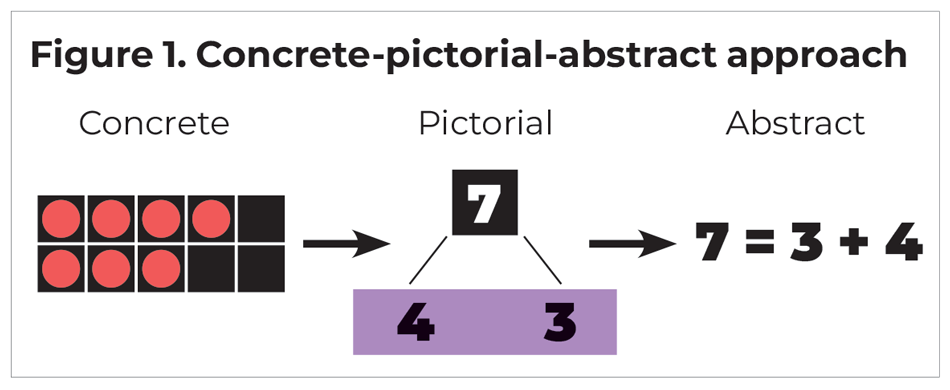
The use of manipulatives is the beginning of the concrete-pictorial-abstract (CPA) approach (Figure 1), which consists of three steps (Putri, 2019; Yuliyanto et al., 2019):
- Students engage with physical objects or concrete materials.
- Students transition to visual representations or pictures.
- Students use symbol and number representations for abstract reasoning.
Students need to interact with mathematics through concrete tools before they can effectively model scenarios with pictures or understand abstract representations. However, this approach is not linear. Students who have mastered abstract reasoning for one mathematics concept (such as basic addition) might need to return to using physical objects when learning something new (such as adding fractions).
By guiding students through this process, teachers can ensure that their mathematics instruction is more engaging, inclusive, and effective for all learners. At the same time, they will be giving students the foundation they need to succeed as they move on to more complex mathematics.
Making math relevant
Effective mathematics instruction requires more than an understanding of the content. It also demands a thoughtful, inclusive, and engaging approach that connects learning to students’ lives and cultural experiences. Meaningful mathematics is what all children need because it reinforces the idea that everyone can be a math person. Students who engage in tasks that reflect real-world scenarios find greater interest and motivation in learning.
Best practices in mathematics instruction involve a shift from the traditional focus on rote memorization of procedures to more engaging approaches that prioritize actively engaging in mathematics tasks (NCTM, 2014). By embracing foundational mathematics tasks that promote critical thinking and problem solving, even at the primary levels, we can help all students see themselves as capable budding mathematicians. Students want to engage in practical mathematics because it connects to concepts they can use daily. This approach builds foundational skills and fosters a love of learning by making mathematics relevant and meaningful.
Examples of practical mathematics include, but are not limited to, using concrete tools — such as unifix cubes or paper clips — to conduct linear measurements of pencils, toys, and other real-world items. Additionally, students may use their body parts (width of their fingers, feet, hands) to measure the distance from one place to another, and practical items such as torn paper or even coupons to represent currency for use in consumer activities. Video games also provide opportunities to engage in practical mathematics, as we’ve observed when students playing Roblox need to calculate what they need to build, furnish, and maintain their worlds.
These real-world tasks should resonate with students’ everyday experiences to cultivate their understanding of mathematical concepts (Matthews, Jones, & Parker, 2022). When they have opportunities to connect mathematical concepts to meaningful and relevant situations, students can grasp abstract ideas more deeply and see the practical value of their learning.
Finally, a classroom environment that emphasizes mathematics discourse — where students explain their thinking, ask questions, and build on each other’s ideas — can become a strong mathematics community that keeps students interested. Collaborative learning simulates how society operates, where teamwork is essential. For this reason, it prepares students for real-world interactions where a group approach to problem solving is a daily norm. At the same time, this process enhances student comprehension and increases engagement and motivation, making the learning process impactful and lasting.
Teacher preparation
For teachers to engage in these practices, preparation and professional development programs must equip educators with the necessary knowledge and strategies. Teaching mathematics is a complex task that demands both sustained attention and time. However, time is extremely limited in elementary teacher education programs, where preservice teachers must learn content across various subjects. In a collaborative self-study (Saclarides et al., 2022), five teacher educators identified three important challenges they must find time to address in elementary mathematics methods courses:
- Balancing the teaching of mathematics content and pedagogy.
- Linking theory with practical application.
- Integrating social contexts into mathematics teaching.
An additional obstacle is the long-standing assumption that preservice educators come to their methods classes with enough math knowledge to teach elementary students. However, they need a deeper conceptual understanding of foundational mathematics and specialized pedagogical knowledge to be effective (National Council on Teacher Quality, 2022). Neither of these is adequately covered in most teacher preparation programs. Therefore, teacher preparation programs must reassess their offerings, reallocate time to developing these understandings, and consider dedicating more time overall to mathematics education.
Once teachers are in the classroom, schools can support them by providing job-embedded professional learning. Many invest in and depend on the expertise within their districts through the use of instructional coaching. Others create specialized departments in early elementary grades so that teachers can be part of a community of mathematics specialists dedicated to research-based strategies. Whatever approach to professional learning schools choose, the goal should be to meet both teacher and student needs. Students need competent teachers who exude confidence in their fundamental mathematics skills and employ a depth of diverse instructional strategies. Such teachers encourage students to develop the foundational and conceptual understanding they need to excel and move on to more complex mathematics.
Building a math identity
In addition to building foundational math skills to ensure they can succeed in mathematics, students need to see themselves reflected in the field of mathematics.
Cultural representation
Who we place in front of students matters, as does the message that anyone can be a mathematician. Our research (Holliman et al., 2018) emphasizes how including diverse mathematicians in the curriculum shows all students that “mathematics needs people” and the discipline thrives on the contributions of diverse mathematicians (Parker-Holliman, 2024).
Honoring the achievements of a diverse range of people makes it easier for students to envision a future where they can succeed in mathematics. This representation provides a sense of belonging and illuminates a path forward in their mathematical journey. See the box below for examples of diverse mathematicians.
The concept of windows and mirrors reminds us of the value of bringing examples from diverse cultures into every classroom. Windows enable students to look into the lives, experiences, and perspectives of others. Students get to explore problems and examples that reflect cultures, contexts, and real-world situations they might not personally experience. On the other hand, mirrors reflect students’ own lives, cultures, and experiences. They incorporate problems, examples, and contexts familiar and relevant to the students’ backgrounds and daily lives (Matthews, Jones, & Parker, 2022). Acknowledging and elevating the funds of knowledge students have acquired from their families, communities, and cultural backgrounds can enhance and improve teaching and learning.
Highlighting diverse mathematicians
Black mathematicians
-
-
-
- Benjamin Banneker
- Elbert Frank Cox
- Euphemia Lofton Haynes
- David Blackwell
- Katherine Johnson
- Gladys “GPS” West
-
-
Latinx mathematicians
-
-
-
- Rafael Bombelli
- Carlos Castillo-Chavez
- Arturo H. Cortez
- Irene Fonseca
- Cecilia Aragon
-
-
The Mathematicians Around the World Project offers examples of the contributions people of diverse identities from around the world have made to the field of mathematics. Visit https://bit.ly/MathAroundtheWorld to view the project or contribute.
Positive messaging
Recognizing the contributions different types of people have made to mathematics is one piece of an asset-based approach to learning. Asset-based approaches focus on students’ language, culture, and strengths (Rhodes et al., 2023). These affirming messages (summarized in Figure 2) equip students with a powerful mathematics mindset.

When we start instilling these beliefs in our youngest learners, we promote a growth mindset — an “I can, I am” mindset. Students with this mindset are more prepared to take risks in the classroom. Recognizing students’ brilliance, acknowledging what they bring to the table, and focusing on their strengths are simple strategies teachers can incorporate into their daily routines to boost students’ confidence and strengthen their mathematics identity.
Teachers and school staff can reshape the narrative about who can excel in and enjoy mathematics because everyone can be a math person. Direct messages, such as those in Figure 3, delivered in mathematics learning spaces can build students’ self-efficacy, contributing to feelings of optimism and power (Parker-Holliman & Maina, 2023).

Individual teachers are powerful, but they are even more powerful in combination. Most of us have heard the message that reading is fundamental. We need to make the message that mathematics is fundamental equally resonant. The huge push to encourage STEM learning is helpful, but we need to go further. As mathematics education enthusiasts and professionals, we ask: Where are the public service announcements about the fun of mathematics, the spirit within it, the diverse history of its contributors, and its value to our society? America’s educators have the opportunity to lean deeply into our own and our students’ power to build students’ confidence in mathematics and their mathematical identities.
Starting a positive journey
Many students struggle with mathematics. By building essential math skills at the elementary level, they will be better prepared to advance in mathematics at the secondary level. Even teachers who lack a strong mathematics background can help young students develop those critical skills with the right strategies. These “effective instructional strategies create opportunities for students to be problem solvers” (Holliman et al., 2018, p. 22-23).
Promoting growth mindsets in our youngest learners is a simple move that positions students to take risks in their classrooms among their peers. Recognizing students’ mathematical brilliance, acknowledging their funds of knowledge, and focusing on their strengths to bridge gaps in their learning are some of the most effective instructional strategies that educators can employ to foster a deeper understanding of mathematics.
References
Fuson, K.C., Clements, D.H., & Sarama, J. (2015). Making early math education work for all children. Phi Delta Kappan, 97 (3), 63-68.
Holliman, N., Pendleton, V., Mack, K., & Nwosu, K. (2018). Reclaiming their time: Removing barriers to ensure equity in our children’s education. Lighthouse Almanac, 2 (1), 14–27.
Matthews, L.E., Jones, S.M., & Parker, Y.A. (2022). Engaging in culturally relevant math tasks: Fostering hope in the elementary classroom. Corwin Press.
National Association for the Education of Young Children. (2002). NAEYC/NCTM joint position statement: Early childhood mathematics: Promoting good beginnings.
National Council of Teachers of Mathematics (2014). Principles to actions: Ensuring mathematical success for all.
National Council on Teacher Quality. (2022). Elementary mathematics. www.nctq.org/review/standard/Elementary-Mathematics
Parker-Holliman, N.L. (2024). Mathematics needs people. Mathematics Teacher: Learning and Teaching PK-12, 117 (9), 688-688.
Parker-Holliman, N.L. & Maina, F. (2023). Protective factors that yield empowerment for black girls’ mathematical brilliance. Journal of Mathematics Education at Teachers College, 14 (2), 1–8.
Putri, H.E. (2019). Influence of concrete, pictorial, abstract approach to the improvement of spatial sense ability of elementary school students. Journal of Physics: Conference Series, 1157 (4), 042083.
Rhodes, S., Moldavan, A.M., Smithey, M., & DePiro, A. (2023). Five keys for growing confident math learners. Mathematics Teacher: Learning and Teaching PK-12, 116 (1), 8-15.
Saclarides, E.S., Garner, B., Krause, G., Bertolone-Smith, C., & Munson, J. (2022). Design principles that support course design innovation for elementary mathematics methods courses. Mathematics Teacher Educator, 11 (1), 9-25.
Small, M. (2019). Understanding the math we teach and how to teach it. Stenhouse.
Yuliyanto, A., Turmudi, T., Agustin, M., Putri, H.E., & Muqodas, I. (2019). The interaction between concrete-pictorial-abstract (CPA) approach and elementary students’ self-efficacy in learning mathematics. Al Ibtida: Jurnal Pendidikan Guru MI, 6 (2), 244.
This article appears in the December 2024 issue of Kappan, Vol. 106, No. 4, p. 26-30.

ABOUT THE AUTHORS
Natalie Parker-Holliman
Natalie Parker-Holliman is a mathematics teacher in the Little Rock School District, Arkansas, and south central regional director of the Benjamin Banneker Association.

Tenisha Marcel-Herbert
Tenisha Marcel-Herbert is a mathematics instructional coach in the District of Columbia Public Schools and an adjunct professor at Stockton University, Galloway Township, NJ.