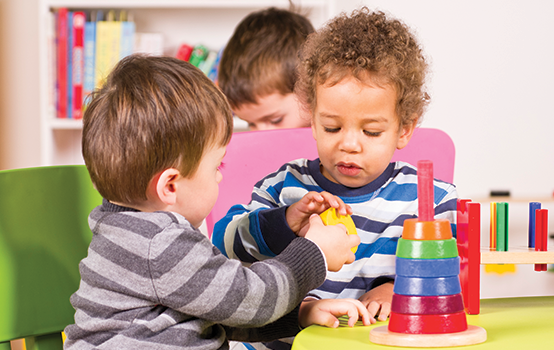
Very young children learn differently even from children in primary grades. Following a set of practices and principles can yield important gains for these children.
National, state, and local policy makers once again have pushed to the forefront of education reform the issue of boosting investment in early childhood education. Children who enter kindergarten lagging their peers in cognitive and social measures are less likely to be successful in grade school and more likely to drop out of high school and earn less as adults. Investing in high-quality early childhood education can increase school readiness so that children not only succeed in elementary school but also in other life experiences (Duncan et al., 2007; Gutman, Sameroff, & Cole, 2003; Reynolds et al., 2011).
This solution seems logical and almost benign, but it is quite contentious. Beyond the political issues over whether and how the government should spend money to educate preschool children is the practical tension over the types of learning experiences that early education programs should offer. Young children learn differently from their elementary school counterparts. They have shorter attention spans, and they’re just beginning to develop the skills of an intentional learner (Bowman, Donovan, & Burns, 2000). As such, the academic practices and expectations of elementary school can’t simply be shoved down into preschool (Hatch, 2002). There is no clear consensus among policy makers, educational administrators, and elementary school personnel about the practices that early educators should employ in their interactions with preschoolers (Howes et al., 2008).
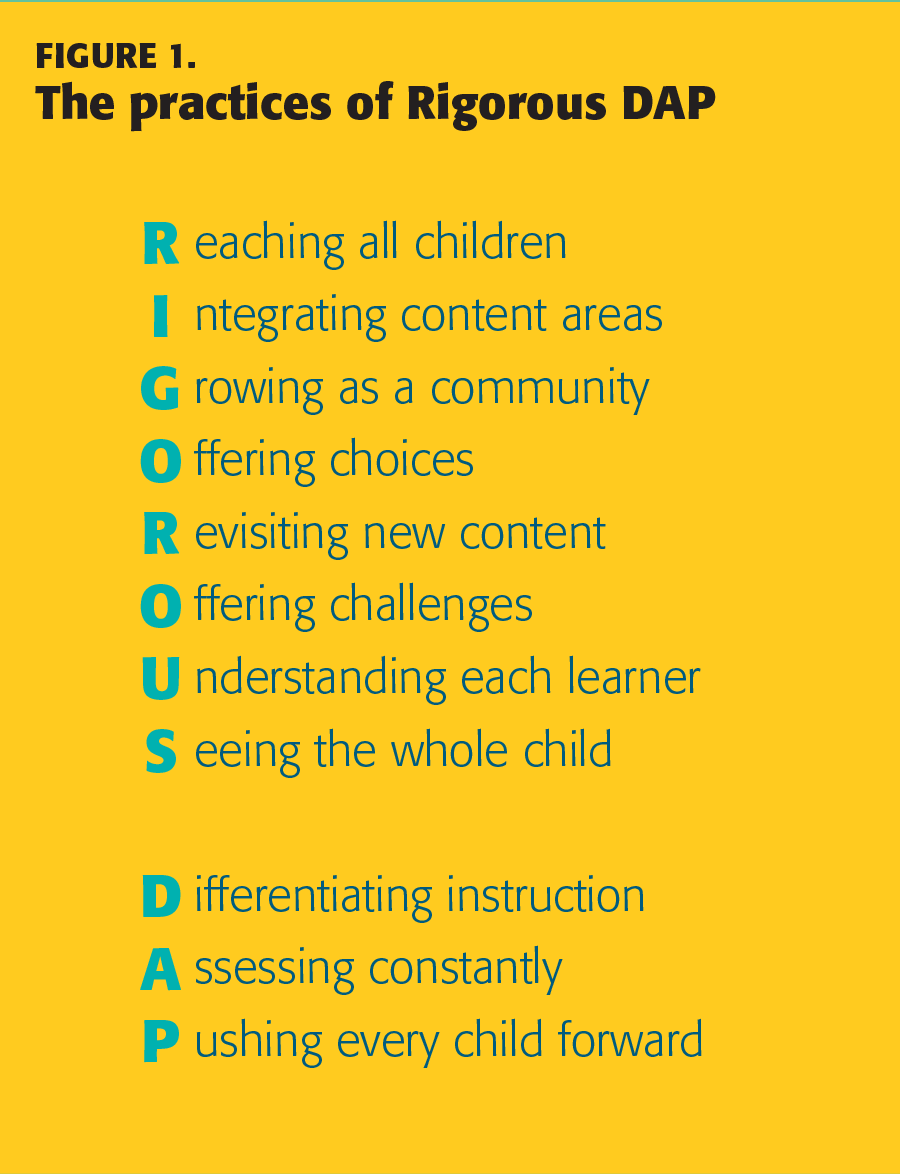
Our solution is what we call Rigorous DAP — which is both a construct and an acronym that offers 11 principles of instruction in which early educators should engage with their students daily (see Figure 1).
Defining Rigorous DAP
Rigorous DAP — developmentally appropriate practices — combines the constructs of academic rigor and developmentally appropriate practice — a mainstay in how the early childhood education field conceptualizes best practices with young children.
Academically rigorous learning environments create the conditions for children to learn at high levels. Academic rigor is the process of working with all children in a manner that addresses the whole child through hands-on learning experiences that “challenge the mind” and “connect learning to real world context[s]” (Washor & Mojkowski, 2006, p. 87). DAP fosters instruction that focuses on the growth and development of individual children across all domains in a manner that addresses “the social and cultural contexts” in which they live (Copple & Bredekamp, 2009, p. 10). While academic rigor focuses on one dimension of education — academic — DAP considers the whole landscape of learning — motivational, cultural, socioemotional as well as cognitive. Combined, Rigorous DAP calls on early childhood educators to teach the knowledge and skills they expect all children to eventually attain and demonstrate on a regular basis. They do this by using practices that reflect an understanding of child development and each student’s individual and sociocultural needs.
Instructional practices
As we explain the 11 essential components of Rigorous DAP, we use excerpts from Ms. Hughes’ (all names are pseudonyms) prekindergarten classroom as she engages students in a daylong scientific investigation into raccoons. These learning activities are part of their monthlong scientific study of living things, which addresses her state’s prekindergarten science standards. The standards declare that each 4-year-old child is to leave prekindergarten being able to identify and define the characteristics of organisms and the differences between living and nonliving things.
Reaching all children
Ms. Hughes was intentional about setting up age-appropriate activities exploring the topic of organisms through a variety of modalities that piqued the children’s interests and increased their participation in the academic content. For example, she created a wilderness habitat that included such things as camping equipment in the dramatic play center, a tree built from cardboard boxes for housing families of stuffed bears, raccoons, squirrels, and robins (each introduced to the tree on separate days), and a bat cave made of black polypropylene, which came to life during choice time as a fan was turned on to pump air through it. On the day the class began its study of raccoons, Ms. Hughes placed the raccoon family in the tree before students arrived. Across that day, students learned about the characteristics of raccoons by reading several books about them, singing a song about a raccoon named Rickey, and having discussions about the similarities and differences between raccoons, squirrels, and robins, which had already arrived in the class tree. Ms. Hughes designed each age-appropriate activity to give students multiple opportunities to be drawn into the academic content of living things — content selected to expose each student to scientific facts and knowledge that extend their thinking beyond their current level of understanding of living things (Vygotsky, 1978). Moreover, Ms. Hughes recognized that her role is more than simply teaching academic content; it is to address all of the development domains of students, including their passion for learning. Doing so lets students know that she cares about each of them as individuals, which is essential for their learning (Palermo et al., 2007).
Integrating content areas
The class investigation into raccoons began with students discussing what they knew about raccoons, which Ms. Hughes documented for the class on chart paper. During this literacy activity, Stephen described how a raccoon ravaged through his family campsite while they were asleep on one of their recent outings, which Ms. Hughes used as a jumping-off point to introduce the scientific term nocturnal. This was one of numerous ways in which students were able to engage in activities where they could apply their scientific knowledge, literacy skills (e.g., using language to explain the difference between nocturnal and diurnal animals), and mathematical knowledge (e.g., comparing the size and weight of raccoons to squirrels). Such integrated learning experiences reflect Ms. Hughes’ understanding of the interconnectedness in how children learn academic content. Developing her students’ scientific vocabulary positively affects their reading comprehension (Moats, 2009).
Growing as a community
During center time, Ms. Hughes taught a small group lesson that asked students to act out a typical day in the life of the animals living in the class tree. As they did this, she asked a range of questions based not only on their actions but also on previous class conversations (Why is Joaquin, the raccoon, asleep while Jasmine, the squirrel, is out gathering nuts?). By having students work together, each child’s contribution enhances the group’s generation of knowledge. Developing such a shared understanding of how different organisms coexist in their natural environment compensates for the tendency of 4- and 5-year-olds to go off on different tangents in open-ended learning activities (Rogoff, 2003). Alerting the children to Joaquin sleeping exemplifies this point. Such actions demonstrate how Ms. Hughes has created a social dynamic in which the children’s group participation not only keeps each child accountable to this learning situation, but it also offers them the chance to question, respond, and build off each other’s ideas and suggestions.
Developmentally appropriate practices (DAP) fosters instructional practices that reflect an understanding of child development and each student’s individual and sociocultural needs.
Offering choices
Across the day, Ms. Hughes intentionally designed a classroom environment that gave children choice and voice in a range of learning activities that included whole-group, small-group, and center-based instruction, child-initiated activities, indoor and outdoor play-based learning activities, and loud and quiet learning experiences. Alongside such teacher-directed activities as having a small group of children act out a typical day in the life of the animals living in their class tree, Ms. Hughes gave students 45 minutes of uninterrupted play time with the tree and the other learning centers in her classroom: blocks, construction materials, literacy, science, and mathematics. The time and centers gave students the chance to intentionally develop their social, literacy, and mathematical skills as well as the skill of self-regulation (Singer, Golinkoff, & Hirsh-Pasek, 2006). Ms. Hughes was engaged with students during this time so she could support their play and step in to provide scaffolding when needed (Leong & Bodrova, 2012).
Revisiting new content
Because Ms. Hughes recognized that learning new content was not a seamless process and the children would be inconsistent in demonstrating their newfound skills (Bowman et al., 2000), this day was one of many in which the class investigated raccoons and other living organisms. Some lessons emerged from and built upon children’s explorations (e.g., the children’s investigation into the types and number of squirrels that lived in their own neighborhoods), while others followed the lead of Ms. Hughes’s direct instruction (e.g., having the children write/draw in their science journals about what robins need to live). Ms. Hughes knows such instruction is necessary but should be limited to teaching discrete facts, skills, or routines (Bonawitz et al., 2011). Ms. Hughes also was intentional about spiraling her curriculum, which allowed students to revisit aspects of a concept that they may have known well in one context but failed to master as they applied it to novel situations (National Research Council, 2000). Understanding this allowed Ms. Hughes to go forward with her teaching because she knew they would revisit these new skills and knowledge again and again through multiple learning opportunities.
Offering challenges
Ms. Hughes challenged children’s academic learning by introducing them to some of the core scientific principles they will need in later grades through engaging age-appropriate materials and activities (e.g., detailing the difference between what robins, squirrels, raccoons, and humans need to live). Doing so allowed her to map the children’s hands-on experiences with living organisms on to a significant thread of scientific inquiry — life sciences — that motivates them to intentionally reflect upon and connect their informal knowledge about animals to characteristics that describe organisms, such as color, size, shape, and needs (e.g., air, water, food, shelter). They also learned how to use such scientific tools as binoculars to locate and document the squirrels and robins that lived around their school playground, which taught them how scientists used such tools to observe and document animals in their natural habitat.
Understanding each learner
Ms. Hughes knew that she must create a classroom environment that makes connections between children’s personal, cultural, and linguistic experiences for each student to be successful. She learned about each child through such activities as home visits, sending home weekly newsletters that offered families the chance to respond to content-specific questions, and by making herself available to families at the beginning and end of each day. Moreover, she knew she needed to create a context-rich environment that offered learning experiences children might not have had before entering prekindergarten (e.g., creating a cave in the classroom that teaches children about a bat’s habitat and introduces them to the activity of spelunking). Cognitive scientists have shown that such experiences are essential for learning. When children fail to grasp a particular lesson or topic of study, it is more than likely due to the task or a lack of background knowledge rather than the concept itself (National Research Council, 2000).
Seeing the whole child
Across this investigation into raccoons, Ms. Hughes created a learning environment with students that allowed them to apply a range of their attributes to their study of living things:
- Physical— playing in the classroom and outdoors;
- Conceptual— describing and evaluating their reenactment of animals;
- Emotional— regulating their responses to Ms. Hughes’s challenges; and
- Social— working in a small- and whole-group learning situations.
Such activities reflect Ms. Hughes’s understanding that growth in one developmental domain depends upon and influences the progression of others (Bowman, Donovan, & Burns, 2000).
Differentiating instruction
The built-in variability of the activities Ms. Hughes offered students, which included using large and small groups and individualized instruction, created the opportunity for her to closely monitor the children’s scientific thinking. Based on their discussions and questions, Ms. Hughes could easily adjust her interactions with students to their individual learning and cultural needs (e.g., a lack of experience in such outdoor environments as forests, caves, or mountains or being from a culture where learning is framed through collective rather than individual experiences). Such explorations also offered her the chance to differentiate the level of support she provided each child, the difficulty/breadth of the content she discussed with them, the level of participation she demanded from each child, and the terminology she expected each child to attain (Smutny & von Fremd, 2004).
Assessing constantly
Across each day Ms. Hughes documented children’s learning by recording and dictating their statements about living organisms through anecdotal records, work samples, digital photographs, and video. She then transferred these assessment artifacts into a portfolio that documented their learning. Ms. Hughes used this documentation to help her understand what students did and did not know about living things and the life sciences so she could adjust her instruction to help them learn more effectively (Epstein, 2007).
Pushing forward
Ms. Hughes notes that her central goal as a teacher is to create a learning environment that is “a great place to be” for students where they “live what they are learning” so that “every child is successful in all areas.” She achieved this goal by first knowing what knowledge and skills state policy makers have defined as essential for prekindergarten students to know. She then engaged students in a range of educational opportunities in and out of school (e.g., sending the robins, squirrels, raccoons, and bears home each weekend with a journal so children could document their experiences with their weekend visitors) that allowed children to explore living organisms while monitoring and scaffolding their engagement with and understanding of these scientific concepts. Doing so allowed Ms. Hughes to know how to push every child’s learning and development forward so they would reach and even go beyond the academic and social expectations of prekindergarten (Gmitrová & Gmitrov, 2003).
Conclusion
Rigorous DAP is a framework of early childhood instruction that policy makers, public school administrators, classroom teachers, and families can use to discuss what is and what should be occurring in early learning classrooms so children enter elementary school confident and prepared for the academic and social demands that await them.
Using Ms. Hughes as an example, we have demonstrated how early educators can achieve such learning environments by offering children intentional learning experiences that motivate them through multiple learning experiences and a range of instructional formats that reflect their developmental, individual, and sociocultural knowledge. Classrooms that practice Rigorous DAP have active, multimodal learning sites that address all developmental domains — cognitive, social, emotional, and physical — through such activities as whole-group, small-group, and center-based instruction, indoor and outdoor play, loud and quiet learning activities, and depending on the length of the school day, snacks and taking a rest.
Rigorous DAP learning environments offer children meaningful choices, opportunities to experiment with new ideas in a safe and comfortable setting, and time to revisit new knowledge and skills. Such learning contexts build off what children know and can do so they can develop the skills and knowledge to be successful in elementary school.
References
Bonawitz, E., Shafto, P., Gweon, H., Goodman, N.D., Spelke, E., & Schulz, L. (2011). The double-edged sword of pedagogy: Instruction limits spontaneous exploration and discovery. Cognition, 120, 322-330.
Bowman, B.T., Donovan, M.S., & Burns, M.S. (2000). Eager to learn: Educating our preschoolers. Washington, DC: National Academies Press.
Copple, C. & Bredekamp, S. (2009). Developmentally appropriate practice in early childhood programs serving children from birth through age 8 (3rd ed.). Washington, DC: National Association for the Education of Young Children.
Duncan, G.J., Dowsett, C.J., Claessens, A., Magnuson, K., Huston, A.C., Klebanov, P., … Duckworth, K. (2007). School readiness and later achievement. Developmental Psychology, 43, 1428-1446.
Epstein, A.S. (2007). The intentional teacher: Choosing the best strategies for young children’s learning. Washington, DC: National Association for the Education of Young Children.
Gmitrová, V. & Gmitrov, J. (2003). The impact of teacher-directed and child-directed pretend play on cognitive competence in kindergarten children. Early Childhood Education Journal, 30 (4), 241-246.
Gutman, L.M., Sameroff, A.J., & Cole, R. (2003). Academic growth curve trajectories from 1st grade to 12th grade: Effects of multiple social risk factors and preschool child factors. Developmental Psychology, 39, 777-790.
Hatch, J.A. (2002, February). Accountability shovedown: Resisting the standards movement in early childhood education. Phi Delta Kappan, 83 (6), 457-463.
Howes, C., Burchinal, M., Pianta, R., Bryant, D., Early, D., Clifford, R., & Barbarin, O. (2008). Ready to learn? Children’s preacademic achievement in prekindergarten programs. Early Childhood Research Quarterly, 23, 27-50.
Leong, D.J. & Bodrova, E. (2012). Assessing and scaffolding make-believe play. Young Children, 67, 28-34.
Moats, L.C. (2009). Knowledge foundations for teaching reading and spelling. Reading and Writing: An Interdisciplinary Journal, 22, 379-399.
National Research Council. (2000). How people learn: Brain, mind, experience, and school (expanded ed.). Washington, DC: National Academy Press.
Palermo, F., Hanish, L.D., Martin, C.L., Fabes, R.A., & Reiser, M. (2007). Preschoolers’ academic readiness: What role does the teacher-child relationship play? Early Childhood Research Quarterly, 22, 407-422.
Reynolds, A.J., Temple, J.A., Ou, S., Arteaga, I.A., & White, B.A.B. (2011, July 15). School-based early childhood education and age-28 well-being: Effects by timing, dosage, and subgroups. Science, 333 (6040), 360-364.
Rogoff, B. (2003). The cultural nature of human development. New York, NY: Oxford University Press.
Singer, D., Golinkoff, R., & Hirsh-Pasek, K. (2006). Play = learning: How play motivates and enhances children’s cognitive and social-emotional growth. New York, NY: Oxford University Press.
Smutny, J.F. & von Fremd, S.E. (2004). Differentiating for the young child: Teaching strategies across the content areas (K-3). Thousand Oaks, CA: Corwin Press.
Vygotsky, L. (1978). Mind in society. Cambridge, UK: Cambridge University Press.
Washor, E. & Mojkowski, C. (2006, December). What do you mean by rigor? Educational Leadership, 64 (4), 84-87.
Citation: Brown, C.P. & Mowry, B. (2015). Close early learning gaps with Rigorous DAP. Phi Delta Kappan, 96 (7), 53-57.
ABOUT THE AUTHORS

Brian Mowry
BRIAN MOWRY is an early childhood specialist in the Austin Independent School District.
Christopher P. Brown
CHRISTOPHER P. BROWN is an associate professor in the Department of Curriculum and Instruction and a fellow in the Elizabeth Glenadine Gibb Teaching Fellowship in Education at the University of Texas at Austin.