If schools are to meet the real needs of today’s students, they need to be structured differently.
“We are not giving students what they need,” Lydia, an educator in rural Vermont, and Ayesha, an educator in an urban public school district, said to Linda, their former graduate school teacher. After teaching for many years and navigating the trials of the pandemic, all three of us are frustrated. We see district leaders saying all the right things, but nothing seems to fundamentally shift outcomes for the young people and families in their schools every day.
Lydia and Ayesha are deeply committed to creating places where young people can fall in love with learning. However, their students are experiencing a mental health crisis in a country that continues to put Band-Aids on the issues instead of making real changes. Their schools have seen a post-pandemic influx of mental health professionals and supports, which have given students needed opportunities to talk and try to learn to regulate their emotions. However, those successes are never part of how their schools are judged. Scores on standardized tests are still the only measure that seems to count.
As the long-term consequences of the pandemic become ever clearer, we believe it is critical to listen to educators’ experiences to develop solutions that will, finally, once-and-for-all ensure that the optimistic rhetoric of schooling matches the on-the-ground reality.
Lydia’s story: Getting at the root problem
I am an elementary school principal at a public school in rural Vermont. I show up to work every day because I believe education is a fundamental right, and I want every student to see school as a place where they fall in love with learning.
During the pandemic, we had to rethink our preK program because the behavioral issues that had been challenging before the pandemic had only gotten worse. We tried having classes of 10 with a classroom teacher and two assistant teachers, but students and adults were still getting hurt daily. In 2021-22, we opened a third preK classroom in the middle of the year so we could have three classes of around six students each. The needs kept increasing, so we had to adapt again. Currently, I have one class of 10 students with a classroom teacher and three 1-to-1 paraeducators. That’s almost a 2-to-1 ratio! Still, I have students being carried out of the room because they are too agitated to stay and learn. One young child’s behavior was becoming unsafe because he has nightmares about a gun violence incident he witnessed involving his father. We increased his naptime to help with the immediate problem, but we know that’s not enough. Another student in that same class keeps telling her peers in great detail that she’s going to fatally wound her family and run away. These are four-year-olds.
Each year, teachers everywhere have to manage the individual development of students with decreasing levels of independence. Teachers have to juggle multiple token system behavior plans, individualized education programs, and toileting plans. Out of 62 1st graders last year, we had four whom I wouldn’t consider potty-trained. One 1st-grade student, Lily, runs out of the room every chance she gets. One day, I had to chase her down the main street as she attempted to run home. I can’t decide if that was worse than the time she ran out of the building and locked herself in a porta-potty. We have spent more time figuring out how to keep her in the building than on helping her grow in her academic skills. It’s clear we are not the best learning environment for her.
Before the pandemic, I thought schools should be a one-stop shop for taking care of the whole child. I embraced the idea of community schools. The past few years have shown me that this isn’t possible within the current structure of school. Public schools have not adapted. We just keep adding and adding and adding to the school’s plate of responsibilities. On top of teaching literacy, math, science and history, my staff also are potty training, sleep training, teaching emotional regulation, running restorative circles, communicating with families, and supporting children so they can learn despite their big worries.
Regardless what some may think, these are not just “troubled” kids with broken families. Corporal punishment isn’t going to “straighten these kids out.” Schools haven’t “gone soft” and caused these issues. The root cause of these issues can’t be fixed in schools alone.
In this country, we say we value education but refuse to create an environment that allows families to prioritize it. To really fix what is wrong, we need to truly embrace equity. However, that requires us to confront an uncomfortable truth about our economic system as it exists today. Most principals don’t indict our economic system. Perhaps that’s the problem. Schools wouldn’t be failing, teachers wouldn’t be leaving the profession, and affordable childcare wouldn’t be a myth if we actually prioritized education over individual wealth.
Until we address the fact that American capitalism — and American government — depends on an impoverished working class, we will not solve the schooling crisis. The educational solutions are myriad — different teaching models, therapeutic schools, smaller classes, better teacher training — but none of them can solve the underlying problems of housing, employment, and inequitable taxation.
Ayesha’s story: School isn’t working for all
I am the leader of a new middle school academy that I helped design along with my graduate school professor and various community stakeholders. I came into this leadership role with a lot of hope. I have seen firsthand the power of tapping into young people’s strengths and interests. We are trying to be project-based, we regularly incorporate service learning, and we have amazing community partners who work with us. Within a few months on the job, however, I realized quickly the disconnect between what students actually need and the top-down imposition of accountability measures that take teachers’ time away from providing the support that would help students thrive.
We are all beholden to a statewide system that puts test scores at the top of the pyramid. Attendance numbers are just below. I worry that we will all tumble down. The intention of creating standardized tests may be good, but the results haven’t allowed us to tap into young people’s strengths and interests or give students what they actually need.
When Leo, a 7th grader, came to school, the first words he said were “Don’t talk to me,” followed by “get the F’s away from me.” Gentle coaxing and many one-on-ones in the office slowly melted his tough shell, and I began to see a scared child. Leo was one who chose flight over fight. When we went on an outdoor learning ropes course trip, he was the only student who did not go up the ladder to try. Leo worked in a peer group for a Black History Month presentation and just happened to go the bathroom right when his group had to present in front of the middle school academy.
Leo was “on the run.” He always asked to leave class to come sit in my office, or he hid in stairwells and hallways. He ran away from home multiple times this year, and he appeared on the news as a missing person. Leo had all Fs in class. He worked hard to avoid work. His mom pleaded with us for help, expressing that she had no control over him. When his father got involved, Leo’s vulnerability surfaced. He told me, “I don’t even know who he is. He’s not even a part of my life. How is he saying I am going to live with him? He’s a stranger.” As much as we all tried to help, the current schooling environment clearly did not work for him — or for the other students who got constantly disrupted because of his outbursts.
The traditional school system did not have the capacity to cater to Leo’s needs. Leo needed daily one-on-one talking sessions, preferably a form of behavior therapy where he could learn new skills with a male figure he could relate to. He also needed a lot more physical activity, and he needed to pursue something that he could become good at to build a sense of self-worth.
About one-third of my students share similar behaviors to Leo. School is not working for them. In a previous era, Leo and students like him may have been reassigned to an alternative school, but public schools today are expected to serve all students, and the alternatives are limited. Teachers are not equipped to work with students with needs as severe as Leo’s when they have so many students with other varying needs to attend to simultaneously. You can’t send one-third of your students elsewhere. Given that the number of students with so many needs is high, we must rethink traditional school.
Too many problems, not enough time
Schools are being asked to do too much. Teachers not only must manage students with severe challenges but also ensure that they pass live-or-die standardized tests. Teachers are working with students with a plethora of serious needs, many of which require more intensive support and expertise than teachers can provide. At the same time, teachers are expected to have all students reach predetermined benchmarks of achievement on standardized assessments. No teacher wants to say their students cannot meet those guidelines. But many leaders, policy makers, and community members rate teachers — and their schools — by what’s digestible: raw data from test scores. This leaves teachers in a futile position: stuck between exams that they must prepare for and students who are mentally, physically, and emotionally unable to perform.
Abandoning testing isn’t necessarily the answer because testing can help establish a floor for what kids should know and be able to do. But more and more students are struggling with feelings of abandonment, lack of self-regulation, and hopelessness. They need support with housing, food, medical care, and so on. Before any kind of test can help, those much larger issues must be addressed.
In an ideal world, there is time in the school day for academics and all the other work that kids need to grow. However, in practice, there are only 24 hours in a day, and if students need a lot of time to work through social and emotional issues, there is naturally going to be less time to build their academic skills. The situation is untenable.
The answer is not to ignore the poverty, structural racism, family breakdown, mental health crisis, and other problems that have devastated communities. Instead, we advocate radically redefining school to include diverse ways to measure success. If the needs of our young people are different, then let’s measure success differently — or let’s create an infrastructure outside school to support the whole child and leave school to academics. Although it might sound heretical to say: What about a shorter school day?
A new model of quality over quantity
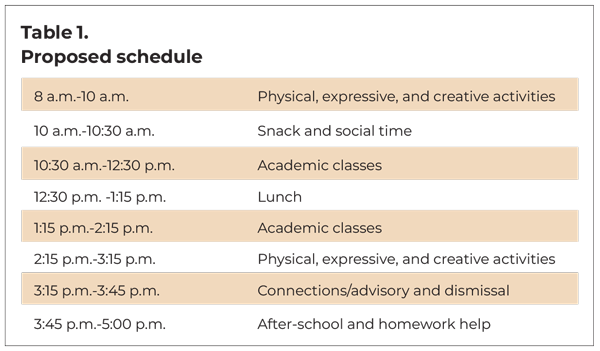
Too many students have turned their backs on school because the structure isn’t working for them. If schools are going to have to continue addressing so many different needs, we need a different kind of school structure. Our proposed schedule for elementary and middle school students (see Figure 1) is a wraparound day that separates academic work into two blocks that focus on foundational skills, content exploration, and projects that put it all together. Instead of adding more and more academic time, this model prizes quality over quantity.
Each day begins with breakfast followed by physical, expressive, and creative activities from approximately 8 a.m. to 10 a.m. Partner organizations from the neighborhood or community lead activities such as cooking, sports, theater, art therapy, music, outdoor adventure, small-group counseling, gardening, and community connections while teachers use the time for planning and small-group or one-on-one tutoring. After a healthy snack, students who are now fully awake and fed attend academic classes for the next two hours.
During the 45-minute lunch, students sit with adults and friends to eat a nutritious meal, family-
style. This is in contrast to the frenzy of so many school lunch periods. After lunch, students return to academic classes, followed by physical, expressive, and creative activities for another 90 minutes while teachers are planning and training assistant teachers. The day ends with an advisory period when students can get specific help from teachers and counselors.
Teachers need enough time to deeply plan for individualized instruction and to get to know their students well. They also need time to work with one another to discuss the complex art of teaching and the specific needs of their students. Within this model, teaching time is only about 3.5 hours a day, but those two academic blocks are absolutely sacrosanct for academic work. The meal and snack breaks and separate time for physical and creative activities help ensure that students are nourished and able to engage in activities that promote physical, creative, social, and emotional growth.
Academics are project-based (students are actually building and making), and they incorporate skill development based on individual needs. Because students’ individual skills differ, they receive a great deal of one-on-one attention. Some are reading fluently by 3rd grade, and others need much more targeted instruction. By 7th grade, these differences become even more pronounced. Teachers work with highly trained assistant teachers, and no class is larger than eight students. Currently, teachers are leaving the profession because the job has become impossible. Smaller class sizes and more manageable responsibilities could make the job feel less impossible and the profession more attractive.
The small class sizes and use of assistant teachers enable teachers to better individualize instruction. All students would be taught essential foundational numeracy and literacy skills. Because these skills are usually so varied among students, they can be best taught through direct instruction delivered in small groups or one-on-one. The larger groups would be for more project-based work, determined by student interest and enabling students to develop 21st-century skills like communication and critical thinking. This approach means students can own their own learning, which empowers them to be even more successful. Focusing on opportunities for success, rather than just labeling students by a test score, can begin to change narratives of failure for both students and schools.
Our schedule relies on the partnership of many other adults from local community-based organizations. These adults play crucial roles for our students and offer funds of knowledge that are critical for positive youth development. By incorporating these organizations and separating out the blocks for academics, we believe that teachers and students will begin to access what they need to thrive.
Examples to build on
Although to some this may seem like a radical reenvisioning of school, we know of schools where similar models have been successful. Specifically, schools that work with young people on the margins often have more room for experimentation, and we should learn from them.
At the High School for Recording Arts in Minneapolis, for example, young people work with teachers they call facilitators of learning, each of whom is responsible for a different aspect of their students’ development (Lipset & Nathan, 2021). Many of the students previously had negative experiences of school and are returning to school after long absences, and the school uses the recording arts to tap into young people’s passions related to music. Students learn skills necessary to succeed in recording arts and other creative endeavors while moving through an academic schedule geared to meet their needs.
Boston Arts Academy (BAA), which Linda founded and where she served as headmaster for many years, makes a similar bargain with young people (Nathan, 2020). Students spend half the day in their specific arts curriculum, for which they have expressed a passion, and the other half in academics. All the arts curricula include a theoretical component, so students learn what’s behind the making of art. As they grow in skill and knowledge in their arts major, students feel an enormous sense of pride in their development. The school also offers three career and technical programs (design and visual communication, multimedia entertainment production, and fashion design), and many students leave these programs with a certificate and can get a job right away.
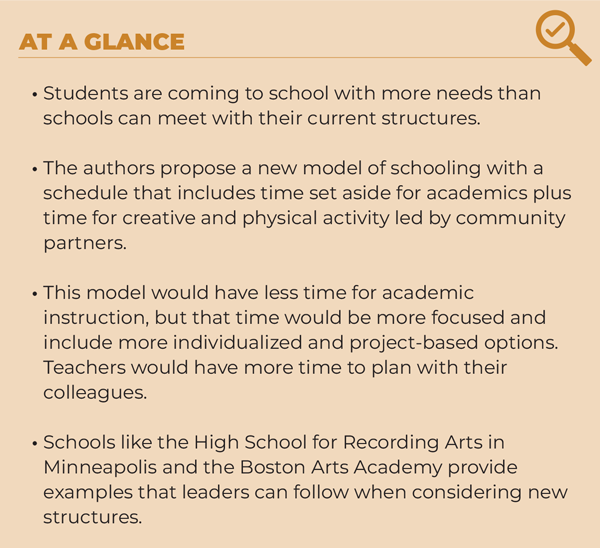
It is critical to listen to educators’ experiences to develop solutions that will, finally, once-and-for-all ensure that the optimistic rhetoric of schooling matches the on-the-ground reality.
Humanities IV, a small arts-centered high school in New York City, inspired in part by BAA, requires all students to complete a senior project that combines their academic and artistic interests to focus on an issue in their community. Students have tackled immigration, climate change, school uniforms, and awareness of the unhoused among their issues. These projects give young people the opportunity to see real connections between school and social issues and to experience the power of knowledge, research, and communication.
Schools like Boston Day and Evening Academy get students involved with almost every decision at the school. They have choices about how to move through the curriculum, engage in supplemental curricular activities, and spend time with peers and adults in nonacademic settings. Even though many students come to the school without having earned the academic credits generally expected of students their age, being treated like the young adults that they are helps them begin to take control of their lives.
Personalized approaches also work for young students. Maria Baldwin Elementary School in Cambridge, Massachusetts, embraces joy, belonging, challenge, and growth as core to its mission and curriculum. The principal asks everyone who visits the school to provide feedback on whether they see evidence of those values and qualities for every student. She and her team want to know whether all students, especially those who have historically been the most marginalized, are part of this vision. Outdoor education experiences are central at this school, and the faculty has adapted these experiences to meet families’ specific needs. Before the pandemic, students participated in overnight outdoor education trips, but now parents are more reluctant. Rather than canceling the trips, the school partnered with organizations to provide daylong trips for all students while continuing to offer some overnight experiences in locations that are nearby enough that families can pick up their children at 10 p.m. instead of having them stay overnight.
What must change
Unfortunately, our capitalist society does not offer our students an even playing field. People with privilege continue to advance more and more, while our students play catch up. The answer during the “no excuses” era was to drill down and add double English and math classes that focused on the skills necessary to ace the tests. Some schools did get results, but they often were short-lived and insufficient.
We know school is a microcosm for society. And we know that big changes are needed to address our big problems. Here’s our short list of how we might start:
- Recognize that schools cannot do this work alone. Many other systems outside education must change and coordinate with schools.
- Commit to providing the resources so that schools have small class sizes, therapeutic support, and the artistic and physical education that they need. There is no equity without this.
- Give teachers the opportunity for deep professional learning. We might say that all teachers are reading teachers, but we aren’t helping them understand what that means.
- Rethink the relationship between social-emotional learning (SEL) and academics. SEL cannot be an add-on but must be an integral part of the school day. What do we give up to make this happen
- Rethink accountability systems that focus on test scores on academic subjects and find ways to show that we value such essential skills as empathy, problem solving, or collaboration as much as we value reading and math — but without adding more tests.
- Unpopular as this might sound, consider embracing the idea that less is more and valuing depth over breadth. Can we agree to a handful of essential concepts and not require absolutely everything?
- Give young people multiple opportunities in the day to build, make, and move: Art and physical education are critical for healthy human development.
- Honor the professionalism of teachers by giving them adequate planning time and small class sizes.
Recently, as Ayesha was preparing for a field trip, one of her 8th graders came into the office. “Miss, I can’t go today. My sister died.” Ayesha looked up from sorting the field trip forms. “We went to the emergency room. She turned red. She died.” The sister was nine months old.
“I’m just so sorry,” Ayesha said as she hugged her. In the next minute, the young girl had to go to class, and Ayesha had to continue to corral kids for the field trip. There are no sufficient words for this level of stress and trauma for teachers or students, and this is an all-too-typical story. We need to stop reproducing what isn’t working.
References
Lipset, M. & Nathan, L.F. (2021). When school goes home: Reimagining the educator’s role. Phi Delta Kappan, 103 (3), 39-42.
Nathan, L.F. (2020). Joyful learning at scale: Immersing students in the arts. Phi Delta Kappan, 101 (8), 8-14.
This article appears in the March 2024 issue of Kappan, Vol. 105, No. 6, p. 26-31.

ABOUT THE AUTHORS

Linda F. Nathan
Linda F. Nathan is a leadership coach and a professor at the Harvard Graduate School of Education, Cambridge, Massachusetts, and Cambridge College-Puerto Rico.
Visit their website at: www.lindanathan.com
Lydia Cochrane
LYDIA COCHRANE is the principal for preK-3rd grade in a preK-8 public school in rural Vermont.

Ayesha Hoda
AYESHA HODA is the middle school academy leader at a grade 7-12 school in an urban district in Massachusetts.