In addition to extra coverage about the COVID-19 crisis, education outlets and teams are producing all sorts of special sections, reader callouts, and rebranded sections.
By Jenny Manrique
At least 124,000 U.S. public and private schools and 55.1 million students have been affected by the COVID-19 pandemic, according to the National Center for Education Statistics.
Education and non-education news outlets are trying to respond with a variety of new offerings to help students, parents, and educators cope with the effects on both public and private education.
“Newsrooms have to rethink what information is useful, what scrutiny is required, and what larger questions aren’t necessarily being asked yet because we’re just struggling to get through each day,” Steve Snyder, editor-in-chief of The 74, told The Grade in an email. “We are anticipating where things will be one month, one semester, and one year from now.”
Here’s a sampling of the special COVID-19 education features The Grade found, organized by category:

Above: In response to the COVID-19 school shutdown, education outlets and teams have produced extras and specials including standalone sections, new series, reader callouts, and even comic books.
Asking students to tell their own stories.
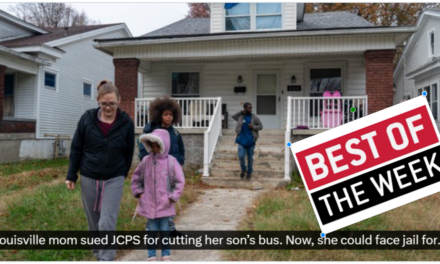
Callouts to students have been one of the most common approaches we’ve seen in the past few weeks:
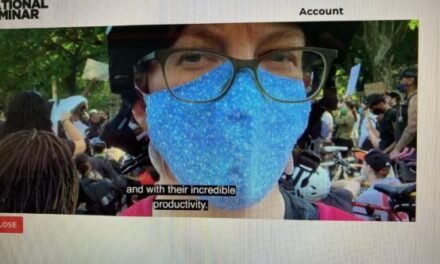
The New York Times’ Coronavirus Resource Page for Students, a part of its Learning Network, has asked students to share their experiences about living through a pandemic.
The 74’s “Student Voice” series features high school students’ takes on their experiences, too, including this gem by a California high school junior, Hope Li, who wrote a post headlined, “Barking Dogs, Breathing Exercises and Eckhart Tolle — Diary of My First Day of ‘Social-Distance’ Learning at Sunny Hills High.”
She gave readers a sense of her mood, writing, “As I worked my way through that glitchy first day, it occurred to me that in small ways I was suddenly being asked to rearrange the circumstances of my life.”
ICYMI: The case for (more) COVID-19 collaboration
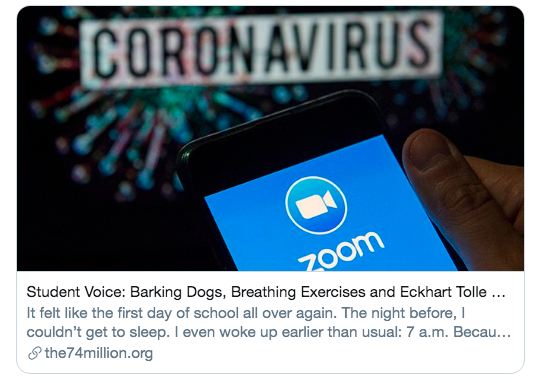
Above: The 74 is among several outlets and teams that have set up COVID-19 pages and reader callout sections.
Creating special sections
Special sections are another way news outlets have responded to the crisis.
The 74 now runs a special coronavirus section that includes photo essays, practical homeschooling tips for parents, lessons learned from school leaders, and a roundup on Coronavirus Must-Reads that the team expects to update weekly.
The Hechinger Report also launched a special section, which features its reporting and readers’ stories. Liz Willen, Hechinger’s editor-in-chief wrote in an email to readers that a recent story of a premed (and pregnant) community college student, who lacks access to a laptop, prompted a “compassionate reader” to donate a computer.
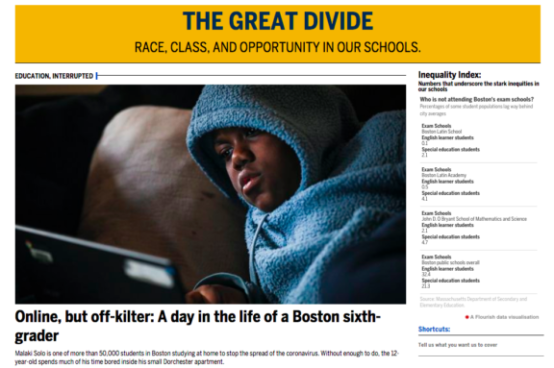
And last weekend, the Boston Globe launched Education Interrupted, an ongoing series as part of its investigative project The Great Divide. Reporters will be looking at how school closures are affecting students in the wake of the pandemic. Its first piece explores the nuances of a day in the life of a Boston 6th grader.
ICYMI: Journalists push to report student participation in remote learning

Above: The Boston Globe has announced a new series, Education, Interrupted, focused on the impact of the school shutdown.
Mapping it out
Maps and other forms of data visualization have been popular elements of COVID-19 coverage. In an example that’s been widely admired, Education Week updates daily a national interactive map detailing school closings. The California-based nonprofit EdSource compiled a list of schools in the 942 districts of California with dates of closures and potential reopenings.
And Chalkbeat designed a map that shows the Denver metro area food distribution sites where families can get breakfast and lunch for children ages 1 to 18. This is a critical effort in a city where 64 percent of students are eligible for subsidized meals. The story is also available in Spanish.
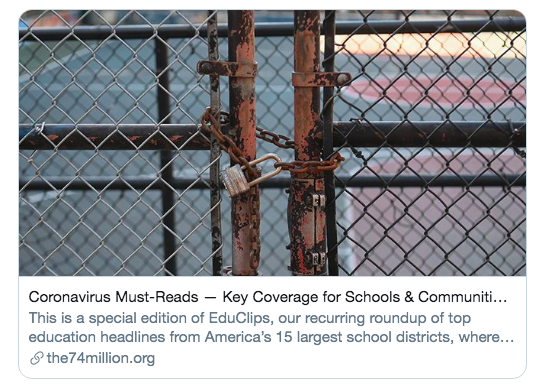
Above: The 74’s weekly “coronavirus must-reads” is a collection of COVID-19 coverage, organized by subtopic.
Readers ask, reporters answer.
EdNC, an education news outlet serving North Carolina, created Ask & Answer, where readers can submit a question that a reporter will then answer after some sleuthing. Questions and topics have included the North Carolina governor’s executive orders and changes to state education policies, like this one explaining school district recommendations for continuing the 2019-20 school year.
“It became clear to me that our audience needed quicker access to primary sources redefining the contours of their lives”, said Mebane Rash, EdNC’s editor-in-chief, who noted how her publication embeds the sources in the feature for readers’ benefit.
Podcasts, cartoons, and more
EdNC also began producing Hope Starts Here, a weekly podcast that surfaces good news stories in the education space hosted by engagement reporter Alli Lindenberg. And special episodes like this of CNN’s Coronavirus: Fact vs. Fiction With Dr. Sanjay Gupta, guide parents on how to talk to kids about the outbreak.
NPR’s education correspondent, Anya Kamenetz, and NPR’s art director, LA Johnson, teamed up to produce a comic for families to teach them how to turn their home into a school “without losing your sanity.”
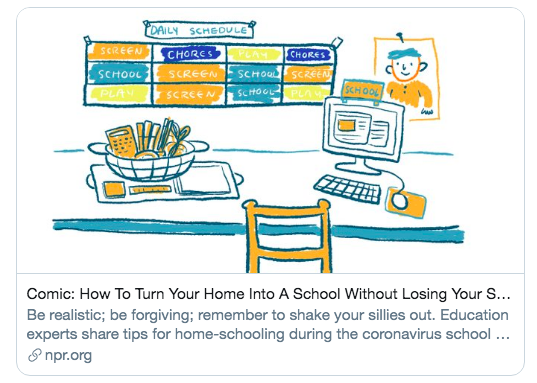
Above: NPR’s national education team published a comic to help parents and children survive the school shutdown and the realities of remote learning at home.
Expanding resources for kids, KERA, the public media service for North Texas, created a special “At-Home Learning Toolkit” on their education website “with content ranging from free lesson materials to resources for keeping children engaged, active and happy at home,” said Andy Canales, director of operations and communications at KERA. The collection includes remote-teaching resources and infographics and videos to help children understand how to care for their health and emotions.
The Education Writers Association has created a new Coronavirus and Education Topics page and is airing podcast episodes where reporters on the front lines offer insights on the impact of the virus for the education systems in their communities. It also has launched a series of webinars to help journalists understand the complex issues at play amid the pandemic.
Education outlets, such as EdSource, are adding new content about the coronavirus to their existing newsletters, but overall, education teams seem to be putting most of their energy into in-depth coverage of remote learning rollouts.
Related coverage:
Journalists push to report remote participation
Newsroom flexibility is key to COVID-19 education coverage
ABOUT THE AUTHOR

Jenny Manrique
Manrique is a freelance reporter who has covered human rights in Latin America and the United States for almost two decades. She previously worked at the Dallas Morning News covering education and immigration issues and covered national politics for Univision. Her work has been published in many publications, including The New York Times, The Boston Globe, CNN and other outlets both in English and Spanish. Follow @jennymanriquec on Twitter.