#CoveringCOVID19, a daily update to help education journalists cover the massive impact of the shutdown of the nation’s schools.
THE CASE FOR COLLABORATION
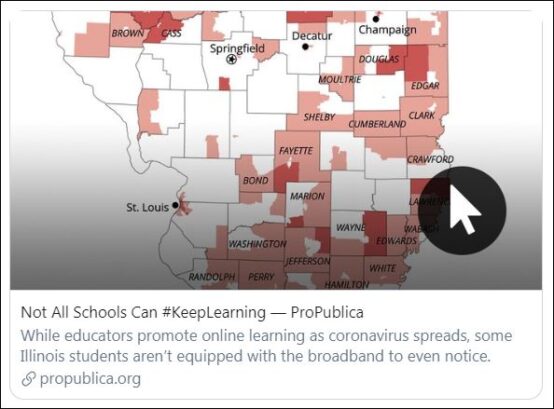
Above: A recent collaboration between the Chicago Tribune and ProPublica IL.
Reporters and media outlets are competitive by nature, rather than collaborative. Getting the scoop is a near-universal goal. But collaboration can be extremely effective, both inside and among different newsrooms, especially when the story is as big as the nationwide shutdown of schools.
Certainly, within newsrooms, reporters frequently team up for a multiple-byline story that combines their strengths. The Houston Chronicle’s Shelby Webb and Jacob Carpenter co-wrote wrote this recent story about the digital divide. The Washington Post’s education reporter Laura Meckler and health reporter Lena H. Sun worked together on a story about the school closings decision last month.
But in terms of collaborations between two different news outlets, the pickings are slim. One nice example was this morning’s WNYC segment about remote learning in NYC, featuring Chalkbeat’s Alex Zimmerman and WNYC’s Jessica Gould. The two education reporters did much better describing the story than I think one could have alone. Another example is the ProPublica Illinois- Chicago Tribune collaboration, which recently found that remote learning was just not going to work for many Illinois students.
But it’d be great to see more collaboration, especially since the story is so big and everyone’s so short-staffed. These could be regional, as with WNYC and Chalkbeat, or statewide, as with ProPublica IL and the Tribune. Or even – dare I dream it out loud? – a collaboration among national news outlets that would help provide better, deeper coverage for readers than even the largest newsrooms can produce on its own.
THE TOP FIVE
Here are five great education stories about how schools are responding to the COVID-19 crisis:
🏫 Thousands of Philadelphia students are stuck at home with no computer or internet – Philadelphia Inquirer
🏫 Austin school district cafeteria worker dies after contracting the coronavirus – Austin American-Statesman
🏫 Launching online learning at L.A. schools during coronavirus is ‘akin to landing on the moon’ – LA Times
🏫 Chicago estimates 115,000 students need computers for e-learning – Chicago Tribune
🏫 For schools, a new challenge: How to feed students during spring break? – Washington Post
PRE-COVID CONTEXT
One of the most important things to include in your COVID coverage is some context about the learning situation students faced before the pandemic caused the schools to shut down. Otherwise, a reader dropping into the story might think that the current remote learning shitshow is something new, that students received the high-quality instruction and materials that they needed until just a few weeks ago. In too many places, that just wasn’t the case. You know that. But your readers might not.
NEW COVID ANGLES
I’m still wanting to see more big-picture information on how the rollout of these remote learning programs is going. But if you’re looking for new education angles on the COVID story, some that I’ve seen include the shutdown’s effects on student teachers (who would normally be doing their classroom training right now) in USA Tody, speculation about teacher shortages in the future (combining my two pet peeves in all of education journalism), and strange new programs for teaching languages, etc. A few stories that I haven’t seen that seem worth checking into include the impact of the shutdown on retirement-age teachers, who may never enter a classroom again, and the impact of the shutdown on pre-COVID initiatives surrounding school discipline reform, integration, and improving reading instruction.

TIDBITS
😷 Kudos to the Seattle Times’ Paige Cornwell, whose effort to help furloughed colleagues, written up in Poynter, has generated thousands of dollars. There’s clearly a need. Poynter’s Kristen Hare is keeping a list of newsroom layoffs, furloughs and closures that have been taking place over the past few weeks.
😷 Cleveland Scene reports that, as part of a major downsizing, longtime Cleveland Plain Dealer education reporter Patrick O’Donnell will be moved off the education beat.
😷 Earlier today, we published Bekah McNeel’s description of how hard it is to get remote learning attendance figures, often called logins, and why they are important enough to push to get.
😷 So long to NPR’s public editor Elizabeth Jensen, who weighed in on several education-related media issues over the past five years, including feel-good coverage of the DC Public Schools. She recently announced that she was stepping down. You can read her farewell note here. Poynter’s Kelly McBride, whose work is often cited in The Grade, was just named as her replacement. McBride recently talked to The Grade about transparency and disclosure for education reporters in unionized newsrooms.
That’s it! See you back here tomorrow. Sign up for the weekly email, Best of the Week, which comes out Fridays around noon Eastern.
ABOUT THE AUTHOR

Alexander Russo
Alexander Russo is founder and editor of The Grade, an award-winning effort to help improve media coverage of education issues. He’s also a Spencer Education Journalism Fellowship winner and a book author. You can reach him at @alexanderrusso.
Visit their website at: https://the-grade.org/