A network of public schools engages high school students by allowing them to explore their interests through internships and projects that prepare them for life beyond graduation.
Students at the Metropolitan Regional Career and Technical Center describe their previous schools in stark terms: buildings damaged by vandalism and neglect where they don’t feel safe.
Some students have had “terrible school experiences,” says Nancy Diaz, co-director of the Rhode Island high school known as The Met. “As soon as the kids come in, we want them to know it’s a different place and there’s different things that are happening.”
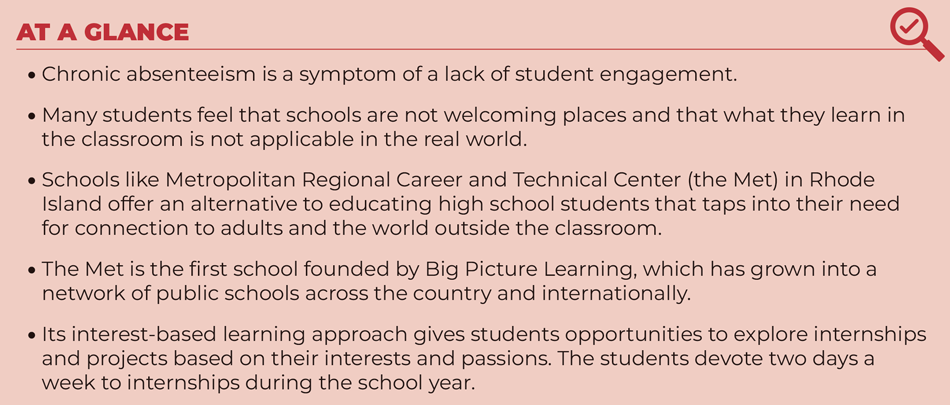
The Met is a public high school with campuses in Providence and Newport that is open to all Rhode Island students. Elliot Washor and Dennis Littky founded the Met in 1995 in part to address student disengagement in high schools. Their reforms include small classes, adults assigned as advisers and mentors, and interest-based learning. The latter involves all students participating in internships and projects in their communities.
“Educators have to realize that learning happens both in and outside of school,” Diaz says. “We support kids from right from the beginning as 9th graders to get their internships so that they really feel that this school is different.”
Student disengagement
Students disengage from school for myriad reasons, personal and institutional. School can seem unsafe and uncaring. Students feel anonymous and unseen by their teachers and other adults. They see little to no connection between what they are learning and the real world.
When school isn’t a place where students want to be, they respond. Student disengagement shows up as chronic absenteeism and high dropout rates. Even students who show up every day disengage by doing the minimum necessary to pass their classes.
Transcend Education’s Leaps Student Voice Survey of more than 100,000 students nationwide found that students who report positive experiences in school are 25% less likely to be chronically absent than students who dislike their school experiences.
The current post-COVID spike in absenteeism has the attention of educators and policy makers, but the issue predates the pandemic. However, federal- and district-level responses focus too much on intervention and not enough on prevention, Washor says. The federal government’s response is to hire more truant officers or counselors to get students to return to the school they left. He says that the response should be to ask, “How do you engage kids around their interests, so they want to come back to school?”
How schools respond to absenteeism can make the problem worse. “You missed 10 days of school. You get an F,” says Washor. “There’s no humanity in that. We should ask, why? What’s going on? Why were you absent?” Interventions are “not the way our system should run. You should know the students well enough to stop a lot of stuff before it happens.”
The big picture
The Met was the first school of Big Picture Learning, the nonprofit Washor and Littky set up to make their reform model available to more students and schools. Big Picture Learning is now a network of 110 schools in 27 states. Some are classified as alternative schools. All are public schools. The network also includes schools in Australia, the Netherlands, Belize, Italy, India, Canada, and other countries.
The Met is well-known throughout Rhode Island, with a reputation for being a physically safe school with a welcoming environment that prepares students for college. It has a 95% graduation rate. The total minority enrollment is 80%, and 73% of students are economically disadvantaged.
New students often are surprised by the atmosphere of the school, says Diaz. “They don’t expect school to be fun. They don’t expect staff to be happy and welcoming. School doesn’t have to be this place where people are unhappy.”
Classes are made up of about 16 students (in contrast to the 30 or more students per class in comprehensive high school classrooms). The students stay together for the four years of high school with the same teacher/adviser. They spend time getting to know each other and their teacher.
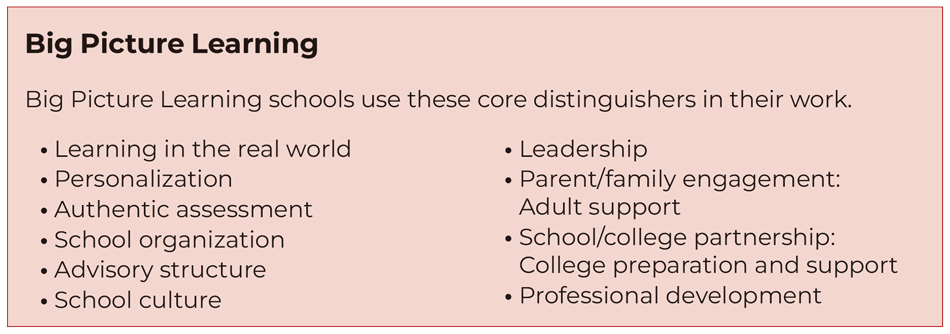
Early in the school year, students participate in a learning plan meeting with their parents. Through this meeting, the staff aims to uncover the students’ interests and goals. They work with the students and their parents to figure out their strengths and where they need to improve and grow. This establishes their individualized learning plan, which helps guide the students to choose projects and internships that most interest them. Advisers make sure the students are getting the instruction in the core subjects that they need for their internships and so they can attend college if they choose.
Connections to adults
Students crave connections to adults, and making those connections is a key part of what the Met offers. Advisers spend four years with their students, getting to know and understand them. They help students create projects and choose internships that best suit their interests and goals. They are available when problems outside academics come up, too.
When students leave campus for internships, advisers provide support and oversight. Internship mentors commit to three-month internships, and the student goes to the site two days a week. Advisers work with the mentors to create the student project, “making sure that the student is learning and excited about being there,” says Diaz. “It’s the adviser’s job and role to make sure that the kid is safe, learning, and being challenged.”
The adviser and mentor create a learning plan for the internship, which may include a list of books that students should read and a checklist of things that the student can do when the mentor is busy. The adviser follows up with site visits and conversations with the mentor and student throughout the internship.
The internship mentors provide another form of adult relationship for the students. They connect students to the community and the world outside school, connections that are invaluable to students, especially those from economically disadvantaged backgrounds.
Internships can extend beyond three months, and some students end up being employed by their mentors after school and during the summer. Students begin to grow a network of people who will support them throughout high school and beyond.
“Adults want to work with young people who are interested in what they’re interested in. It happens all the time, and it happens, whether schools are part of it or not,” says Washor. Through these internships, “young people [are] finding meaning in their lives, in their communities, working with adults.”
Internships at work
Students build skills during their internships that connect with what they’re learning in the classroom. Even the process of finding internships gives students a chance to learn so-called soft skills. They must research potential sites, and they call and schedule interviews. They create their own résumés and tour internship sites before they apply to make sure it’s a good fit. Once they interview and like the place, their adviser sets up a day to shadow their potential mentor. “These kids have options to make decisions, and for the first time, they’re making the decisions,” says Diaz.
The Met has a network of more than 6,000 internship sites. “We have kids everywhere,” says Diaz. They intern with doctors, physical therapists, lawyers, dog groomers, veterinarians, horse trainers, theaters, restaurants, and caterers. Students go to businesses that restore furniture or do construction and manufacturing. Other businesses include hospitals; ship builders; cyber security; and local government offices, such as the department of transportation. They learn about glassblowing, computer science, and architecture.
Students are exposed to many new opportunities, some of which they will love and some of which they will not like. They also see their peers going to different internships, which is beneficial, too. Many students from disadvantaged backgrounds don’t know about other options beyond what they see every day. Diaz points to an example of a student who wanted to go into daycare, “which is fine if that’s what you want to do,” she says. But one of her friends was in marine biology, and she realized that she wanted to explore this path, too. She ended up attending college and becoming a marine biologist. “Unless you give students the exposure and experience, they never know about other options,” Diaz says.
Traditional high schools don’t give students as many choices as The Met, and the structure makes connecting with teachers and other adults difficult. Teenagers crave independence, which isn’t promoted to the same degree in more traditional schools or classrooms. Schools restrict students’ movements throughout the school day. “Schools are not very democratic places,” Washor says. “You don’t have much choice, and they’re not places where you can exercise your agency because you’re not connected to the world outside of school.”
Washor wishes more schools would adopt the reforms that are in place in Big Picture schools. The traditional high school model doesn’t work for many students, which is why attempts to solve chronic absenteeism sometimes fail. “We’re still locked into English, math, science, social studies — a narrow band of how you are smart delivered in a text-based approach to education,” he says. “And that’s not the only way.”
This article appears in the November 2024 issue of Kappan, Vol. 106, No. 3, p. 28-31.

ABOUT THE AUTHOR

Kathleen Vail
Kathleen Vail is editor-in-chief of Kappan magazine.
Visit their website at: https://pdkintl.org/