The emergence of large language models requires us to rethink the purpose and place of writing in school and society.
When calculators became widespread, many feared they would cause students to lose their mathematics skills. However, a more significant issue had already long been present: Many students did not see the value in learning any more algebra than was required for college admission (diSessa, 2000). Calculators presented a dual potential: the potential to de-skill students and the potential to empower them. To empower students, we needed to give them a personal reason to care about algebra and to teach them ways to use calculators to enhance their mathematical understanding and creativity beyond what was possible without them.
We now face the calculator dilemma in a new context: writing. Large language models (LLMs) have the potential to reduce people’s writing skills. However, here, too, many people already do not see a compelling personal need to learn to write, especially in more formal, academic, and specialized registers. The impact of LLMs on people’s writing skills will depend on our ability to provide them with a personal reason to care about writing and to teach them ways to leverage LLMs and other generative artificial intelligence (AI) tools to enhance their cognitive, social, and emotional understanding and creativity beyond what is possible without them.
The dilemma LLMs pose is deeper and more consequential than that of algebra and calculators. Calculators are limited to calculations; they do not think, communicate, or interact with humans. In contrast, LLMs do more than generate text; they simulate understanding, provide coherent responses, and interact in ways that can shape human thought and communication.
Literacy in the age of AI
To ensure that LLMs help humans flourish, we must develop approaches to writing and writing instruction that emphasize the value of writing beyond securing jobs that require specific genres of writing, something LLMs excel at. We need to help people discover authentic reasons to write that resonate with their interests, experiences, and aspirations. And we must enable learners to collaborate with LLMs and other AIs in ways that make both the human and the AI more ethical and wiser.
In the context of the New Literacy Studies, “literacy” extends beyond the conventional ability to read and write to encompass our social contexts (Gee 1990/2015, 2000; Street 1984, 1997). It is not just a cognitive skill but involves how we interact with texts and engage in discourse in various communities. Generative AIs represent a new form of “literacy” that will integrate with and transform existing literacies, including traditional ones.
A new form of AI literacy will embody a true partnership between AI and humans. In this partnership, both parties work together to enhance each other’s strengths, address weaknesses, and achieve results neither could reach alone. Although this set of practices is still emerging, various experiments are exploring how humans and AI interact through language and writing.
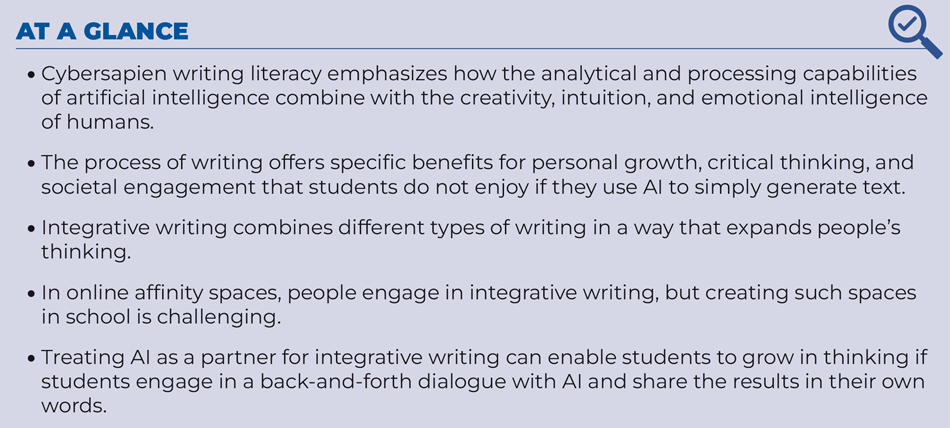
This emerging literacy, which we call “cybersapien literacy,” encompasses the new possibilities arising from the synergistic partnership between human and AI. It combines the analytical and processing capabilities of AI with the creativity, intuition, and emotional intelligence of humans. There will be many forms of cybersapien literacies. We can refer to the writing-focused one as “cybersapien writing literacy.”
Why write?
Writing, in history and personally, creates a tangible record of thought that writers can revisit, revise, and build on over time. Numerous scholars have argued that the act of writing raises our conscious awareness about language structure and use.
Extensive scholarly literature suggests that the shift from a purely oral culture to a written one restructured human consciousness and brought about new cognitive capabilities (Goody, 1977; Havelock, 1976; Olson, 1996; Ong, 1982). Lev Vygotsky (1987), particularly in Thought and Language, highlighted how writing and other symbolic tools promote the development of higher-order thinking skills. More recently, Deborah Brandt (2001), in Literacy in American Lives, demonstrated how writing helps individuals become more aware of language structure and usage, leading to deeper cognitive processing. Additionally, Maryanne Wolf (2008), in Proust and the Squid: The Story and Science of the Reading Brain, argued that the act of reading, and by extension writing, changes the brain’s neural circuitry, enhancing cognitive capacities such as critical thinking and empathy.
The New Literacy Studies movement and others have argued that this literature was often too general and overly cognitive (Gee, 2004; Graff, 1987; Scribner & Cole, 1981). Scholars within this movement contended that different types of writing have distinct cognitive, interactional, social, and emotional effects. These effects are influenced by and, in turn, influence the social and cultural contexts in which the writing operates.
To get anyone to learn anything, especially something like writing that takes a good deal of time and effort to learn well, we must make them feel there is value in the learning. Because the effects of writing on the writer differ depending on the type of writing and its context, we must understand how different types of writing exist in schools and how they benefit the writer.
Four types of writing and their benefits
In today’s rapidly changing world, where technology, media, and complex crises and challenges shape our lives, four essential types of writing are crucial for personal growth, engaged citizenship, and resilience in the face of change. These positive effects are not inevitable; they require the creation of contexts in which they can arise and which they then can transform.
Expository and argumentative writing
Mastering expository and argumentative writing can empower individuals to think critically, evaluate evidence, and make persuasive arguments. This type of writing can foster independent thinking, informed decision-making, and resistance to manipulation. Learning to address counter-
arguments can also promote the writer’s empathy and nuanced understandings essential for constructive dialogue in a diverse society. Expository and argumentative writing can equip individuals to engage in public discourse, drive social change, and advocate for their values while respecting others’ perspectives.
Creative writing
Creative writing can be a tool for personal growth, self-expression, and empathy. It can cultivate deep thinking, emotional resilience, and innovation by giving the writer space to set aside conventional thought patterns and envision new possibilities. Exploring their own and others’ inner lives through creative fiction or nonfiction can develop writers’ emotional intelligence, enable them to build strong relationships, and promote effective communication. Creative writing also can help individuals process life’s challenges, offering catharsis and emotional clarity and enhancing their resilience and adaptability.
Dialogic and collaborative writing
Dialogic and collaborative writing, in which writers respond to others’ writing or work on a project together, can foster intellectual growth, social connection, and collective problem-solving. It can challenge individuals to think critically, engage with diverse perspectives, and refine their reasoning. Collaborative writing projects can teach cooperation, communication, and teamwork, cultivating writers’ intellectual humility and open-mindedness. By exchanging ideas and leveraging others’ strengths, writers can solve complex problems collectively and build empathy and social connection.
Reflective writing
Reflective writing can be important for personal growth, self-awareness, and intentional living. By examining their thoughts, feelings, and experiences in writing, individuals can deepen their understanding of themselves, clarify their values and priorities, and develop emotional intelligence. Reflective writing can foster a growth mindset, promote mental health, and enhance decision-making and problem-solving. Such writing could well be seen as a crucial 21st-century skill, enabling individuals to thrive amid rapid change and stay grounded in their humanity while engaging with media and technologies.
Integrative writing
In all types of writing, the process of externalizing thought through writing allows for reflection, self-awareness, personal and cognitive growth, and skills for engaging productively with others and society as a whole. But more important, writing allows us to connect different ways of thinking. We don’t enjoy the true power of these four forms of writing when we isolate them, but when we allow them to interact with each other.
Integrative writing knits the different forms of writing and thinking into a single complex system and emphasizes the interconnectedness and mutually reinforcing powers of these different forms of writing and thinking. For example, reflective writing about one’s own experiences and perspectives can provide rich material for creative writing, while also surfacing assumptions and biases to examine through analytical writing. Similarly, dialogic writing that engages with others’ ideas can challenge the writer’s own views and prompt further reflective writing and revised analytical writing, while also providing fodder for imaginative play with different perspectives. The interplay between these different modes of writing creates a virtuous cycle of deepening insight and expanding possibilities.
It is ironic that while we worry — and should — about generative AI leading to frozen language and thinking, school assignments often do this very thing.
This integrative writing practice gives rise to expansive cognition, which builds in the writer a more fully realized self that can engage with the world in a more open, curious, and empathetic way. Positioning integrative writing as a pathway to expansive cognition can provide one compelling rationale for the value of writing in the age of AI. Rather than being rendered obsolete by AI tools, writing becomes even more essential as a means of developing the higher-order thinking skills and self-awareness needed to thrive in a world increasingly shaped by these technologies.
Where integrative writing happens
Schools do not appear to devote much time to engaging students in the four forms of writing for intrinsically meaningful purposes or to integrating them as a way to develop expansive cognition. While many teachers pay lip service to writing as a tool for personal development, assignments tend to center on expository essays and rarely relate and integrate the different forms of writing. Given current curricula and assessment systems, teachers may find it impossible to take a more integrative approach. However, this vision of writing already exists in the out-of-school learning systems called “affinity spaces” (Gee, 2017, 2018; Gee & Hayes, 2010).
Affinity spaces are digital and real-world spaces where people come together to engage in a shared interest. In these spaces, people young and old work together to produce knowledge, skills, and media. In the process, they use all our different forms of writing and integrate them in a variety of different social practices.
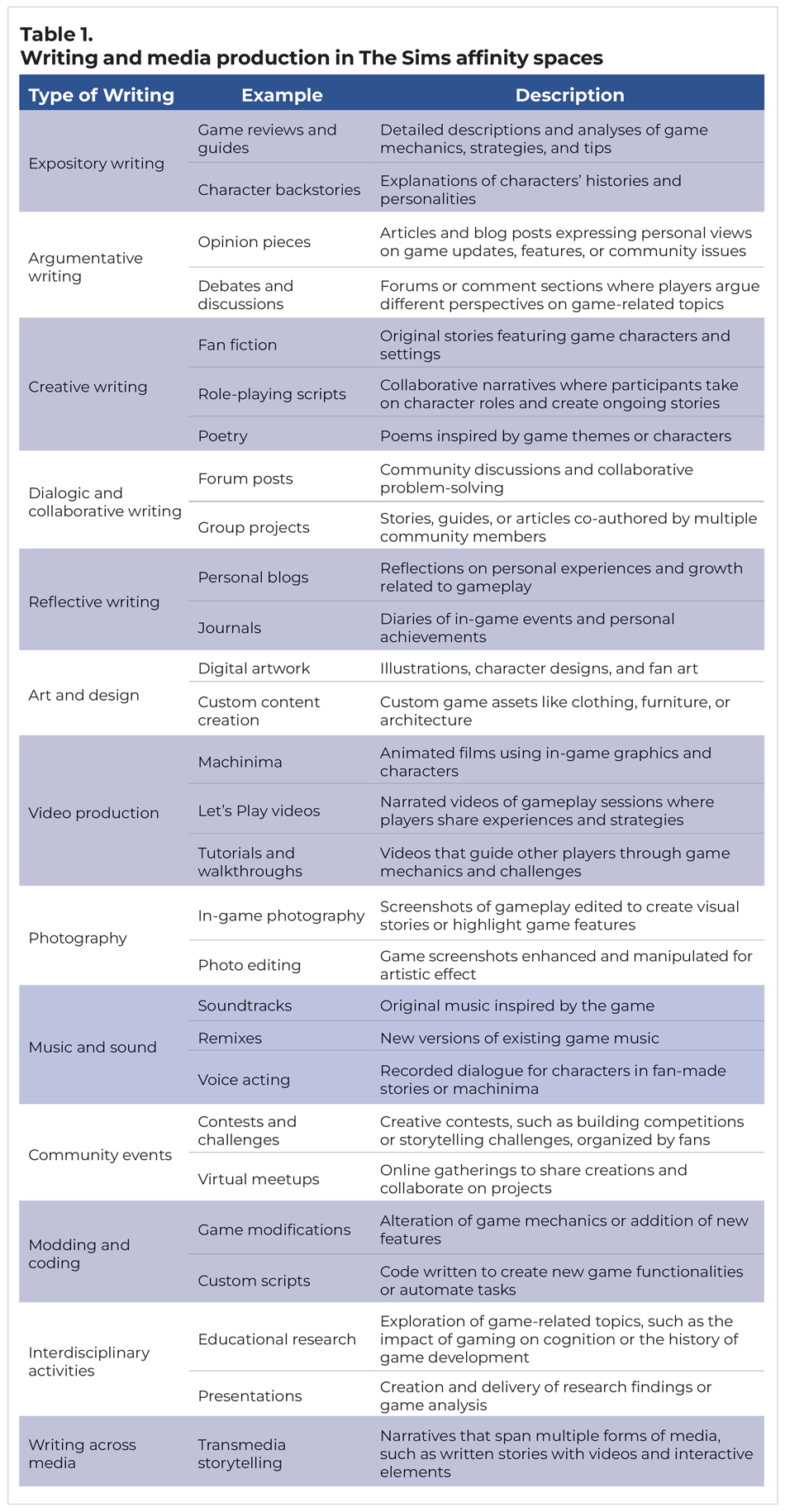
One such affinity space — sets of sites and events where people interact around The Sims — has been well studied. The Sims is a long-running best-selling video game series where players build their own families, neighborhoods, and communities. Many players go to one or more websites, social media sites, and physical locations where they can interact with others to produce writing and other media related to The Sims. These fans are not just consumers, they are producers as well. Table 1 shows the types of writing and other media production that participants in The Sims affinity spaces have engaged in (Gee & Hayes, 2010).
By engaging in these diverse activities, people in affinity spaces develop a wide range of overlapping skills while creating a social context and network of connections that motivates them to learn. People come to The Sims affinity space to accomplish a specific goal, such as to learn how to make original furniture for their simulated family’s home. As they interact with others to learn, their interest grows and sometimes becomes a passion.
People have tried to bring the rich, multimodal, and highly engaging practices of fan-based affinity spaces into traditional school settings, but they’ve faced several challenges. Those challenges include standardization, a focus on coverage, lack of individualized and small-group instruction, fears of the internet, and age-grading.
Encouraging the level of autonomy seen in affinity spaces would require a shift from traditional teacher-led instruction to a more facilitative role. People in affinity spaces progress at different rates, with the more experienced participants helping newcomers. Managing a classroom where students are engaged in different self- and group-directed projects can be challenging, especially with diverse learning styles and abilities. Having students in class linked to people outside class raises fears. And affinity spaces belong to young people’s cultures and must be implemented in schools in ways that do not colonize or co-opt those cultures.
What is the ‘right way’?
Integrating LLMs and other generative AIs into writing instruction is a promising way to create writing classrooms that are more akin to affinity spaces. For teachers, we want the AI to be a partner and colleague. For students, we want the AI to be at first a tutor and co-teacher and then, as students progress, to be a writing partner and colleague. To accomplish these goals, we need to set up interactions with the generative AIs and humans so that both parties learn and get smarter (and more ethical) without having their skills and lives diminished.
Of course, there is no one right way to accomplish this. Here, we offer one potential “right way,” with a hope of inspiring others to seek out additional effective paths.
Go back and forth with AI
First, rather than simply using LLMs to generate text, the human and AI should engage in a back-and-forth process of writing, reviewing, and revising. The human should proactively lead by providing goals, prompts, direction, and feedback, while the AI should contribute ideas, drafts, and suggestions. This iterative collaboration would allow for a deeper melding of human and machine perspectives.
In this back-and-forth collaboration, the human and AI should each focus on their unique strengths. Humans should bring their embodied lived experiences, their goals and desires, their feelings and emotions, and their social and cultural identities to the partnership. The generative AI will offer its vast background knowledge, rapid idea generation, and deep pattern-recognition skills. By playing to their respective strengths, the human and AI could achieve a synergistic effect. (It is ironic, perhaps, that school-based writing often does not make use of the most valuable assets humans bring to an AI-human partnership.)
Rather than simply using LLMs to generate text, the human and AI should engage in a back-and-forth process of writing, reviewing, and revising.
The writing process should involve not just creating text, but also reflecting on the process itself. The human and AI should discuss their thought processes, assumptions, and learning. This would allow both parties to gain deeper insight into their own and each other’s cognition and “nature” (the type of being they are).
The AI’s ability to generate multiple drafts and ideas rapidly enables students to explore a wide range of possibilities. The student would then curate and synthesize these options, using them as raw material for creative recombination that leads to novel ideas and connections.
Look for flexible language
One of people’s biggest fears about LLMs in school is that students will simply let the LLM do the writing, thereby engaging in a form of plagiarism. We need to know whether the student is being a true partner — even a leader — in their interaction with the AI. Early work by Jay Lemke (1990) offers one solution.
In his work on science education, Lemke made the distinction between frozen language and flexible language. Frozen language, also referred to as “fixed” or “authoritative” language, includes the standardized and slowly changing terminology and expressions used in scientific texts, textbooks, and formal communication. This language is often technical, precise, and intended to convey established knowledge clearly and unambiguously. It does not change easily and is often seen as the official way to talk about scientific concepts.
Flexible language, on the other hand, is more adaptable and conversational. It includes the more everyday language that students and scientists might use to explain, discuss, or explore scientific ideas in informal settings. This type of language is more dynamic, allowing for personal interpretation, creativity, and the negotiation of meaning. It is used in classroom discussions, collaborative problem-solving, and other interactive contexts.
Lemke argues that both types of language are essential. Frozen language helps maintain the precision and consistency necessary for formal communication. Flexible language is crucial for learning, understanding, and engaging with concepts in a personal and meaningful way. Students need to be able to move between these modes of language to fully grasp and apply knowledge. Basically, Lemke’s principle is that you do not know what something means unless you can say it in “your own words.”
Table 2 shows how frozen language differs from flexible language in the context of AI use. If students are using flexible language, it is likely that they are treating AI as a partner to enhance their thinking and writing, rather than simply having it do the work.
It is ironic that while we worry — and should — about generative AI leading to frozen language and thinking, school assignments often do this very thing. When education focuses too much on memorizing facts and precise terminology, students may miss out on opportunities to foster deeper understanding and critical-thinking skills.

Time and space for exploration
Schools too often rely on time-bound assessments of learning that assess all students uniformly at the end of a unit or course as if they all started from the same point. This method overlooks the fact that those who take longer to learn something may ultimately possess deeper knowledge and more robust skills. It overlooks the fact that someone who started “behind” may make much more progress than someone who started “ahead.”
Focusing on time disregards the significance of exploration in learning. It emphasizes a linear, upward progression through content. It fails to account for individual differences in interests, motivation, and preferred methods of learning.
Partnering with generative AI can provide each student and small collaborative group with their own tutor, co-teacher, and partner. Instruction can be individualized and based on achievements, not constrained by time or comparisons to others. Different individuals and groups can have different goals. The ultimate aim is not for everyone to pass the same test, but to prepare students for a lifetime of learning from and teaching others, fostering a community with shared knowledge suited for collaborative problem-solving.
References
Brandt, D. (2001). Literacy in American lives. Cambridge University Press.
diSessa, A A. (2000). Changing minds: Computers, learning, and literacy. CMIT Press.
Gee, J.P. (2000). The New Literacy Studies: From “socially situated” to the work of the social. In D. Barton, M. Hamilton, & R. Ivanic (Eds.), Situated literacies: Reading and writing in context (pp. 180-196). Routledge.
Gee, J.P. (2004). Situated language and learning: A critique of traditional schooling. London: Routledge.
Gee, J.P. (2015). Social linguistics and literacies: Ideology in discourses (5th ed.). Taylor & Francis. (Original work published 1990)
Gee, J.P. (2017). Teaching, learning, literacy in our high-risk high-tech world: A framework for becoming human. Teachers College Press.
Gee, J.P. (2018). Affinity spaces: How young people live and learn online and out of school. Phi Delta Kappan, 99 (6), 8-13.
Gee, J.P. & Hayes, E.R. (2010). Women as gamers: The Sims and 21st century learning. Palgrave.
Goody, J. (1977). The domestication of the savage mind. Cambridge University Press.
Graff, H.J. (1987). The legacies of literacy: Continuities and contradictions in Western culture and society. University of Indiana Press.
Havelock, E. (1976). Preface to Plato. Harvard University Press.
Lemke, J.L. (1990). Talking science: Language, learning, and values. Ablex Publishing.
Olson, D.R. (1996). The world on paper: The conceptual and cognitive implications of writing and reading. Cambridge University Press.
Ong, W.J. (1982). Orality and literacy: The technologizing of the word. Methuen.
Scribner, S. & Cole, M. (1981). The psychology of literacy. Harvard University Press.
Street, B. (1984). Literacy in theory and practice. Cambridge University Press.
Street, B. (1997). The implications of the “New Literacy Studies” for literacy education. English in Education, 31 (3), 45-59.
Vygotsky, L. (1987). The collected works of L.S. Vygotsky, Volume 1: Problems of general psychology. Including the volume Thinking and speech (R.W. Rieber & A.S. Carton, Eds.). Plenum.
Wolf, M. (2008). Proust and the squid: The story and science of the reading brain. Harper.
This article appears in the November 2024 issue of Kappan, Vol. 106, No. 3, p. 32-38.

ABOUT THE AUTHORS

James Paul Gee
James Paul Gee is Regents’ Professor, Emeritus, at Arizona State University, Tempe. He is the author of What is a Human? Language, Mind, and Culture (Palgrave Macmillan, 2020) and Teaching, Learning, Literacy in Our High-Tech, High-Risk World: A Framework for Becoming Human (Teachers College Press, 2017).
Qing Archer Zhang
Qing Archer Zhang is a lecturer at the Changzhou Institute of Technology in Changzhou, China.