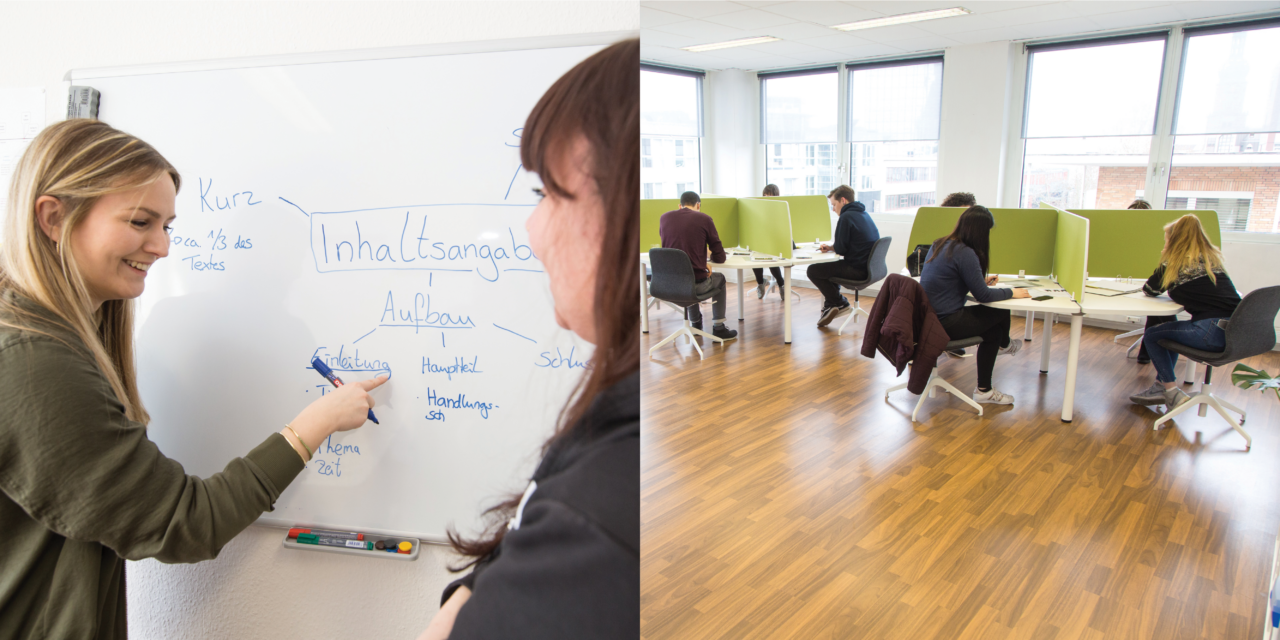
(Above) Every student attending PREJOB (one of Germany’s second-chance schools) can work in small groups equipped with anything they need or individually at their own table. PHOTOS COURTESY OF PREJOB DORTMUND
Germany’s second-chance schools give students experiencing homelessness opportunities to learn in ways that work for them.
Understanding absenteeism requires us to understand students’ circumstances outside school. Outside challenges can prevent regular school attendance just as much as — or even more than — challenges within school. This is especially clear in the case of homelessness.
Homelessness and its impact on schooling
According to the National Center for Homeless Education (NCHE, 2023), 1.2 million U.S. students experienced homelessness in the 2021-22 school year. More than 30 years of research suggests that students experiencing homelessness (SEH) perform worse at school and are less likely to graduate than their housed peers (e.g., Cowen, 2017; Kull et al., 2019).
Only 68% of youth experiencing homelessness graduate from high school within four years, compared to 85% of housed students (National Center for Education Statistics, 2019; NCHE, 2022b). Data suggest that graduation rates are lower for students experiencing homelessness than housed students from households with very low incomes. SEH also have worse school achievement (e.g., GPA, test scores) than housed low-income students (Cutuli et al., 2013). These findings suggest that something about the experience of homelessness — beyond simple low incomes — contributes to achievement and graduation gaps.
Joseph Murphy and Kerri Tobin, in a 2011 issue of Kappan, noted that unstable housing often leads to the growth of risk factors, which in turn have negative impacts on aspects of schooling. Lack of housing can, for example, contribute to absenteeism and school transfers, both of which predict lower graduation rates and achievement (Cowen, 2017; Tobin, 2016). The Institute for Children, Poverty, and Homelessness (2019) found that graduation rates of SEH hardly differed from those of their housed peers if they attended school regularly and never changed schools.
Homelessness and absenteeism
The realities of homelessness make regular attendance at school more difficult; SEH are significantly more likely to be absent than housed peers, including those from low-income families (Tobin, 2016). According to NCHE (2022a), nearly 37% of students experiencing homelessness were chronically absent in the 2018-19 school year, missing at least 10% of all school days.
Reasons for absences include mental and physical health challenges, as well as the reality that school attendance falls to the bottom of the priority list when basic needs are not met (Tobin, 2016). In addition, temporary shelter can be far away from school, leading to an arduous journey (Edwards, 2020). Districts often fail to provide transportation even though it’s required under the McKinney-Vento Act, a U.S. federal law that promotes educational stability for SEH. For example, in 2020, the Riverside Gardens district of St. Louis, Missouri, entered into a consent decree and settled for $800,000 in a federal lawsuit brought by SEH who alleged their transportation was inconsistent or nonexistent, causing their extensive absences (Rivas, 2020).
Students experiencing homelessness do not miss school because they don’t care about learning.
SEH also have experiences in traditional schools that make them unlikely to want to attend. In interviews, students often point out problems with classmates and teachers and a lack of support and understanding from school staff (Semanchin Jones, Bowen, & Ball, 2018). These negative experiences often lead students to gradually withdraw from participation in classes, miss days of school, and eventually become so disengaged that they fall behind academically. At this point, students may give up and leave school altogether (Semanchin Jones, Bowen, & Ball, 2018). After dropping out of school, SEH rarely return to finish or get an equivalent diploma. They’ve come to dislike school and feel that traditional schools or GED classes do not consider their unique needs (Hallett & Skrla, 2017).
Germany’s approach to providing education opportunities for SEH gives us ideas for what high-quality education for these students can look like.
Homelessness and schooling in Germany
Under the McKinney-Vento Act, U.S. schools must allow students experiencing homelessness to attend traditional schools (Underwood, 2016). Although alternative options are available in some communities for students who wish to pursue them, the default for SEH is to continue attending their regular school alongside housed peers.
Likewise in Germany, the default is for students to attend traditional schools, regardless of housing status. However, once students have reached the point that schooling is no longer mandatory (usually after attending regular schools for at least 10 years), a handful of alternatives are available tailored to the needs of SEH. And while the sheer number of SEH in Germany is much lower than in the U.S., such tailored alternatives are rare in the states. Thus, exploring what German scholars call second-chance schools, or street schools, is a promising step.
According to current figures (Statistisches Bundesamt, 2024), 128,700 minors live in emergency housing in Germany, including refugee and homeless shelters. In 2022, an additional 5,500 minors were staying with friends (“couch surfing”), while 1,100 were without any accommodation at all (Bundesministerium für Arbeit und Soziales, 2022).
There is no official count of SEH in Germany, but a handful of studies suggest that their academic experiences and results are similar to those of SEH in the U.S. Their graduation rates are low, and they report negative experiences in school (Annen, 2020; Hoch, 2016). In Germany, too, few SEH who drop out of school ever obtain the German equivalent to a high school diploma. These students benefit from high-quality second-chance education.
Second-chance education
As part of a multiyear research project, we investigated 12 successful second-chance schools for students experiencing homelessness in multiple German cities. Their success can be seen, among other things, in the mean passing rate for final examinations, the equivalent of a high school diploma in the U.S., which is close to 90% (Fischer, Welzel-Breuer, & Woitok, 2023).
These second-chance schools differ significantly from traditional schooling. They stand behind their alternative educational approach with full conviction, as one principal made clear: “We have the megalomaniacal conviction that all schools should be like our school.” We interviewed leaders and educators in these second-chance schools, exploring what they do differently and how they meet the educational needs of students who traditionally struggle to attend and succeed in school.
While absenteeism is still a problem in these schools, they have found ways to respond to irregular attendance and minimize its impact.
What do second-chance schools look like?
The 12 second-chance schools in our study are accelerated learning programs targeting young people in difficult circumstances — including unstable housing — who have left school. Students usually spend one or two years preparing to pass their final examinations and receive diplomas. In addition, they receive ongoing social work support.
Second-chance schools are small. The largest school we found had about 120 students, while the smallest had only five. On average, about 30 students attend each school. These small numbers make possible a high supervision ratio, in which one educator is responsible for no more than 10 youths.
Most of the schools are not officially licensed by the state. Hence, they are not part of the traditional school system. This is why young people still subject to compulsory schooling cannot attend these schools without permission from the local education authorities (roughly equivalent to U.S. school districts). Authorities do not often give this permission. However, students from non-licensed schools are still permitted to take their final qualifying exams in cooperating regular schools. In this way, second-chance schools work hand in hand with traditional schools.
Germany’s second-chance schools follow four basic principles that make their schools accessible to students experiencing homelessness and that minimize the impact of irregular attendance:
- Low barriers.
- Flexibility.
- Needs orientation.
- Motivation and positivity.
Low barriers
One educator explained that in second-chance schools “hurdles to participate are made very small or, ideally, are not there at all.” This applies to prerequisites and attendance policies, as well as other barriers that might keep students from attending. For example, young people are usually allowed to bring pets, such as dogs, for emotional support.
Likewise, there is no attendance requirement. Missing school days is seen as part of life and thus accepted. One school leader explained this to us: “There can be important reasons why someone doesn’t come. Maybe they have to find a new place to sleep, or they have found a job, and the work hours do not match the school hours.” Young people in these schools are allowed to decide for themselves when they can learn and participate, and when outside problems, such as finding a new place to sleep, take priority.
This approach stands in stark contrast to strict compulsory schooling in traditional German schools. The police pick up students who skip traditional school and take them to school. If truancy continues, legal sanctions are common, possibly landing a juvenile in prison. As one school leader remarked, these measures reveal the ineffectiveness of the traditional school approach to truancy, since they are not likely to help students enjoy going to school.
Initial admission to second-chance schools also reflects this low-barrier approach. Most schools allow students to come for a few days and get a taste of school life before signing up. When students do sign up, educators attach great importance to gaining their trust and making them feel welcome. This shows students that second-chance schools are not simply a continuation of their mostly negative traditional school experiences, but, instead, a new start.
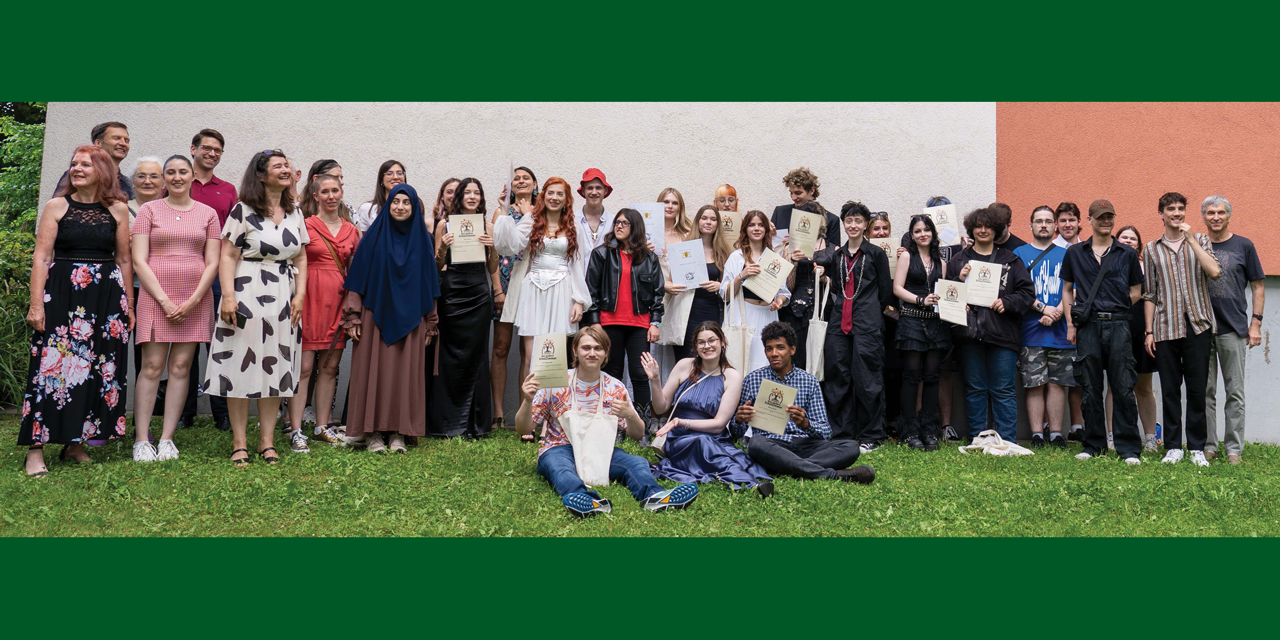
The students and staff of Das andere SchulZimmer celebrate the latest batch of graduates. PHOTO COURTESY OF GERHARD FRIEDERICI
Flexibility
Closely linked to the first principle is the quest for flexibility. Lessons generally do not follow set schedules. Rather, most schools have open time slots that students sign up for. Students then usually commit to a certain amount of school time per week, and it is up to them to decide what days they will attend and for how long. Educators are available during these hours to respond to students’ requests and questions. There are no penalties for not showing up.
In most cases, students work individually. For example, they receive weekly assignments, but they can determine their pace of learning. At the same time, educators motivate young people to attend regularly by helping them identify career aspirations and take steps toward them. If youth know what they want to do after finishing school, attending regularly becomes more important to them.
Flexibility is also evident in the fact that second-chance schools usually accept new students at any time of the year. If a school is not at capacity, youth can act on their impulse to obtain a high school diploma and enroll immediately without any waiting time. At the same time, students can pause their attendance without losing their place in the school. This is sometimes necessary for students to take care of their physical or mental health or to dedicate time to finding and financing suitable housing.
Needs orientation
To meet students’ individual needs, second-chance schools ask students what will help them and try to align the school setup to those wants and needs. For example, many of the educators we interviewed emphasized that they had to change how educational work was carried out. Each school year, educators must look anew at the students, their life situations, their needs, and their strengths, constantly adapting their approaches. Some young people, for example, are not able to spend much time in large groups due to previous trauma. Educators use trauma-sensitive learning approaches for these individuals.
The educators and school leaders in these schools are convinced that successful schooling is not possible if students’ life situations are chaotic. For this reason, second-chance schools usually employ social workers to help youth deal with emotional issues and hone life skills. This might include finding housing, applying for unemployment benefits, pursuing therapy, or accessing free food sources. School staff also maintain and use their networks to connect students to lawyers, doctors, psychologists, or other professionals.
The principle of needs orientation also includes the social atmosphere in second-chance schools. In almost every interview, we heard about the importance of relationship work and gaining trust. Even though this task is sometimes challenging, school leaders and educators see it as key to success. They invest a large portion of their time building and maintaining sustainable relationships between teachers and students and promoting a sense of togetherness among students. By doing so, they hope to prevent any repetition of the youths’ previous bad experiences in school settings. The trust they form with teachers and fellow students makes second-chance schools a safe and positive space where students want to be. In the words of one educator, “the students vote with their feet. If school sucks for them, they stop coming.”
Motivation and positivity
Second-chance educators also told us that students’ negative experiences in traditional schools left clear traces in their self-confidence, competence beliefs, motivation, and emotions about learning. Students usually come in believing that learning is no fun and that they are not capable of mastering challenging tasks. Sometimes these beliefs are so strong that they prevent students from learning at all. One school leader explained that students are particularly likely to be absent on days when subjects they fear — like mathematics — are part of the schedule.
For this reason, educators dedicate time to fostering positive views of learning and of students’ abilities. Interviewees emphasized promoting a sense of achievement, aligning learning opportunities to students’ interests and strengths, and providing ongoing encouragement. By doing so, they seek to replace students’ negative beliefs with positive ones.
Learning from second-chance schools
German second-chance school leaders and educators provide crucial insights about what education should look like for young people who experience homelessness and who have dropped out of school. This knowledge might help traditional schools change to prevent students from dropping out in the first place, since even the most successful second-chance schools only have limited power to undo the damage done to students by negative experiences in traditional schools.
Students experiencing homelessness should not feel forced out of an unresponsive traditional school system. Rather, the system must change so that all students enjoy going there regularly. Ideas for meaningful changes can come from the four basic principles these 12 second-chance schools follow. However, it’s not clear how well traditional schools can implement some of those principles. For example, can traditional schools relax districtwide attendance policies for students in extenuating circumstances? The question certainly begs to be explored, in both the U.S. and Germany.
In the meantime, schools can apply some of the other ideas immediately. If students appear to struggle in the classroom, teachers should try to find out what’s happening in their lives. They should consciously build relationships with students, especially with those in difficult circumstances. And they should learn how to communicate to students that they are trustworthy and will provide a safe environment.
Students experiencing homelessness do not miss school because they don’t care about learning. In fact, some studies have shown that SEH are more likely than their housed peers to say they value academic achievement and good behavior (Begg, Levitt, & Hayden, 2017; Ziesemer, Marcoux, & Marwell, 1994). If they feel safe and cared for at school, they will make every effort to attend. Even if educators cannot alter attendance policies, they can respond with patience and compassion when students’ life situations interfere with schooling, rather than reacting with anger and shaming. A caring response can help ensure students do not lose the vital learning and social connections they need to thrive.
Note: Thank you to the Hanns-Seidel Foundation for funding this research with funds from the German Federal Ministry of Education and Research.
References
Annen, P. (2020). Agency auf der Straße: Eine biografietheoretische Studie zu jungen Menschen und ihren Wegen in die Wohnungslosigkeit [Agency on the street: A biographical-theoretical study of young people and their paths to homelessness]. Springer VS.
Begg, N.A., Levitt, H.M., & Hayden, L.A. (2017). Understanding the school experience of African-American homeless children. Journal of Constructivist Psychology, 30 (3), 235-254.
Bundesministerium für Arbeit und Soziales. (2022). Ausmaß und Struktur von Wohnungslosigkeit: Der Wohnungslosenbericht 2022 des Bundesministeriums für Arbeit und Soziales [Extent and structure of homelessness: The Federal Ministry of Labor and Social Affairs’ Homelessness Report 2022].
Cowen, J.M. (2017). Who are the homeless? Student mobility and achievement in Michigan 2010-2013. Educational Researcher, 46 (1), 33-43.
Cutuli, J.J., Desjardins, C.D., Herbers, J.E., Long, J.D., Heistad, D., Chan, C. K., Hinz, E., & Masten, A.S. (2013). Academic achievement trajectories of homeless and highly mobile students: Resilience in the context of chronic and acute risk. Child Development, 84 (3), 841-857.
Edwards, E.J. (2020). Listening to formerly homeless youth. Phi Delta Kappan, 102 (4), 52-57.
Fischer, M., Welzel-Breuer, M., & Woitok, J. (2023). Straßenschulen — ein außerschulischer Ort zum Lernen für wohnungslose Jugendliche [Street Schools — An out-of-school place to learn for homeless young people]. heiEDUCATION Journal, 11, 239-250.
Hallett, R.E. & Skrla, L. (2017). Serving students who are homeless: A resource guide for schools, districts, and educational leaders. Teachers College Press.
Hoch, C. (2016). Straßenjugendliche in Deutschland — eine Erhebung zum Ausmaß des Phänomens [Street youths in Germany — a survey on the extent of the phenomenon: interim report]. Deutsches Jugendinstitut.
Institute for Children, Poverty, & Homelessness. (2019). Student homelessness in New York City: Disparities in academic achievement.
Kull, M., Morton, M., Patel, S., Curry, S., & Carreon, E. (2019). Missed opportunities: Education among youth experiencing homelessness in America. Chapin Hall at the University of Chicago.
Murphy, J. & Tobin, K.J. (2011). Homelessness comes to school. Phi Delta Kappan, 93 (3), 32-37.
National Center for Education Statistics. (2019). Public high school 4-year adjusted cohort graduation rate: School year 2017-18. U.S. Department of Education.
National Center for Homeless Education. (2022a). Chronic absenteeism among students experiencing homelessness in America: School years 2016-17 to 2020-21. U.S. Department of Education.
National Center for Homeless Education. (2022b). Graduation rates of students who experienced homelessness in America: School years 2017-18 to 2018-19. U.S. Department of Education.
National Center for Homeless Education. (2023). Housing and education collaborations to serve homeless children, youth, and families. U.S. Department of Education.
Rivas, R. (2020, February 21). Riverview Gardens agree to improve services to families in transition. The St. Louis American.
Semanchin Jones, A., Bowen, E. & Ball, A. (2018). “School definitely failed me, the system failed me”: Identifying opportunities to impact educational outcomes for homeless and child welfare-involved youth. Children and Youth Services Review, 91, 66-76.
Statistisches Bundesamt. (2024). Ende Januar 2024 rund 439500 untergebrachte wohnungslose Personen in Deutschland [Roughly 439500 homeless people housed in Germany at the end of January 2024].
Tobin, K.J. (2016). Homeless students and academic achievement. Urban Education, 51 (2), 197-220.
Underwood, J. (2016). Under the Law: Expanded support for homeless students. Phi Delta Kappan, 98 (3), 76-77.
Ziesemer, C., Marcoux, L., & Marwell, B.E. (1994). Homeless children: Are they different from other low-income children? Social Work, 39 (6), 658-668.
This article appears in the November 2024 issue of Kappan, Vol. 106, No. 3, p. 23-27.

ABOUT THE AUTHORS

Matthias Fischer
Matthias Fischer is a Ph.D. candidate at the University of Education Heidelberg in Germany.

Kerri Tobin
Kerri Tobin is an associate professor at the Lutrill & Pearl Payne School of Education, Louisiana State University, Baton Rouge. She is the author of Homelessness in the Classroom (DIO Press, 2021).