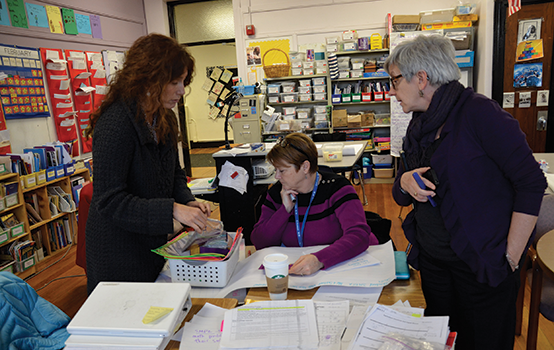
Teachers, with very different experiences teaching very similar students, tear through artificial boundaries of school politics to ask how they can better serve students.
It is Wednesday afternoon, a professional development day. Students have gone home early, leaving a classroom full of teachers to their monthly ritual of pedagogical discussions.
Today, the conversation is unusually animated. At one table, three teachers are discussing a math lesson they have just seen on video:
“I have never seen those manipulatives used this way to teach fractions.”
“It takes practice for them to get the hang of it, but, over the long run, it pays off.”
“I can see how this could be helpful to English language learners when illustrating story problems.”
What makes today such an exciting session? The format is nothing out of the ordinary, but today is a meeting of the minds that rarely takes place in urban education. For the first time, teachers from the neighborhood charter, public, and Catholic schools have come together to share ideas and practices. Three groups of teachers, with very different experiences teaching very similar students, are tearing through artificial boundaries of school politics to ask the question, “how can we better serve our students?”
These teachers from Edison K-8 Boston Public School, St. Columbkille Parochial School, and Conservatory Lab Charter School are participating in one of five school-based partnerships that are part of the Boston Compact between the Boston Public Schools, Archdiocese of Boston, and the Boston Charter Alliance. Their goal is to improve results for all students in Boston, regardless of school sector or governance. The Compact and its partnerships are committed to raising student achievement and student growth percentiles for ELL, black and Latino boys, and/or students with disabilities by intensely working together and holding each other accountable for results. The Compact set goals for the partnerships to increase the rate of growth for these three groups by 20% and reduce by 30% the gap between their level of performance in 2011 and 100% proficiency, as measured by Massachusetts’ composite index.
“Our learners struggle with the same things in every classroom. It is helpful to get the perspective of other teachers at the same grade level,” shares one teacher from the Conservatory Lab Charter School. Across the room, heads nod in agreement.
Every school has something to learn and something to teach.
Cross-sector school collaborations like this one have powerful implications for the future of school choice and sustainable school improvement. Meaningful collaborations among charter schools, public schools, and private schools are unusual. When they occur, they often take the form of a one-way mentorship relationship between a thriving and struggling school that is often conceived and directed from on high.
Three factors make the Boston’s School Performance Partnerships unique:
- The partnerships represent an all-kids-are-our-kids agenda, transforming the portfolio-based notion of schooling from one of market-driven incentives that prioritize survival of the fittest to one of support and improvement that acknowledges that the different choices parents and families in a community make are all legitimate.
- Teachers and administrators drive the partnership activities, focusing on specific teaching and learning challenges shared by schools. While the partnerships began life as a top-down initiative, their success and sustainability depends of the organic development of collaborative professional communities that move beyond politics and policies.
- The partnerships are based on reciprocal relationships with each school bringing something to the table; everyone has something to give and something to gain. This reciprocity breaks the conventional one-way street paradigm that positions charters as the benevolent mentor and the district school as the grateful student.
An all-kids-are-our-kids agenda
Cross-sector school cooperation represents a major shift in Boston’s political and educational landscape. Former Boston Mayor Thomas Menino expressed strong reservations about charter schools for most of his 20 years in office. Since the mayor appoints members of the Boston School Committee, the governing school board, this political stance significantly affected charter-district relations. Since the first state-authorized charter school opened in Boston in 1994, relationships have been characterized by tension rather than cooperation. Charter detractors have opposed redirecting tuition funds to charter schools and expressed a belief that charter schools discourage harder-to-serve children from enrolling.
Now, however, Boston is positioned to be a national leader in cross-sector school collaboration. In 2012, a $25-million grant from the Bill & Melinda Gates Foundation funded collaborations among public, charter, and private schools in seven cities — Denver, Hartford, New Orleans, New York, Philadelphia, and Spring Branch, Texas. Boston received $3.25 million and part of these funds support five cross-sector school collaborations.
The Gates Foundation grants assume that new ideas and solutions come from many sources and that diverse school options address the increasingly diverse needs and interests among students and teachers today. This approach celebrates the diversity of school governances available in the city, while relying on a holistic community approach rather than one driven by market-based incentives. It strives for excellent schools for all students, regardless of governance or sector, and it is intended to encourage charter schools to share their innovations with public schools, as they were originally intended to do. Finally, the portfolio approach invites charter schools to look closely at areas where public schools often have led, particularly serving students with special needs.
The School Performance Partnerships are the primary vehicle to achieving the overriding goal of the Boston Compact, which is to raise student achievement for ELL, black and Latino boys, and/or students with disabilities in Boston, regardless of where they attend school. Five School Performance Partnerships make up the Boston Compact, consisting of 13 charter, public, and private schools serving over 5,000 students, about 8% of all school-age children in Boston. The Boston Compact also includes initiatives to improve the alignment of operations, such as enrollment and transportation, as well as to improve school leaders across all three sectors.
The partnership among the Edison K-8 School, the Conservatory Lab Charter School, and St. Columbkille Parochial School represents the potential of the portfolio approach as one of support rather than survival.
- The Edison K-8, a Boston Public School, opened in 1932 as Thomas A. Edison Middle School. In 2009, due to declining enrollment, the middle school was merged with two elementary schools to form the current K-8 school whose vision combines rigorous academics and the arts to prepare students for college and beyond.
- Founded in 1901, St. Columbkille School is a preK-8 parochial school. In 2006, St. Columbkille entered into a historic partnership with nearby Boston College to create a new national model of excellence in Catholic schooling.
- The Conservatory Lab Charter, founded in 1999, implemented El Sistema, an intensive ensemble-focused music education program, which along with an Expeditionary Learning based-curriculum has become the defining force in the school culture.
All three schools serve the Allston-Brighton section of Boston. Conservatory Lab and St. Columbkille share a building; Edison is less than a mile away. Under the commonly adopted “market-based” portfolio approach, these schools would all compete for the same children. As a School Performance Partnership, these schools work together to improve student outcomes for all students in their corner of Boston, acknowledging that all choices that parents and families make are legitimate. Through this partnership, the schools are opening up opportunities for all students in the neighborhood to receive a deeper, more complete education, enhancing school culture, and meeting more individual needs.
The close proximity is a strength of the partnership, eliminating some barriers to collaboration, including shared coaching and classroom observations, and offering the potential to enlist the entire community in its success. In December 2012, 100 students from all three schools performed a series of instrumental and vocal pieces for classmates, parents, teachers, and local leaders, celebrating the announcement of the Boston Compact’s Gates Foundation grant. Responding to the performance, Rev. Gregory G. Groover Sr., chairman of the Boston School Committee, said, “We don’t have to compete anymore. We don’t have to feud. We can fuel each other.”
“It almost brought tears to my eyes,” he said after the concert.
The school as the unit of change
The Boston Compact work is based on the core beliefs that schools are the units of change and that relationships across sectors are key to changing the culture of Boston’s education institutions. While administrators and policy makers create structures for reform, teachers are the ones who make those reforms a reality. While each partnership began life as a top-down initiative, their success and sustainability depends on developing collaborative professional communities that move beyond politics and policies. The key to these successful partnerships is the dialogue between teachers. By establishing a multi-directional, collaborative relationship rather than a one-way mentorship, each teacher is empowered to share what is working well and to find solutions for ongoing challenges.
When teachers can reach through the political haze of school competition, students and communities benefit.
With these core beliefs as the guiding principles, each of the partnership’s activities are driven by teachers and administrators, focusing on specific teaching and learning challenges shared by schools, within the context of the overall Compact objectives to reach students who have been traditionally poorly served across the city. The partnership agreement outlines responsibilities to be fulfilled by particular staff members over three years. Teachers and administrators from the partnership schools meet regularly to support one another in specific goals, analyze achievement data, hold one another accountable for real outcomes, and train one another in areas of expertise. Even students from different schools sometimes come together to mentor one another and learn together.
Edison, Conservatory Lab, and St. Columbkille have identified five goals, based in the broader goals of the Compact.
- Design units of study and implement instructional practices that are aligned to Common Core State Standards, which Massachusetts has adopted.
- Use interim assessments to refine instruction and focus particularly on planning, implementing and assessing the effectiveness of reteaching interventions for literacy and mathematics.
- Implement arts programs to motivate students by leading student achievement and implementing joint performances by student ensembles.
- Identify and formally adopt validated and reliable standards for social-emotional learning in alignment with our respective schools’ arts and academic standards and assessments.
- Support ELL students through teacher cohorts and joint professional development.
One of the most effective elements of this partnership in its first year has been the support of teachers of English language learners. Eighteen teachers from across the three schools completed the Quality Teaching of English Learners (QTEL) training together, and they have begun meeting regularly as a cohort to support one another. In spring 2013, the Edison teachers invited the cohort to observe the implementation of QTEL in their classrooms, followed by a share-out discussion session.
Six of the teachers have elected to complete additional training as QTEL coaches, ensuring that this collaboration can continue. Next school year (2014-15), Conservatory Lab will bring on a new ELL teacher who has not completed QTEL, but who will be mentored by an Edison teacher with many years of training and experience.
The compact is also providing the School Performance Partnerships with an external coach through the Achievement Network (A-Net) to help analyze data for particular grade levels and develop reteaching plans. Teachers in grades 2-6 at the partnership schools met with their A-Net coach several times this past spring to review student work, create reteaching plans, and review data that targets the foundational skills necessary to reach proficiency on the statewide math assessment.
Combined with the data-driven teaching practices of A-Net, this work has tremendous potential to improve the quality of learning for all students among these three schools. As the partnership grows, grade-level teams will form relationships similar to the ELL cohort in order to challenge, encourage, and support each other in deepening the learning of all children in the Allston-Brighton schools. Through collaborations emphasizing social-emotional learning and excellence in the arts, teachers will hold each other accountable for nurturing the body, mind, and spirit of each child.
Giving and getting
The School Performance Partnership concept grew out of the successful collaboration between the Neighborhood House Charter School and the Harbor School, a Boston Public School. In 2011, at the request of then-Superintendent Carol Johnson, the two schools began a partnership focused on professional development. Although the schools have similar demographics, Neighborhood Charter outperformed the Harbor School on the Massachusetts Comprehensive Achievement Tests (MCAS). In the initial collaboration of this pioneering partnership, Neighborhood Charter shared tools and protocols with Harbor, resulting in immediate improvement in Harbor’s MCAS results. As relationships between teachers and administrators at the schools matured, the partnership has evolved into a more reciprocal relationship, building off each school’s strengths and needs and expanding into several areas of student learning.
The reciprocal nature of the relationship is the defining structure of the School Performance Partnerships and may be the critical component for long-term success. The partners are matched so that schools that have success with particular populations are coaching schools struggling to serve students in similar demographics. But, equally as important, is that partners are selected so individual schools bring differing expertise to the table to share with peers. All participants have something to give and something to gain. These partnerships break the conventional one-way street paradigm that positions charters as the benevolent mentor and the district school as the grateful student. Hopefully, these supportive and mutually beneficial collaborations will foster relationships that will continue organically beyond the scope of the formal Compact — in terms of both time and substance — to serve the needs of all children.
For example, each school is taking the lead in a particular area of expertise. The Conservatory Lab faculty is taking the lead sharing curriculum strategies from the acclaimed music program El Sistema and from its multidisciplinary project-based learning approach, Edison K-8 educators in supporting English language learners, and St Columbkille educators in the partnership in social-emotional learning.
After one year, the schools have made progress on all five of the partnership goals. Each school implemented an Expeditionary Learning-based investigation, based on the Common Core-aligned curriculum from Conservatory Lab. Teachers met routinely to analyze results of A-Net testing, discussing ways to help individual learners and reinforce difficult concepts. Students from St. Columbkille participated in Conservatory Lab’s El Sistema music program, and Conservatory Lab teachers visited Edison to do a music clinic in order to boost momentum for the band program. Conversations around social-emotional learning are leading to the development of new curriculum and tools at each school, based on the successes at St. Columbkille, but tailored to each individual school.
Conclusion
At the kickoff presentation for the Gates grant, 80 young musicians from Conservatory Lab, Edison K-8, and St. Columbkille took the stage and sang “Walk a Mile in Each Other’s Shoes.” As they stood together, three styles of uniform distinguished one school from another. But, when they began to sing, there was only a single, clear voice.
There is nothing fundamentally different about the students or teachers at a public school, private school, or charter school. While any given school may have a different balance of demographics, the schools face similar challenges, and each school has fantastic teachers with effective ideas. When teachers can reach through the political haze of school competition, students and communities benefit.
This is pioneering work. For public education to benefit from the innovations in charter, district, and private schools, there must be exchanges on a deeper level about how to adapt ideas and practices into different settings. Real reform occurs when teachers convene, trade ideas, implement, and refine them in their classrooms, and become sounding boards and resources for one another.
Every school has something to learn and something to teach. The strength of this partnership is that it binds charter, public, and private schools together at every level, working toward a common goal. Teachers, administrators, students, and families are all responsible for the success of the schools in the neighborhood. Each style of governance has unique advantages and particular challenges, and, through collaboration, the benefits of each can be shared.
Reference
Rocheleau, M. (2012, December 5). Boston’s city, charter, Catholic schools sing praises of $3.25m grant to aid year-old partnership. Boston Globe. www.boston.com/yourtown/news/allston_brighton/2012/12/bostons_city_charter_catholic.html
CITATION: Lam, D. (2014). Charter, private, and public schools work together in Boston. Phi Delta Kappan, 95 (5), 35-39.
ABOUT THE AUTHOR

Diana Lam
DIANA LAM is the head of school at Conservatory Lab Charter School, Boston, Mass.