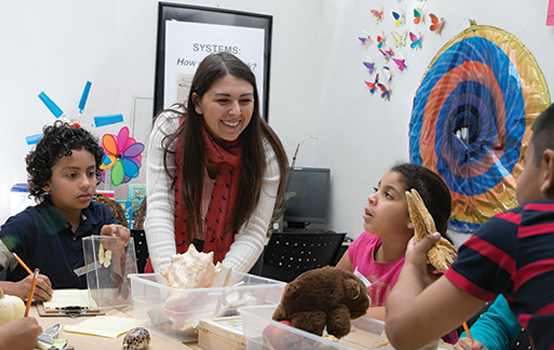
Children and teachers discover new ways of teaching and learning in a university lab setting.
“I didn’t like science, but when I came to STEM Studio, that changed my mind,” said Jasmine.
“We got to learn where patterns start. For example, a starfish!” said Janae.
“STEM Studio made me smart,” said Karem.
After a year in a teaching and learning lab based on real-world, multidisciplinary design challenges, 4th graders Jasmine, Janae, and Karem have learned more about how to think creatively and critically. They did this as part of the STEM Studio at Hofstra University School of Education.
In 2012, Hofstra created STEM Studio, a “space of liberty” (Brooks, Libresco, & Plonczak, 2007) where preservice teachers learn to effectively offer instruction that teaches children to think more reasonably, write more cogently, and compute more carefully. STEM Studio spreads successful teaching practices and classroom structures by engaging teachers in honing their skills by analyzing their students’ performances and artifacts. Schools and teachers learn and grow from practices that help their students learn and grow. Innovation generates innovation.
What is STEM Studio?
STEM Studio was born out of a problem: Preservice teachers were not transferring pedagogical understandings and practices learned in university methods classes to their practice. A starting point was creating a vibrant classroom on campus that brings together elementary pupils with preservice elementary teachers and secondary pupils with secondary preservice teachers in a setting that offers problem-based curriculum and just-in-time instructional mentoring. STEM Studio provides real-world math, science, and engineering design challenges that integrate literacy, social studies, multiculturalism, and the arts. The setting integrates teacher education and student learning by providing:
- Classroom structures using multidisciplinary STEM tasks as platforms for learning;
- Design challenge templates for diverse student populations; and
- Inclusive, just-in-time, multiple career stage professional learning community.
STEM Studio offers problem-based, distinctive curricula where pupils learn concepts at deeper levels with transferable skills, and preservice and in-service teachers learn instructional strategies rooted in the research (Bransford, Brown, & Cocking, 2002).
How STEM Studio practices differ
In a typical elementary science class, teachers expect 4th graders to learn the life processes of living things — specifically that all living things grow, take in nutrients and eliminate waste, breathe, reproduce, and die. Many teachers begin lessons on living and nonliving with a discussion, lecture, or textbook selection highlighting new vocabulary and concepts or a video of the processes in which all living things engage. Students may sort objects or pictures according to whether they’re living or nonliving. Some classes may go outside to collect items. At the end of the unit, students often take a written assessment in which they identify living and nonliving pictures and vocabulary before moving on to the next topic.
Most 4th graders are hard-pressed to construct robust understandings of living and nonliving when they are working only with black-and-white information in a textbook. Lessons often fall short of enhancing students’ abilities to integrate information and develop and present a coherent understanding of the topic, a skill on which many standards are pinned, especially the Common Core State Standards and the Next Generation Science Standards (www.nextgenscience.org/).
In the living and nonliving lesson example, STEM Studio uses a different approach. We present a scenario to students: “You are a museum curator and are putting together an exhibit to help visitors understand the difference between living and nonliving. To create your exhibit, use anything on the table, or write a request to purchase other supplies.” On the table, there are beans, oats, salt, sugar, cork, garlic cloves, rocks, stones, cotton, water, apple juice, snail shells, starfish, logs, seeds, paper, among many other items.
STEM Studio, a “space of liberty” where preservice teachers learn to effectively offer instruction that teaches children to think more reasonably, write more cogently, and compute more carefully.
Presented with a host of objects, substances, and artifacts, pupils ask themselves, each other, and their teachers if what they see is living or nonliving. By observing and thinking about these items, learners discuss, research, debate, and then come up with their own system, supported by their own reasoning, to define what is living and what is not. Some student groups watch videos; some go out to gather specimens. However, there is a fundamental difference. In STEM Studio, students select the activities in which they engage. They decide whether the activity helps them answer the questions that are posed. Choices in STEM Studio are intentional and teachers work with pupils to make them reasoned and purposeful. Conversely, traditional classrooms offer few choices; activities are typically acts of compliance.
Innovation stems from innovation
STEM Studio innovates and then generates innovation through questions, interactions, and collaborations among preservice teachers, in-service teachers, and university professors. Each participant comes to the teaching-learning dynamic with different and sometimes conflicting perspectives on what constitutes exemplary teaching. As a result, the tensions of unresolved and ongoing pedagogical issues fuel significant discussion, particularly among the university faculty. The model is powerful because it intentionally engages students, teachers, and professors in real-world investigations that enhance students’ conceptualizations and skills. As the program evolves, we are introducing new quantitative performance measures, such as formal pupil assessments and analytics of teacher practice. Three structures underpin the STEM Studio process.
Structure #1: Classroom structures use multi-disciplinary STEM tasks as platforms for learning.
Problem-based tasks are central to instruction and are linked to social roles, jobs, or professions. In the case of the living and nonliving unit, pupils assume the role of a museum curator and take the responsibility very seriously, selecting items for the exhibit they create, consulting several sources in their research, discussing options with peers, and interacting with teachers. For example, Maria was puzzled about the origin of cotton balls. The preservice teacher working with Maria helped her research using an iPad. As a result, Maria not only found descriptions and pictures of cotton growing on plants, she found a map of cotton production in the United States. With this information, Maria found that a cotton ball came from a living plant. Seeking an answer to a seemingly simple question led Maria to research using technology and to gain practice and skill in reading informational texts, maps, and charts. She also learned about the geography of cotton-growing areas throughout the world. Maria now faced a dilemma: If something comes from a living thing does that make it living? Indeed, was the cotton ball living now, once living, or a nonliving product of a living thing? Her inquiry prompted other inquiries, an essential component of a problem-solving model.
Many teachers — in-service and preservice — believe problem-based learning is not compatible with preparing for state standards and assessments. We continually find the converse to be true. Maria’s classification of a cotton ball as nonliving is consistent with the correct answer on many state assessments that nonliving things can be made from living things. Because Maria uncovered this “fact” on her own, she used it the next day as she shared her knowledge with classmates.
Problem-based learning tasks give students plentiful invitations to learn concepts and develop skills across all disciplines at any one time, and we find that students readily accept these design challenges. The tasks describe a context inspired by everyday situations; they trigger cognitive dissonance, encourage students to access their prior knowledge, promote metacognition, and can be adapted to diverse learners. To solve tasks, students plan, measure, analyze, find out, and think about what they’re doing, and talk about and listen to each other’s thinking. At the end of the year, Maria’s classmate, Tanya, stated, with some incredulity in her voice that even without worksheets and assigned textbook readings or homework at STEM Studio, she remembered more of what she learned than in her science class at school. Her classmates wholeheartedly agreed.
STEM Studio tasks are authentic tools for assessment, as well as teaching. They reclaim the balance between assessment for learning and assessment of learning and conceptually serve as formative assessments. But, our preservice teachers do not readily see them as such. So, we are planning to introduce formative assessment probes to make assessment more explicit. For instance, the “Is it Alive?” assessment probe (Keeley, Eberle, & Farrin, 2005) is a list of 24 living, nonliving, and once-living things where students are instructed to mark an X next to the living things. Students are then asked to justify in writing why they chose those objects. Giving this assessment probe to students before and after the museum curator task gives preservice teachers a measure of their students’ conceptual change in a more understandable format for a novice teacher.
Structure #2: Design challenge templates to serve diverse student populations.
Using the core tenets from Universal Design for Learning (www.udlcenter.org), STEM Studio designs challenges that provide multiple means of engagement, representation, and expression, making them flexible by design and accessible to diverse learners. Our tasks optimize physical and mental engagement. Choice is a hallmark of STEM Studio; we give students opportunities to self-direct learning and avoid formulaic processes. Students have access to mini audio recorders and iPads to dictate field notes, iPads and flip cameras to document their investigation process, and a microphone/amplification system to orally share their findings with the larger group.
At STEM Studio, we consider each child’s unique profile. For instance, some students have auditory processing difficulties or are English language learners and have particular difficulties with high verbal input and requests. Likewise, students with executive functioning difficulties are exceptionally challenged by problem-solving procedures that require organizing, planning, flexible thinking, working memory, and metacognitive skills. In addition, students who struggle in reading, writing, and math encounter challenges reading supplemental materials, writing field notes, and calculating and interpreting data.
STEM Studio addresses these unique needs in numerous ways. For example, a preservice teacher supporting Antonia, a student with a severe visual impairment shared descriptions of the living and nonliving artifacts. The preservice teacher described what she saw while Antonia described what she felt, thus expanding her vocabulary and language of the task. Mateo, a student with writing challenges, took pictures of his findings, wrote captions using the iPad and then emailed the preservice teacher his work for assessment. All students are encouraged to “buddy up” and share problem-solving responsibilities capitalizing on collaboration rather than solitary efforts.
Many teachers — in-service and preservice — believe problem-based learning is not compatible with preparing for state standards and assessments. We continually find the converse to be true.
On another occasion, a pupil wanted to know more about the moldy slice of white bread in a plastic zipper bag. The moldy bread was green so the student thought it must be a plant because plants are green. Because the bread was decomposing at a rate that the student would not be able to see, the preservice teacher found online time-lapse videos of bread molding for the student. The teacher and student then engaged in a spirited dialogue about the relationship between the mold, which the student concluded was living but not a plant, and the bread, which he concluded was not living but processed from a plant.
Our preservice teachers constantly struggle to ask more meaningful questions instead of “what do you think” or “why is that?” We may scaffold their teaching by placing an object in front of a student that might be critical in making a certain connection or by offering a key word for student research. We may help the teacher engage children in literacy development lessons in selected circumstances. For instance, when a child is wondering whether a log is living, the teacher can engage the child in conversations that route through any number of literacy development lessons: learning how to appropriately use relational words such as “before” and “after,” use adverbs such as “never “and “always,” or use tenses, such as “will be” or ”used to be” or “were.” In related domains, we make sure that reference materials available to students include many reading levels, and we help preservice teachers mark sections with sticky notes for easy reference, including material on the life cycle of plants, rock identification books, 3-D animal life forms from insects to coral reefs, and water cycle charts.
The reliance on oral scaffolding to expand thinking poses problems with which we continually struggle. If we supply visual organizers to scaffold the process or provide ways to organize information, are we limiting thinking by the boundaries of those organizers? We’re investigating whether concept maps would help both preservice teachers and pupils organize information in order to generalize findings. We’re also investigating whether to provide teachers with more explicit direction on what to monitor, for example by using gender neutral language and culturally responsive activities, evaluating the reasonable range of data students collect and responding accordingly, and looking for how or if students are tracking their thinking.
Structure #3: Provide inclusive, just-in-time, multiple career professional learning community.
During an active session at STEM Studio, one will find educators with different positions and backgrounds working with pupils: preservice, general and special education teachers, the STEM Studio master teacher, and university professors. These educators at multiple career stages and with multiple perspectives work collaboratively to enhance professional learning and student learning.
Preservice teachers beginning in STEM Studio are often overwhelmed and somewhat confused. Looking around at all the possibilities of problem solving, some preservice teachers think, “If it’s a hands-on activity, pupils must be learning a lot! I don’t need to do much, just sit back.” Others think, “If it’s a hands-on activity, pupils couldn’t be learning much!” These preservice teachers tend to talk over the problem-solving activity, telling pupils what to do and providing answers, in essence, falling back on lecture. Often, preservice teachers scaffold their pupils’ reality to match their own reality, limiting the types of questions and potentially fruitful outcomes. In these types of situations, preservice teachers need to better understand the learning task and their role in it. This is both modeled and scaffolded by teacher educators.
Oats, salt, sugar, cork, garlic cloves, a broken rock, a cotton ball, water, and snail shells may be fun to touch, hold, and look at, but touching, holding, and looking at these items doesn’t necessarily mean pupils are constructing knowledge about characteristics and processes of living and nonliving, let alone the kinds of knowledge the teacher intends or the standards demand. For learning to take place, teachers must deconstruct pupil approaches to problem solving and patterns of error so teachers can determine their next pedagogical move. STEM Studio’s goal is to foster deep reflectivity on lessons that successfully (and unsuccessfully) engage pupils. This is done through dialogue between preservice teachers, classroom teachers, and teacher educators — all who have witnessed and engaged with students. Preservice teachers begin to recognize this. As Mary said, “I have to admit, the cognitive dissonance that I experienced when I began teaching in the STEM Studio was most disconcerting, but it was also what drove me to work harder and become a better teacher.” In-service teachers see pupils and learning in different ways; said one, at the end of the year, “I love this program, this is just what the kids need.”
Collaborative discussion between preservice teachers in STEM Studio is not easy, but it is not meant to be easy. It is meant to show them that learning and teaching (just like the classification of living and nonliving) is not black and white. The discussions that occur aim to accentuate the kind of deep reflection and analysis that teaching requires for deliberate learning to occur. Deep reflection requires educators to examine their assumptions and perspectives, recognize errors, and change viewpoints. This requires a trusting, safe environment. Exploring ideas authentically depends on the teachers’ levels of content knowledge, pedagogical knowledge, and relationships with others in the community. We grapple with many questions in STEM Studio:
- How do we build a safe environment for preservice teachers to explore gaps in their content knowledge?
- How might we offer reasonably alternate ways to think about their practice?
- How do we model building challenging and supportive relationships with students?
- How might we help preservice teachers to recognize more fully the pedagogical moves we make to challenge and support learning?
- Can we be explicit in the scaffolding techniques and strategies we use without somehow limiting their own identities as teachers?
These puzzlements form the basis for further innovation. We understand that grappling with these questions from myriad perspectives is part of our work in preparing effective teachers. Our task in innovating is not merely to prepare teachers whose identities mirror our identities. Our task is to push pedagogical boundaries. This is the work in which we are engaged.
References
Bransford, J., Brown, A., & Cocking, R. (Eds.) (2002). How people learn: Brain, mind, and school. Washington, DC: National Academy Press.
Brooks, J.G., Libresco, A.S., & Plonczak, I. (2007). Spaces of liberty: Battling the new soft bigotry of NCLB. Phi Delta Kappan, 88 (10), 749-757.
Keeley, P., Eberle, F., & Farrin, L. (2005). Uncovering student ideas in science, Volume 1: Formative assessment probes. Arlington, VA: NSTA Press.
CITATION: Plonczak, I., Brooks, J.G., Wilson, G.L., Elijah, R., & Caliendo, J. (2014). STEM Studio: Where innovation generates innovation. Phi Delta Kappan, 95 (5), 52-56.
ABOUT THE AUTHORS

Gloria Lodato Wilson
GLORIA LODATO WILSON is an associate professor and director of special education secondary programs at Hofstra University, Hempstead, N.Y.
Irene Plonczak
IRENE PLONCZAK is an associate professor of teaching, literacy, and leadership and codirector of STEM elementary education at Hofstra University, Hempstead, N.Y.
Julia Caliendo
JULIA CALIENDO is STEM Studio administrative coordinator at Hofstra University, Hempstead, N.Y.
Jacqueline Grennon Brooks
JACQUELINE GRENNON BROOKS is a professor of teaching, literacy, and leadership, director of the Institute for the Development of Education in the Advanced Sciences, and director of secondary science education at brookHofstra University, Hempstead, N.Y.
Rosebud Elijah
ROSEBUD ELIJAH is an associate professor of teaching, literacy, and leadership at Hofstra University, Hempstead, N.Y.