
Understanding relationships within a school can help a principal leverage support for new ideas.
A colleague who was studying a school’s use of data began by following teachers’ suggestions to talk with the instructional technology coordinator. Expecting a conversation about how technology enables data use, our colleague was surprised by the coordinator’s thoughtful and powerful approach to supporting teachers’ use of data. The coordinator had written the names of all the school’s teachers on a board, connecting those who worked well together with lines, and organizing names into groups based on their interaction. He had mapped out who worked well with whom, who took advice from whom, and who was unlikely to talk to or listen to advice from anyone else. He was using the map strategically to support the use of the new data system, tailoring his approach to different teacher groups, and focusing efforts where he’d have the greatest effect. The IT coordinator was on to something: He understood that the underlying structure of the school could be a powerful way to move the initiative forward.
Researchers also have been using this mapping strategy to better understand how administrators and teachers in a school are organized and how their organization can affect school improvements. In research jargon, this is called social network analysis. Research on educator networks has shown that they affect educators’ beliefs, attitudes, and practice (Cole & Weinbaum, 2010; Finnegan & Daly, 2012), influence outcomes of reform (Coburn, Russell, Kaufman, & Stein, 2012; Penuel, Sun, Frank, & Gallagher, 2012), and create or constrain access to resources such as expertise (Baker-Doyle & Yoon, 2010; Frank, Zhao, & Borman, 2004; Penuel et al., 2010). We are particularly interested in this last function. If relationships are the conduits for knowledge, then understanding those relationships will help us build capacity for improvement and change.
Our recent work has explored teacher networks around data use in an elementary school in a mid-Atlantic state. Allegheny Elementary School serves a population of more than 80% minority and more than 80% free or reduced lunch eligible. This school has made substantial progress over the past three years in raising student achievement, with more than 85% of students now meeting the state standard in reading and math. Data use was an integral part of its improvement efforts. For example, we observed schoolwide meetings where grade-level teams shared data on student performance, developed goals collaboratively, and worked on curricular and instructional alignment across grades. Further, the principal described the use of interim data to deploy instructional specialists to support teachers and to develop interventions for individual students. These data use practices were simply part of the culture and norms of the school and were facilitated by district participation in a statewide data service center that provided access to data files and reports summarizing student achievement across a broad set of local and state measures.
We wanted to learn how Allegheny educators became competent data users to improve instruction. We accomplished this, much like the IT coordinator, by creating a map of teachers’ professional relationships and their interactions around data use. (See Figure 1.)
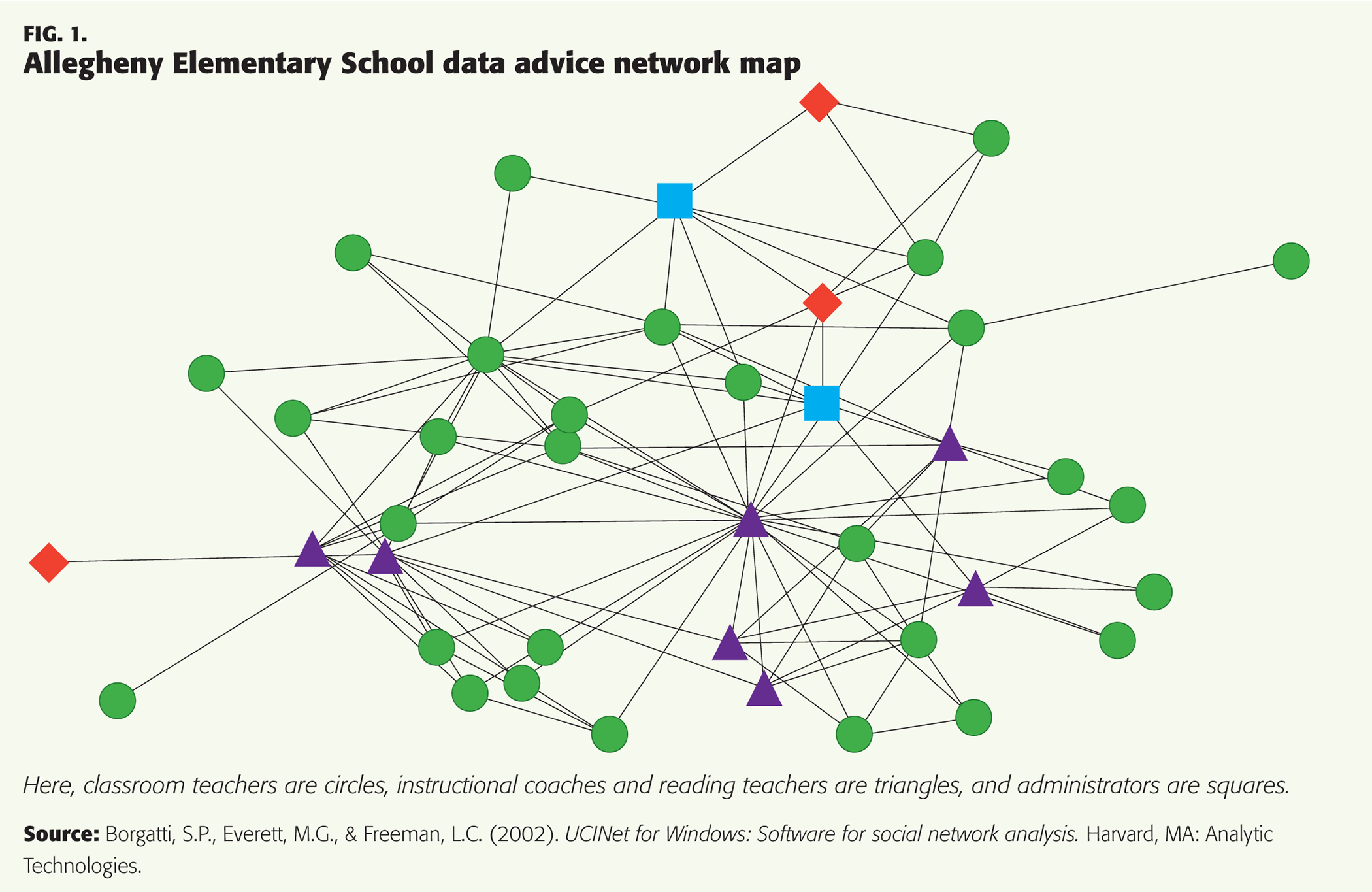
Such an image can be visually powerful; almost immediately, we can pinpoint who is most frequently involved in giving data use advice, identify groups of teachers who interact around data, and recognize teachers who are isolated from others in the advice network.
We coupled this information with survey responses about teacher experience, roles, and practices related to data use. We used this information to understand from whom teachers sought advice, the characteristics of advice givers, and whether those relationships actually had any influence on practice. We learned some important lessons about the power of networks and drew some inferences about capacity building for instructional improvement.
Lesson #1. Teachers sought advice from those with whom they already had strong professional relationships, and generally didn’t seek advice from others with whom they interacted less frequently.
Their professional and data use networks were highly correlated: They sought advice from the same colleagues for both purposes. Networks with multiple purposes can be powerful in constraining or supporting change. For example, in an advice network, we might expect that educators with a particular level of skill or knowledge would be tapped for advice. However, if teachers only operate within their existing networks, then the expertise available to them will be constrained. Conversely, strong ties among teachers can support trust and a willingness to share ideas and innovate together. In either case, teachers’ professional networks are highly influential in the diffusion and implementation of reform.
Lesson #2. Teachers most often sought advice on data use from those with formal instructional leadership positions.
Those leadership positions include literacy coach, math coach, reading teachers, and principal. Further, teachers also identified these leaders as close professional colleagues. Thus leadership was central to the professional structure of the school, and leaders’ expertise made a crucial contribution to capacity development for the entire staff.
Advice networks support the development of shared practices — for better or worse.
Lesson #3. Those who give advice do not necessarily have more expertise than those who seek advice.
In Allegheny, teachers and leaders who gave advice were not necessarily more experienced, did not report different beliefs or practices around data use, and did not feel more comfortable using data. In fact, those who gave advice were as likely as those who sought it to feel they still needed to learn a lot. On one hand, this suggests that even perceived experts continue to seek to improve practice — an important characteristic of a learning organization — on the other hand, this reinforces the possibility that seeking advice within existing networks may constrain the expertise available to improve practice.
Lesson #4. It’s not just who you know but who they know as well.
In our work, the data advice networks were highly centralized. Allegheny had a large group of advice seekers (mostly teachers) and a few perceived experts from whom many sought advice (mostly administrators and instructional coaches). In between them, we identified a set of brokers — teachers who sought advice from the perceived experts but who also gave advice to advice seekers. These individuals were bridges between the two groups and were positioned to either facilitate or constrain the flow of information or advice on data use throughout the school. These individuals likely supported the development of data use capacity. Brokers can also serve a valuable function in making the work of central experts more manageable. Administrators and instructional coaches can work through brokers to reach individual classroom teachers. In this sense, it isn’t just the direct relationship between teachers that matters for capacity development but also the indirect relationships.
Lesson #5. Teachers who interact around data use in the advice network were significantly more likely to report similar data use practices than those who interact less.
It wasn’t the direct relationship that mattered the most; it was the indirect relationship, which reinforces our previous lesson that it isn’t who you know, but who they know as well. Therefore, networks are not only instrumental in the diffusion of resources such as expertise, but they are influential in changing teacher practice as well.
Using teacher networks
What does this mean for improving school practice? Like the coordinator our colleague described, principals can identify and leverage teacher networks to promote and support the adoption of new programs or practices. Principals who understand the power of teacher networks are better positioned to be successful in their improvement efforts. They are able to target resources strategically. They are able to take advantage of teacher leaders (e.g. brokers) and others who can support desired changes. Leveraging these networks helps both the principal and the teachers work smarter and not just harder.
Networks are instrumental in spreading resources such as expertise and also are influential in changing teacher practice.
In order to take advantage of teacher networks, principals must first map the existing networks in their schools, identifying teachers and others who are experts or advice givers, brokers, and advice seekers. Once these are known, principals can decide on a strategy for tapping teacher networks to promote the desired change. For example, a principal may opt to offer professional development to introduce a new instructional intervention to teachers. However, professional development resources are limited and so the entire school may not attend. One option is to select teachers who are advice givers or brokers with the expectation that they will further spread the information on the new intervention. Another option might be including those who are most isolated and least likely to interact with others to ensure they are introduced to the new intervention. After the professional development, the principal could arrange formal and informal opportunities for teachers to interact to maximize the spread of information and resources. The key here is harnessing the power of teacher networks to promote and support the desired changes.
One final caveat from our work: Advice networks support the development of shared practices. For better or worse, networks can support the diffusion of both desirable and undesirable practices. To ensure that networks are a productive influence within schools, our work has two implications. First, let’s not forget a need to invest in the professional development for school leaders. At the school we studied, formal instructional leaders are highly central in data advice networks, such that their knowledge and expertise contribute to capacity development schoolwide. Yet professional development resources are typically focused on classroom teachers. Because leaders can be influential in the advice networks of their school, they must have a deep understanding of the reform. Second, leaders must develop positive norms and a supportive culture based on trust and shared practice to enable the development of productive teacher relationships. This is particularly important in expanding advice seeking from within existing networks to the full range of expertise schools have to offer.
Schools are continually asked to adopt new practices, yet generating change schoolwide is a challenging endeavor. Harnessing the power of teacher networks could help schools generate improvements needed to support learning for all students.
References
Baker-Doyle, K.J. & Yoon, S.A. (2010). Making expertise transparent: Using technology to strengthen social networks in teacher professional development. In A.J. Daly (Ed.), Social network theory and educational change (pp.115-126). Cambridge, MA: Harvard Press.
Coburn, C.E., Russell, J.L., Kaufman, J.H., & Stein, M.K. (2012). Supporting sustainability: Teachers’ advice networks and ambitious instructional reform. American Journal of Education, 119, 137-182.
Cole, R.P. & Weinbaum, E.H. (2010). Changes in attitude: Peer influence in high school reform. In A.J. Daly (Ed.), Social network theory and educational change (pp. 77-96). Cambridge, MA: Harvard University Press.
Finnegan, K.S. & Daly, A.J. (2012). Mind the gap: Organizational learning and improvement in an underperforming system. American Journal of Education, 119, 41-70.
Frank, K.A., Zhao, Y., & Borman, K. (2004). Social capital and the diffusion of innovations within organizations: Application to the implementation of computer technology in schools. Sociology of Education, 77 (2), 148–171.
Penuel, W.R., Riel, M., Joshi, A., Pearlman, L., Kim, C.M., & Frank, K.A. (2010). The alignment of the informal and formal organizational supports for reform: Implications for improving teaching in schools. Educational Administration Quarterly, 46 (1), 57-95.
Penuel, W.R., Sun, M., Frank, K.A., & Gallagher, H.A. (2012). Using social network analysis to study how collegial interactions can augment teacher learning from external professional development. American Journal of Education, 119, 103-136.
CITATION: Farley-Ripple, E.N. & Buttram, J.L. (2013). Harnessing the power of teacher networks. Phi Delta Kappan, 95 (3), 12-15.
ABOUT THE AUTHORS

Elizabeth N. Farley-Ripple
ELIZABETH N. FARLEY-RIPPLE is an associate professor at the University of Delaware, Newark.
Joan L. Buttram
JOAN L. BUTTRAM is director of the Delaware Education Research and Development Center at the University of Delaware, Newark, Del.