
Specific professional learning strategies helped some teachers, schools, and districts succeed in bringing about the gains in student learning that standards were intended to foster.
When the Common Core State Standards (CCSS) and Next Generation Science Standards (NGSS) were adopted in the early 2010s in most U.S. states, teachers and district staff put extraordinary effort into changing instructional content and practices (Desimone et al., 2019; Pak, Desimone, & Parsons, 2020; Pak, Polikoff, et al., 2020). Almost a decade later, there is little evidence that students’ achievement or equity in educational outcomes improved at the state or national level (Bleiberg, 2020; Loveless, 2016; Song et al., 2022). However, state and national averages obscure differences in outcomes that occurred at the local level.
The Chicago Public Schools saw significant improvements in math achievement and equity when the CCSS in mathematics (CCSS-M) were implemented (National Assessment Governing Board, 2020). After Chicago implemented CCSS-M, students reported that their teachers engaged more frequently in standards-aligned instructional practices; and students saw gains in test scores, grades, and pass rates in their math classes. The largest improvements occurred among students with the lowest initial mathematics test scores (Allensworth, Cashdollar, & Gwynne, 2021). The practices adopted in Chicago and other locales could hold lessons for standards implementation in other places.
A set of in-depth studies across multiple states and in Chicago help illuminate what strategies seem most promising. The Center for Standards, Assessment, Instruction, and Learning (C-SAIL), a five-year research center funded by the Institute for Education Sciences, drew on data from California, Kentucky, Massachusetts, Ohio, and Texas for its studies (Desimone et al., 2019; Edgerton & Desimone, 2018, 2019; Pak, Desimone, & Parsons, 2020; Nichols, Edgerton, & Desimone, 2021; Pak, Polikoff et al., 2020; Song et al., 2022; Stornaiuolo, Desimone, & Polikoff, 2023). Data included representative surveys of 84 district officials, 439 principals, and 1,760 teachers; 36 interviews with state officials; 54 district interviews across nine districts; and in-depth teacher interviews, classroom observations, and focus groups with students in three districts. Another set of studies closely examined implementation in Chicago using administrative data on student achievement and teacher and student surveys on instruction and use of implementation resources in 552 schools, as well as interviews with 10 district leaders, 12 principals, and 16 teacher leaders (Allensworth, Cashdollar, & Cassata, 2022; Allensworth, Cashdollar, & Gwynne, 2021; Allensworth et al., 2022; Cassata & Allensworth, 2021).
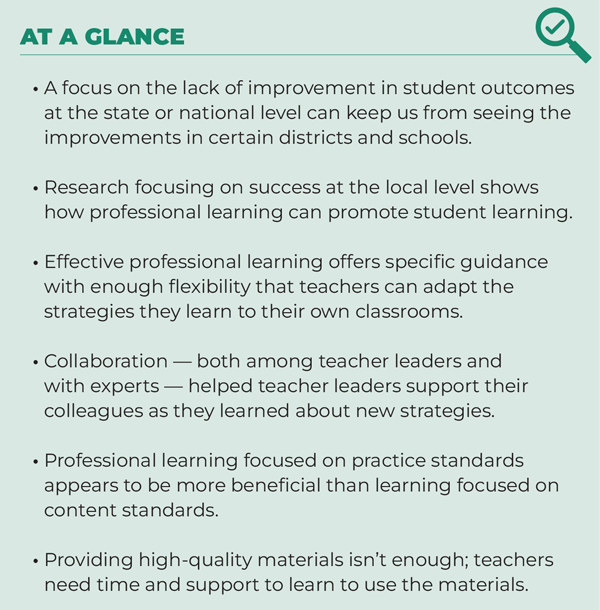
Across both the C-SAIL and the Chicago studies, professional learning emerged as critical for change, but how the learning was structured mattered. Teachers had more buy-in and success when there was flexible specificity, collaboration with knowledgeable colleagues, a focus on changing practice, and guidance in using resources.
Professional learning that promotes instructional change
Professional learning is a key lever for instructional change associated with higher student achievement. We see this at work in a study of CCSS implementation across five states that found learning gains in mathematics were related to more days in professional learning (Kane et al., 2016). The importance of professional learning was also evident in Chicago. When compared to schools with limited professional learning, schools where teachers reported extensive time in professional learning around the standards showed significantly larger improvements in aligning instructional practices to the standards, student grades, pass rates, and test scores (Allensworth, Cashdollar, & Gwynne, 2021).
C-SAIL also found that high-quality professional learning was associated with more aligned instruction (Edgerton & Desimone, 2018), but many teachers reported not having sufficient learning opportunities to allow them to feel fully prepared to implement the standards (Edgerton & Desimone, 2019). This finding may explain why there was little change in student achievement nationally (Song et al., 2022).
Offering a lot of professional learning is not enough. How professional learning is structured seems to matter. Yet the desire to ensure local control has led state and district officials to be reluctant to be too specific about the design of supports for teacher learning (Stornaiolo, Desimone, & Polikoff, 2023). As a result, local school leaders often lack clarity on how instruction should change and how best to support that change (Desimone et al., 2019). Our research revealed several factors that seem to be most critical for professional learning to lead to positive instructional change.
Flexible specificity
In C-SAIL’s statewide surveys, specificity emerged as a key factor in how supported educators felt in their efforts to implement standards-aligned instruction. Specificity refers to the clarity and detail of the guidance and support teachers receive. Research shows that when teachers have specific guidance about what is being asked of them, the quality of implementation increases (Desimone, 2009).
Yet C-SAIL data showed that too much specificity — where teachers were given specific materials and told exactly how to use them — resulted in teachers feeling little ownership of the standards. Because rigid guidance did not allow teachers to adapt materials to their classroom, teachers felt the standards were not appropriate for their students (Edgerton & Desimone, 2018, 2019; Stornaiolo, Desimone, & Polikoff, 2023). District leaders, then, face a challenge: They must balance the need for specificity with teachers’ desire for autonomy.
A flexibly specific approach to curriculum and professional development hits the “sweet spot” by including enough guidance for different actors (e.g., teachers, coaches, principals) to feel confident in what they were doing, but allowing for flexibility so these stakeholders could exercise professional judgment.
Five shared practices characterized this approach (Stornaiolo, Desimone, & Polikoff, 2023):
- Flexibility was negotiated over time. District and school leaders engaged in an ongoing process to find the right balance between specificity and flexibility.
- Districts built an infrastructure for flexible specificity. For example, professional development activities were expected to have both concrete detailed guidance and opportunities for teachers to shape lessons, based on their students’ needs.
- Districts explicitly aligned their professional learning activities with the standards, the curriculum, and other activities in the district.
- Policies existed to indicate which aspects of an intervention or approach teachers could adapt.
- Stakeholders were involved in decision making that shaped learning opportunities.
Chicago’s implementation of standards embodied many of the principles of flexible specificity identified in C-SAIL’s multistate study. Chicago district leaders provided training to two teachers per school (designated as teacher leaders) through Teacher Leader Institutes on the instructional practices they wanted teachers to enact and provided materials to all teachers through a web-based depository called the Knowledge Center. Teacher leaders were responsible for trying out new methods, figuring out what worked for them in their context, and serving as models for instructional change in their schools. The district was clear that this was not a train-the-trainer strategy with one correct way of implementing new practices. They wanted all teachers to enact certain instructional practices, and they trained teacher leaders on how to elicit those practices. But there was considerable flexibility in how teacher leaders could enact those practices in their own classrooms and how they could support other teachers at their school (Cassata & Allensworth, 2021).
Collaboration with knowledgeable colleagues
Professional development has become more collaborative in recent years, often including sustained collaborative opportunities, such as quarterly curriculum check-ins and weekly instructional coaching (Pak, Desimone, & Parsons, 2020). Collaboration — not just between teachers but also among teachers and other stakeholders — appears to be a recurring theme in districts where things work. In C-SAIL’s research, this was particularly visible in the ways that different districts approached coaching. In some places, coaches were seen as mechanisms for compliance; in others, coaches were collaborative thought partners.
Collaboration — not just between teachers but also among teachers and other stakeholders — appears to be a recurring theme in districts where things work.
Similarly, collaboration was a key part of Chicago’s teacher leader model. Teacher leaders could meet with other teacher leaders within their own school who had been through the same training and at
regular intervals with teacher leaders from other schools, as well as district and university experts, to learn about new practices, share resources and experiences with those resources, and get feedback on their own instruction. They also discussed different ways of spreading change, from modeling to coaching to developing lesson plans together. Teacher leaders said that the most meaningful change that occurred for their own practice, and for large-scale instructional changes in the school, came from collaboration, specifically working on instruction with other teachers. In districtwide survey data, collaboration with colleagues around the standards emerged as the factor most strongly associated with teachers’ use of standards-aligned instructional practices (Allensworth, Cashdollar, & Cassata, 2022).
However, collaboration does not always lead to stronger instruction. In the five-state study of CCSS implementation discussed earlier (Kane et al., 2016), professional development and feedback on teaching were related to stronger test score gains, but teacher collaboration was not. The Chicago teacher leaders were clear that it wasn’t just collaboration that was helpful, but collaboration with others who shared knowledge about the goals of the standards, including experts in their own school and district and university experts who were available outside the formal trainings. The district encouraged collaborative activities that were similar to those associated with learning gains in the five-state study. For example, the Knowledge Center provided resources for peer observations, while the Teacher Leader Institutes included training in reviewing student work, conducting peer classroom observations, and providing feedback to other teachers (Cassata & Allensworth, 2021).
Focus on practice
The CCSS-M and NGSS contain two types of standards: Content standards describe what students should learn at each grade level, while practice standards call for learning of “processes and proficiencies” to support conceptual understanding across content areas. Teachers in statewide surveys reported making changes to their teaching in accordance with the standards (Bay-Williams et al., 2016; Kane et al., 2016; Opfer, Kaufman, & Thompson, 2016), but they found it difficult to engage students in the conceptual processes that the CCSS-M and NGSS demanded (Friedrichsen & Barnett, 2018; Opfer, Kaufman, & Thompson, 2016; Tekkumru-Kisa et al., 2019).
Early on, district officials in Chicago made the decision to emphasize the practice standards in their messaging and professional learning. One district leader described their strategy this way: “If the materials changed, the standards changed, if anything — the assessment — changes, it doesn’t matter because this is still good teaching.” The instructional materials they provided were designed to encourage practices where students would come up with different solutions to problems, discuss mathematics strategies, and develop their own mathematics problems, all of which would contribute to a strong conceptual understanding of mathematics. Previously, these kinds of practices were much more likely to be employed in classrooms with high-achieving students. With practice-focused standards implementation, the biggest changes were seen among students with low math test scores; they experienced the largest gains in test scores, grades, and pass rates (Allensworth et al., 2021).
In contrast, we have not seen evidence that adherence to the content standards improves student learning gains. Research before CCSS showed no significant relationship between alignment to content standards and test scores (Polikoff & Porter, 2014). Several studies of the impact of CCSS found generally null and sometimes negative results on achievement (Loveless, 2016; Song et al., 2022); one found positive impacts only for economically advantaged students (Bleiberg, 2021). C-SAIL found pockets of promising implementation practices, as well as evidence that high-quality support could foster better instructional alignment. However, they found no improvement in student learning in their analysis of scores on the National Assessment of Educational Progress or in their randomized control trial of an intervention focused on helping teachers align their instruction to content standards.
Resources with support
The C-SAIL studies showed that it’s not sufficient to adopt some “high-quality” material and provide baseline professional development. Teachers need support and time to adapt those resources. There is no evidence that developing or shifting materials in response to the CCSS-M (Kane et al., 2016), or using textbooks developed after the standards were adopted (Blazar et al., 2019), had significant impacts on student outcomes.
A coherent, adaptive approach to curriculum implementation recognizes the complexities of instructional change. This means helping teachers understand, adapt, and implement the materials in standards-aligned ways. It also means building in a process and clear expectations for teachers related to implementation and collaboration, including structures and time that allow teachers to collaborate and multi-year implementation plans. In Chicago, one of the goals of the Teacher Leader Institutes was to support use of the instructional resources available in the Knowledge Center. Teacher leaders regularly had opportunities to try them out with the support of other colleagues.
The types of resources available to teachers also make a difference. The easier they are to use to enact the desired change, the more likely teachers are to use them as intended. In Chicago, teacher leaders said that it was easy to see how the mathematics materials fit with different standards and that students enjoyed using the resources. In contrast, the science materials in the Knowledge Center at the time of our research were mostly scope-and-sequence guides and resources for modifying lessons from existing science kits to align to the NGSS. The more teachers used these resources, the less they enacted standards-aligned practices (Allensworth, Cashdollar, & Cassata, 2022).
Creating buy-in and making change
Whenever teachers try a new instructional technique, they take a risk that it will fail, that they will lose instructional time, and that their students will lose interest or struggle more. Time spent preparing to do things differently is time teachers could spend preparing to do what they already know works. New curricula, materials, standards, and assessments come and go. It is often not clear whether the new is any better than the old, and buy-in is critical to any change effort.
New curricula, materials, standards, and assessments come and go. It is often not clear whether the new is any better than the old, and buy-in is critical to any change effort.
This notion of teacher buy-in is an underemphasized component of reform. We saw districts using what we call “smart power” to balance accountability requirements with the need for teacher buy-in (Nichols, Edgerton, & Desimone, 2021). Building true buy-in is an iterative process, where the quality of materials interacts with collaborative professional learning, undergirded by sufficiently specific guidance to make the target and process clear, while allowing for experimentation and improvement.
In the ever-elusive quest to improve the learning outcomes for all our nation’s students, our findings offer practical insights to move us closer to our goals. Even when the overall picture looks bleak, there are successes we can learn from. Our data show that it is possible to create a productive path toward improvement through useful materials, a focus on practice, opportunities to collaborate, and flexible specificity.
References
Allensworth, E., Cashdollar, S., & Cassata, A. (2022). Supporting change in instructional practices to meet the Common Core Mathematics and Next Generation Science Standards: How are different supports related to instructional change? AERAOpen, 8 (1), 1-15.
Allensworth, E.M., Cashdollar, S., Cassata, A., & Gwynne, J.A. (2022). Standards-driven instructional improvement: Lessons learned in Chicago. University of Chicago Consortium on School Research.
Allensworth, E., Cashdollar, S., & Gwynne, J. (2021). Improvements in math instruction and student achievement through professional learning around the Common Core State Standards in Chicago. AERA Open, 7 (1), 1-19.
Bay-Williams, J., Duffett, A., & Griffith, D. (2016). Common core math in the K-8 classroom: Results from a national survey. Thomas B. Fordham Institute.
Blazar, D., Heller, B., Kane, T., Polikoff, M., Staiger, D., Carrell, S., . . . , & Kurlaender, M. (2019). Learning by the book: Comparing math achievement growth by textbook in six Common Core states. Center for Education Policy Research, Harvard University.
Bleiberg, J. (2021). Does the Common Core have a common effect? An exploration of effects on academically vulnerable students. AERA Open, 7 (1), 1-18.
Cassata, A. & Allensworth, E. (2021). Scaling standards-aligned instruction through teacher leadership: Methods, supports, and challenges. International Journal of STEM Education, 8 (1), 1-21.
Desimone, L.M. (2009). Improving impact studies of teachers’ professional development: Toward better conceptualizations and measures. Educational Researcher, 38 (3), 181-199.
Desimone, L.M., Stornaiuolo, A., Flores, N., Pak, K., Edgerton, A., Nichols, T.P., . . . & Porter, A. (2019). Successes and challenges of the “new” college-and career-ready standards: Seven implementation trends. Educational Researcher, 48 (3), 167-178.
Edgerton, A.K. & Desimone, L.M. (2018). Teacher implementation of college- and career-readiness standards: Links among policy, instruction, challenges, and resources. AERA Open, 4 (5), 1-22.
Edgerton, A K. & Desimone, L.M. (2019). Mind the gaps: Differences in how teachers, principals, and districts experience college- and career-readiness policies. American Journal of Education, 125 (4).
Friedrichsen, P.J. & Barnett, E. (2018). Negotiating the meaning of Next Generation Science Standards in a secondary biology teacher professional learning community. Journal of Research in Science Teaching, 55 (7), 999-1025.
Kane, T.J., Owens, A.M., Marinell, W.H., Thal, D., & Staiger, D. (2016). Educators’ perspectives on Common Core implementation. Center for Education Policy Research, Harvard University.
Loveless, T. (2016). How well are American students learning? The Brown Center Report on American Education. Brookings Institution.
National Assessment Governing Board. (2020). Chicago’s progress evident on NAEP.
Nichols, T.P., Edgerton, A.K., & Desimone, L. (2021). Smart power in standards implementation after No Child Left Behind. American Journal of Education, 128 (1), 147-169.
Opfer, V.D., Kaufman, J.H., & Thompson, L.E. (2016). Implementation of K–12 state standards for mathematics and English language arts and literacy. RAND.
Pak, K., Desimone, L.M., & Parsons, A. (2020). An integrative approach to professional development to support college-and career-readiness standards. Education Policy Analysis Archives, 28 (111).
Pak, K., Polikoff, M S., Desimone, L.M., & Saldívar García, E. (2020). The adaptive challenges of curriculum implementation: Insights for educational leaders driving standards-based reform. AERA Open, 6 (2).
Polikoff, M.S. & Porter, A.C. (2014). Instructional alignment as a measure of teaching quality. Educational Evaluation and Policy Analysis, 36 (4), 399-416.
Song, M., Garet, M.S., Yang, R., & Atchison, D. (2022). Did states’ adoption of more rigorous standards lead to improved student achievement? Evidence from a comparative interrupted time series study of standards-based reform. American Educational Research Journal, 59 (3), 610-647.
Stornaiuolo, A., Desimone, L.M., & Polikoff, M. (2023). “The good struggle” of flexible specificity: Districts balancing specific guidance with autonomy to support standards-based instruction. American Educational Research Journal, 60 (3), 521-561.
Tekkumru-Kisa, M., Schunn, C., Stein, M.K., & Reynolds, B. (2019). Change in thinking demands for students across the phases of a science task: An exploratory study. Research in Science Education, 49 (3), 859-883.
This article appears in the September 2023 issue of Kappan, Vol. 105, No. 1, pp. 18-23.
ABOUT THE AUTHORS

Elaine Allensworth
ELAINE ALLENSWORTH is the Lewis-Sebring Director of the Consortium on School Research at the University of Chicago’s Urban Education Institute.
Laura M. Desimone
LAURA M. DESIMONE is the director of the School of Education and director of research at the College of Education and Human Development, University of Delaware, Newark.
Latrice Marianno
LATRICE MARIANNO is a doctoral candidate at the University of Delaware, Newark.