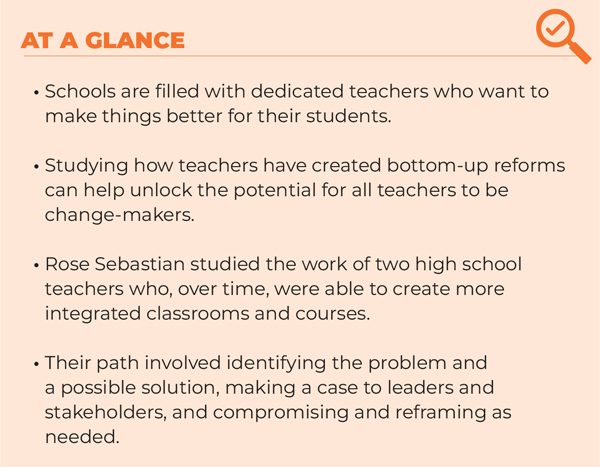
Schools are filled with dedicated teachers eager to make change for their students. Understanding how change-making teachers have succeeded can help smooth the way for others.
Too often, the public narrative about schools focuses on everything that is wrong, not on what is right. We get bogged down in the challenges our students, teachers, and schools are facing. Yet transformative, bottom-up changes are occurring in many schools across the U.S. These innovations often are concocted by teachers who saw a problem, had an idea, persevered over time and through challenges, and compromised and collaborated to turn their idea into established practice. We must not only laud these innovations but also start understanding the paths these teachers walk so we can unlock the power of every teacher to become a change-maker.
As part of my research into educational equity, I observed two teachers at high schools where the diversity in the halls was not reflected in the classrooms. Both teachers found ways to address the problems. The choices and obstacles they faced on the path to change help us understand how other teachers can become change-makers. They also illuminate what is right with our schools. Across the nation, teachers innovate day in and day out to make school better for students. These are but two of the many out there.
Stepping inside classrooms that work for students
In the fall and spring of 2018, I spent weeks immersed in the classrooms of Dr. Sumner and Ms. Holmes (both pseudonyms). The two teachers taught in adjoining southeastern U.S. communities at large economically, linguistically, and racially diverse high schools — a diversity that was often not reflected in the makeup of individual classrooms within their schools. Like many change-making teachers, Ms. Holmes and Dr. Sumner were experts at their crafts, creating powerful and welcoming learning experiences (Fullan, 1993; Van der Heijden et al., 2015). Their rooms were oases within their schools.
Dr. Sumner’s 11th-grade English for Speakers of Other Languages (ESOL), English, and history classroom was full of comfortable couches and soft lights. It was such a welcoming space that students came in during study periods and their lunches to relax and work. Ms. Holmes’ 9th-grade English and public speaking classroom was a hive of activity, with overflowing bookcases, animated discussions, and vibrant posters on the walls. Ms. Holmes’ and Dr. Sumner’s instruction blended individualized supports with intellectual rigor. Both sought ways to make learning matter to their students. For example, Ms. Holmes had students create sales pitches for books, competing to get the most new readers. Dr. Sumner’s students wrote letters to local politicians about issues that mattered to them.
Each teacher treated students as experts. During lessons on the Gilded Age, Dr. Sumner broke the class into small groups and asked them to teach the other students about a political cartoon from the era. As students began to share, he told the class to listen to their peers because “You can learn from them.” Ms. Holmes loved group discussions where students could share knowledge. One day, as students discussed a book they had read, a small group of students sat in the middle fielding questions from her and from each other. When students on the outside wanted to share, they tapped someone in the circle out. In this and other activities, the students, not the teacher, were positioned as the experts.
Both teachers celebrated student diversity in their classrooms. Ms. Holmes’ classroom included students who flew to France for holidays and students who experienced hunger, students taking the course for honors credit and those taking it for standard credit. At 20% Black and Latinx, Ms. Holmes’ classes were not as racially diverse as the school as a whole, but she described them as more diverse than her past courses.
For Ms. Holmes, students’ differing experiences became a tool to expand their learning. For example, in an exercise in which students weighed the impacts of poverty and slavery, students were quick to line up in agreement with slavery being worse than poverty. However, one refugee student went to the opposite side of the room. When it was his turn to share, he described his sister’s death from starvation and said that, in slavery, “at least . . . someone has a reason to care if you live or die.” His lived experience gave him a radically different window into Ms. Holmes’ question.
Dr. Sumner taught an English and history synthesis course that enrolled a mixture of ESOL students and native speakers, students taking the course for honors credit and those not, and students with special education services and those without. He too drew on that diversity to enrich students’ learning. When students were confused about the Great Migration, Dr. Sumner turned to a student who had immigrated from El Salvador. As the student shared the reasons his family had chosen to leave, Dr. Sumner connected that to the Great Migration. His goal is to create a classroom where all students feel like part of the school and the community and feel like “they have a voice and . . . power to influence the community and to share their voice with others.”
Facing a problem and finding an innovation
The diversity in Dr. Sumner’s and Ms. Holmes’ classes is no accident. Both teachers felt a deep sense of personal responsibility for their students, and their sense of responsibility made it hard for them to ignore the problems they saw at their schools, including the problem of within-school segregation (Priestley, Biesta, & Robinson, 2013).
Dr. Sumner helped write a district equity report, so he knew which students had access to elite academic opportunities at his school. But his ESOL students called his attention to their isolation, telling him that they “felt segregated.” Class after class, they saw only English learners in the seats next to them. They wanted to “be more integrated” with other students.
Ms. Holmes witnessed firsthand the segregation at her school. When she had started there 11 years earlier, the division between course levels at her school was so extreme that teachers said they could tell whether a course was advanced or standard level by the skin color of the students enrolled. District data bore out her initial observations — few Black and Latinx students at the high school were taking courses for honors credit. Integration at her school stopped at the classroom doors.
Neither teacher was committed to the status quo, so when they saw the problems at their schools, they were able to imagine innovative solutions (Burch, 2007). For Ms. Holmes, while her ideal would have been dismantling tracking, she knew she wouldn’t get buy-in for that. Her solution was an honors option course where students could earn honors credit if they chose to do the extra honors work, like reading more advanced books or completing more complex writing assignments, or earn standard credit if they did not want to do the extra work. For Dr. Sumner, the solution was a co-taught project-based synthesis course that would combine English and history and be set up so that ESOL students would receive linguistic support, students with special needs would receive individualized support, and all students would enjoy a dynamic learning experience. Neither teacher anticipated how long it would take to get from idea to enactment.
Pestering the innovation into existence
Rather than accepting the status quo, Ms. Holmes and Dr. Sumner decided to act to bring about the change they wanted (Brown, White, & Kelly, 2021; Van der Heijden et al., 2015). When Dr. Sumner went to his school leaders with the idea for the synthesis course, the school leaders said yes. Dr. Sumner taught the first synthesis class the following fall, but it was as segregated as the ESOL classes it had replaced. He went back to the school leaders and advocated for more diversity. The second year, the class was slightly more diverse. Dr. Sumner advocated for still more diversity. In year three, the year I observed, Dr. Sumner finally felt like the class had meaningful diversity.
When it came to the problems in her school, Ms. Holmes thought, “There’s just so much looking at stuff. Let’s do something.” So she went to the principal with her evidence and ideas, but she was shut down. Unfortunately, she found that doing something required both meticulous data collection and the slow building of legitimacy (Burch, 2007). When she couldn’t get her principal to let her teach a multilevel English course, she decided to go a different route. She asked to teach multiple levels of English and was given those classes in her second year. She taught the different levels in the exact same way and collected data. In her third year, she convinced the principal to let her teach a multilevel public speaking class, and she again collected data. She took her results to the principal who, after all her “pestering,” finally told her that if she could sell the class and fill it, she could teach a multilevel English course. She then set about selling her honors option course to every stakeholder she could find.
Selling the innovation
Getting bottom-up change to work requires communication, collaboration, and building relationships with colleagues, parents, and other stakeholders (Brown, White, & Kelly, 2021; Fullan, 1993; Priestley, Biesta, & Robinson, 2013; Van der Heijden et al., 2015). For Ms. Holmes, this meant selling the honors option to anyone who might be able to help her fill enough seats to offer the course. She went to “every meeting [she] could go to.” She met with prospective students, families, and middle school teachers and counselors. She sold the honors option so well that she filled two sections.
Stories of change-making teachers highlight that, beneath the headlines and the challenges at our schools, something is going right.
Once the course was offered, she focused on building its reach. Like other change-making teachers, she leveraged her relationships and soft power, building trust and moving the honors option forward (Brown, White, & Kelly, 2021). She started talking to other teachers in her department about how fun the honors option course was to teach and how good it was for students. The next fall, the other 9th-grade English teacher came aboard. Ms. Holmes then started speaking at school board meetings and presenting at professional development sessions. Teachers in other grades and other departments started asking to teach honors option versions of their own courses. Eventually, her department replaced traditional honors courses entirely with honors option, offering just honors option and standard English courses to 9th- and 10th-grade students.
Dr. Sumner’s collaboration and communication were different. His goal was not to expand the synthesis course, but instead to use it as a springboard to get underrepresented students into advanced courses and college. His goal was to change trajectories. He organized Spanish-language community events where college alumni came and spoke about financial aid, the impact of college on their lives, and their experiences. Dr. Sumner arranged information sessions for his students on dual enrollment and Advanced Placement courses. During the sessions, teachers met with small groups of students and talked about financial aid for fee-based tests and books, academic support in the class, and what made their courses exciting. In class, Dr. Sumner brought up college over and over as he held students accountable and gave them accolades. The success of the synthesis class, however, still relied on his collaborations and sales pitches — and his willingness to make compromises.
Compromising and reframing to get things done
Creating change is complex and requires teachers to draw on their rich knowledge of their communities and the barriers they might encounter (Brown, White, & Kelly, 2021). For Dr. Sumner, the key barriers related to state tests. All his students needed to take high-stakes tests in English and U.S. history in the spring, and his ESOL students also had high-stakes tests in English acquisition. He wanted a project-based course, full of deep learning experiences. But he had to balance that against making sure students had the specific pieces of knowledge covered on the tests. There were items he chose not to cover, like who was the president of the Constitutional Convention, but he estimated that 90% of the items asked for on the state tests made their way into his course, even if it meant him having to compromise on his vision.
Ms. Holmes encountered a different set of barriers. First, she hit resistance to her plan to make the honors option course open to all students. School leaders insisted that students earn a cut-off score on the 8th-grade state test prior to enrolling. That requirement was never dropped for the 9th-grade honors option, although the option in other grades was, in time, truly open to all.
The second challenge had to do with the nature of her reform. The problem she saw at her school was the lack of opportunities for students in standard-level courses, a large percentage of whom were Black or Latinx. If she framed the problem like that, though, she risked having people see the reform as something that took a benefit away from the existing honors students. That framing would likely have caused her to face pushback from these students’ families (Diamond & Lewis, 2022). So, like many change-making teachers before her, Ms. Holmes reframed and reinterpreted the problem (Burch, 2007).
Instead of framing honors option as benefiting students who had been in lower-level courses, she framed it as benefiting the “typical honors student.” When she met with families, she spoke about how the school had failed to live up to its promise and had failed to give their children a “vibrant, real world, diverse experience.” In doing so, she explained, the school had missed an opportunity to provide their child the best possible education. Her framing worked. Over the next six years, she encountered little resistance.
Becoming a change-making teacher
There is so much more in our schools than the problems that plague them. Teachers like Dr. Sumner and Ms. Holmes are in schools across the country, full of ideas for solving the challenges they see. We need to make it easier for teachers to go from problem to innovation to enactment. Change-making teachers need support from their leaders, buy-in from colleagues, opportunities for training, and autonomy (Brown, White, & Kelly, 2021). We also need to start understanding not just what changes they create but the paths they travel. The more we understand those paths, the more we can help unlock the potential of all teachers to become agents of change.
As other teachers look to become change-makers at their schools, Dr. Sumner and Ms. Holmes illuminate one possible path. This path involves identifying a problem, generating a solution, persevering through challenges and rejections, selling an innovation to stakeholders, and being willing to compromise to gain traction. Other change-makers might have a different path, but the more we can map these paths, the easier it will be for teachers to create bottom-up change.
Above all, stories of change-making teachers highlight that, beneath the headlines and the challenges at our schools, something is going right. Day in and day out, teachers show up and find new ways to make their schools better for their students. We need to celebrate what is going right and encourage the change-making teachers across the country.
References
Brown, C., White, R., & Kelly, A. (2021). Teachers as educational change agents: What do we currently know? Findings from a systematic review. Emerald Open Research, 3, 26.
Burch, P. (2007). Educational policy and practice from the lens of institutional theory: Crafting a wider lens. Educational Researcher, 36 (2), 84-95.
Diamond, J.B. & Lewis, A.E. (2022). Opportunity hoarding and the maintenance of “white” educational space. American Behavioral Scientist, 66 (11), 1470-1489.
Fullan, M.G. (1993). Why teachers must become change agents. Educational Leadership, 50, 12-12.
Priestley, M., Biesta, G., & Robinson, S. (2013). Teachers as agents of change: Teacher agency and emerging models of curriculum. Reinventing the curriculum: New trends in curriculum policy and practice, 187-206.
Van der Heijden, H.R.M.A., Geldens, J.J., Beijaard, D., & Popeijus, H.L. (2015). Characteristics of teachers as change agents. Teachers and Teaching, 21 (6), 681-699.
This article appears in the September 2023 issue of Kappan, Vol. 105, No. 1, pp. 13-17.
ABOUT THE AUTHOR

Rose Sebastian
ROSE SEBASTIAN is a special education teacher and the founder of Spedhelper.org.