Sustainable change in schools and classrooms is possible. Districts have seen success by using six strategies to support their teachers.
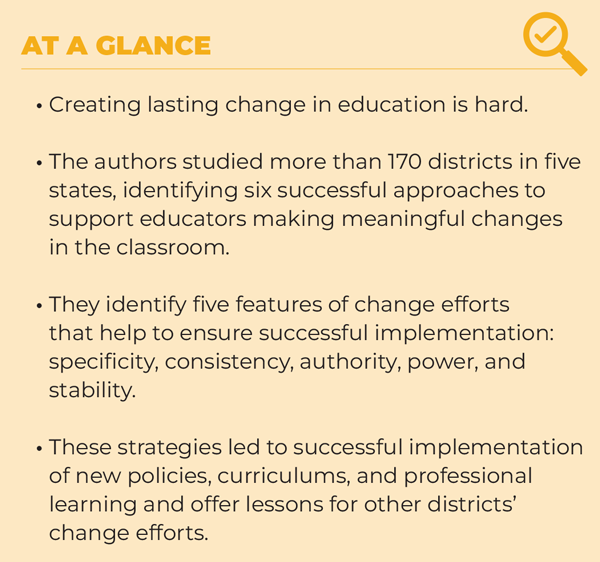
Making sustainable education policy change is difficult. For decades, researchers have studied how to best support district leaders in implementing new policy reforms, whether it is a new approach to instruction, a new curriculum, or new standards for learning. From 2015 to 2020, we looked at school change efforts in more than 170 districts in California, Massachusetts, Ohio, Pennsylvania, and Texas.
We use a framework that identifies five features of change efforts that help to ensure successful implementation:
- Specificity refers to how detailed or specific the policy is.
- Consistency refers to how the policy aligns with or supports other policies, beliefs, and practices.
- Authority refers to how stakeholders buy in to or believe in the policy, as well as the amount of resources that support the policy.
- Power refers to how policies are reinforced or required.
- Stability refers to how much the policy changes over time, as well as how much student, teacher, and administrator mobility there is (Porter, 1994).
The more a policy possesses these qualities, the stronger implementation will be (Desimone, 2002). However, education leaders need to know how to enact these attributes in practice. Through analysis of thousands of surveys, and nearly a hundred interviews and classroom observations, we identified six successful approaches to support educators making meaningful changes in the classroom. We studied change in the context of curriculum adoption and standards implementation, but we believe these approaches are broadly applicable to implementing changes in a variety of reforms and contexts.
1. Balance specificity with flexibility
Providing teachers with clear, detailed guidance in policy language, curriculum materials, or professional learning can help them implement new practices with fidelity (Comstock, Edgerton, & Desimone, 2022). However, a common complaint among teachers is that too-specific guidance does not allow for creativity, autonomy, and innovation (Datnow & Castellano, 2000). To address this conundrum, districts in our study used an approach we call flexible specificity. Their guidance provided enough detail for teachers to understand what the materials asked of them, but educators could exercise professional judgment in adapting the materials to fit their classrooms. A 4th-grade teacher described their district’s approach to flexible specificity:
There are certain deadlines for when specific assessments have to be given. They’re usually pulled from the curriculum so you have to have moved through that piece before so you can give that assessment by that due date. And all of that goes into a district database so that across the district we can compare data and see everyone’s results and stuff. But within that time frame no one tells us what we have to do on which day. We determine that as a PLC [professional learning community]; as a grade level team we determine how we’re going to pace things (Stornaiuolo, Desimone, & Polikoff, 2023).
Districts can facilitate flexible specificity by creating continuous feedback loops or conversations that allow educators to communicate their needs (Stornaiuolo, Desimone, & Polikoff, 2023). In these conversations, teachers can discuss implementation and the supports they need, and leaders can share how they will address those needs. Data from surveys, dialogue from school events, and teacher feedback can inform these conversations. To achieve flexible specificity, leaders should let teachers know how they will gather feedback, how participants can best communicate needs, and how leaders will act upon next steps.
2. Implement changes consistent with current policies, practices, or beliefs
We must stop pulling teachers in different directions. How educators perceive a new policy, curriculum, or professional learning fitting into their current practice influences its overall success. The more teachers must modify their established practice to accommodate a change, the more difficult implementation will be (Cohen & Ball, 1990). When changes are aligned with current norms, educators can understand, adopt, and integrate them into their existing practice more easily. One 2nd-grade teacher described the stressors she comes up against when new changes are introduced:
They’ve got all these materials, but how are we going to fit it into that time and again? The standards are listed for us there, but it’s so many standards and it’s just — how is this going to work in my classroom? (Stornaiuolo, Desimone, & Polikoff, 2023)
In our study, district leaders used several mechanisms to promote consistency between new policies and educators’ current practice, as well as consistency among resources and professional learnings. Continuous feedback loops, such as gathering feedback through surveys or in meetings and responding to concerns raised, helped ensure consistency by providing teachers the opportunity to communicate how the policy integrated into their current practice and to suggest ways to adapt the policy to better fit their instruction and their students’ needs (Stornaiuolo, Desimone, & Polikoff, 2023). In other examples, districts brought together teachers of students with disabilities, English learners, and general education students to help them understand the policy and to share supports, ideas, and strategies for implementation (Pak, Desimone, & Parsons, 2020). Districts can bring teachers and staff together in shared learning sessions to promote alignment between the change and current practice. Continuous feedback loops ensure everyone understands and effectively implements the changes. Creating coherence in the policy system is essential, and district leaders can play a key role.
3. Make power smart, not hard
Educational changes are sometimes implemented with ties to accountability, such as rewards or punitive actions based on outcomes. “Hard” power tactics, such as public grading of schools and merit raises or dismissal based on student test scores, often create a threatening environment. Instead of focusing on developing positive learning environments, teachers feel stressed to meet stringent requirements (Hamilton et al., 2007).
Districts in our study saw success using what we refer to as smart power. Smart power is when leaders weakened rewards and sanctions associated with a policy and instead instituted more local control and participation for implementation (Nichols, Desimone, & Edgerton, 2021). This creates a safe trial-and-error environment for teachers to discover how to make policies work in their classroom. An elementary teacher shared the benefits of instructional reviews tied to constructive feedback instead of accountability:
I like the inquiry cycle … because I mean that is how we’re going to grow as colleagues. I think anybody in any profession would benefit from an inquiry cycle … that’s been to me the best and most effective. When somebody comes in, they give me feedback, I go back, and I make changes (Stornaiuolo, Desimone, & Polikoff, 2023).
Districts we studied operationalized smart power by varying accountability systems, providing affirming language and supports, and employing teacher-led curricula (Nichols, Desimone, & Edgerton, 2021). For example, several district administrators carefully communicated with teachers that the implementation of new practices would not be tied to penalties used in prior systems of strict accountability. To enact affirming language, one Texas district administrator highlighted how implementation of new data practices would be nonevaluative and nonpunitive, and instead would be focused on having conversations to support teachers. In Ohio, districts employed teacher-led curriculum by working with teachers to select preferred textbooks to implement state standards and piloted textbook usage in a few classrooms before expanding to the full district.
Districts also built smart power by using ongoing negotiations through continuous feedback loops between teachers, principals, coaches, and support staff. This dynamic process helped leaders understand how the accountability system associated with a policy worked, negotiate changes, and identify specific needs to target (Stornaiuolo, Desimone, & Polikoff, 2023). Districts wishing to build smart power might prioritize supportive tactics, such as encouraging improved teaching and learning by providing additional resources aligned with teacher needs and involving teachers in shaping supports. Districts can also consider incorporating a dynamic conversation process to ensure all stakeholders understand the power structures and they can negotiate throughout implementation.
4. Consider the history of stability
New curricula, instruction styles, or approaches to professional learning frequently sweep through districts. Rapidly evolving policy environments challenge educators, because each new change requires them to modify their established practices and relearn new requirements, resources, and content (Loeb, Knapp, & Elfers, 2008). Policies designed to be put in place over a longer span of time are more likely to be successfully implemented (Desimone, 2002). Those policies allow teachers to learn the content at a reasonable pace, integrate it with their instruction, and adjust to find what works best in their classrooms.
We examined the policy environment of districts over the course of several years and found that teacher perceptions of the strength and supportiveness of their policy environments strengthened over time (Comstock, Edgerton, & Desimone, 2022). One elementary teacher described the benefits of seeing a districts’ investment in new priorities: “This district has put a lot of money into [professional development] and it’s been district-wide. There’s been a slow rollout, and they really grasp the concept of ‘go slowly to go fast.’”
While our study did not reveal short-term paths to achieving stability, districts wishing to implement a change must consider how often they introduce new policies, curriculum materials, or professional learning practices to staff. Districts that frequently change direction may have trouble garnering support from educators. Educators are more likely to invest in changes they think have staying power, and a district’s history of change informs educators’ perceptions of current and future efforts.
5. Acknowledge and encourage teacher authority
School leaders often implement widespread change through top-down approaches with administrators telling teachers what changes to make, when, and how. They make change without taking into consideration how teachers view the policy (Darling-Hammond & McLaughlin, 1995). In our study of standards implementation, we found that teachers had lower authority, or buy in, to the new policy than principals (Edgerton & Desimone, 2019). And teachers of students with disabilities had lower authority than general education teachers (Edgerton & Desimone, 2018). A possible explanation could be that policy implementation is difficult when it hits the classroom, and specialized teachers experience it differently due to the unique needs of their classrooms. In both instances, the teachers with less authority for the policy were less likely to teach the content in the standards (Edgerton & Desimone, 2018, 2019).
It is important for district leaders to consider teachers’ authority, because teachers are the primary implementers of the change. If they do not authentically buy into the change, they will not be as willing to learn about or implement it. We have found that the more teachers believe in the appropriateness of a policy change, the more they include the change in their instruction (Edgerton & Desimone, 2018). In other words, teacher authority is key for successful implementation at the classroom level. One high school teacher shared the benefits of districts allowing for flexibility in implementation: “I feel like I’ve been trusted as a professional to make decisions” (Stornaiuolo, Desimone, & Polikoff, 2023).
6. Use flexible specificity, consistency, smart power, and stability to build authority
While working with districts, we found that flexible specificity, consistency, smart power, and stability contributed to increased authority, which in turn improved policy implementation.
Flexible specificity provided teachers with opportunities to exercise professional judgment and adapt the policy to fit both their instructional needs and the needs of their students. This improved morale related to the policy implementation, and it increased buy-in because teachers were able to use the guidance they needed and omit what they did not (Comstock, Edgerton, & Desimone, 2022).
Consistency ensured that new policies aligned with current practices and that related supports, such as materials, professional learning, and accountability systems, worked together. This improved buy-in by building perceptions of legitimacy of the materials (Desimone et al., 2019).
Smart power created nonthreatening environments for teachers to learn and enact the policy. This approach created buy-in by increasing the goodwill of those who implemented it (Nichols, Desimone, & Edgerton, 2021).
Finally, over time, teachers’ authority for standards improved (Comstock, Edgerton, & Desimone, 2022), suggesting the importance of stability, or sustained implementation of new policies over time. This provided teachers with the time to understand and implement the policy and find what works in their classroom.
Sustainable change
We have witnessed how districts across the country built successful approaches to implementing change. Districts used specificity, consistency, power, and stability to help build authority, which in turn led to successful implementation of new policies, curriculums, and professional learning practices. We found that each of these attributes can bolster the others so that districts can create a positive environment to support teachers’ high-quality implementation of standards.
The struggle to find appropriate ways to support educators in implementing new reforms is a consistent challenge in our field. We believe these lessons hold great promise for education leaders wishing to enact sustainable change in their school or district, whether for standards, new policies, a new curriculum, or other changes we seek to make as we reimagine our school systems.
References
Cohen, D.K. & Ball, D.L. (1990). Policy and practice: An overview. Educational Evaluation and Policy Analysis, 12 (3), 233-239.
Comstock, M., Edgerton, A., & Desimone, L.M. (2022). Connecting policy to practice: How state and local policy environments relate to teachers’ instruction. Teachers College Record, 124 (11).
Darling-Hammond, L. & McLaughlin, M.W. (1995). Policies that support professional development in an era of reform. Phi Delta Kappan, 76 (8), 597-604.
Datnow, A. & Castellano, M. (2000). Teachers’ responses to success for all: How beliefs, experiences, and adaptations shape implementation. American Educational Research Journal, 37 (3), 775-799.
Desimone, L. (2002). How can comprehensive school reform models be successfully implemented? Review of Educational Research, 72 (3), 433-479.
Desimone, L.M., Stornaiuolo, A., Pak, K., Edgerton, A., Flores, N., Nichols, P., & Plumber, E. (2019). Successes and challenges of the “new” college and career ready standards: Seven implementation trends. Educational Researcher, 48 (3), 167-178.
Edgerton, A. & Desimone, L.M. (2018). Teacher implementation of CCR standards: Links among policy, instruction, challenges, and resources. AERA Open. 4 (4).
Edgerton, A.K. & Desimone, L.M. (2019). Mind the gaps: Differences in how teachers, principals, and districts experience college-and career-readiness policies. American Journal of Education, 125 (4).
Hamilton, L.S., Stecher, B.M., Marsh, J.A., McCombs, J.S., & Robyn, A. (2007). Standards-based accountability under No Child Left Behind: Experiences of teachers and administrators in three states (MG-589-NSF). RAND Corporation.
Loeb, H., Knapp, M.S., & Elfers, A.M. (2008). Teachers’ response to standards-based reform: Probing reform assumptions in Washington State. Education Policy Analysis Archives, 16 (8), 1-29.
Nichols, P., Desimone, L., & Edgerton, A. (2021). Smart power in standards implementation after No Child Left Behind. American Journal of Education, 128 (1), 147-169.
Pak, K., Desimone, L.M., & Parsons, A. (2020). An integrative approach to professional development tosupport college-and career-readiness standards. Education Policy Analysis Archives, 28 (111).
Porter, A. (1994). National standards and school improvement in the 1990s: Issues and promise. American Journal of Education, 102 (4), 421-49.
Stornaiuolo, A., Desimone, L., & Polikoff, M. (2023). “The good struggle” of flexible specificity: Districts balancing specific guidance with autonomy to support standards-based instruction. American Education Research Journal, 60 (3), 521-561.
This article appears in the March 2024 issue of Kappan, Vol. 105, No. 6, p. 8-11.

ABOUT THE AUTHORS

Arielle Lentz
ARIELLE LENTZ is a doctoral student at the University of Delaware, Newark.
Laura M. Desimone
LAURA M. DESIMONE is the director of the School of Education and director of research at the College of Education and Human Development, University of Delaware, Newark.
Amy Stornaiuolo
AMY STORNAIUOLO is an associate professor in the Learning, Teaching, and Literacies Division and the faculty director of the Philadelphia Writing Project at the Graduate School of Education at the University of Pennsylvania.
Katie Pak
KATIE PAK is a doctoral candidate at the University of Pennsylvania Graduate School of Education, Philadelphia.
Nelson Flores
NELSON FLORES is an associate professor of Educational Linguistics Division at the Graduate School of Education of the University of Pennsylvania.
T. Philip NIchols
T. Philip Nichols is an associate professor in the Department of Curriculum & Instruction at Baylor University, Waco, Texas.
Morgan Polikoff
MORGAN POLIKOFF is an associate professor of education at the Rossier School of Education of the University of Southern California, Los Angeles.
Andy Porter
ANDY PORTER is the director of the Center on Standards, Alignment, Instruction, and Learning, Philadelphia, PA.