
Improving classroom practice requires more than simply having good ideas. Educators must focus on developing technical, human, and social capital both inside and outside schools.
Policy makers in the United States often assume that as a nation we have the personnel, knowledge, and funding to reach many of our education goals. In turn, many policies and improvement efforts rely heavily on strategies that emphasize the power of individuals to take advantage of that potential and catapult schools to higher levels of achievement.
Such assumptions, however, mask the complexities of innovation and underestimate what is really required to change the status quo and make substantial improvements in schooling on a wide scale. Although innovation suggests a dramatic departure or a disruptive event or product that leads to something previously difficult to imagine, innovation isn’t always big or bold. Like change, innovation covers a wide range of possibilities, from small adaptations to revolutions. In fact, innovations often evolve out of a series of what may seem to be minor developments. As a consequence, instead of waiting for disruptive products and technologies, we need to create the conditions for individuals, groups, and organizations to adapt, innovate, and improve all the time. Developing those conditions begins with rethinking what is really required to build capacity for educational improvement and recognizing the social and systemic aspects of innovation.
Improvement and innovation depend on technical, human, and social capital.
In education, capacity means the resources and effort needed to achieve a particular goal. Schools have low capacity when they need substantial new resources, time, and energy in order to improve student outcomes, or they need major changes in structures or routines to improve their effectiveness. Conversely, schools with high capacity don’t require significant new investments or changes to make improvements.
The simplicity of this definition, however, ignores aspects of capacity that have critical implications for schools. First, while conventional views equate capacity with the money or resources schools need to improve student learning, studies of large-scale reform efforts in the 1990s and 2000s have identified a broader array of factors to be considered. These factors include money and resources (what many refer to as technical capital); the skills, knowledge, and dispositions of the personnel involved (human capital); and relationships, social networks, trust, and collective commitment (social capital) (Cohen & Ball, 1999; Goertz, Floden, & O’Day, 1995; Spillane, Hallet, & Diamond, 2003). Second, studies of efforts to turn around chronically failing schools and schools identified as needing improvement have also shown that simply having resources doesn’t mean those resources will be used well (Corcoran & Goertz, 1995; Hatch, 2009; Malen & Rice, 2004). Maximizing the use of resources and using them strategically to meet key goals depends on the abilities of the people involved and the social connections between them.
Strong networks of relationships increase the chances that teachers can work together to develop innovative classroom practices and create opportunities for teachers to share those practices with others.
Historically, many large-scale initiatives to improve schools initially focused on providing schools with technical capital (in the form of funding and compensatory programs), while more recent efforts have focused particularly on human capital. However, these policy strategies often have ignored the power of relationships and social capital. Thus, schools where staff have developed good working relationships, share a common understanding of what they’re doing and why, and who trust one another have more opportunities to share expertise and information, and are more likely to be effective with their students (Bryk & Schneider, 2002; Leana, 2011; Putnam, 2000). In particular, strong networks of relationships both increase the chances that teachers can work together to develop innovative classroom practices and create opportunities for teachers to share those practices with others. Without strong relationships and the collective commitment and understanding that can help foster those relationships, innovations and improvements are likely to remain sequestered in the classrooms, departments, or other small groups of pioneers and early adopters. In turn, those independent innovations are likely to be difficult to sustain over significant periods of time.
Improvement and innovation depend on building capacity at the classroom, school, and local level.
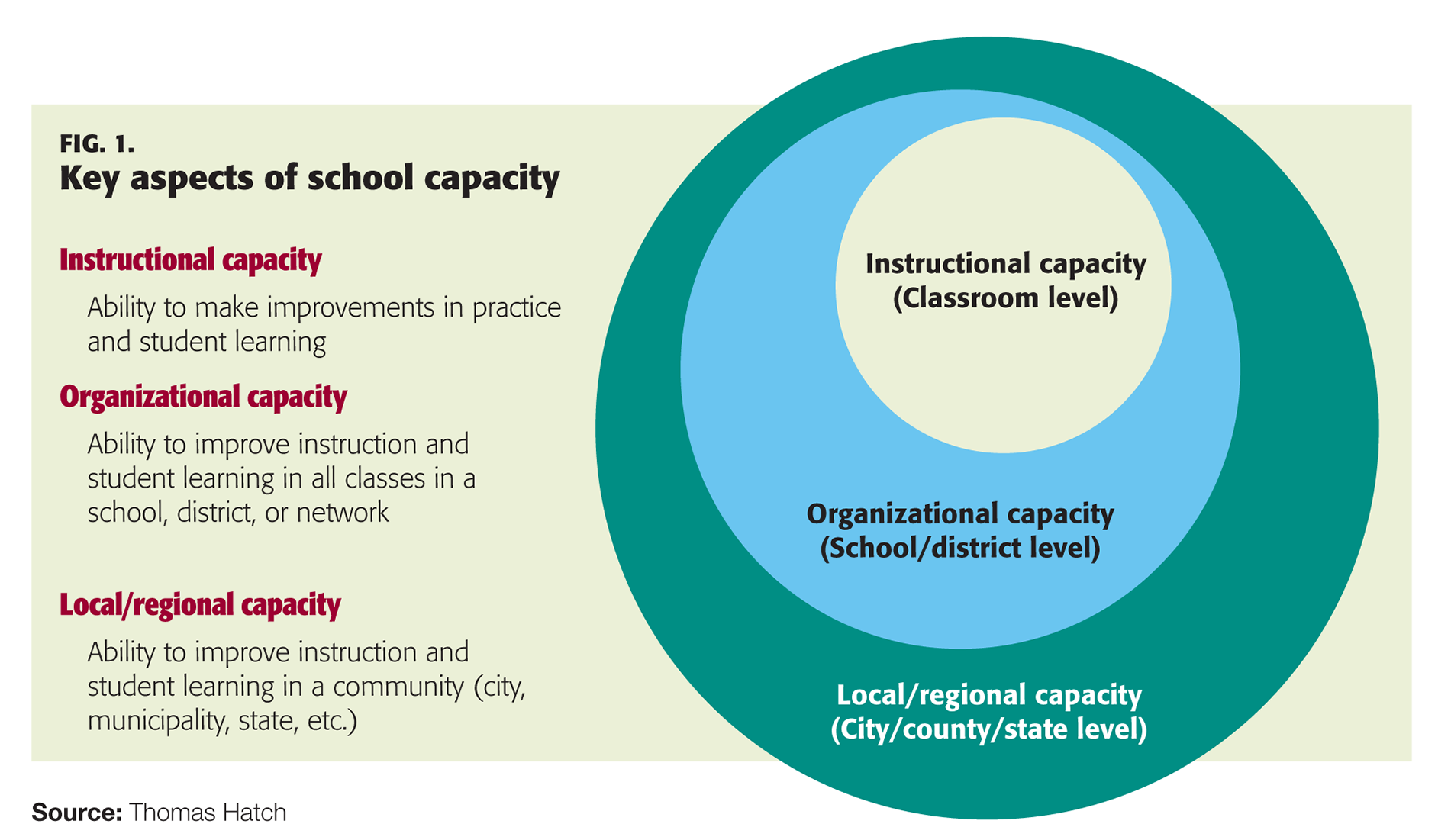
The capacity to make substantial improvements in conventional practices and procedures also depends on interactions between the technical, human, and social capital available at the classroom level, the school level, and the local/regional level. At the classroom level, instructional capacity — the ability to improve classroom practices and learning outcomes — depends on the availability and quality of key resources like textbooks, technologies, assessments, and learning tasks. However, resources are unlikely to have a significant impact on the instructional core — the intersection between students, teachers, and content (Cohen & Ball, 1999; Elmore, 2000) — unless teachers and students have good relationships and the abilities and willingness to use those resources to engage with challenging content in new and more sophisticated ways.
It is extremely difficult to support “innovation at the core,” however, and to improve classroom practice throughout a school, a district, or a network of schools without organizational capacity. In turn, organizational capacity depends on the distribution of resources across classrooms; the collective skills, knowledge, and dispositions of teachers, staff, and students; and the social networks among individuals and groups in the organization. Unfortunately, many schools and districts that lack instructional capacity also lack organizational capacity. They lack the capacity to make improvements in the classroom, and they also lack the capacity to make significant changes in their organizational structures and practices. In other words, it takes organizational capacity to build instructional capacity. Conversely, developing organizational capacity is much easier if a school or district already has the instructional capacity to support high levels of student learning. As a consequence, low-performing schools and districts face a serious catch-22: Reform initiatives that underestimate the demands of building technical, human, and social capital can lead to a cycle of failure, but failure to attempt to make significant changes means being stuck with the status quo.
If developing instructional and organizational capacity were not difficult enough, schools and districts also must rely on a host of groups and institutions in the surrounding environment for the technical, human, and social capital to develop innovative practices and make improvements. Schools and districts depend on government agencies, philanthropies, businesses, nonprofit organizations, and universities for funding, facilities, resources, instructional materials, and preparation and professional development programs. Furthermore, social capital and relationships among the groups and institutions in the local community are key mediators of the resources, information, expertise, and political and public support that schools and districts need to build instructional and organizational capacity. Unfortunately, the networks of relationships in which schools and districts are embedded are often overlooked. In particular, efforts to scale-up new and innovative tools, practices, and programs that have succeeded in one context often ignore the reliance of those efforts on external relationships and the inequitable distribution of social capital that can undermine successful spread and replication.
The system matters
All in all, this multidimensional view of school capacity suggests that creating innovations in classroom practices on a wide scale depends on a long-term commitment to developing technical, human, and social capital both inside and outside schools. While advocates for almost any reform idea in the United States seem able to find a correlate in some higher-performing system, comparisons of many different high-performing countries reveal that no single approach or policy explains their success. Across the board, higher-performing countries invest in developing technical, human, and social capital: producing high-quality facilities, rigorous curricula, high-quality textbooks, and sophisticated assessments; developing exemplary preparation and professional development programs; and supporting the development of a common commitment to education and the individual and group relationships that make schooling a communal and societal endeavor rather than an individual pursuit (OECD, 2011; Tucker, 2011).
Certainly, effective teachers and education leaders are crucial to ensure successful educational experiences for every child, and most policy makers and many members of the general public know that some research shows that teachers make more of a difference in student learning outcomes on current tests than any other school-related factor. But those results should not be a surprise in a weak system overall, and one in which there are massive inequities in the distribution of technical, human and social capital. Enabling large numbers of students to reach high levels of learning means coming to terms with the fact that effective education takes more than individual effort. It takes an entire system to enable every child to reach high standards of learning.
Effective education takes more than individual effort. It takes an entire system to enable every child to reach high standards of learning.
To that end, initiatives to build human capital should be accompanied by efforts to build social capital. That means engaging in deliberate efforts to create and sustain productive work environments and not assuming those environments will emerge when some individuals come and some individuals go. One critical means of supporting productive and collaborative work environments in schools is to shift from a focus on high-stakes examinations of the yearly performance of individual students and teachers to a focus on the performance of both individuals and groups over several years. Putting in place assessment systems that sample the performance of groups of students rather than testing every student in multiple subjects every year can also reduce the substantial costs of testing and create incentives that can help foster the relationships, collaboration, and common commitment essential to social capital.
Beyond the organizational level, when U.S. policy makers think of systemic reform, they often assume that aligning goals, curriculum, assessments, and incentives will unleash some previously hidden capacity for improvement. Similarly, numerous advocates for charter schools and efforts to decentralize school systems expect that granting autonomy will free individuals and organizations to fulfill previously untapped potential. However, the focus on structural alignment and governance ignores the fact that whether the educational systems of higher-performing countries are centralized or decentralized, they often have tremendously powerful social networks that make it possible to share information, ideas, and expertise. Those connections across individuals, groups, and institutions help create coherence and a common understanding of the purposes of schooling. That common purpose serves as another crucial resource for teachers and schools and all those who want to develop new materials and new ideas. Correspondingly, ongoing efforts to align curricula and assessments in the United States, like those reflected in the work on the Common Core State Standards, should also include initiatives to build relationships and social networks across institutions and sectors. Like the networked improvement communities being developed by the Carnegie Foundation for the Advancement of Teaching (Bryk, Gomez, & Grunow, 2011), local networks can bring individuals and groups from schools, districts, support providers, community organizations, and research institutions together to identify key local problems and explore potential solutions. These networks can help establish conditions that will enable teachers and schools to develop their own innovations in classroom practice and to experiment with and adopt innovations developed elsewhere. This attention to the social side of capacity building recognizes we have to take collective responsibility for the effectiveness of our educational system.
Beyond the current system
Ironically, although collective effort and the common understanding that can come with it may be central to building the capacity for significant improvements in our current educational system, the constraints of common expectations can also act as a serious barrier to innovation. Familiarity with the conventions of schooling, long-standing expectations about what students are able to do, beliefs about what “real” school looks like, and the reinforcements of good scores and related rewards can sustain high-performing systems at the same time that they undermine further improvement efforts. Even the work on building capacity described here takes for granted the basic structures and “grammar” of schooling that have defined teaching and learning over the past century (Tyack & Cuban, 1995).
Thus, while fostering innovation at the core of the classroom depends on building capacity both inside and outside schools, dramatic improvements in learning may depend on rethinking our fundamental assumptions about where learning takes place. The next revolutions in education may well occur outside schools, perhaps in the online worlds of virtual education. But even in those cases, the revolution may depend as much on what happens offline as online. As long as the U.S. and many other developed countries need a place to keep most children and young adults between the hours of 8 a.m. and 3 p.m., even efforts to reinvent education are likely to continue to make schools the “seat of learning.” Those constraints make it extremely difficult to change the basic structures and classroom practices that have grown so familiar worldwide. Just as it took the industrial revolution to create the factory school, it may take another profound change in the relationships between adults and children to finally break down school walls and allow us to reimagine learning at the center of everyday activities. Looking to higher-performing countries may provide examples of ways to improve American schools, but developments in countries that are currently lower performing — and that may move past the industrial revolution — may provide the impetus for future educational innovations.
References
Bryk, A. & Schneider, B. (2002). Trust in schools: A core resource for improvement. New York, NY: Russell Sage Foundation.
Bryk, A., Gomez, L., & Grunow, A. (2011). Getting ideas into action: Building networked improvement communities in education. In M. Hallinan (Ed.), Frontiers in sociology of education. New York, NY: Springer.
Cohen, D.K. & Ball, D.L. (1999). Instruction, capacity, and improvement. CPRE Research Report Series RR-43. Philadelphia, PA: University of Pennsylvania, Consortium for Policy Research in Education.
Corcoran, T. & Goertz, M. (1995). Instructional capacity and high performance. Educational Researcher, 24 (9), 27-31.
Elmore, R. (2000). Building a new structure for school leadership. Washington, DC: Albert Shanker Institute.
Goertz, M., Floden, R., & O’Day, J. (1995). Studies of education reform: Systemic reform, volume 1. Findings and conclusions. New Brunswick, NJ: Consortium for Policy Research in Education.
Hatch, T. (2009). Managing to change: How schools can survive (and sometimes thrive) in turbulent times. New York, NY: Teachers College Press.
Leana, C. (2011). The missing link in school reform. Stanford Social Innovation Review. www.ssireview.org/articles/entry/the_missing_link_in_school_reform
Malen, B. & Rice, J. (2004). A framework for assessing the impact of education reforms on school capacity: Insights from studies of high-stakes accountability initiatives. Educational Policy, 18 (5), 631-660.
Organization for Economic Cooperation and Development. (2011). Strong performers and successful reformers in education: Lessons from PISA for the United States. Paris, France: Author.
Putnam, R. (2000). Bowling alone: The collapse and revival of American community. New York, NY: Simon & Schuster.
Spillane, J.P., Hallett, T., & Diamond, J.B. (2003). Forms of capital and the construction of leadership: Instructional leadership in urban elementary schools. Sociology of Education, 76 (1), 1-17.
Tucker, M.S. (2011). Surpassing Shanghai: An agenda for American education built on the world’s leading systems. Cambridge, MA: Harvard Education Press.
Tyack, D. & Cuban, L. (1995). Tinkering toward utopia: A century of public school reform. Cambridge, MA: Harvard University Press.
CITATION: Hatch, T. (2013). Innovation at the core. Phi Delta Kappan, 95 (3), 34-38.
ABOUT THE AUTHOR

Thomas Hatch
THOMAS HATCH is a professor of education and director of the National Center for Restructuring Education, Schools, and Teaching at Teachers College, Columbia University, New York, NY. He is the author, with Jordon Corson and Sarah Gerth van den Berg, of The Education We Need for a Future We Can’t Predict .