A former education reporter has a new vision for education coverage in New York.
By Alexander Russo
Though it might be hard to believe, the outlet HuffPost once had a formidable education team that produced a steady stream of national education coverage.
One of the members of that team was Rebecca Klein, who’s now publisher of a nonprofit statewide news organization, New York Focus.
The statewide nonprofit is looking to add an education reporter, an announcement Klein described as “a dream.”
As part of figuring out a vision for the future, Klein is taking a sharp look back at her own work.
“I think that I too frequently got stuck in the typical echo chambers and confines of narrow debates,” she told me in a recent phone interview.
Now a mom, she describes that her coverage was often shaped by the experiences and priorities of “advocates and highly engaged individuals” rather than everyday parents and community members.
In this regard, she’s not alone. Several other veteran education journalists are having a successful second (or third) act. Current and former education journalists have also critiqued similar aspects of their own work, calling for changes in how schools get covered.
What’s different about her reflections or role? Klein is in a position now to shape education coverage. As of this week, the education reporter position is still open.
The following interview has been edited and condensed for clarity.
NY FOCUS
Why did New York Focus decide to hire an education reporter at this point, even before Gov. Hochul announced the new literacy initiative?
RK: There is a bunch of local education coverage in New York, but there’s very little by way of statewide education policy, which is what we cover, and so it felt like there was a big gap and a big opportunity. We’re so excited that we were able to obtain funding for it, and so we plan to bring someone on full time in the new year.
Is there currently any statewide New York education coverage?
RK: Politico New York does state policy out of Albany, but we are a pretty different outlet than they are. Chalkbeat occasionally does statewide work, [as does the New York Times and others]. But there’s very little dedicated coverage.
What other outlets or approaches would you compare yourself to?
RK: The most direct comparisons that we often receive are to other statewide newsrooms, places like the Texas Tribune and CalMatters, whom we greatly admire. We don’t have a particular place that we’re currently modeling this beat after. I would love to hear from folks about some of their favorite pieces of statewide journalism on this beat.

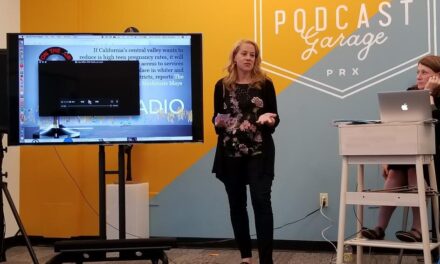
Above: Now publisher of the upstart New York Focus, Klein (pictured center in a 2023 New York Times article profiling the outlet) describes the experience as “the thrill of my life.”
REFLECTIONS
What reflections do you have about the journalism you produced as an education reporter?
RK: When reflecting on my own years as an education reporter, I think that I too frequently got stuck in the typical echo chambers and confines of narrow debates that define the way advocates and highly engaged individuals interact with education systems. I didn’t think enough about individual parents and what would be the most useful information for them in terms of how to help serve their children and help interact with their local school districts.
I wrote for a far more abstract audience than a concrete one in terms of who the main constituents and stakeholders are in education. Those are obviously some of the folks who are less accessible when it comes to defining these debates, but they are central and they are the most important voices. And so when I reflect on some of my pieces, I reflect with a certain level of regret because I feel as though I wish I could have been closer to those audiences because I think the work would have been a lot more meaningful and a lot more effective.
[At New York Focus,] I think that our stories have to be fundamentally grounded in helping to make the system more accessible and transparent for students and families and providing a service-oriented utility for people on the ground.
I didn’t think enough about individual parents and what would be the most useful information for them.
Are there any pieces where you felt like you were able to do some of the things that you now want to do?
RK: I think that I did an okay job on a piece I did reflecting on Betsy DeVos and her tenure, in that I worked to get beyond the “sides” that defined that era and focus on the work. But I don’t think that’s particularly useful to most families or students or parents.
How about your piece about teachers who support Trump, reminding us that we weren’t in a binary world? I loved that piece.
RK: I wish that more of my pieces had taken that type of nuance.
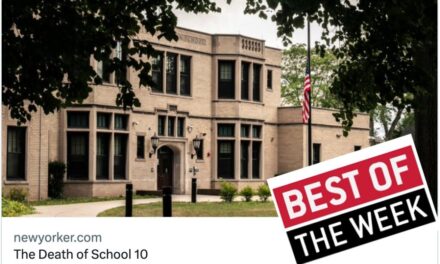
What about your HuffPost education stories, like Parents Worry New School Waivers Could Unravel Special Ed Protections. Districts Say They’re Necessary and To Access Online Services, New Jersey Students With Disabilities Must Promise Not To Sue? I think The Grade named After Months Of Special Education Turmoil, Families Say Schools Owe Them, published on NPR, a best of the week pick.
RK: It strikes me that all the pieces you just named are related to special education, an area that deserves 10 times more coverage than it currently receives. I’m proud of the times I got to help make that intensely opaque, complicated system more accessible and wish I had focused on it more.
How would you do a story if you weren’t focused on highly engaged readers and advocates?
RK: I just think a lot of the paradigms in which we tend to view the more political aspects of education as it comes to issues around school choice, labor, etc. are only useful through a political lens and are substantially less useful when translating that to families and communities and so I think that I would, in retrospect, approach some of those stories differently in terms of framing.
It’s partly by necessity that some of these issues are translated into our national political lens. … But I think doesn’t really mean that much to most people as they navigate their children’s educational experiences.
Say we’re talking about choice. What does the less useful framing look like, and what does the more useful framing look like?
RK: I think that it’s partly by necessity that some of these issues are translated into our national political lens when we think about left right, progressive, far left, far right, etc., which can be useful framing to an extent. But I think doesn’t really mean that much to most people as they navigate their children’s educational experiences. I wish that I had relied less on some of those shortcuts for contextualization when framing some of these issues.

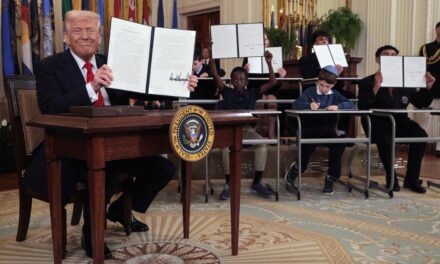
Above: Klein’s 2016 HuffPost story about the surprising number of pro-Trump teachers.
REALITY CHECK
Where do these insights come from?
RK: Some of it is reflecting on my own clips — the pieces that I’m most proud of as well as the pieces that I am less proud of, as well as the overall contours of how I approached my coverage.
I think some of it may also be attributable to some personal life changes, becoming a parent myself and thinking about the questions I have and what is most useful for me in my day-to-day life.
And then I think part of it also is because I’m not reporting every day, I have a certain level of distance that allows me to think more broadly about some of these issues in a way that I have found really useful. And it’s something that when you’re reporting and you’re in the weeds, you aren’t often afforded that type of time to reflect.
Let’s get specific. What are one or two of your past pieces that you find more than a little horrifying to see?
RK: I think it is easy to criticize pandemic coverage in retrospect, and I produced some pieces during that time that I’m really proud of, particularly as it relates to the experiences of individual communities and students. But I do still think about how I could have approached debates between unions, teachers, and districts differently. I’m not sure what the answer is, but it feels like something was lacking.
I still feel like I don’t have answers to some of the biggest questions in education in regard to what’s working and what’s not and why. These stories aren’t always the sexiest, especially in a large general newsroom. But I wish I had spent more time thinking about them and trying to find the answers.
I think it is easy to criticize pandemic coverage in retrospect. … But I do still think about how I could have approached debates between unions, teachers, and districts differently.
What are one or two New York Focus stories that exemplify what you’re going to be trying to do on the education beat?
RK: Our series on the implementation (or lack thereof) of the state’s solitary confinement rules. We went back months after the law went into effect to see what was really happening. We like to stay on topics — passing a law to fix a problem doesn’t indicate the end of our coverage on a topic. It is usually just the beginning.
Now can you give an example of the different way New York Focus might try to do an education story?
RK: Something that we are thinking about is how to make examination of education budgets at the district, school, and municipality and statewide levels more concretely accessible — as opposed to defining what the budget says and where it says this money is going to go.
Making sure we follow up and elucidate what that money means in a child’s day-to-day life and how it’s been distributed.
And some of the more opaque management processes that have a large impact on how money is felt and seen for schools.
Many places feel like their schools are under-resourced and underfunded. And that’s an issue where I feel like the current contours of the debate are often less useful when you’re not on the ground really taking these abstract ideas and making them really concrete for children and parents.
Now that Gov. Hochul has announced a new literacy initiative, how are you going to cover it? Or is that too newsy or political a story for New York Focus to take on?
RK: This is something that we would cover — not necessarily the news of it, but what it means and what it is going to mean for kids and districts.
Do you think that this reconsidered version of the beat is something that a reporter could do in a traditional newsroom, or do you think that the newsroom has to change?
RK: I think it’s possible, but I think what you need is institutional buy-in because it’s not necessarily the type of approach and disposition that I think tends to drive the day-to-day machinations of most newsrooms. I think it just has to be deliberate in terms of the reporter editor and team relationship. I mean, it’s possible [to change the beat individually], but I think it’s more difficult depending on whatever pressures you might be facing internally.
Also — personal plug. Everyone should apply to be an education reporter at New York Focus! And reach out to me if you have any questions.
Previous interviews & reflections from The Grade:
‘I don’t think I did enough,’ says former PBS correspondent John Merrow
‘We could have been a lot louder’ (Anya Kamenetz)
Making education news more useful (Ruth Serven Smith)
Reflections on covering a hazing death at a Florida HBCU (Denise-Marie Ordway)
Lessons from 30 years covering education for NPR (Claudio Sanchez)
De-tracking, school culture wars coverage, and ‘Monday-morning quarterbacking’ (Laura Meckler)
People are fighting. Is that news? (Greg Toppo)
‘Complicating the narratives’ in education journalism (Amanda Ripley)
‘Better stories’: student-centered schools coverage in Las Vegas (Lorraine Longhi)
ABOUT THE AUTHOR

Alexander Russo
Alexander Russo is founder and editor of The Grade, an award-winning effort to help improve media coverage of education issues. He’s also a Spencer Education Journalism Fellowship winner and a book author. You can reach him at @alexanderrusso.
Visit their website at: https://the-grade.org/