The veteran education journalist wishes he’d made powerful people more uncomfortable.
By John Merrow
“Confrontation” is in the job description for journalists, as these two familiar quotes make clear:
“If one source says it’s raining, and another source says the sun is shining, your job isn’t to print both claims. Your job is to look out the fucking window!”
“The journalist’s job is to comfort the afflicted and afflict the comfortable.”
In other words, it’s part of our main mission to delve beneath the surface for facts and verification, and to confront victimizers and abusers — thus bringing relief to those without power.
I was involved in a few memorable confrontations while covering the education beat in documentaries and reports for NPR and PBS NewsHour for 41 years.
Still, looking back, I wish I’d confronted certain education power brokers earlier, more often, and more powerfully.
I wish I’d confronted certain education power brokers earlier, more often, and more powerfully.
I generally approach life positively; for me it’s “a glass half full.”
In contrast, I see my own career as “a half-empty glass.”
All I can see is what I could have done better.
“Woulda, shoulda, coulda” isn’t a pleasant way to pass the time.
For example, in 2007 we filmed former Washington, DC, Public Schools head Michelle Rhee firing a principal.
Of course, she should fire educators who don’t measure up, but what gave her the right to invite a film crew to record it, making the man’s humiliation public?
I should have asked her that question.
See also Lessons from 30 years covering education for NPR (Claudio Sanchez)
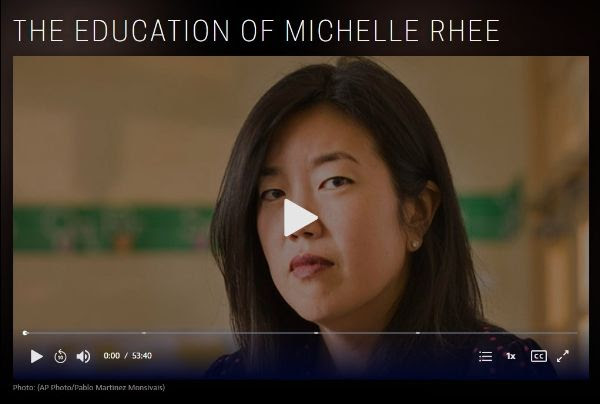
Above: Frontline’s The Education of Michelle Rhee, which aired in 2013
Many federal policies had damaging consequences for low-income children and children of color, going back to Ronald Reagan (ketchup as a vegetable!) and including No Child Left Behind (which led to more testing and drastic cuts in the arts, recess, etc.) and Race to the Top (which promoted test-based evaluation of all teachers, even those who taught physical education).
I should have forcefully confronted former education secretaries Margaret Spellings, Rod Paige, Bill Bennett, and Arne Duncan about those policies.
I should have forcefully confronted former education secretaries Margaret Spellings, Rod Paige, Bill Bennett, and Arne Duncan.
I can dredge up other examples where I could have done more.
PHONICS
Sometime in the early 1990’s I spent a year following two first-grade classes in DC. One rookie teacher used the “whole language” approach, while the veteran across the hall, Johnny Brinson, used both phonics and whole language, with phonics as the engine, whole language as the chassis.
His kids were reading with comprehension halfway through the year; hers were not. We knew her students weren’t learning to read, and we wrestled with the journalist’s dilemma: the drowning man bit.
Should we tell the principal? Ask her to go into the room? Instead we just watched.
The ensuing outcry after the documentary aired was gratifying: The principal put all of those first-graders into Johnny’s class the following year. We returned and did a follow-up report — they became readers.
However, 30 years later, I think that we should have confronted the principal about what we saw happening. Why hadn’t she been observing that rookie teacher? It would have changed the story by making us part of it, so we didn’t intervene.
I’m still conflicted about that, believe it or not.
“ADD” MEDICATION
About the only time I was in full-attack mode was in the film John Tulenko and I did in 1995, “ADD: A Dubious Diagnosis?” While ADD exists, the epidemic of over-medication (of white boys, mostly) was clearly man-made. Our film nailed the greedy bastards, the drug manufacturers, the sham organization CHADD, and the Department of Education hacks who enabled their behavior. I lost friends, including a Harvard classmate then at the USDE, but it was worth it.
In one respect, confrontation didn’t pay. The film scared PBS and my presenting station, South Carolina ETV. Despite our incontrovertible evidence, they forced us to add the question mark to the title. We were forced to get double the normal amount of insurance.
They delayed the broadcast for a couple of months, during which time someone at ABC apparently got a look at part of it, which allowed it to scoop us on one piece of the story. And because we reported on the phony diagnoses that some affluent parents were essentially buying as a way of “explaining” why their children weren’t on track to go to Harvard, we were ignored when awards were being handed out.
The last part I didn’t care about because we kept the federal government from reclassifying methylphenidate to make it even easier to obtain (at a time when the U.S. was already consuming about 90% of the world’s supply of that drug), and we slowed down the ADD train — for a while.
NPR
When I was at NPR with my own program (1974-82), I was more apt to confront bullshitters, of which there are many in education.
I remember being “asked to leave” an education association dinner because, after listening to some hotshot lobbyist tell the table how easy it was to influence educators, I turned on my tape recorder, began talking into it, and then stuck the mike in front of him and asked for more information, etc., etc.
Another time I was interviewing North Carolina’s state education chief. After I turned off my tape recorder, he said, “Now do you want to know what I REALLY think?” I was furious that he expected me to go along, and I turned the recorder back on, repeated his question and said, “Yes, tell me what you really think!” He threw me out, as I recall.
See also: ‘We could have been a lot louder’ (Anya Kamenetz)
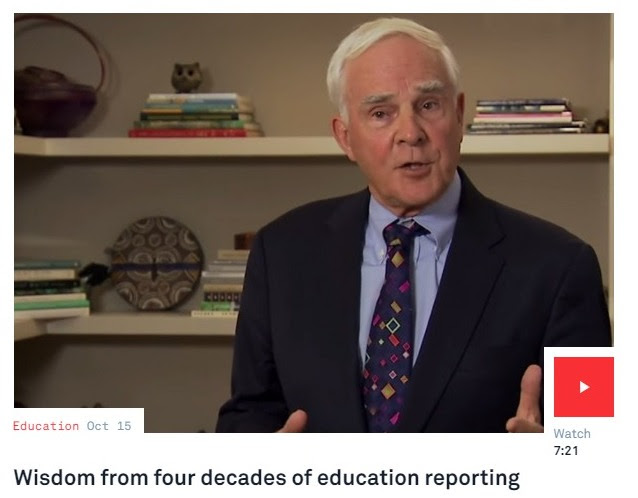
Above: Merrow was the longtime education correspondent for the PBS NewsHour, in partnership with his independent production company.
Throughout my career, my belief (or perhaps it’s a rationalization) was the Madisonian notion that, if we put good information in the hands of the citizens, they will make informed (better) decisions. That too easily becomes what is called “both sides-ism,” or (in full parody) “Equal Time for Hitler.”
Some stories have multiple sides. Some policies are con jobs. Some people we report on are phonies or con artists. Our job isn’t about comforting. Confronting, however, must be high on the list of our responsibilities.
I (and perhaps many of my colleagues) are reluctant to be confrontational because it cuts off access going forward.
The people in power will just turn down requests for interviews in the future. But that’s a risk journalists must take, one that I didn’t take often enough.
[Loss of access is] a risk journalists must take, one that I didn’t take often enough.
Summing up, I don’t think I did enough to make powerful people uncomfortable.
Maybe this year!
John Merrow is an award-winning former PBS NewsHour education correspondent and NPR education reporter. Subscribe to his newsletter, The Merrow Report, or follow him on Twitter at @john_merrow.
Previously from The Grade
How I missed the phonics story (Patti Ghezzi)
People are fighting. Is that news? (Greg Toppo)
‘We could have been a lot louder’ (Anya Kamenetz)
Reflections on covering a hazing death at a Florida HBCU (Denise-Marie Ordway)
Lessons from 30 years covering education for NPR (Claudio Sanchez)
ABOUT THE AUTHOR

The Grade
Launched in 2015, The Grade is a journalist-run effort to encourage high-quality coverage of K-12 education issues.