In this week’s newsletter: Prevention efforts are under scrutiny after school shootings in Iowa and Virginia. A former PBS and NPR education reporter regrets not confronting powerful officials more frequently. A new study finds that teachers of color have higher retention rates. And NPR is finally slated to broadcast an hour-long version of “Sold a Story.”
MORE SCHOOL SHOOTINGS
The big story of the week, according to us
The big K-12 education news story of the week is the horrifying school shootings in Iowa and Virginia. In Virginia, the Newport News teacher who was shot by her student is accusing school officials of downplaying multiple teachers’ concerns on the day of the event (Daily Press, Associated Press, The 74, Washington Post). Meanwhile in Iowa, two young people were killed at a Des Moines youth program (NYT, Des Moines Register).
While school shootings remain exceedingly rare, guns are now a top cause of death for children, off-campus juvenile crime is on the rise, and some school systems are under pressure to take a harder line on student discipline. In situations like these and Oxford, school officials’ prevention efforts — and parents’ responsibilities — are increasingly being scrutinized.
Other big stories of the week:
Backlash is growing after Florida Governor Ron DeSantis said he was rejecting the new AP African American studies course for high schoolers. State education officials said the course — currently being piloted at 60 schools across the country — contains examples of “woke indoctrination” and violates state laws on how race can be taught in the classroom. However, experts involved with the course suggest that the curriculum isn’t objectionable. (You can read it here for yourself). Three students say they’re ready to sue over the decision.
Teachers in Florida’s Manatee County were asked to remove all books from their classroom libraries that haven’t been vetted by librarians — an attempt to comply with a law signed by Gov. DeSantis last year.
Growing poverty among children is being explored by a myriad of news outlets. In Atlanta, there are signs that it’s spreading to the suburbs. And as more families struggle to feed their kids with the federal free meals program ending and food prices spiking, states including California, Colorado, and Maine are considering stepping in.

STUDENT ARREST
The best education journalism of the week, according to us
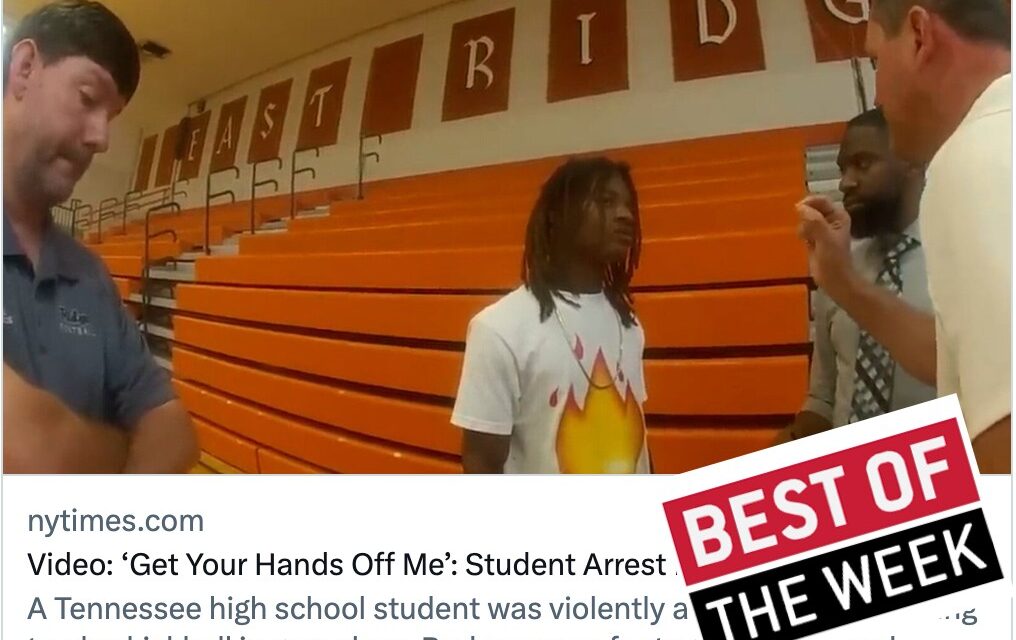
The best story of the week is the New York Times’ ‘Get Your Hands Off Me’: Student Arrest Puts Role of School Police Under Scrutiny, by By Kassie Bracken, Nailah Morgan, Mark Boyer, and Elliot deBruyn.
Focused on an one particularly upsetting incident, the 9-minute video piece combines vivid bodycam footage of the arrest of Hamilton County, Tenn., high school student Tauris Sledge with interviews with the district superintendent, who — shortly after the Uvalde school shooting — requested nearly $1 million in additional funds to put armed school resource officers in all 79 district schools.
With or without the bodycam footage, stories like this that explore the mixed motivations and implementation challenges of school safety efforts are examples that other outlets should consider. In Hamilton County and elsewhere, it’s been a challenge screening and hiring additional officers — and figuring out how to make sure that educators only pull officers into situations that affect student safety.
RUNNERS-UP:
🏆 Busing doesn’t improve academic outcomes for students of color, report says (Boston Globe)
🏆 Seizing on Parents’ Frustration, GOP Governors Push for Education Savings Accounts (The 74)
🏆 When Students Change Gender Identity, and Parents Don’t Know (New York Times)
🏆 Schools Speed Up Covid-Aid Spending After a Slow Start (Wall Street Journal)
🏆 How Charlie Javice Got JPMorgan to Pay $175 Million for … What Exactly? (New York Times)
🏆 The problem with saying ‘my son won’t play football’ (Washington Post)
‘I DON’T THINK I DID ENOUGH’
What we’ve been up to at The Grade
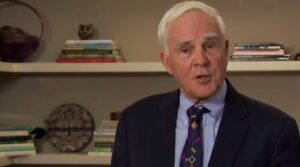
Michelle Rhee. Margaret Spellings. Arne Duncan. The list of powerful education officials whom former PBS and NPR education reporter John Merrow regrets not having confronted more forcefully and frequently goes on and on.
Fearing loss of access and sticking closely to the traditional role of journalist as observer, Merrow — one of the most prominent and influential education reporters of his era — says, “I don’t think I did enough.”
STUDENT MENTAL HEALTH IN COLORADO
Coverage of promising school innovations & signs of progress
💡 Colorado’s only high school for students struggling with addiction focuses on mental health and community-building. (KUNC, as part of a series on youth mental health) See also these stories about Colorado’s free therapy program for 6th through 12th graders.
💡 A district in South Carolina has a bilingual liaison at each of its schools, and families are taking advantage. (Post and Courier) Read also about a new Arabic class at a Denver high school.
💡 Many states are experimenting with apprenticeships and more flexible certificate programs to recruit, train, and retain teachers. (USA Today)
💡 Indiana’s board of education created an alternate diploma for students with significant cognitive disabilities, which advocates say will set them up for greater success upon graduating. (WFYI)
💡 A new study suggests progress in Texas’s efforts to retain teachers of color. (Houston Chronicle)
Read more about the importance of covering promising innovations and preliminary successes.
PEOPLE
Who’s going where and doing what. Plus job openings.
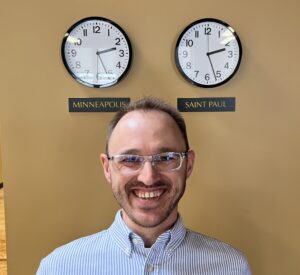
Above: Kyle Stokes’ old education reporter position at KPCC/LAist is now open, and he’s eager to start his new job at the MinnPost. We hear — and hope! — he will still be doing some education reporting there.
🔥 Welcome back! Great to have US News’ Lauren Camera back at her desk after a couple of months focusing on her family. “It’s been nice to hear from so many people in the ed policy and politics space who reached out with genuine concern,” tweeted Camera, a longtime education reporter who wrote a memorable 2018 essay for us about being a mom and an education reporter. Other folks returning to the beat include Jennifer Pignolet, who reappeared at EWA’s higher ed conference this week.
🔥 Job openings: The Chicago Tribune is seeking an education reporter whose primary focus will be on Chicago Public Schools. KPCC and LAist are looking for an education reporter who will “bring creativity, innovation, and joyful exuberance to our daily and enterprise reporting.” Chalkbeat Tennessee is hiring a reporter. And The Center for Sustainable Journalism’s Youth Today is looking for a part-time editor in the spring and a freelance policy reporter. Email editor Molly Bloom if you’re interested.
🔥 Awards: PEN America announced its literary awards longlists, and we spot one education journalist on there. Congrats to the Philadelphia Inquirer’s Will Bunch, who’s listed for the nonfiction award for his book “After the Ivory Tower Falls: How College Broke the American Dream and Blew Up Our Politics – And How to Fix It.” Finalists will be announced in February.
🔥 Layoffs: Condolences to the 20 Washington Post staffers who were laid off this week, and crossed fingers none of the education team is affected. As part of the layoffs, the paper will discontinue KidsPost, a news and features section aimed at children, and Launcher, its video game vertical. And in more bad media news, Vox is also eliminating 7% of its staff.
🔥 Yikes: KPCC’s Adolfo Guzman-Lopez has the horrifying story about how a student newspaper at a university where most of the students are Latino covered one of its issues with anti-Latino slurs — without the paper’s staff knowing about it.

PODCASTS & MORE
What’s happening and new research
Above: In case you missed it last week (like we did), Bloomberg’s ‘Bedrock, USA’ podcast published a three-part series on The School Board Queen, a DeSantis-endorsed Florida mother of three who’s had a big — and polarizing — impact on education politics there.
⏰ Coming soon: There’s no official announcement yet, but I’m told that there’s going to be an hour-long version of “Sold a Story” broadcast in February on Reveal, NPR’s weekly investigative news show. Stay tuned!
⏰ Also, the TV version of Nikole Hannah-Jones’ 1619 Project premiered Thursday on Hulu. You can read the New York Times review here.
⏰ Conferences: NICAR is just around the corner in early March, and there’s at least one education-focused session: “How much does school spending matter for outcomes in education?” Any others I’m missing? SXSW EDU is also coming up in Austin, Texas, March 6-9. Who will be there?!
⏰ Journo resources: Hélène Biandudi Hofer, manager of the Solutions Journalism Network’s Complicating the Narratives Project, wrote about how journalists can cover controversy without making it worse. And if you’re interested in reporting on education and politics, check out Future Ed’s spreadsheet on how education showed up — or didn’t — in every governor’s 2023 state-of-the-state addresses.
THE KICKER
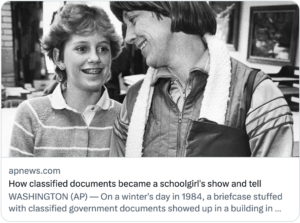
Dramas over the mishandling of classified government documents aren’t all new, notes the Associated Press. In 1984, 13-year-old Kristin Preble brought a briefcase of classified papers that her dad had found in a Cleveland hotel room years earlier to school for show-and-tell.
ABOUT THE AUTHOR

The Grade
Launched in 2015, The Grade is a journalist-run effort to encourage high-quality coverage of K-12 education issues.