Reporters need to find a way to acknowledge the threat to teachers without overstating ‘culture war noise.’
By Jonathan Zimmerman, University of Pennsylvania
I’m sorry. Mea culpa. My bad.
I’ve spent my career studying culture wars in American education.
And it seems like I might have exaggerated them.
That’s my sheepish takeaway from the recent report by the American Historical Association, which conducted a survey of 3,000 middle and high school history teachers.
Just 2% of the teachers said they “frequently” faced “objections or criticisms” to the way they teach their subject. Another 14% said that had happened “several times” in their careers, and 40% said they had experienced it “once or twice.”
Forty-five percent — that is, nearly half of the sample — had never received an objection to their instruction.
I’ve spent my career studying culture wars in American education. And it seems like I might have exaggerated them.
I was pleasantly surprised — and more than a little embarrassed — by these results.
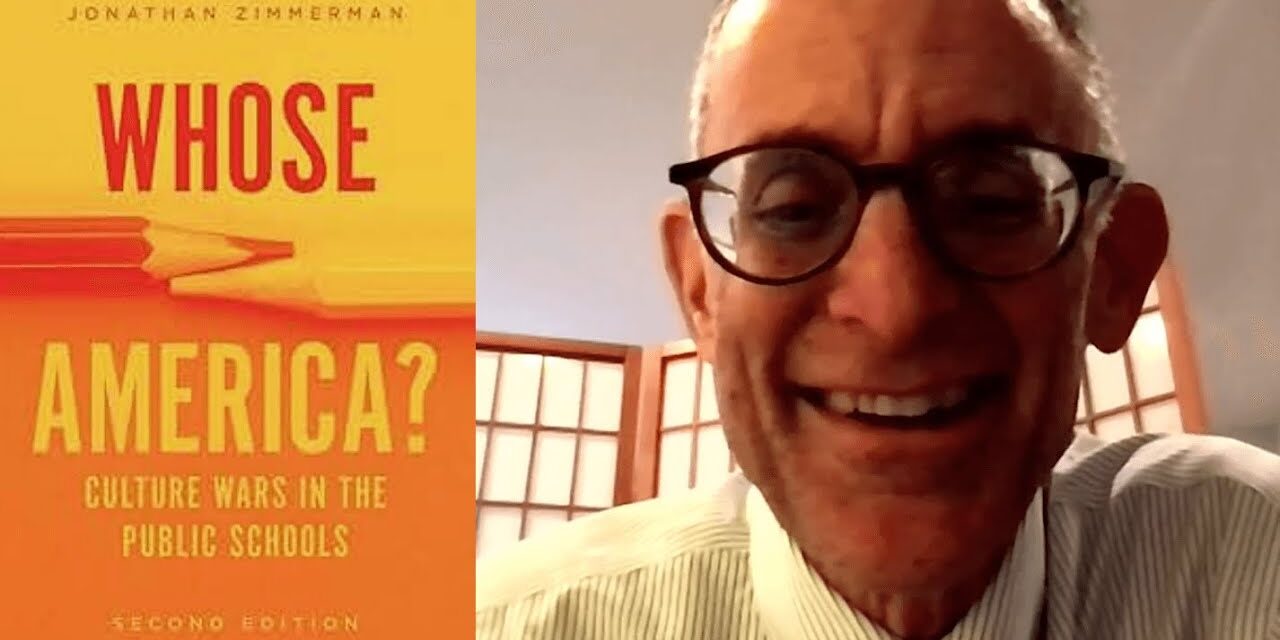
In the 2022 revised edition of my book, “Whose America? Culture Wars in the Public Schools,” I argued that our conflicts about religion in education had cooled and our battles around history had flared as never before.
I was right about the first part. Battles over Bible instruction are rare, despite recent efforts to revive it in Oklahoma. Ditto for school prayer and evolution, a source of controversy from the Scopes Trial of 1925 into the 1990s. Although millions of Americans still express doubts about Darwin’s theory, they rarely contest it in their public schools.
But I also argued our growing political polarization made history instruction more contentious than ever. In a nation split into mutually hostile camps of Red and Blue, we lacked a shared narrative about the purpose and meaning of America.
That’s the part where I went too far. When it comes to teaching history, at least, classroom-level polarization and conflict are not nearly as widespread as I thought.
When it comes to teaching history, at least, classroom-level polarization and conflict are not nearly as widespread as I thought.
To be sure, Americans are deeply divided about their history.
The election of Barack Obama fueled fears among mostly white conservatives that they were “losing the nation they love,” as one Tea Party leader warned. They converged upon schools to attack ethnic studies courses and the Advanced Placement history curriculum, which allegedly magnified America’s sins — especially racism — and blinded students to its virtues.
These complaints reached a crescendo with the ascent of Donald Trump, who famously pledged to Make America Great Again.
In response to the New York Times’ 1619 Project, which rooted American history in enslavement and Native American removal, Trump appointed a “1776 Commission” to defend the country’s timeless truths. And he sparked a campaign against critical race theory, which became a frequent bogeyman on Fox News and other right-wing media. It supposedly taught children that racism was baked into American institutions — including law, health care, and education — from the very start.
State legislatures responded with a spate of laws banning CRT, the 1619 Project, and lessons teaching students to feel discomfort, guilt, or any other “psychological distress” on account of race or sex.
And surely these measures generated their own forms of distress among American history instructors. One Oklahoma teacher quoted in my 2022 book wondered if she could address the Tulsa Race Massacre of 1921; another worried about sharing interviews with ex-slaves recorded in the 1930s, as she had done for many years. “If a kid comes home and says they’re uncomfortable, now you’re breaking the law,” she warned.
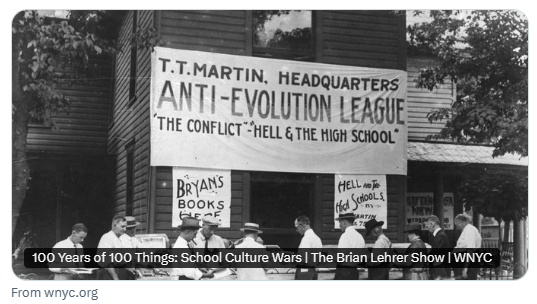
Above: Zimmerman appeared on a recent WNYC public radio segment on the history of school culture wars.
All of these pressures are real, and they should alarm anyone who cares about education and democracy. History teachers are charged with presenting America — in all of its diversity and complexity — so our students can make sense of it on their own. That’s not going to happen if the teachers are looking over their shoulders, fearful that their lessons will trigger attacks from angry parents or politicians.
And some history teachers do feel under fire, as the new AHA report confirms. An Illinois teacher received a spate of emails from parents referencing critical race theory and asking him how he teaches about slavery, which had never happened to him before. In Virginia, where Gov. Glenn Youngkin prohibited CRT and set up a “tip line” for parents to report violations, a teacher said it placed a “target on our backs” even after the line was discontinued. “You find yourself picking words very carefully,” the teacher added.
But these kinds of experiences are the exceptions, not the rule. And that’s not because teachers are presenting a whitewashed view of the past, as some left-leaning readers might suspect. Nor do teachers harp incessantly on America’s flaws, as per the long-standing complaint on the political right.
The AHA report shows that American history teachers are dedicated to illuminating “the good, the bad, and the ugly,” as one Texas teacher said. And despite all of the culture-war noise surrounding the subject, they receive shockingly little pushback from their communities.
Despite all of the culture-war noise… history teachers receive shockingly little pushback from their communities.
How do we explain this gap between rhetoric and reality? Why does it seem like storms are raging around history instruction, but most of our teachers report moderately sunny skies?
Part of the reason has to do with way we have chronicled these matters, of course.
I was a journalist before I was a historian, and I still live by the credo of the trade: if it bleeds, it leads.
So I’m biased towards culture wars. I’d much rather write about a school board under attack for teaching CRT than I would about the many districts where this isn’t an issue. “Parents aren’t pressing teachers about history instruction” isn’t much of a story. Indeed, it’s not a story at all.
I also suspect that English and language arts teachers are under more pressure than history teachers right now because their lessons provide an obvious and convenient target: specific book titles.
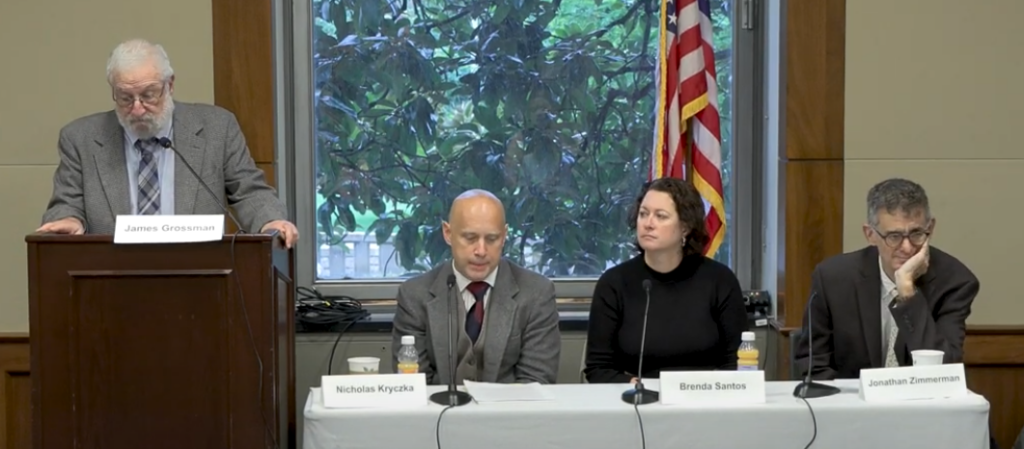
Above: Zimmerman (far right) at a recent Congressional briefing on the AHA report, which notes that “speculation and outrage do little to address the many challenges our schools confront on a daily basis.”
Consider the sound and fury over Maia Kobabe’s “Gender Queer” or Toni Morrison’s “Beloved,” which both contain graphic passages that activists can easily excerpt (even if they haven’t actually read the books) and post on social media.
In prior generations, as my 2002 edition of “Whose America” showed, history textbooks frequently drew fire for their depictions of the Founding Fathers, slavery, and more. But according to the AHA’s new report, most American history teachers no longer use a textbook for their day-to-day instruction; instead, they employ a wide range of online sources.
Some of these materials — like the 1619 Project — have sparked complaints from parents and other critics. But most of the sources used in our history classrooms fly under the political radar.
It’s a lot simpler for right-wing groups to proscribe a list of novels taught in English class than it is to scrutinize the websites that a history teacher assigns. And fictional works more commonly reference sex and gender identity, which have replaced CRT in conservative media as the biggest threats to our schools.
Of course, history instructors teach about gender, which is an important lens for analyzing the past. But they’re less likely to be denounced as pedophiles or “groomers” — the most insidious charge of all — than an English instructor or school librarian who teaches (or lends out) “All Boys Aren’t Blue” or even “Romeo and Juliet.”
In a study released last February by the RAND Corporation, two-thirds of American K-12 teachers said they had decided to “limit instruction about political and social issues in class.” As the report admits, it’s hard to know how many of the respondents made that decision because of fears of political repercussions. But new research by education historian Jonna Perrillo confirms that many English teachers and librarians feel unsupported by administrators, who frequently cave at the first hint of controversy over a book.
That’s bad news for our country as well as our schools. But we need to find a way to acknowledge the threat to teachers without overstating it.
That starts with careful reporting about real instruction, rather than recycling the hype of culture warriors. Citing controversies over CRT and the 1619 Project, former Trump adviser Steve Bannon famously declared in 2021 that “the path to save the nation” would “go through the school boards.”
He also predicted that right-wing parent groups like Moms for Liberty — which Bannon called “the Tea Party to the 10th power” — would spearhead a GOP landslide in the 2022 Congressional elections.
He was wrong, of course. But so was I, because I imagined that Bannon’s battle cry had sparked a full-scale war over history in our schools. The path to understanding education in the United States takes us through school boards, to be sure, but it shouldn’t end there. We must look much more carefully at classrooms, where teachers and students do the messy day-to-day work of democracy. They will tell us what we need to know.
Jonathan Zimmerman teaches history and education at the University of Pennsylvania. He is the author of “Whose America? Culture Wars in the Public Schools,” which was published in a revised 20th-anniversary edition in 2022 by University of Chicago Press.
Previously from The Grade
Demand concrete examples & avoid ‘emotionalism’: How to cover school culture war stories
An expert journalist’s guide to covering book bans
‘The backlash was the story’; an insider looks back at school culture wars coverage
A Texas librarian’s guide to book bans
Tabloid-style education news is all the rage
The culture war is the easy, less important story