
A predominantly white school district responds to a racist incident by embracing social justice and anti-racist teaching and leadership.
A predominantly white and affluent New Hampshire school district made national headlines in 2017 for a racist incident. While riding the school bus home after school, a white student told a Black student that “Blacks are whites’ slaves” and repeatedly hit him with a baseball. This incident revealed to many people the racism in their community, and the district superintendent decided to make racial equity and inclusiveness a priority. Over time, other stories surfaced, including a student who wears a hijab being pelted by bottle caps and called a terrorist and another student being called a racial slur.
It is a common belief within predominantly white schools that justice-oriented education is irrelevant because there is little to no racial diversity in the community. However, as is evident above, there is a strong need for racially inclusive education in predominantly white schools. The lack of diversity may mean that community members have minimal experience identifying and addressing racial injustice and therefore more easily overlook or misinterpret acts of injustice. Members of progressive-leaning communities who believe their culture is inclusive may be especially prone to making this mistake. Reflecting on the instances of injustice in his district, the superintendent, Michael, shared with us:
You have this incredibly, quote unquote, “welcoming community,” and yet have racial stereotyping and racial slang. That was probably my mind-blowing experience when we heard from the students because we all just assumed it wasn’t happening here. But it was and does happen here.
Becoming aware of injustice in their schools prompted this community to address social justice concerns in the district’s cultures and systems. For the last several years, we have collaborated with them to support their efforts to create an environment that advances their anti-racist and justice-oriented goals. We also engaged in research that examines the process of how they work toward justice-oriented education. Out of our collaboration and research, we found four ways that this predominantly white school district continues to promote inclusivity and social justice. We agreed to protect the identities of the district staff for our research, so the names in this article are pseudonyms.
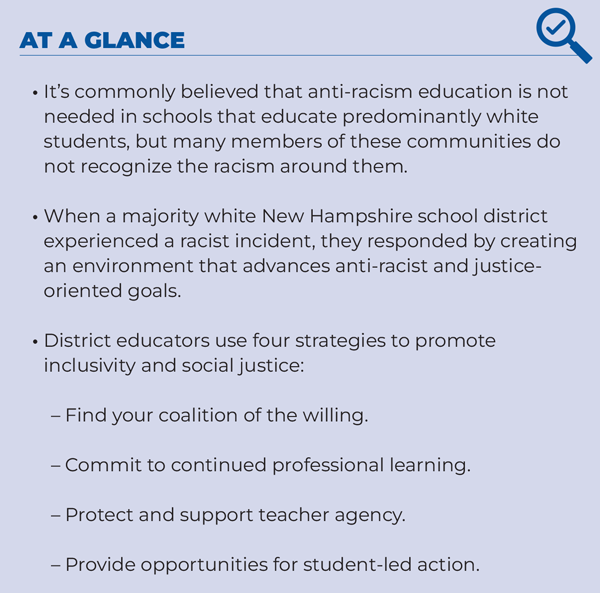
1. Find your COW
In their writing about naysayers who resist learning about teacher inquiry, Nancy Fichtman Dana, Carol M. Thomas, and Sylvia S. Boynton (2011) share a story about a reading coach who recommends that teachers “start with finding your COW.” A COW, or coalition of the willing, is a group of teachers who are interested in and willing to make changes to their practice. This concept can be used for schools that wish to improve their own cultures to support social justice.
The social justice educators we have worked with over the last several years describe the importance of finding their COW so that they can take risks and learn with colleagues who push their thinking and instructional practice. Vera, a high school social studies teacher, shared that her team was fearful about continuing to teach for social justice due to legislation and executive orders in New Hampshire that seek to restrict teaching, professional learning, and student learning regarding race, gender, sexuality, and U.S. history.
As a group, they decided that, despite these emotions, they were going to continue to use justice-oriented materials in their teaching:
We decided, as a faculty, for social studies, that we were all going to use it. So . . . it’s going to be a group mentality. Whatever one of us is doing, we’re all going to do [it]. And if we’re all going to walk into the fray, we’re all going to walk in the fray together.
With courage and support from the other teachers on her team, they have found community and solidarity in teaching for social justice.
In another example, a group of middle school social studies and language arts teachers collaborated on a multi-grade-level curriculum about the contributions of Black Americans in their local community. Jasmine, a novice teacher, shared that she felt unsure how to address or guide student discussions about racism or injustice. Collaborating with other teachers who were more confident and experienced inspired and motivated her to continue.
Some teachers had the advantage of like-minded colleagues on their teams and in their schools. Others needed to seek out their COW. For example, Janet, a justice-oriented math teacher, explained that she does not have support in her department. In fact, she said her math colleagues avoid the topic of teaching for justice around her:
We have lunch as a math department every day, and I sometimes feel like it’s the elephant in the room. Nobody wants to talk about that side of what I do. Because I know that many of the math teachers don’t see that as relevant to their job.
Janet sought out other people in the district who could help her build momentum. Interested in discussing anti-racism after the murder of George Floyd, she emailed faculty and staff over the summer soliciting their participation in discussing what anti-racism could look like in their school. She leads the diversity, equity, inclusion, and justice (DEIJ) professional learning community (PLC) at her school and is a member of the district’s equity and anti-racist community group. Although Janet doesn’t feel welcome to talk about her work as a social justice pedagogue with her math team, she found other passionate teachers in the pursuit of social justice aims.
2. Commit to continued professional learning
As Antony Farag points out in his 2023 Kappan article, teachers who persist in addressing social justice in their teaching must understand both the conceptual and political landscapes of anti-racism and social justice. This allows them to guide their students and be prepared for objections or challenges. Teachers in our study engaged in professional learning about social justice in many ways. They participated in and led PLCs and committees, attended district-provided trainings, read, listened to podcasts, and watched films on social justice topics. This learning enabled some teachers to analyze themselves and their identities. Wendy, a middle school social studies teacher, reflected:
It wasn’t that many years ago that the idea of saying, “I’m white, and I have a white culture that I practice” was a foreign concept to me. I can see it now. So, I think identifying that helps pierce this idea that whiteness is neutral, that it’s normative.
Sustained professional learning can help teachers, especially white teachers, recognize the significance of their own socialization. This recognition can lead to a better understanding of the power they hold and how they can use their power to dismantle injustice.
The school district took seriously the need to invest in faculty and staff learning when they realized that their schools may only be welcoming for some. After the racist incident on the school bus, Michael, the superintendent, quickly implemented a diversity training for every person who worked in the school district, including bus drivers, teachers, and cafeteria workers. Zoe, an elementary school teacher, said that training helped the school community come together and “sparked everybody’s desire to want to reflect on their own experiences with race, their own schooling with race, their own lack of experience, their own fears, their own implicit bias.”
This was not stand-alone training but one that set the groundwork for continued professional learning. Michael followed that initial training with sustained learning opportunities, such as partnering with a local civic engagement group. He created a district committee for continued learning and policy review made up of community members, teachers, administrators, and students, which formed the framework for their efforts going forward.
3. Protect and support teacher agency
Teachers who address racial injustice in their teaching often face challenges from parents and community members, especially in states such as New Hampshire where divisive concepts legislation has been passed (Farag, 2023). In a nationwide RAND survey, teachers reported that divisive concepts legislation has “infringed on their [professional] autonomy by constraining the topics they could address and their choice of instructional materials and discussion topics” (Woo et al., 2023, p. 2). Some teachers have responded by changing their practices, but they worry about how such changes limit student learning. To enable teachers to persist in the essential work of addressing racial and social justice issues in their classrooms, the researchers call on school and district leadership to “explicitly and clearly messag[e] their support of teachers” (Woo et al., 2023, p. 24).
There is a strong need for racially inclusive education in predominantly white schools. The lack of diversity may mean that community members have minimal experience identifying and addressing racial injustice and therefore more easily overlook or misinterpret acts of injustice.
The New Hampshire legislature in June 2021 passed the budget bill for the fiscal year. Part of the bill included a section titled, “The Right to Freedom from Discrimination in Public Workplaces and Education,” which said, “No pupil in any public school in this state shall be taught” that an individual is “inherently racist, sexist, or oppressive whether consciously or unconsciously.” Teachers can be disciplined by the state board of education if found in violation of the law.
This legislation presented a challenge to teachers’ agency in relation to justice-oriented teaching. When the law passed, Michael brought in an attorney to help teachers understand the law and feel confident continuing with justice-oriented teaching. He also wrote a letter to the community addressing what can and cannot be taught under the law, asserting that “the district’s work on DEI [diversity, equity, and inclusion] is in compliance with the new law and will continue unabated.” Michael sent a message that leaders support teachers’ social justice efforts.
Further, when parents challenged teachers’ practices, Michael addressed parents’ concerns while supporting teachers’ authority in their classrooms. For example, when a parent wanted the film 12 Years a Slave pulled from the curriculum because they objected to the content, Michael worked with the teacher, Vera, and the parent to ensure the parent understood their options for replacing the content for their own child. He also affirmed that Vera had sound pedagogical reasons for showing the film and that she had the right to keep it in the curriculum for the rest of the students. Michael’s actions in this situation showed a respect for and trust in Vera and a willingness to intervene to protect her agency.
In another case, a complaint from a parent was raised against Janet under the legislation, making her feel “very nervous and worried.” Janet’s signing of the Zinn Education Project’s Pledge to Teach the Truth prompted the complaint. As soon as it happened, Michael called Janet to keep her apprised of the situation. While following the district’s procedure for complaints, Michael continually reassured Janet that he supported her and her professional agency. Janet shared that his reassurance brought her a lot of emotional relief as they went through the process.
Leadership also supported teacher agency in the district by valuing their pedagogical contributions. Teachers were encouraged to take a graduate course on social justice in education, at no cost. This created an opportunity for teachers to explore social justice concepts more deeply, work on projects to create social justice-oriented lessons for their classes, and evaluate their schools’ policies and systems. Two elementary school teachers, Deanna and Susan, who took this course conducted an equity audit on their school’s special education placement and practices with the text Using Equity Audits to Create Equitable and Excellent Schools (Skrla, McKenzie, & Scheurich, 2009). The teachers presented their findings to their school leaders, who considered the teachers’ proposals and made plans to act without delay. By encouraging teachers to take the course, leaders sent the message that teachers can be change-makers in their schools. By listening to the teachers and taking their findings seriously, leadership supported teacher agency in policy and program changes, positioning these teachers to make significant contributions to social justice efforts within and beyond their classrooms.
4. Provide opportunities for student-led action
Teachers who want to advocate for greater justice provide pathways for their students to take the lead. When Darya’s 4th graders learned about Pride Month and injustices experienced by the LGBTQ+ community, they demonstrated solidarity by forming a student-led pride parade at recess. As they paraded outside with flags they made earlier, students from other classes joined in. Similarly, when Zoe’s students learned about the plight of Asian elephants, deforestation, and its impact on the environment, they decided to write letters and collect donations to send to a conservation organization in Thailand. For Zoe, exposing students to the ways that injustice impacts individual people and the larger society helps to build empathy and understanding for others. Asking students how they want to act encourages them to be active citizens and agents of change.
To improve cultures that support social justice, schools that serve mostly white students must first recognize that injustice does indeed “happen here.”
The DEIJ high school club, which Janet advises, promotes and engages in social justice action. Members met with the department heads of each academic subject to bring up issues of cultural appropriation, excluding others because of their race or religion, and hearing the N-word used repeatedly at their school. They explained that racist comments and other forms of injustice hindered their ability to learn and asked that their teachers intervene rather than remain as bystanders in these moments. They also insisted that their teachers tend to their own equity literacy (Gorski & Swalwell, 2015) and learn to be greater advocates for social justice. In another example, the DEIJ club created a video for elementary school teachers about how they can be more inclusive when they teach about religious holidays. They also worked with the district’s policy committee to revise the racism policy to include the acknowledgment that people are in different phases of their anti-racism journey and that as a district, they are aspiring to become an equitable and anti-racist school district.
‘This is lifelong work’
Many educators in our study shared with us that teaching for social justice is a process of becoming, and that, to draw on educator Wendy’s words, “this is lifelong work.” To improve cultures that support social justice, schools that serve mostly white students must first recognize that injustice does indeed “happen here.” These schools have a special responsibility because they educate white privileged children who are likely to occupy positions of power later in life, therefore holding political power to bring about real change. We urge educators to move from recognition to action guided by the practices we discuss here to cultivate more equitable learning opportunities for all students.
References
Dana, N., Thomas, C., & Boynton, S. (2011). Inquiry: A districtwide approach to staff and student learning. Corwin Press.
Farag, A. (2023). The CRT culture war in the suburbs. Phi Delta Kappan, 104 (5), 18-23.
Gorski, P. & Swalwell, K. (2015). Equity literacy for all. Educational Leadership, 72 (6), 34-40.
Skrla, L., McKenzie, K.B., & Scheurich, J.J. (2009). Using equity audits to create equitable and excellent schools. Corwin Press.
Woo, A., Lee, S., Prado Tuma, A., Kaufman, J.H., Lawrence, R.A., & Reed, N. (2023). Walking on eggshells — Teachers’ responses to classroom limitations on race- or gender-related topics: Findings from the 2022 American Instructional Resources Survey. RAND Corporation.
This article appears in the October 2023 issue of Kappan, Vol. 105, No. 2, pp. 53-57.

ABOUT THE AUTHORS

Elyse Hambacher
ELYSE HAMBACHER is a clinical associate professor of education at the University of Florida, Gainesville.
Denise Desrosiers
DENISE DESROSIERS is a doctoral candidate in curriculum and instruction at the University of New Hampshire, Durham.