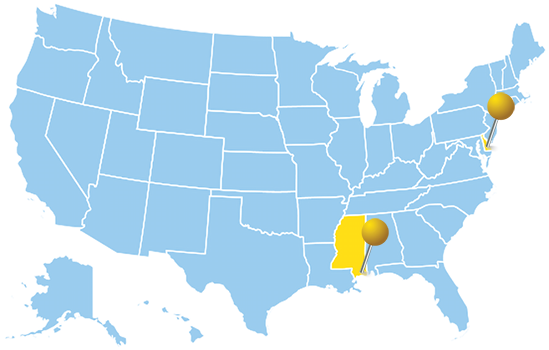
Two unlikely districts whose students beat the odds give broad lessons about what district leaders can do to leverage achievement.
More than a decade of research demonstrating the importance of school leaders in creating school culture has intensified attention on their role in student achievement. But they don’t work in isolation. School districts shape the conditions in which schools operate and as such can support or undermine school success and thus student success. All of which is to say — to steal a phrase — school districts matter.
But how?
This is not an easy question, in part, because the landscape of the nation’s more than 13,000 school districts is incredibly diverse. Some are behemoths with hundreds of thousands of students (New York City and Los Angeles); some are tiny with just a few hundred. Making any definitive statement about districts is almost impossible, except to note that school districts form one of the fundamental political building blocks of American democracy.
For those looking to improve education at scale rather than school-by-school, understanding the levers of improvement available to districts is important. Research has established some general principles. But it is often difficult to understand in an immediate, palpable way what a central office can do to make a difference for students. This article examines the actions and experiences of two districts to offer lessons and examples of what districts can do to make broad improvements that affect all their students rather than having pockets of success in certain schools.
Pass Christian School District
On the Gulf Coast, just 50 miles northeast of New Orleans, the city of Pass Christian lies on a peninsula separating Bay St. Louis and the Gulf of Mexico. Hurricane Katrina damaged or destroyed all but 500 of the city’s 8,000 structures, including three of the district’s four schools and the homes of most students and teachers.
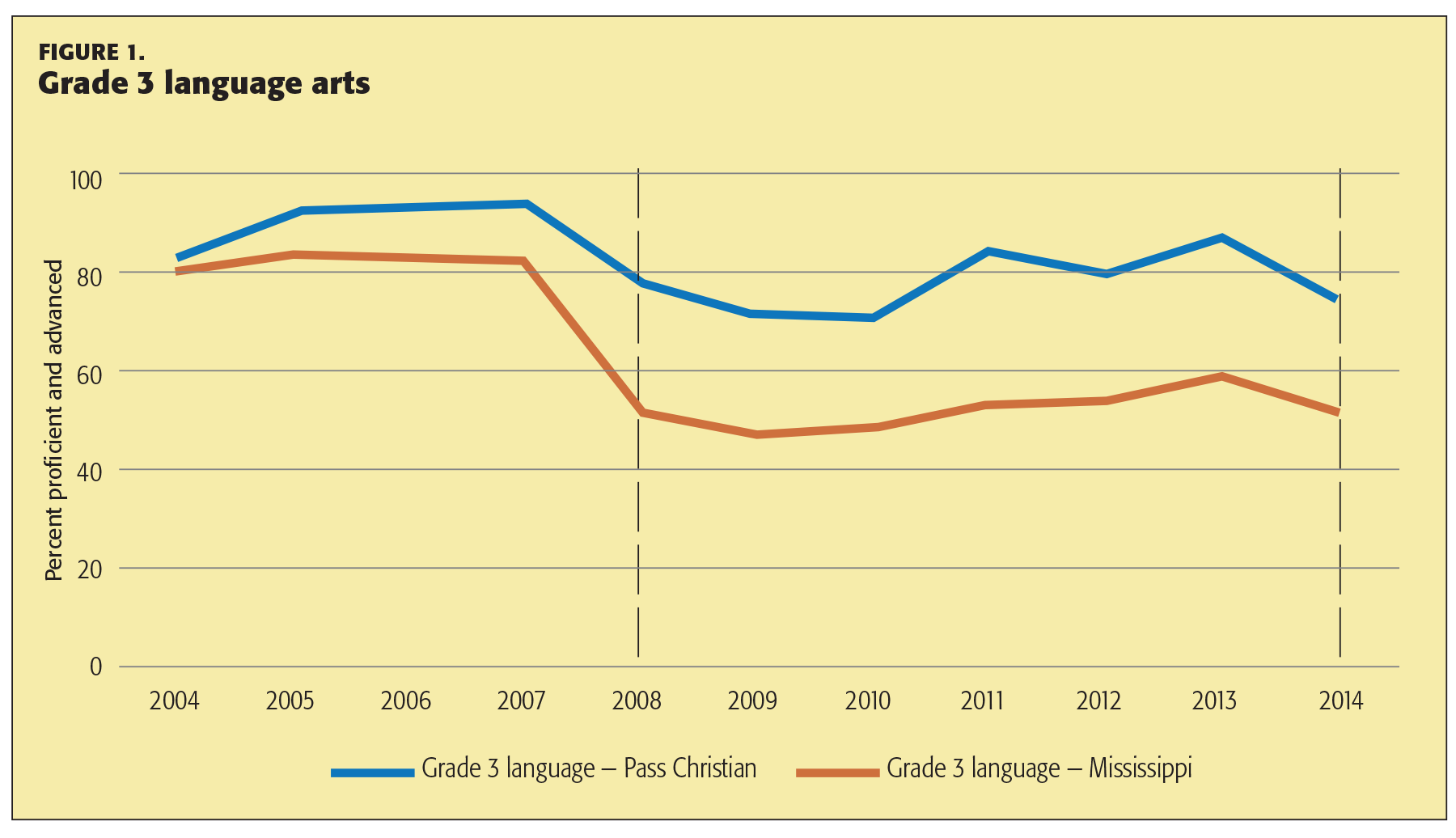
Ten years later, the Pass Christian public school district has recovered most of its population and now has about 2,200 students. Although that makes it small in comparison to large urban districts, Pass Christian is larger or comparable to more than 70% of the nation’s districts. About two-thirds of the district’s students qualify for free and reduced-price lunch. What makes Pass Christian worth learning from is that its graduation rate, at 89%, is more than 13 percentage points above that of the state average. More notable is that its low-income students and its African-American students — who make up one-third of the district’s students — graduate at the same rate as its middle-class and white students. This is unusual not only in Mississippi, where 80% of whites and only 64% of African-Americans graduate, but in the country.
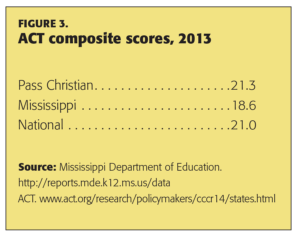
In addition, Pass Christian’s proficiency rates at all its schools have been on an upward climb for more than a decade, as have its enrollment and success in Advanced Placement classes. More than 80% of students take the ACT, and the average score was 21.3 in 2013, well above Mississippi’s average score of 19 and somewhat above the national average of 21 — again, unusual for a high-poverty district. Perhaps most notable is that the district’s achievement gaps among demographic groups are small or nonexistent. That performance led the Education Trust, a Washington, D.C., national nonprofit that advocates for students from low-income homes and students of color, to award the high school its Dispelling the Myth Award. Three of the district’s four schools have been recognized as National Blue Ribbon Schools by the U.S. Department of Education, and the fourth is not far behind.
So, what’s the district doing?
Committed to Excellence — words directly from the district’s logo — is where Superintendent Beth John starts her explanation. “Those three little words have driven everything we’ve done in our district.” If Pass Christian students are going to be prepared to compete not just in Mississippi but also in the rest of the country and the world, excellence must permeate through the district, John said.
In pursuance of that goal is another commitment: to monitor evidence of whether the district is achieving excellence. “We look at all the data,” said Joe Nelson, principal of Pass Christian Middle School.
Teachers can have all the training and know what should happen, but the principal should lead instruction.
Each school has its own system for data examination, but some of the most powerful monitoring is done districtwide. Superintendent John holds an annual summer retreat where school principals and central office administrators (including the heads of finance, transportation, and food services) examine achievement, attendance, and discipline data, and peruse results of teacher and parent surveys.
“Those are hard times,” John said. “You always want to look at the positive, you want to be growing all the time. But growth is hard, and growth has a lot of stumbling blocks along the way. It’s important for us to build a culture where we’re honest with each other. When we get together in the summer, and we look at our data, sometimes we’re not happy with it, and we have to regroup.”
This regrouping involves everyone, she said. “A district will not move forward unless all its stakeholders move forward. That is the bus drivers, the cafeteria workers, the custodial staff, the secretaries, the teachers, the nurses, the parents, the business leaders, and community members. Everyone who has a stake in that school must be on the same page.”
Collaboration is key
One of John’s opportunities to get everyone on the same page, first as curriculum director and now as superintendent, was in implementing the Common Core State Standards, adopted by Mississippi in 2010. “Common Core was the perfect way to do that because it’s so aligned,” John said. In the past, she said, high school teachers would ask why students didn’t know something that they thought they should. “We would look back and say, ‘It wasn’t in the curriculum,’ ” John said. “There were holes all along,” and redundancies, too. They found that the same novels were being studied in multiple years, for example. Fixing those problems required more collaboration among teachers across the schools. “We sat, and we mapped out a plan, and we did a lot of training with K-12 all in one room,” John said.
One of the keys to any improvement in instruction, she said, is building the instructional expertise of principals. “I can’t say enough about principals and how they are so important to the instructional process. When I came in as curriculum director, one of the things I insisted on is that principals sit in on as much professional development as possible — to be in those rooms where the teachers were learning.”
With principals fully understanding the changes in the instruction required by Common Core, “I wasn’t running around trying to implement. They were implementing, and I was support,” John said.
 Teachers meet as grade levels and as departments once a month to discuss curriculum and standards. Every summer, teachers from across the district meet to develop pacing guides, and, once a month, teachers from kindergarten through 12th grade meet to ensure vertical alignment of the curriculum. “We have conversations beginning in kindergarten about the scientific process,” said Meridith Bang, former principal of Pass Christian High School and now the district’s curriculum director. “High school teachers said that [we should start] using the word hypothesis in kindergarten.” Now they do.
John also needed to be innovative. A budget crunch kept her from being able to continue bringing in outside consultants to support teachers as they adapted their teaching to the Common Core. “I looked for high flyers, the teachers who had come to me and said, ‘We can do this with Common Core,’ and ‘Here’s a great book I’ve been reading.’ Those high flyers emerge if you’re out and about in your schools and are open and listen. I found three of the best.”
John created a new job description, reducing the teaching loads of a high school math teacher, a high school English teacher, and an elementary special educator so they could work as Common Core facilitators. They worked with teachers across K-12 to help them understand the content, model lessons, and spread best practices across the district.
What started as a budget measure, John said, ended up being better organizationally because it exposed and developed internal expertise. “I wanted to build capacity throughout the district,” she said. “I thought that was really, really important. If I fall off the face of the earth, who can take over?”
Indian River School District
Indian River School District sprawls across 360 square miles covering 10 towns and includes stretches of rural Delaware. Immigration from Mexico and Central America in the past 15 years, drawn by work in local poultry plants, has added 2,000 children to the now 10,000-student district. As such, Indian River is bigger than 90% of the districts in the country. Many new arrivals live in poverty and do not speak English at home. In the 2012-13 school year, more than 60% of Indian River’s students qualified for free and reduced-price meals, compared to about 40% in 2003.
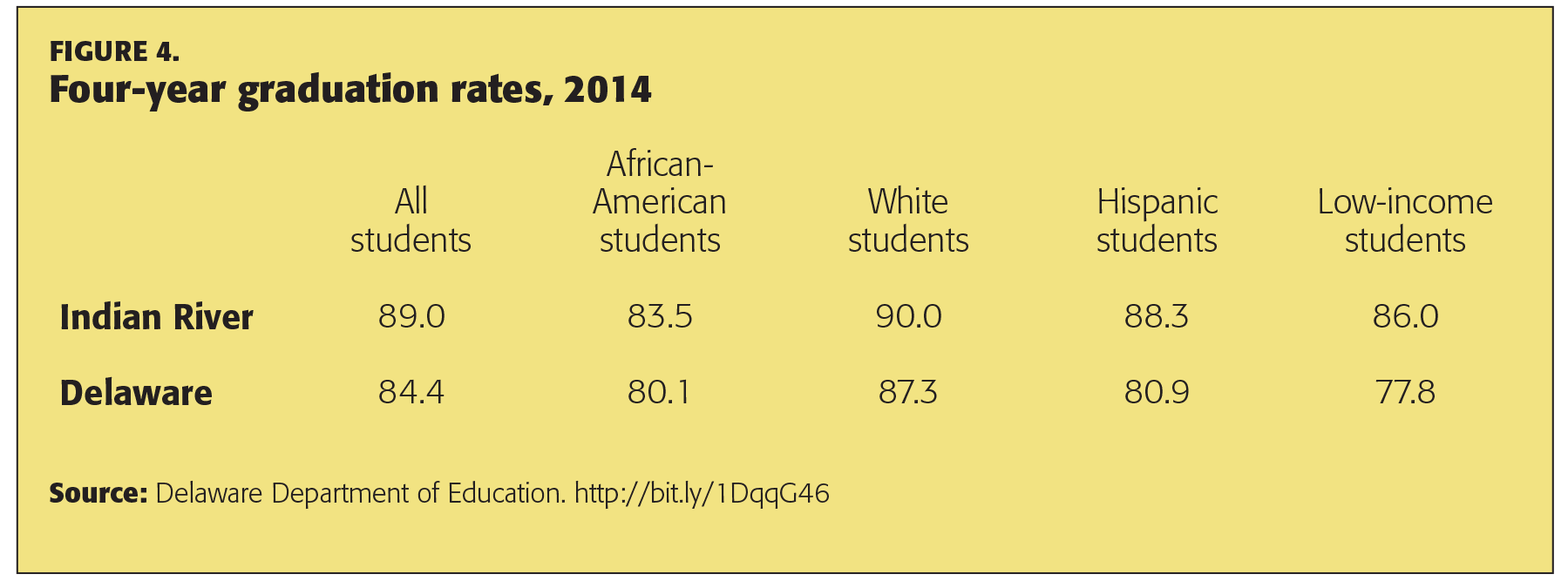
In other places, such demographic shifts have been accompanied by a downturn in academic achievement. But, in Indian River, achievement has climbed, albeit slowly and unevenly. Today, its elementary schools are at the top of the state and its middle and high schools are closing in on the state’s top performers. Although the district still has gaps in achievement and graduation rates, all groups of students do better than their counterparts elsewhere in the state.
Growth is hard, and growth has a lot of stumbling blocks along the way.
Where Pass Christian has its three-word vision, Committed to Excellence, teachers, school leaders, and central administrators in Indian River say, “All children can learn, and it’s our responsibility to enable them to do so.” Superintendent Susan Bunting attributes the origin of that vision to her predecessor, Lois Hobbs. Bunting served as her curriculum coordinator and then became superintendent in 2006.
Key to the vision, Bunting said, is having a comprehensive system of monitoring progress. Each teacher monitors growth and improvement of each student and meets regularly with colleagues and school leaders to review student data and find ways to move students forward. Systems are in place to catch faltering students and to provide enrichment to those who are already proficient.
This process is mirrored at a district level. Bunting meets twice a year with each principal to talk through what principals are doing to help teachers improve. Key questions are:
- What professional development is occurring?
- What peer walkthrough processes are they leading?
- What books are they reading?
- How are they incorporating complex questioning and close reading in their buildings?
By all accounts, these are intense meetings. During those meetings, they go through a “balanced report card” that lays out goals for each school — from attendance to student behavior to academic growth. In addition, Bunting randomly pulls 20% of all the teacher evaluations to ensure that principals are holding to the standard that all students will improve. When she thinks principals aren’t pushing hard enough on teachers to read key research or engage students in complex questions, she provides feedback to principals so their evaluations become more pointed and helpful. Principals at the district’s 16 schools, in turn, are expected to look at samples of student work to ensure that teachers are expecting enough of students.
A comprehensive system
“It’s a comprehensive system,” Bunting said. “Another thing that we’ve done across the district that I believe has made a tremendous difference is that we develop our principals. We have had a leadership institute for the past 11 years. As our teachers get professional development opportunities, our principals are learning and implementing what it is we’re learning as our own professional learning community.”
Once a month, principals meet as a group, and once a month, principals at each level (elementary, middle, and high) meet to talk through issues they face. Ivan Neal, assistant principal of Georgetown Elementary School, said the administrative professional learning community means “having a direct line to the superintendent and not being ashamed to ask the crazy little questions we have.”
Sharon Brittingham, who was principal for many years of Frankford Elementary School in Indian River and is now working with principals throughout the state through the University of Delaware, remembers her early days as a principal when principal meetings consisted of “daylong meetings where you checked off agenda items.” Over time, she said, “We started having meaningful conversations and sharing best practices. We read books; we talked about books and their implications for our buildings. We would learn something and take it back to our buildings and reflect on that in the portfolios we did. We [became] a learning organization.”
This system of professional support of building leaders reflects Bunting’s idea that “Teachers can have all the training and know what should happen, but it’s the building leader who leads instruction — and I insist that principals be learning leaders of their buildings.”
In addition, principals identify leadership potential among teachers who, if they are interested, attend a districtwide administrative development program where the superintendent and other central office directors teach classes about instructional and managerial leadership and the issues facing the district. Sussex High School principal Jay Owens, who went through the administrative development program, said meeting with the superintendent, the director of finance, and the director of curriculum allows aspiring leaders to have “kind of a test drive. So when you’re in the driver’s seat you have a good relationship with these people, and you don’t feel nervous picking up the phone and talking to them or going to them.”
Everyone who has a stake in a school must be on the same page.
Learning from unexpected places
Pass Christian and Indian River School Districts are very different in a lot of ways — size, location, demographics. But both are high-poverty districts that lead their states on a number of measures, including graduation and achievement on state assessments. They share a few commonalities worth heeding.
- Each district has educators deeply committed to their communities. Indeed, both have superintendents and principals who have spent much or all of their careers in the districts. The districts systematically provide opportunities for educators and other school staff members to grow and take on leadership positions.
- Both superintendents consider it critical that they understand curriculum and instruction. As John said, “Those days of just being the manager of the district are over. If a superintendent doesn’t understand what they’re asking their faculties and their administrators to do, I don’t think that the superintendent and district will make as much progress as when the superintendent thoroughly understands the task at hand.” Both superintendents said one of their jobs is ensuring that all principals and central administrators — including the directors of finance, food services, and transportation — understand the needs of instruction well enough to work together in a coherent way.
- Each district has clear systems to advance the knowledge and skill of every adult in the district, with regular meetings and structured conversations that don’t simply impart information but systematically grapple with the implications of new research and expose existing expertise through data sharing. In this way, they deliberately strengthen the knowledge and skill of teachers and leaders across the district.
- Each district has ways of monitoring the learning and achievement of students and of collaborating on solving problems that obstruct learning.
- Perhaps most important, each district has deeply embedded within its culture a belief that each student can learn and grow. “Ultimately,” Bunting said, “it all comes down to a belief in the capacity of students.”
This is hardly an exhaustive list, but perhaps it will provoke further reflection as we continue to think about the role districts can and should play in improving the education of students.
CITATION: Chenoweth, K. (2015). Teachers matter. Yes. Schools matter. Yes. Districts matter — really? Phi Delta Kappan, 97 (2), 14-20.
ABOUT THE AUTHOR

Karin Chenoweth
KARIN CHENOWETH is writer-in-residence at The Education Trust and, most recently, coauthor of Getting It Done: Leading Academic Success in Unexpected Schools .