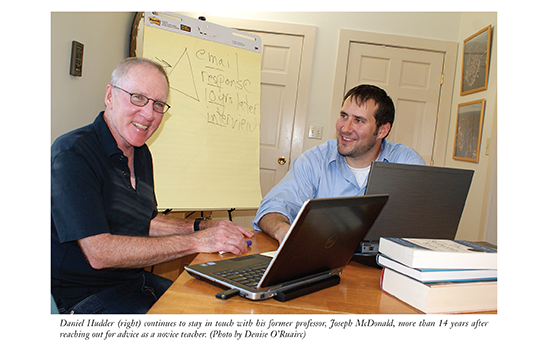
A new teacher reaches out to a veteran teacher educator after discovering the reality of managing his own classroom.
Over 14 years, two teachers had an ongoing conversation about classroom management. One teacher, Joe, is a college professor who taught Dan in an introductory course in teacher education at New York University. Two years later, Dan was in his first teaching job at a high-poverty middle school in Brooklyn. Excerpts from their email conversations and a face-to-face interview illuminate the fresh challenges that emerge in the classroom — always requiring some blend of assertiveness, deliberateness, caring, and a steadfast belief in development.
Their conversation began on Sept. 10, 2000.
Dan starts the conversation
Joe,
I felt compelled to write to you, perhaps asking for advice or perhaps just to assure myself that the people who introduced me to teaching are still there. As you may have guessed, the first couple days were really hard. The funny thing is that I wasn’t nervous on the first day. I taught this summer in an enrichment program and it rocked. I was very confident going into Thursday, but that confidence dwindled as the day went on. Bottom line: They wouldn’t stop talking.
I thought this was supposed to happen later and that I’d be able to lay the groundwork that would help me when they did challenge me. That’s how it worked in the summer. But they started almost immediately. And the last class of the day — awful. None of my little tricks seemed to work. There were kids who wanted to do stuff, but there were so many who just wouldn’t shut up! When I got home, I was almost sick thinking I had to do this for 10 more months.
Dan
Joe responds to Dan
As he read Dan’s message, Joe too felt “almost sick” — about the possibility that he and his NYU colleagues might not have taught Dan enough about classroom management, and that, as a result, Dan (and his students) now faced a crisis.
Dan’s reference to laying “groundwork” suggested to Joe that he likely had key technical knowledge — especially about teaching routines and procedures. But something had interfered with his ability to actually do this. Joe imagined that it was something visceral and checked his bookshelves for accounts of the visceral side of teachers’ first days. He found Esmé Codell’s account of her first day, Educating Esmé: Diary of a Teacher’s First Year (Algonquin Books, 1999).
As they entered, they each took a numbered apple off the bulletin board and matched it to the numbered apples taped to the desks. This is how they were seated, temporarily. . . . Then I looked them over and thought, “This is my destiny, to have this group of children before me.” As they were growing, aging to be 5th graders, I was training, and now we meet, in this unique place and time. The moment felt holy. I gave them my speech about how mean I was and how I’ve taught football players and cowboys and dinosaurs and Martians, so a few 5th graders aren’t too challenging, but I need the money, so I’d give it a shot. I told them that they were going to work harder than they ever have in their whole lives so, if they want extra credit, they should get a head start on sweating. I told them that if they didn’t have their supplies by Monday, they already will have earned a check on their report card for preparedness. I showed them my one Golden Rule: “Treat others the way you would like to be treated,” written out in gold glitter (pp. 25-26).
Joe knew a speech about Martians and gold glitter would never work for Dan, but he thought Codell’s story was otherwise well pitched to his needs. First, she was clearly assertive and, second, stunningly serious and confident. But her confidence had a touch of humor that likely delighted her 5th graders even as it doubtlessly brought them to complete attention. Joe knew Dan could pull this off in his own way. Third, Codell was clearly deliberate. Those numbered apples and gold glitter practically shout out deliberateness, but dozens of other artifacts could easily replace them to the same effect. Finally — although this was not a particular emphasis for Joe at this point — Codell’s call for sweat evokes the right mindset. Out of Codell’s story and some other sources, Joe concocted the following reply to Dan:
Dan,
There’s something I will call The Deal. Here’s how it works. Students (at any level) don’t like to have their personal freedom constrained by teachers. They’d rather just talk with each other, drink Cokes, smoke, horse around, come and go as they please. However, they’re willing to allow their freedom to be constrained as long as the teacher can assure them there is a pay-off for them in this — that they’re actually going to learn some things that will improve their lives, enhance their freedoms, and make them feel better about themselves. It’s pretty easy for teachers to make such assurances when, for example, they’re college teachers, and their students have come to college knowing that a degree is worth something, or when they’re teaching in an enrichment summer school that their students chose to attend. It’s tough at other times, particularly when students have had a lot of experience with teaching that didn’t benefit them in any obvious way and may even have made them feel worse about themselves. But even they will be willing to honor The Deal if you show them that you really understand what it is and that you are very, very serious about fulfilling your end of it. If students sense that you don’t really understand it or go along with it — if, for example, they sense that you’re not very confident of your capacity to deliver any benefit or that you’re ambivalent about your authority to constrain them for a greater good — then they’ll act up like crazy. The word will pass through your room and from one room to another: “Hey, this guy doesn’t know The Deal, so why should we bother about it?”
The Deal is making clear to kids that it matters how hard they try, and I’ll notice when they don’t try — and that matters, too.
The first part of Joe’s message emphasizes the explicit exchange of liberty for academic press. He suggests that this recognition is fundamental to Dan’s recovery. But how could simply knowing that students want academic press possibly help a beginner summon the confidence to deliver the press — especially in the face of adverse behavior? Codell seems to prepare herself to do this as an actor might prepare to play a challenging role — with her interior monologue about meeting at a holy moment. And Joe certainly seems to be coaching the actor in Dan in what he writes next:
First, be serious, resolutely serious . . . until they clearly understand . . . that everything you ask of them has been deliberately planned in THEIR interest — and that you’re absolutely confident (even if secretly you’re not) that it WILL be in their interest.
Here, between parentheses, Joe tips his hand: He is asking Dan to pretend to be confident. Later in their conversation, however, Dan would wonder whether such pretense is possible.
Dan responds to Joe
Dan felt a little defensive when he read Joe’s Deal message. Of course, he recalls thinking, “I have a reason behind everything I do, and I’m confident and serious.”
Still, the next day, Dan found himself very conscious of The Deal, and he began striving to be more deliberate than before. Like Codell, Dan had developed a seating chart for his first day, but now he strictly enforced it. He tried to answer every question with conviction. He also began to press hard on homework. And one other important thing: Dan made a point of getting to know every student’s name more quickly than he might have otherwise — well enough to greet them in the hallway. Indeed, he felt that this was integral to The Deal. If students are going to trust me, he remembers thinking — to believe that I have something of value to offer them — they need to know that I recognize them as individual people, as willful participants in The Deal.
They meet again
In 2010, Joe received another message from Dan thanking Joe for his original Deal message. “Not only did I save the message,” he wrote, “but your concept of The Deal has framed how I view teaching in general.”
The pair decided to make public their discussion about The Deal. So, in 2012, one of Joe’s students, Jessica Furlong, interviewed them in front of one of Joe’s methods classes at NYU.
Jessica: Dan, what prompted you to write Joe in the first place?
DAN: Fear. Look, I’m a cocky kind of guy in some ways. I went into teaching thinking I was going to be really good. This was a middle school in Brooklyn that doesn’t exist anymore because it struggled so much. But it was new then and had hired several new English teachers, and I was the one from NYU! So I was supposed to be the really good one. I kind of lapped that up and enjoyed it. But, boy, the first days! The first day was Thursday, then I had Friday, and I emailed Joe on Sunday morning. I hadn’t gotten over the hell of Thursday and Friday by Sunday morning. Joe was church for me.
Jessica: When you got Joe’s email, how did you feel?
DAN: It really was formative for me in terms of how to figure out classroom management.
Jessica: Joe, you felt really accountable for Dan’s struggle. Why?
JOE: In those days, my colleagues and I didn’t even use the term “classroom management.” We would say, “It’s about classroom environment, so let’s just use that term.” So I was feeling, damn, I wasn’t explicit enough about this stuff, and now Dan is screwed. That’s what I thought. Screwed. And I thought to myself, I have to tell him what The Deal is and how to play it.
Jessica: What did you mean?
JOE: Fundamentally, that he had to act as if he were confident.
DAN: Nah, I wasn’t screwed. I muddled through. But at the end of that first day in Brooklyn, we three brand-new English teachers went out for a drink. We’d all had a rough day, but Josh said to us, “I can’t do this.” He was a small dude, and he actually said, “I’m not built for this.” “Oh, c’mon, Josh,” I said. And though I didn’t interpret it at the time this way, I think that in this language about how he was built, he was presuming that his talents were somehow fixed. He’d never get better. And, sure enough, the very next day he quit.
JOE: See, that’s what I was afraid was going to happen to you!
Teaching is weird. Everybody starting out thinks they know how to do it because they’ve been around it for so many years.
DAN: No, I’ve got stories from that year, but I was always going to muddle through. I think Josh didn’t get The Deal simply because he didn’t believe he could deliver. But the way he was “built” had nothing to do with it. You know, the woman who took over for Josh — she was just 4’ 11”, and she kicked butt in that room! She stayed in that school for years. She was feisty in a way that projected tough love. I mean, yes, you have to act, but you can’t act like a person who is not you.
Jessica: Dan, so you had a different interpretation of The Deal?
DAN: For me, it wasn’t so much about doing things differently. I mean I can tell you now a few things I might have done differently, but what the message created for me was a mindset about shaping behavior. I needed to be deliberate, to be assertive, and to always have a reason for everything. Not that I needed to give the reason all the time. In fact, I didn’t. I just needed to have it. I couldn’t just fall into this default way of being. You know, teaching is weird. Everybody starting out thinks they know how to do it because they’ve been around it for so many years — so they default instead of deliberate, but that doesn’t work.
JOE: And you have to project deliberateness. Isn’t that what The Deal is about?
DAN: Yes, partly. But it’s about persistence too, and you have to project that. I learned to say, “I can’t have side conversations.” And now at the beginning of every year, I just say that incessantly until they know I mean it. “No side conversations,” I’ll say, “because I can’t hear Flo right now, and I need to.” Simple as that.
Jessica: But if you go back through your imagination to that first time that you said, “No side conversations,” there surely still was a side conversation, no? So then what? What did you do?
DAN: At some point, I learned to wait. Now I always wait. And occasionally go toe-to-toe, as in “I need to talk to you after class.” But I don’t make it punitive. It’s just to say, “I can’t have you talking.” After the first week of you just not putting up with it, they relent. Of course, you’re combining this with meaningful lessons that are giving them a reason not to talk. They’re getting something out of not talking — they’re learning. The Deal is not just about behavior; it’s about learning.
JOE: When you say, “I can’t have side conversations,” we hear the confidence in your voice. But it’s the confidence of experience — you’re 12 years in the game. How could you possibly have had that confidence way back in Brooklyn? Wouldn’t you have had to pretend?
DAN: A little bit.
JOE: What do you mean “a little bit”?
DAN: Well, it’s not just pretending. The most concrete thing that I did back in Brooklyn after your message was to learn all the names of the kids as quickly as I could. That’s not pretending, and it signals the kids that you know them. They are individuals.
JOE: So are you saying that The Deal is not just the first day, that it has longevity?
DAN: Definitely. The Deal is making clear to kids that it matters how hard they try, and I’ll notice when they don’t try — and that matters too. It’s about holding that line to say that this particular piece of work is not good enough yet. It’s projecting confidence in them and in yourself, then just saying again and again in a million ways, “Nobody’s stuck in terms of what they can accomplish. Everybody can get better.”
JOE: And that includes the teacher too, doesn’t it?
DAN: Yes, you learn, I learn. No pretense.
CITATION: McDonald, J.P. & Hudder, D. (2014). Uncovering “The Deal” in classroom mana./;.,lgement. Phi Delta Kappan, 96 (2), 44-47.
ABOUT THE AUTHORS

Daniel Hudder
DANIEL HUDDER is chair of the English department at Franklin High School and an adjunct professor and student-teacher supervisor at Boston University, Boston, Mass.
Joseph P. McDonald
JOSEPH P. McDONALD is an emeritus professor of Teaching and Learning at New York University, New York, N.Y. He is a coauthor of Data and Teaching: Moving Beyond Magical Thinking to Effective Practice .