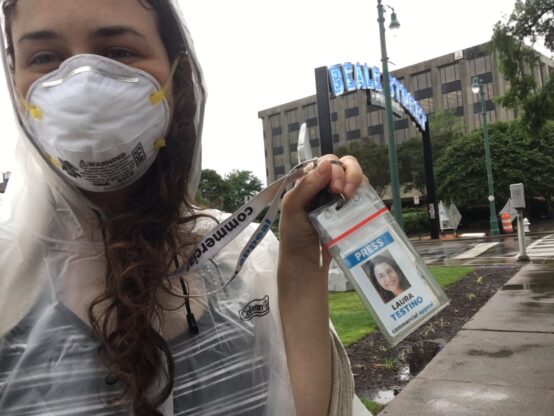
The Commercial Appeal’s education reporter on the many benefits of making parents a more central part of the beat, both in terms of improving coverage and building stronger relationships with the community.
By Alexander Russo
Like many local education reporters, The Commercial Appeal’s Laura Testino is relatively new to the beat and comes from someplace else than the Memphis area she’s covering. But she’s not your typical education reporter. If you’re not already familiar, her work includes this amazing 2021 story going deep to explain why there are so many different highly segregated school districts in Memphis. (Hint: It’s not an accident.)
Part of the reason is that she’s technically not “just” an education reporter. Her beat is education and children’s issues. In that role, she tries to tell stories about people rather than school systems. She also comes to education reporting from stints covering arts and culture, which you can spot in her education coverage.
More than that, Testino is a particularly parent-focused reporter, often getting story ideas from them and starting out with parent interviews, rather than putting them last – or not including them at all. “When you include parents,” she told me in a recent phone interview, “there are more people that tell their friends and more people are willing to speak to you. And they’re reading the paper.”
Now, perhaps more than ever, education journalists are being called on to put parent voices front and center in their coverage. As you’ll see in the following interview, Testino incorporates parent voices and concerns in her stories to make her reporting and storytelling better and to build new connections with the communities she’s covering.
This interview has been edited and condensed for clarity
When you first came onto the beat, did you have much of a sense of the role of parents or caregivers? Were they front and center in your thinking right from the start?
LT: I don’t know that ‘front and center’ would be the right characterization, but they were definitely a group of people that I sought out to speak to. One reason is that I came to the education beat from arts and culture, and when I made the move I wanted a way to be able to still tell stories about people. Another is that I’m not a parent myself, so I knew that if was going to understand the community in Memphis that I was going to have to talk to parents.
How did you find parents to talk to?
LT: You can’t be in the city for very long and not know [parent advocate] Sarah Carpenter. I met her, and she introduced me to other parents. And I also sought out parents through different community events. For example, high school reunions are like a huge, huge cultural community event that happen every year here. So I went to those and talked to people. I would also reach out to people through the high school sports reporters. I have also used breaking news stories as a way to find parents. That includes reunions, barbeques – social places where people are ready to talk more so than going to the store or finding people in the school drop-off line. It’s fine for journalists to do that, but I think finding social events where people are ready to be talking is helpful.
When you include parents, there are more people that tell their friends and more people are willing to speak to you. And they’re reading the paper.
How do people react to the inclusion of parents in education stories?
LT: I don’t know that have enough information to gauge that, but I can feel the response when there’s more community familiarity with who you are, who your newspaper is. There’s a lot of work, particularly for plenty of Southern newspapers, to not just rebuild but to build a presence and a familiarity with a lot of communities that we are now covering that historically have not been adequately covered by our newspaper or who have been covered for negative reasons. So I think just when you include parents, what I have noticed is there are more people that tell their friends and more people are willing to speak to you. And they’re reading the paper.
Have you gotten any negative reactions from readers or educators or anyone else for the way that you cover stories?
LT: I don’t have an experience like that coming to mind. I don’t suppose it’s any worse than if I was writing anything else. The school district often does not want to see itself as not engaged with parents. But I don’t know that anything that I have ever written has provoked a particularly negative response from that view, either.
What about parent reactions? Do they express frustrations with your coverage?
LT: One element of that is treating parents the same way that you would any other source, in the way that just because you might be talking to them about a topic, that doesn’t mean that I’m going to write it every time. Sometimes there’s some frustration there. But as a reporter it’s important to be cognizant that it’s not the parents’ stories that don’t reach the merit of getting coverage. Even if not every single one of these little stories is worthy of coverage, what’s the larger kind of story that everybody is trying to tell, if there is one?
One of the most common questions reporters have is how to cover parents who are advocates or who receive outside funding. How do you make it clear to the reader who they are without diminishing them? What’s your approach?
LT: To me, it depends on what it is that the story is about and who it is that those voices are. If I’m writing about something that is political in nature in which their involvement with any group or funding from any kind of group would be a conflict, I think that’s where you would decide: ‘OK, maybe this is not the best parent voice for this.’ I think it’s a very important reporting choice to make sure that you were communicating to the reader that this person belongs to a very active, engaged organization. They’re not representative of an average parent. But I think in other kinds of stories where the nature of the story is not one that is so overtly political, I may not flesh out those relationships.
There’s a lot of work, particularly for plenty of Southern newspapers, to not just rebuild but to build a presence and a familiarity with a lot of communities that we are now covering that historically have not been adequately covered by our newspaper.
What have you learned about how parents think about school from your reporting?
LT: Based on talking with parents, one main thing I think I’ve discovered there’s that there’s a lack of understanding of the curriculum, and frustration with the curriculum, which has changed frequently. On the one hand, parents feel involved, but you also feel as a parent like you don’t really know your next step because it’s being taught differently than the way that it was taught before. That’s not necessarily bad. It’s just different. And so I’ve tried encapsulating that experience from a parent perspective and the kids’ perspective.
Are there stories written by other people that have a have a focus on parents or caregivers that you’ve admired? Are their stories or journalists out there that you feel sort of like, get this the way that you get it?
LT: I probably have very similar patterns in terms of the journalists I admire as anybody else: I would say Erica Green always does this really well. She pays attention and is ahead of the curve. I loved her story about the enduring mistrust of school districts among parents in some communities and how that’s played out with COVID. I think former Hechinger Report reporter Bracey Harris has also done that really well and was early to write about that. I would also say Aliyya Swaby when she was at the Texas Tribune really paid attention not only just to parents, but to kind of how education has impacted entire families and what that looks like. She’s shown how you can look at education through a family lens or family through an education lens. Thinking through those parent lenses is an important part of education reporting.
Within the USA Today network that I’m a part of, the Mandy McLaren and Olivia Krauth project included a generational look at education, showing that talking to parents also can point you in a different way than it does talking to a district or talking to teachers about it.
Aliyya Swaby really paid attention not only just to parents, but to kind of how education has impacted entire families and what that looks like. She’s shown how you can look at education through a family lens or family through an education lens.
You can read Testino’s Commercial Appeal stories here and follow her on Twitter here.
Previous journalist interviews from The Grade:
Education and race: 9 journalists reflect
Pulling back the curtain on desegregation in Louisville
Lessons from 30 years covering education for NPR
Covering communities that are not your own
Previously from The Grade on parent-focused journalism:
‘So, are YOU a parent?’ (by Ruth Serven Smith)
Putting parents front and center
An open letter to education writers (Sarah Carpenter)
Nice White Parents: a different way of covering school inequality
Teacher strike coverage illustrates need to amplify parent, student voices
New York City 1968 wasn’t a teachers strike; it was a community insurrection.
ABOUT THE AUTHOR

Alexander Russo
Alexander Russo is founder and editor of The Grade, an award-winning effort to help improve media coverage of education issues. He’s also a Spencer Education Journalism Fellowship winner and a book author. You can reach him at @alexanderrusso.
Visit their website at: https://the-grade.org/