To decide what students should learn in civics, let’s begin by looking at what skilled citizens do.
Civics has long been neglected in the preK-12 schools. Yet there is growing support for civics education, coming from a broad range of voices. In 2021, for instance, more than 300 experts from across the political spectrum released The Roadmap to Educating for American Democracy, which was swiftly endorsed by six former secretaries of education — Republicans and Democrats. And new civics requirements have been introduced by both Republicans and Democrats in states like Indiana and Massachusetts. A window of opportunity seemingly has opened.
But an opportunity for what, exactly? As a recent report from the Fordham Foundation notes, civics education varies in both focus and quality across states (Stern et al., 2021). Massachusetts, for example, requires students to complete a civics action research project, whereas Missouri requires students to pass a multiple-choice test similar to the U.S. citizenship exam. (For more on the origin of the U.S. citizenship exam, see Schneider, 2010.) The broad support for civics education, in other words, should not be mistaken for consensus about what students should learn in civics classrooms.
If we possessed a shared understanding of what particularly skilled citizens do, then perhaps we could plan backward from that endpoint. That might be one way to bring about some coherence and agreement.

Finding citizenship experts
In some fields, it’s easy to figure out what the most skilled practitioners do. The best baseball players can be found in Major League stadiums for six months of the year. Watch them in the infield and the outfield, on the mound, and in the batter’s box, and you can determine what skills novices should be developing. The best historians are in the archives, holding office hours, and at their desks — reading and writing about the past. Once again, there is a clear set of experts to learn from.
But how would one find the “best” citizens to study their skills and dispositions? There is no obvious group to tap.
Although there may not be a clear hierarchy of top citizens, two groups might have important insights about what skilled citizens do. We surveyed 100 “experts” whose work directly engages the topic of civics, as well as roughly 500 “ordinary citizens” who are engaged in their communities in a variety of ways. They came from the “blue” state of Massachusetts and the “red” state of Missouri. Our experts were drawn from a pool of local and statewide elected officials, professors in relevant fields, and leaders of liberal and conservative advocacy groups. Our ordinary citizens were recruited using Amazon’s Mechanical Turk service, through which we polled more than 500 adult residents from our two sample states. To ensure demographic diversity, we asked respondents to complete questions about gender, race, political affiliation, annual household income, and voting frequency.
For each group of participants, we asked:
If we wanted to watch writers engage in their craft, we might ask them to sit down with paper and pen, or perhaps in front of a computer. If we wanted to watch builders apply their expertise, we might ask them to sketch out plans for a house. But what kinds of tasks should we watch “expert citizens” engage in?
Our findings can help us rethink some of what is happening in the civics classroom. By understanding what civic activities our respondents consider most characteristic of “expert citizens,” we may be able to develop curricula that better prepare young people for the demands of democratic life.
What tasks do skilled citizens engage in?
The open-ended survey of more than 600 people allowed for multiple responses, giving us more than 1,000 “tasks” to make sense of. A pair of graduate students, whose work was tested for interrater reliability at a minimum threshold of 90% agreement, organized these tasks into 28 categories, which they then grouped into 10 larger themes.
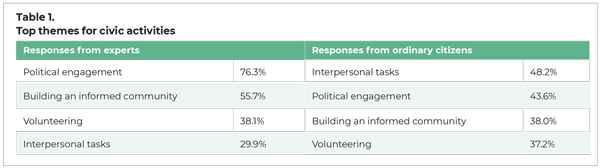
As Table 1 illustrates, experts and ordinary citizens broadly agree about what skilled citizens do. The top four themes that emerged from the data were the same for both experts and ordinary citizens, and these were the only themes to receive support from more than 25% of respondents from either group.
Despite the broad agreement about which themes are most important, there were points of departure between the two groups. A majority of experts identified tasks related to “political engagement” and “building an informed community” as activities of expert citizens. No single theme garnered majority support among ordinary citizens, but “interpersonal tasks” appeared in a higher percentage of ordinary citizens’ responses, in comparison to those of experts.
It is worth noting that support for these themes was consistent regardless of political affiliation. Among our ordinary citizen respondents, there was no obvious split between Republicans and Democrats.
Beyond voting
The vast majority of our experts (76.3%) identified the broad theme of political engagement as a core civic task, as did nearly half of our ordinary citizen respondents. As Table 1 indicates, political engagement was the top-ranked theme among professionals and the second-ranked theme among ordinary citizens.
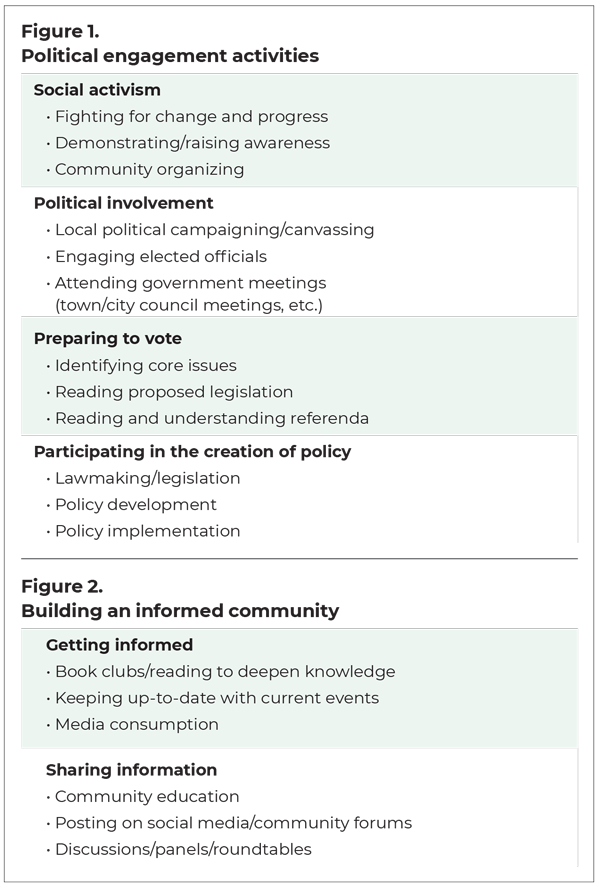
What kinds of tasks fall under the theme of political engagement? The activities within this theme fell into four categories (see Figure 1).
Social activism, which we define as tasks that seek to make change outside the political system, includes such activities as participating in protests and engaging in community organizing efforts. Among experts, it was the most frequently identified category of task (58.8%), and it was the third most commonly mentioned category among ordinary citizens (24.3%).
Political involvement, which we define as working within the system, was the second most frequently mentioned category of tasks among our experts (48.5%). Although it was mentioned far less frequently by ordinary citizens (17.5%), it still ranked sixth among all categories of tasks, slightly higher than seemingly essential tasks like voting (15.4%).
The two other categories in this theme — preparing to vote and participating in policy creation — were less frequently named by both groups.
What does this mean? For many of us, the idea of engaged citizenship is tightly related to the ballot box. As our respondents indicate, however, political engagement is much more expansive. It is an ongoing activity with formal and informal dimensions, not bounded by elections. This more expansive definition of political engagement can be intentionally cultivated in classrooms. In Massachusetts, for instance, students are now required to complete a civics project in 8th grade and again in high school — projects in which they will ostensibly develop skills like “social political awareness” (Massachusetts Department of Elementary and Secondary Education, 2021). Although such projects are likely not sufficient, they point the way toward the kinds of activities that might advance student understanding of political engagement.
Information matters
Both groups saw the theme of “building an informed community” as work that skilled citizens engage in. As Table 1 shows, 55.7% of experts and 38% of ordinary Americans named tasks from this theme.
What does it mean to build an informed community? Figure 2 shows the categories or activities we included in this theme. “Getting informed” includes activities like book clubs and keeping up with current events. Unlike preparing to vote — for example, by reading about candidates or reviewing endorsements — getting informed is an ongoing process. Similarly, “sharing information,” which includes tasks like community education and posting on social media, is an ongoing activity, rather than an instrumental activity designed with a specific action in mind.
This finding is in keeping with a long-standing societal interest in fostering an informed citizenry. Leaders from the earliest days of the republic were concerned with preparing Americans to govern themselves, and they supported interventions like public education to facilitate that outcome (Black, 2020). In recent years, such interests have been magnified in discussions of “fake news” and misinformation, which demand an ability to critically consume information (Wineburg, 2018).
The fact that so many of our respondents named activities in these areas reminds us that getting informed and sharing information are, at their core, acts of citizenship. Recognizing the civic imperative of building an informed community may not only help us carve out additional space for media literacy in our curricula, but also generate bipartisan support for these efforts. As research has revealed, there is a significant need for more curriculum that will “prepare students to thrive in a world in which information flows ceaselessly across their screens” (Breakstone et al., 2021).
We’re all in this together
Several of the top civic tasks experts and ordinary citizens named relate to participation in political life. Yet we also observed very strong support for what in an earlier era might have been referred to as neighborliness — or a belief in a “shared fate” (Ben-Porath, 2012). Among ordinary citizens, “interpersonal tasks” — including collaborating and helping others — were at the very top of those named (48.2%), while ranking fourth among experts (29.9%). Tasks falling under the theme of “volunteering” ranked fourth (37.2%) among ordinary citizens and third (38.1%) among professionals. As we looked at the categories and activities falling under these themes (see Figure 3), we were struck by the fact that both themes address engagement, collaboration, and mutual aid.
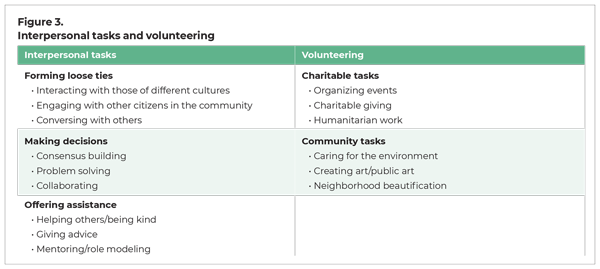
Interpersonal tasks are more relational in nature — rooted in interactions among members of a community. Volunteering is more about the specific work that people do together to strengthen communities. Volunteer tasks like organizing events and neighborhood beautification involve working with organizations in a planned and formal way. Interpersonal tasks like helping others, on the other hand, occur among individuals and tend not to involve organizations or larger-scale activity. At their core, however, both volunteer tasks and interpersonal tasks can be described as the work of people who are fundamentally engaged with each other.
In many ways, Americans are deeply polarized. In our local communities, however, there are opportunities to work together in less political, but nevertheless civic ways (Putnam, 1993). Including this facet of citizenship in the work of preK-12 education, then, might do much to carve out badly needed common ground. While a small number of states like New York include such skills and dispositions in their standards documents, they are generally overlooked or included only implicitly.
Toward a shared sense of citizenship
This study was designed as the beginning of a long-term research project. As such, it should be viewed more as a springboard for further work — by us and by others — than as a final word about what constitutes civic expertise. Nevertheless, we feel that it offers some important insights about civics education in preK-12 schools.
In many ways, Americans are deeply polarized. In our local communities, however, there are opportunities to work together in less political, but nevertheless civic ways.
At a time of tremendous divisiveness, there is also a great deal of bipartisan agreement that civics education has a place in American public education, and several states have taken steps to require more instruction in the subject. There are national frameworks for civic education such as The Roadmap to Educating for American Democracy; quality open-access civics curricula (e.g., iCivics); and promising research endeavors from organizations like the National Academy of Education and the Center for Information and Research on Civic Learning and Engagement (CIRCLE). Yet the field of civics education remains loosely defined, and sometimes at odds with itself. Civics education, it seems, can mean many different things (Stern et al., 2021). At the same time, the hand of history guides civics courses toward an understanding of formal roles, responsibilities, rights, and procedures (Carnegie Corporation of New York & CIRCLE, 2003).
Drawing out a shared sense of what skilled citizens know and can do, as well as of their habits and dispositions, might be an important contribution in this new era in civics education, enabling us to strengthen our efforts to develop citizens inside and outside schools. As energy and enthusiasm for civics continue to rise, we see both a challenge and an opportunity. The challenge is obvious: Without a shared vision for a 21st-century civics education, new efforts will simply reanimate old approaches that are unlikely to meet the needs of our modern democracy. Yet the opportunity is equally clear. Working backward from a clear end goal, we might foster an approach to civics education that does what we so badly need it to.
References
Ben‐Porath, S. (2012). Citizenship as shared fate: Education for membership in a diverse democracy. Educational Theory, 62 (4), 381-395.
Black, D.W. (2020) Schoolhouse burning: Public education and the assault on American democracy. Public Affairs.
Breakstone, J., Smith, M., Wineburg, S., Rapaport, A., Carle, J., Garland, M., & Saavedra, A. (2021). Students’ civic online reasoning: A national portrait. Educational Researcher, 50 (8), 505-515.
Carnegie Corporation of New York & CIRCLE. (2003). The civic mission of schools.
Massachusetts Department of Elementary and Secondary Education. (2021). Civics project guidebook.
Putnam, R. (1993). The prosperous community: Social capital and public life. The American Prospect, 13 (4).
Schneider, J. (2010). Memory test: A history of U.S. citizenship education and examination. Teachers College Record, 112 (9), 2379-2404.
Stern, J.A., Brod, A.E., Gregory, J.A, Griffith, S., & Pulvers, J, (2021). State of state standards for civics and U.S. History in 2021. Thomas B. Fordham Institute.
Wineburg, S. (2018). Why learn history (when it’s already on your phone). University of Chicago Press.
This article appears in the May 2023 issue of Kappan, Vol. 104, No. 8, pp. 47-51.

ABOUT THE AUTHORS

Jack Schneider
Jack Schneider is the Dwight W. Allen Distinguished Professor at the University of Massachusetts Amherst and director of the UMass Center for Education Policy.

Eric Soto-Shed
Eric Soto-Shed is a lecturer on education at the Harvard Graduate School of Education , Cambridge, MA, and the founding director of HGSE’s Teacher Residency Program.
Karalyn McGovern
Karalyn McGovern is a doctoral candidate and research assistant at the University of Massachusetts Lowell.