Efforts to recruit diverse teachers will fail unless school leaders change systems that burden and isolate novice Black teachers.
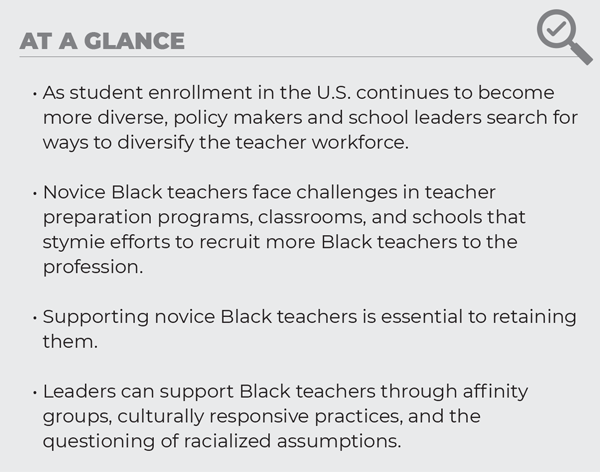
Increasing the racial diversity of the teacher workforce to reflect the changing demographics of their communities and our country is the focus and goal of many education policy makers, groups, and teacher education programs. Bringing more teachers of color into the classroom is vital because evidence shows that Black students are more successful when they are taught by Black teachers (Goldhaber, Theobald, & Tien, 2019).
Unfortunately, the racially toxic environments of many U.S. schools often stymie these efforts, as novice Black teachers find themselves teaching in environments tainted by racism (Stovall & Sullivan, 2022). Many teacher educators, administrators, and school leaders who could improve these conditions, thereby increasing the odds of retaining novice teachers, may not understand how their school policies and practices marginalize Black teachers and students and place disproportionate demands on Black teachers, both novices and veterans (Santoro, Hazel, & Morales, 2022).
The double bind: Experiences of novice Black teachers
Veteran and novice Black teachers experience a double bind when their personal commitments as members of Black communities conflict with professional expectations in schools that perpetuate racist hierarchies (Achinstein & Ogawa, 2011; Gist, 2017). In our recent systematic review of studies on the experiences of novice teachers of color, we identified elements that create this double bind (Bettini et al., 2022).
For example, white colleagues and administrators often hold biased assumptions about Black teachers (Bristol & Mentor, 2018; Cormier, 2022). Black male teachers are expected to act as disciplinarians for Black students, including those beyond their classrooms, often at the expense of fulfilling their own teaching responsibilities and without additional compensation (Bristol & Mentor, 2018). Gendered assumptions about what it means to be a Black man often show up in policies and programs that aim to recruit more Black men into teaching. These expectations further marginalize Black male novices who do not align with traditional, heteropatriarchal gender norms, such as gay and transgender Black men (Woodson & Pabon, 2016).
Black teachers also are scrutinized in ways other novices are not (Cormier et al., 2022). For example, many Black teachers report that colleagues, administrators, and parents frequently question their pedagogical and content expertise (Bryan & Browder, 2013; Stovall & Sullivan, 2022). For example, one novice Black male kindergarten teacher recounted how a parent asked, “Are you sure you know what you are doing?” (Bryan & Browder, 2013, p. 151). All new teachers are still learning, but white novices are perceived as “normal” teachers and thus are less likely to face this level of questioning.
At the same time, evidence suggests Black teachers have expertise in Black students’ cultural backgrounds that enables them to deliver culturally responsive and sustaining pedagogy (Borrero, Flores, & de la Cruz, 2016). Evidence shows that this kind of instruction improves student outcomes (Aronson & Laughter, 2016), but the extra effort and expertise required does not come with additional compensation. On the contrary, many administrators and colleagues do not value culturally responsive approaches, and many actively discourage or disallow it.
In fact, school policies often are based on white norms, creating barriers to culturally responsive practices (Ball, 2022). School curricula often reinforce racist narratives by overlooking texts written by and about people of color (Achinstein & Ogawa, 2012). Eurocentric pedagogical and behavioral norms can conflict with novice Black teachers’ own values, expertise, and beliefs (Achinstein & Ogawa, 2012; McKinney de Royston et al., 2021). For example, a Black female teacher in a school with a rigid policy banning head coverings was unable to defend a Black female student who was wearing a bandana because, as the teacher recognized, she had not finished the lengthy process of removing her synthetic braids the night before and needed to cover her hair (Neason, 2014). This incident played a role in her departure from the school.
Because they are still learning, novices depend on colleagues, curricular materials, and school instructional norms to help them learn how to teach (Wang, Odell, & Schwille, 2008). When these supports do not value the cultural expertise of Black teachers and their commitments to culturally relevant pedagogy, novices may struggle, leading to frustration (Achinstein & Ogawa, 2011, 2012) and, in some cases, attrition (Scott, 2020).
Being one of a few (or the only) Black teacher in a teacher education program, school, or department can be isolating.
Another factor that contributes to the double bind: Black teachers disproportionately choose to teach in higher-poverty schools serving more students of color. Such schools have lower per-pupil funding than schools serving more white and affluent students, even in the same district, and administrator turnover tends to be higher. With high leader turnover and insufficient funding, these schools struggle to sustain improvement initiatives, have higher teacher attrition rates, and are lacking in areas like materials and collegial support compared to more affluent schools that serve mostly white students (Bettini et al., 2022). Collectively, these issues leave novices without the strong collegial and administrative support and resources needed to learn and enact effective practices.
All these factors leave Black teachers in a double bind. Their commitments to effective, culturally relevant pedagogy for students are at odds with professional expectations, and they are overloaded with extra demands and insufficient resources (Scott, 2020). Many novice Black teachers report a strong commitment to changing these inequitable systems. Though this is valuable, it constitutes yet another burden. Efforts to recruit more Black teachers will not work if high proportions of novice Black teachers continue to leave because of the double bind and related challenges (Achinstein et al., 2010).
Supporting novice Black teachers
How can teacher educators, policy makers, and school leaders better support novice Black teachers? Leaders must begin by addressing the ways current systems place novice Black teachers in double binds. These are some of the steps that teacher education programs and school and district leaders can take to reduce disproportionate burdens on Black teachers, which will help retain novice Black teachers in the profession.
Build support networks
Being one of a few (or the only) Black teacher in a teacher education program, school, or department can be isolating. Racial affinity groups can address this challenge (Mosely, 2018; Santoro, Hazel, & Morales, 2022; Stovall & Sullivan, 2022). In these groups, teachers of color can be supported by and build solidarity with their colleagues of color. For example, Micia Mosely (2018) found that more experienced Black teachers helped novices in their affinity group to navigate racial microaggressions and avoid burnout. Participants have described how affinity groups often “gave them life” (Mosely, 2018, p. 7).
Affinity groups don’t need to be confined to a school or a district. A district can provide funding for Black teachers to participate in a national affinity group. For example, Profound Gentlemen is an affinity group for male educators of color that offers mentorship from veteran teachers (www.profoundgentlemen.org). Affinity groups also can focus on content areas. For example, given complex intersections between ableism and racism (Artiles, 2011), districts could develop affinity groups for Black special educator teachers (Kulkarni, Marinia Gaeta, & Bland, 2022). Teacher education programs also can create affinity groups to support preservice Black teachers during student teaching or internships.
Center culturally responsive pedagogy and practices
School leaders can work with teachers and staff to construct a vision of culturally relevant and responsive pedagogy (Gay, 2018) across content areas (Aronson & Laughter, 2016). This vision must begin with a leader’s awareness of their own responsibilities and power within their schools and a commitment to being “continuously responsive” (Khalifa, Gooden, & Davis, 2016, p. 1274) to the shifting demographics in their schools’ teaching force and student body. School leaders can implement a culturally responsive vision by evaluating curricular materials (Comprehensive Center Network, 2020), while also centering the role of race and culture within professional development, coaching, and evaluation. For example, school leaders can provide spaces where “justice-oriented teachers” can come together for shared learning and support (Lisle-Johnson & Kohli, 2020, p. 352).
Veteran and novice Black teachers experience a double bind when their personal commitments as members of Black communities conflict with professional expectations in schools that perpetuate racist hierarchies.
When creating these learning opportunities, leaders should not expect teachers of color to educate white peers. Teacher educators also should not disproportionately demand vulnerability or expertise from Black teacher candidates when discussing issues of equity and diversity in schools. Instead, they should turn to external partners trained in this kind of professional development (Blaisdell, 2018). Leaders also should be prepared to mediate conflicts among teachers and between teachers and parents regarding culturally responsive curriculum and practices. This support is crucial for Black teachers’ sustainability within the field.
Question racialized expectations
Many aspects of school policies, materials, and operations can send messages about teachers’ roles and value in the school. Leaders should ensure that their expectations communicate value for all teachers, without disproportionately burdening teachers of color. For example, all teachers should be expected to develop cultural competence to serve their students.
Teacher educators and school leaders should understand what they may be inadvertently communicating through policy. For example, dress codes that reflect white, middle-class, cis-heteronormative ideals of professionalism may require teachers to present themselves in ways that do not align with their identity (Morris, 2005).
Other policies, such as disciplinary rules that do not reflect Black cultural behavioral norms (e.g., the Black female student who was disciplined for wearing a bandana in Neason, 2014), may similarly marginalize both Black teachers and Black students. Administrators should initiate and support collaborative efforts to critique and revise such policies. Teacher educators may provide clear opportunities for Black teacher candidates to seek support in navigating racialized expectations during their internships and student-teaching placements.
Appreciate, but do not assume, teachers’ expertise
Many novices report that sharing racial identities with students and families is helpful to teaching their students and building strong relationships with families (e.g., Cormier, 2020; Plachowski, 2019). However, sharing students’ racial and ethnic identity does not necessarily mean teachers fully share students’ sociocultural identity, nor does it guarantee shared experiences that create understanding (Fordham & Ogbu, 1986). Black novices cannot be assumed to share Black students’ cultural backgrounds (Achinstein & Aguirre, 2008). For example, in many studies, Black teachers from middle-class backgrounds reported feeling poorly prepared to support Black students from lower-
income backgrounds (Sato, Fisette, & Walton, 2013). Some of these novices described how, when they started teaching in low-income, predominantly Black schools, they realized that they held class-based stereotypes about their students, and they wanted more opportunities to understand their students’ backgrounds (Sato, Fisette, & Walton, 2013). Teacher education and school-level leaders should support all teachers in developing cultural competence for their community and avoid defining culture as merely racial identity.
Beyond recruitment
Ultimately, leaders have broad power to make systemic improvements to support and retain Black teachers. These changes are just as important as improving efforts to recruit Black teachers. Recruitment efforts will have little effect if attrition remains high because of novice Black teachers’ experiences with the double bind.
References
Achinstein, B. & Aguirre, J. (2008). Cultural match or culturally suspect: How new teachers of color negotiate sociocultural challenges in the classroom. Teachers College Record, 110 (8), 1505-1540.
Achinstein, B. & Ogawa, R.T. (2011). Change(d) agents: School contexts and the cultural/professional roles of new teachers of Mexican descent. Teachers College Record, 113 (11), 2503-2551.
Achinstein, B. & Ogawa, R.T. (2012). New teachers of color and culturally responsive teaching in an era of educational accountability: Caught in a double bind. Journal of Educational Change, 13 (1), 1-39.
Achinstein, B., Ogawa, R.T., Sexton, D., & Freitas, C. (2010). Retaining teachers of color: A pressing problem and a potential strategy for “hard-to-staff” schools. Review of Educational Research, 80 (1), 71-107.
Aronson, B. & Laughter, J. (2016). The theory and practice of culturally relevant education: A synthesis of research across content areas. Review of Educational Research, 86 (1), 163-206.
Artiles, A.J. (2011). Toward an interdisciplinary understanding of educational equity and difference: The case of the racialization of ability. Educational Researcher, 40 (9), 431-445.
Ball, D.L. (2022). Coming to terms with the power of teaching. Phi Delta Kappan, 103 (7), 51-55.
Bettini, E., Cormier, C.J., Ragunathan, M., & Stark, K. (2022). Navigating the double bind: A systematic literature review of the experiences of novice teachers of color in K-12 schools. Review of Educational Research, 92 (4), 495-542.
Blaisdell, B. (2018). Beyond discomfort? Equity coaching to disrupt whiteness. Whiteness and Education, 3 (2), 162-181.
Borrero, N.E., Flores, E., & de la Cruz, G. (2016). Developing and enacting culturally relevant pedagogy: Voices of new teachers of color. Equity & Excellence in Education, 49 (1), 27-40.
Bristol, T.J. & Mentor, M. (2018). Policing and teaching: The positioning of Black male teachers as agents in the universal carceral apparatus. The Urban Review, 50 (2), 218-234.
Bryan, N. & Browder, J.K. (2013). “Are you sure you know what you are doing?” — The lived experiences of an African American male kindergarten teacher. Interdisciplinary Journal of Teaching and Learning, 3 (3), 142-158.
Cormier, C.J. (2020). They do it for the culture: Analyzing why Black men enter the field of special education. Multiple Voices: Disability, Race and Language Intersections in Special Education, 20 (2), 24-37.
Cormier, C.J. (2022). White folks teach, Black men police: Black male teachers as the regulators of student behavior. Teachers College Record.
Cormier, C.J., Scott, L.A., Powell, C., & Hall, K. (2022). Locked in glass classrooms: Black male special education teachers socialized as everything else but educators. Teacher Education and Special Education, 45 (1), 77-94.
Comprehensive Center Network. (2020). Tools and guidance for evaluating bias in instructional materials (ED612040). ERIC.
Fordham, S. & Ogbu, J.U. (1986). Black students’ school success: Coping with the burden of ‘acting white’. The Urban Review, 18 (3), 176-206.
Gay, G. (2018). Culturally responsive teaching: Theory, research, and practice. Teachers College Press.
Gist, C.D. (2017). Voices of aspiring teachers of color: Unraveling the double bind in teacher education. Urban Education, 52 (8), 927-56.
Goldhaber, D., Theobald, R., & Tien, C. (2019). Why we need a diverse teacher workforce. Phi Delta Kappan, 100 (5), 25-30.
Khalifa, M.A., Gooden, M.A., & Davis, J.E. (2016). Culturally responsive school leadership: A synthesis of the literature. Review of Educational Research, 86 (4), 1272-1311.
Kulkarni, S.S., Marinia Gaeta, J., & Bland, S. (2022). From support to action: A critical affinity group of special education teachers of color. Teacher Education and Special Education, 45 (1), 43-60.
Lisle-Johnson, T. & Kohli, R. (2020). Critical Black women educators: Resisting the racial and ideological marginality of K-12 teaching through critical professional development. Theory Into Practice, 59 (4), 348-357.
McKinney de Royston, M., Madkins, T.C., Givens, J.R., & Nasir, N.I.S. (2021). ‘I’m a teacher, I’m gonna always protect you’: Understanding Black educators’ protection of Black children. American Educational Research Journal, 58 (1), 68-106.
Morris, E.W. (2005). ‘Tuck in that shirt!’ Race, class, gender, and discipline in an urban school. Sociological Perspectives, 48 (1), 25-48.
Mosely, M. (2018). The Black teacher project: How racial affinity professional development sustains Black teachers. The Urban Review, 50 (2), 267-283.
Neason, A. (2014, December 17). Our teacher diversity problem is not just about recruitment. It’s about retention. Slate.
Plachowski, T.J. (2019). Reflections of preservice teachers of color: Implications for the teacher demographic diversity gap. Education Sciences, 9 (2), 144.
Santoro, D.A., Hazel, J., & Morales, A. (2022). Cultivating anti-racist professional cultures that support teachers of color. Phi Delta Kappan, 104 (1), 22-27.
Sato, T., Fisette, J., & Walton, T. (2013). The experiences of African American physical education teacher candidates at secondary urban schools. The Urban Review, 45 (5), 611-631.
Scott, L.A. (2020). Reasons early career Black special education teachers quit their positions. American Journal of Educational Research and Reviews, 79 (5), 1-17.
Stovall, J.L. & Sullivan, T.R. (2022). ‘Grant us the sun’: What Black teachers need. Phi Delta Kappan, 104 (1), 18-21.
Wang, J., Odell, S.J., & Schwille, S.A. (2008). Effects of teacher induction on beginning teachers’ teaching: A critical review of the literature. Journal of Teacher Education, 59 (2), 132-152.
Woodson, A.N. & Pabon, A. (2016). ‘I’m none of the above’: Exploring themes of heteropatriarchy in the life histories of Black male educators. Equity & Excellence in Education, 49 (1), 57-71.
This article appears in the May 2023 issue of Kappan, Vol. 104, No. 8, pp. 19-24.

ABOUT THE AUTHORS

Christopher J. Cormier
CHRISTOPHER J. CORMIER is an associate professor at Loyola Marymount University, Los Angeles, CA.
Elizabeth Bettini
ELIZABETH BETTINI is an associate professor at Boston University, MA.
Kristabel Stark
Kristabel Stark is an assistant professor at the University of Vermont, Burlington.