Teachers in predominately white communities must understand the political landscape of their communities and be prepared for objections if they discuss controversial topics in the classroom.
In February 2021, Kappan published my first article, which discussed my research into teachers’ knowledge of CRT and the controversies surrounding a high school course I taught that was explicitly framed by critical race theory (CRT) in the predominantly white suburb of Westfield, New Jersey (Farag, 2021). To my surprise, it turned out to be the most viewed Kappan article of that year (Preston, 2021), and discussions about CRT have become even more intense since then. Politicians have made hostility toward the theory a foundation of their platforms, and policy makers have passed laws against it (Alfonseca, 2022). Citizens, often riled up by sensationalized media accounts, have turned out at school board meetings across the county to voice their concerns about liberal schoolteachers indoctrinating children (Reilly, 2022). Some experts argued after the off-year election in 2021 that fears about CRT could be a galvanizing force for white suburban voters (Barnum, 2021).
Most of the discussions about CRT are dominated by media pundits, politicians, and academics. The voices of teachers on the front lines of these debates, and specifically teachers of color teaching in the suburbs, remain largely absent. As a teacher of color in a predominately white suburban school district who is also a teacher educator, I believe our voices are necessary to help current and future teachers navigate this culture war. My experiences — and those of teachers like me — can be useful to anyone looking to understand the nature of the controversy and how teachers can equip themselves to respond.
What’s behind calls for transparency
Proponents of anti-CRT legislation say that public school districts are insufficiently transparent, leaving parents and guardians in the dark about what their children are learning in school (Heritage Foundation, 2021). Christopher Rufo (2022) of the Manhattan Institute and an early leader of politicized attacks on CRT has argued that all teaching material should be posted online for parents to audit. Transparency bills have been proposed in multiple state legislatures (Meckler, 2022).
In my own suburban community of Westfield, these concerns about transparency arose when a group of community members, who (ironically) remain anonymous, launched a WPS Transparency website (https://wpstransparency.org). The site attacks the Westfield administration’s racial literacy initiative and displays administrators’ and teachers’ emails related to these efforts. There is also an entire section devoted to me, my research, and my Power, Privilege, and Imbalance in American Society course at Westfield High School. While such investigations are well within the rights of parents of public school students, many of these criticisms, at best, have been ill-informed and, at worst, appear to be done in bad faith.
For example, the criticisms of my doctoral dissertation stated there was no evidence supporting my assertion that New Jersey is one of the most racially and ethnically segregated states in the country, ignoring my citation of the UCLA Civil Rights Study. A similar inaccurate criticism occurred during a board meeting when a Westfield resident falsely claimed that my research into awareness of CRT studied Westfield students (Westfield NJ Public Schools, 2021) even though the abstract to my dissertation explicitly states that the study was about teachers, not students (Farag, 2020).
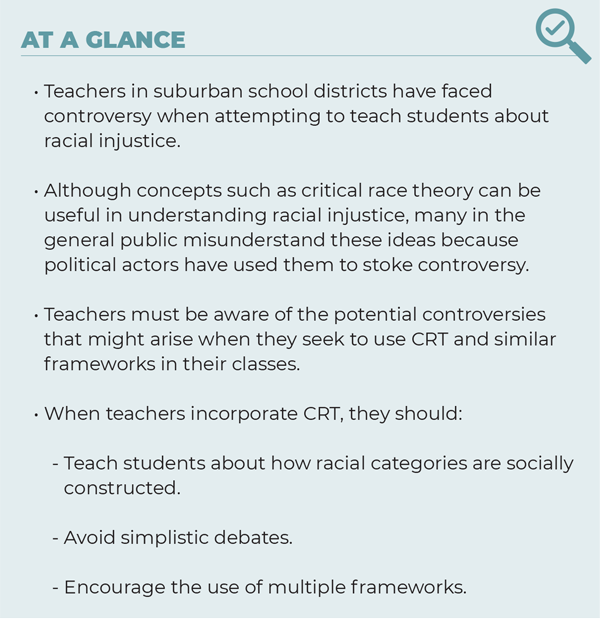
Teachers on the front lines must anticipate potential objections to any work they might do that could be perceived as related to CRT and be aware that some people will look for reasons to object to their work, sometimes misrepresenting what they are doing.
Although I’ve been fortunate enough to have the support of school and district leaders, the controversy has led to some professional repercussions. This became evident when I was invited to present my research at the 2022 American Educational Research Association (AERA) annual meeting (Farag, 2022). In addition to being a great honor, this would serve as an important professional development opportunity. Yet when I applied for reimbursement for travel costs, this request received extra scrutiny. Although some concerns were related to the amount of money requested, reimbursements of similar amounts had been approved for others. The critic who raised the objection fixated on the fact that I was presenting a paper about CRT (Kadosh, 2022; Westfield NJ Public Schools, 2022). Teachers on the front lines must anticipate potential objections to any work they might do that could be perceived as related to CRT and be aware that some people will look for reasons to object to their work, sometimes misrepresenting what they are doing.
When an academic idea is politicized
Many members of the public derive more of their understanding of CRT from media pundits and political operatives than from educators and scholars. A December 2021 Northeastern University poll found that 7 in 10 members of the public had no knowledge of CRT (Ramjug, 2021). Teachers, too, are not always knowledgeable about the topic. My dissertation research, done before CRT became a national controversy, showed that 62.5% of the social studies teachers in predominantly white high schools in New Jersey had never heard of CRT (Farag, 2020). Stephen Sawchuk (2021) of Education Week writes:
There is a good deal of confusion over what CRT means, as well as its relationship to other terms, like “anti-racism” and “social justice,” with which it is often conflated . . . the term “critical race theory” is now cited as the basis of all diversity and inclusion efforts regardless of how much it’s informed those programs.
This confusion allows media pundits and political operatives to fill the void and shows how important it is for academics to make their ideas more accessible to K-12 educators and members of the general public.
I was one of the few classroom teachers at the national conference that caused so much controversy in Westfield. The presentations and panels that I attended discussed the culture wars surrounding CRT, and everyone in attendance seemed to have a clear understanding of the academic theory and its application. However, I couldn’t help but feel a fundamental disconnect between those in higher education and my experience as a high school social studies teacher.
One such presentation was led by the authors of a recent Kappan article, which highlighted the need for digital citizenship education to prepare students to grapple with polarizing topics such as CRT. Their first principle encourages teachers to “delve deeper into the root causes of racism and racist rhetoric in U.S. society” and guide students toward “fuller consideration of the root causes and mechanisms of polarization (and its frequent white supremacist undertones)” (Mirra et al., 2022, p. 31). Though this approach is necessary, it is precisely when teachers attempt to dig deeper that they can be most under attack. Teachers pursuing these topics must be aware that any attempt to get to the roots of racism can get swept up in the political firestorm surrounding CRT. The reality is that those who need the kind of citizenship education these scholars recommend may be the very same people fighting against it.
While it is important to conceptualize and theorize solutions to educational inequities within schools, it is also important to engage those who seek to maintain the status quo or fight against social justice initiatives. Otherwise, academics will find themselves preaching to the choir as our society gets more and more divided. The public (as well as many classroom teachers) will continue to get their knowledge of CRT from media pundits and political operatives rather than scholars and researchers. And some people will direct their ire not just at academics but at teachers, administrators, and board members advocating for social justice.
If we, as educators, continue to allow media pundits and political operatives to dictate the terms of this culture war, students who are unprepared for a globalizing multiracial world will be the ones who suffer the most.
To fight the intellectual censorship of anti-CRT legislation, K-12 educators and administrators need the full support and involvement of higher education institutions. On a practical level, this can mean providing more intensive and ongoing professional development to help teachers understand the scope of the current culture war and ways to navigate it effectively. They might offer graduate-level credit-bearing courses with discounted or free tuition or use grant money to provide stipends for teachers. Higher education institutions also can help organize their scholars to speak at local board meetings about what CRT actually is and what it means for public schools. They must also equip future teachers with knowledge of the political landscape they are entering as educators.
Preparing to navigate controversy
As a teacher educator, I try hard to prepare preservice social studies teachers for the current culture war. This requires a complex and nuanced view of the power dynamics at play. For example, teachers need to be aware that parent influence is very powerful in many suburban districts (Calarco, 2020) and can even dictate which teachers get retained and which ones do not get tenure. In fact, I advise my preservice teachers to only discuss very controversial issues when they have tenure or have gained enough credibility in their community that their employment would not be threatened. This puts the onus on veteran teachers in suburban districts to accurately frame controversial topics and on administrators to protect the intellectual freedom of teachers, especially those without tenure.
Teachers at all levels need to be prepared to have their pedagogy questioned by those who perceive teachers as liberal indoctrinators of their children (e.g., Blair, 2020). Teachers who choose to discuss politically and racially charged issues in their classrooms will need to carefully lay a foundation for their students and conduct their lessons in ways that promote thoughtfulness and understanding. As a teacher of color in a predominately white district who explicitly teaches a course framed by CRT, the following strategies have helped me frame the conversations in my classroom:
Understand and teach about social constructs.
At the core of this culture war is a debate over definitions and identities. So, before teachers can engage students in discussions about race and other similarly controversial topics, we need to make clear to students how our definitions and categories are socially constructed.
In my courses, I start at a very basic level. For example, I discuss how people’s names are actually how we decided to label the unique collection of cells that make up each person. Another example, the construct of time, is how we decided to quantify the Earth’s rotation and its revolution around the sun. These conversations can transition naturally into discussions of how other civilizations have constructed their societies. Regarding race, this allows me to frame racial categories not as good or bad, not as moral or immoral, but as a way in which society has been organized. Discussion then turns to the flaws in racial categories (Adelman, 2003) and how we might use different structures to construct a more effective society.
This framing allows racially charged discussions to be considered more objectively and avoids making my white students feel guilty for being white or responsible for the inequalities previous generations created using inaccurate social constructs. It also treats solving racial inequities as a mutually beneficial endeavor rather than a zero-sum game where white people lose if people of color reach equality.
Avoid either/or debates.
While many liberal media organizations try to portray conservatives as racists who minimize the discrimination minorities face, and conservative media organizations portray liberals as socialists dependent on government handouts, the classroom cannot become just another arena where students fight over these simplistic characterizations. When discussing the racial inequities that cause controversy, I try to ask questions that avoid these characterizations.
Broadly speaking, debates between conservatives and liberals revolve around questions of small government versus big government. So if we’re talking about the role of government in solving racial inequities, instead of asking whether the government should be involved, I ask, “To what extent has government intervention been effective in solving inequities?” and “To what extent has the free market been effective in solving inequities?” Social studies teachers, armed with empirical evidence and the historical record, can contextualize such topics by discussing ways in which government intervention exacerbated racial inequities, such as how redlining led to housing discrimination. At the same time, we can share how real estate agencies and banks, representing the free market, contributed to racial inequities by encouraging white flight. Conversely, teachers can provide evidence of times in which both government intervention and the free market attempted to solve racial inequities. Providing such information can complicate the assumptions that politically polarized arguments are built on.
CRT is a highly effective lens to critically analyze the policies of both governmental institutions and corporations. Specifically, it can challenge liberal assumptions that government intervention is always the solution as well as conservative assumptions that free market capitalism is always the solution. Ironically, even though many conservatives argue against employing CRT in schools, it can bolster their arguments in support of a smaller role of government in addressing racial inequities.
Explore multiple frameworks.
Part of being an effective educator is staying as objective as possible in the classroom. Social studies teachers must be especially aware of our own subjectivity because our field of study naturally leads many of us to develop deeply informed political identities and opinions related to the topics covered in our courses. The course I teach at Westfield High School — Power, Privilege, and Imbalance in American Society — uses CRT as its guiding framework, but I make sure to discuss the fundamental counterarguments to CRT and other social theories.
I require my students to provide a theoretical counterargument for any framework they might use to analyze events in history. For example, if we’re analyzing the influence of societal structures on people’s lives, I make sure they also understand the role of individual agency in outcomes. I ask students to what extent individual decisions impact people’s lives and help them see how individual decisions can undermine the influence of societal structures. If we’re exploring how ideas about reality are socially constructed, I remind them that their conclusions must also be tempered by objective approaches to knowledge and discuss ways in which scientific inquiry can inform the ways we construct society.
There are few things worse than having students discuss racially charged topics when operating from radically different worldviews, and there are few things better than facilitating unifying discussions where students can see the logic and evidence someone who thinks differently than themselves might use to form their conclusions. As social studies teachers, we are fighting powerful forces that seek to divide us, and only through deep awareness of these forces can we hope to be the unifying force our society so desperately needs.
Preparation for a changing world
As educators, we cannot ignore the societal and economic changes within our society. We must prepare students for a much more complex and interconnected world. Suburbs across the U.S. have generally been thought of as predominately white, but they are becoming increasingly diverse (Frey, 2022). Understanding the perspectives of different races empowers white students in these communities to better function in a world in which they are not in the majority (Mitchell, 2020).
In addition, racism and racial discrimination are not solely U.S. problems but global ones. The era of European Imperialism of the 17th to 20th centuries and the subsequent decolonization following World War II have forced the entire world to grapple with white supremacy and racism in different ways. Although CRT originated within the U.S. legal system, it can assist students in understanding the way race has shaped societies around the world. States that hamstring teachers and administrators by censoring CRT disadvantage their students by potentially making them less prepared for life in our continually globalizing and multiracial world.
Intellectual censorship is never the answer, and those of us in academia and education must take back control of political narratives surrounding academic theories. The suburbs are the front lines of culture wars surrounding race, with CRT being the focal point of controversy. Misunderstandings and misrepresentations of the theory can threaten the future of all our students.
In our socially segregated and politically polarized society, social studies teachers hold the immense responsibility of being forces for unity within our democracy. Those of us on the front lines need to make our experiences and perspectives heard. We need to be prepared for the volleys and attacks we will face if we hold the line and protect our intellectual integrity and freedom. In the end, if we, as educators, continue to allow media pundits and political operatives to dictate the terms of this culture war, students who are unprepared for a globalizing multiracial world will be the ones who suffer the most.
References
Adelman, L. (Executive Producer). (2003). Race: The power of an illusion [Film]. California Newsreel.
Alfonseca, K. (2022, March 24). Map: Where anti-critical race theory efforts have reached. ABC News.
Barnum, M. (2021, November 5). How will fights about race and suburban schools change education politics? Chalkbeat.
Blair, D. (2020, August 17). I’m a former teacher. Here’s how your children are getting indoctrinated by leftist ideology. The Heritage Foundation.
Calarco, J.M. (2020). Avoiding us versus them: How schools’ dependence on privileged “helicopter” parents influences enforcement of rules. American Sociological Review, 85 (2), 223-246.
Farag, A. (2020). Structured whiteness: A study of social studies teachers who teach in predominantly white public school districts [Doctoral dissertation, Rutgers, The State University of New Jersey].
Farag, A. (2021). The fear of multiple truths: On teaching about racism in a predominantly white school. Phi Delta Kappan, 102 (5), 18-23.
Farag, A. (2022, April). Critical race theory in white spaces: A quantitative study of the teachers of white students [Conference presentation]. American Educational Research Association Annual Meeting, San Diego, CA, USA.
Frey, W.H. (2022, June 15). Today’s suburbs are symbolic of America’s rising diversity: A 2020 census portrait. The Brookings Institution..
Heritage Foundation. (2021, December 2). Coalition calls on states to increase transparency, end critical race theory in schools. Author.
Kadosh, M. (2022, April 11). School board probes teacher’s trip costs to present study on critical race theory. TAP into Westfield.
Meckler, L. (2022, March 2). New transparency bills would force teachers to post instructional materials. The Washington Post.
Mitchell, T. (2020, May 30). 1. Demographic and economic trends in urban, suburban and rural communities. Pew Research Center.
Mirra, N., McGrew, S., Kahne, J., Garcia, A., & Tynes, B. (2022). Expanding digital citizenship education to address tough issues. Phi Delta Kappan, 103 (5), 31-35.
Preston, T. (2021, December 16). Kappan’s top articles of 2021. Phi Delta Kappan.
Ramjug, P. (2021, December 23). Seven out of 10 people don’t know what critical race theory is, US poll finds. News @ Northeastern.
Reilly, K. (2022, March 23). Culture wars could be coming to a school board near you. Time.
Rufo, C. (2022, February 23). The fight for curriculum transparency. City Journal.
Sawchuk, S. (2021, May 18). What is critical race theory, and why is it under attack? Education Week.
Westfield NJ Public Schools. (2021, September 24). BOE Meeting 9.21.21 [Video]. YouTube. https://youtu.be/fDiSOQc6vn4
Westfield NJ Public Schools. (2022, April 6). BOE Meeting 04–05-2022 [Video]. YouTube. https://youtu.be/0fxJ-jLglwI
This article appears in the February 2023 issue of Kappan, Vol. 104, No. 5, pp. 18-21.

ABOUT THE AUTHOR

Antony Farag
Antony Farag is a social studies and humanities teacher at Westfield High School, Westfield, NJ, a cofounder of Global Consciousness Consulting, and a lecturer at the Rutgers Graduate School of Education.