How can teachers better help students use online tools to learn about and address racism, polarization, and other volatile topics?
Even as educators wrestle with the ongoing challenges of pandemic-era teaching and learning, they’ve found themselves thrust into the middle of a civic crisis as well. For months now, fierce and hyperpartisan debates have raged at school board meetings and in district offices all over the country, focusing on everything from mask mandates to systemic racism and critical race theory, with those involved drawing on wildly divergent sources of information. No doubt, educators have a lot to contend with already, but these angry conflicts highlight the urgent need for our schools to provide civic and media education that prepares young people for responsible citizenship in a sharply divided and media-saturated society.
As members of the Educating for Civic Reasoning and Discourse Commission (sponsored by the National Academy of Education; Lee, White, & Dong, 2021), we recently reviewed the existing research into digital citizenship, focusing specifically on educators’ efforts to help students use digital tools for civic and political engagement. We found that such efforts primarily cluster around preparing youth in three important areas: civility, information analysis, and civic voice. Further, we found that this work shows much promise, especially in helping to diminish cyberbullying and to increase students’ capacities to decide what online sources to trust (Gaffney et al., 2019; Wineburg et al., 2019). However, we also concluded that if we want our schools to provide civic education that truly prepares young people to contend with current levels of political polarization, disinformation, and racism and other forms of prejudice, then these efforts will need to expand significantly.
Specifically, we urge educators to consider and apply three principles for innovative instructional design. All three can support effective teaching and learning for all age groups and across all subject areas. The strategies we outline are just initial steps, but we believe they can help educators at all levels chart a path through the storm that both youth and adults currently confront.
Principle 1: Delve deeper than surface-level civility
A popular digital citizenship curriculum from Common Sense Media, used in more than 75,000 schools, includes the story of Marcus, an 8th grader who creates a pseudonymous Instagram account and posts an image of his rival school’s mostly Black basketball team, along with a racist message. When other students from Marcus’ school find the post, they post their own racist jokes. The 8th-grade lesson plan suggests that teachers use this hypothetical example to start a discussion with students about ways they can respond to cyberbullying and online hate speech, focusing on raising awareness and supporting those targeted by discrimination and bigotry.
This lesson plan is typical of many current instructional resources in this area. It engages on a surface level with the volatile combination of social media, racism, and civic discourse but fails to delve deeper into the root causes of racism and racist rhetoric in U.S. society. As important as it is to instill in students values of kindness and civility in the face of online racism, lessons that focus on these values often dodge much thornier questions lurking just below the surface. For example, how do the structures of online environments facilitate racism? What does the prevalence of racism online suggest about the state of our society? Other than promoting civility, what can be done to address this urgent social challenge? While this scenario is certainly a valuable conversation starter and could help students consider how they can respond when they see racist posts, it does not do enough to prepare students for the complex demands of digital citizenship. Such preparation requires fuller consideration of the root causes and mechanisms of polarization (and its frequent white supremacist undertones). So, how can teachers get to these deeper issues?
Students should learn to analyze the political partisanship that fuels the production and spread of so much online information, particularly disinformation.
One strategy involves supplementing vignettes like this one with data points that speak to broader structural trends. For example, the story about Marcus could be paired with the recent finding that, each day, the average Black adolescent receives two derogatory messages online, such as a racist image or a racist joke (English et al., 2020). Now, conversation about an individual incident can be put into a wider social context and spark provocative questions such as: If a post like this occurred at our school, what should happen to the student who posted it? Other than addressing this single event, are there things teachers, the principal, or students could do to prevent such abuse? Students might also think about online environments more generally: Do platforms like Instagram do all they can to stop these kinds of events? Are there things they could do that would help? Finally, it would be valuable for students to consider broader societal dynamics — for example, how is it that the same racist ideas keep being recycled by different kids and adults, year after year?
Dialogue about these questions ought to dig deeper into what it means to be a citizen committed to challenging systemic racism in our democracy. Data points can be drawn from local or national research and policy documents and even become a catalyst for classroom inquiry for students who seek out additional data to inform class discussions. While the challenges of racism defy simple solutions, encouraging students to think more carefully about why racist messages proliferate on digital platforms is an important step to addressing the problem. The guidance to simply “be nice” online, without further analysis of the issue, rings hollow as the storm rages on.
Principle 2: Focus on credibility and underlying motivations
On Aug. 23, 2020, the eve of the Republican National Convention, the Twitter account @WentDemtoRep tweeted, “I’ve been a Democrat my whole life. I joined the BLM protests months ago when they began. They opened my eyes wide! I didn’t realize I became a Marxist. It happened w/o me even knowing it. I’m done with this trash. I’ll be registering Republican.” This tweet quickly accumulated 39,000 likes and 22,000 retweets before Twitter suspended the account for violating its policies on platform manipulation. It turns out that the same tweet was posted by dozens of other accounts as part of a targeted disinformation campaign (Timberg & Stanley-Becker, 2020).
How should students critically evaluate a tweet like this? They need an approach that prioritizes questioning the source (Who is this? Do I trust them on this topic?) and discounts less germane elements (the account’s number of followers or the post’s likes and retweets). Additionally, they should analyze the contexts, power relations, and motivations that underlie the production of content like this, understanding not only who produced this information and their political or ideological ties but also why it was produced and who stands to gain power or influence from this tweet and others like it. How does the tweet’s message take advantage of partisan and racial divides in the U.S. to sow further distrust and resentment?
When students turn to the internet for information, they have access to extraordinary troves of content — and they are largely responsible for sifting through it to find information they trust. Efforts to teach students online evaluation skills can help them get better at finding high-quality sources and evidence (McGrew, 2020). In addition to learning to evaluate online content, students should learn to analyze the political partisanship that fuels the production and spread of so much online information, particularly disinformation, and learn to recognize, cope with, and respond to content posted with ill intent (Tynes et al., 2021).
What might this look like? Teachers could help students understand that the production and spread of digital disinformation is often a political act performed for political or ideological gain. Such information often uses racist tropes or messages to inflame preexisting tensions and biases and to promote white supremacy. Consider, for example, the Russian disinformation campaign during the 2016 presidential election cycle. It has been widely reported that Russian operatives tried to use social media to weaken confidence in our democratic institutions. What has received far less attention from the news media, however, is the extent to which their strategy focused on race. Sixty-six percent of Russia-sponsored Facebook posts, for example, aimed to stoke racial division on both the political right and left either by promoting hate among white supremacist groups or by heightening distrust in Black communities (U.S. Senate Select Committee on Intelligence, 2020). In this context, the tweet from @WentDemtoRep is not just an individual post to evaluate; it is part of a larger program that advances its agenda by targeting political and racial fissures. If teachers help students to consider the political motives that often influence the creation and dissemination of social media posts, young people can learn to look beyond individual sources, begin to ask how sources are connected, and investigate why disinformation is produced and shared.
In addition to helping students evaluate the political purposes of disinformation, teachers can ask them to consider their own motivations for sharing such material. Even if students know how to evaluate information, they may still post and share misinformation that aligns with their political views or ideological positions. This is due both to the fact that youth and adults are less likely to critically evaluate content that aligns with their perspectives and because some individuals knowingly share false information. Students won’t necessarily stop retweeting false information just because their teachers call them on it, but at the very least, they should be challenged to reflect on such behavior and define their ethical position on it.
Finally, not only should young people learn to evaluate the credibility of online information, but they should also be challenged to decide how and whether to act on what they’ve learned. For example, they can consider how they might take action in response to online mis- or disinformation in ways that promote equity and justice.
Principle 3: Support youth civic voice
“The world needed to see what I was seeing,” said 17-year-old Darnella Frazer, explaining why she took out her phone to record the murder of George Floyd on May 25, 2020 (Sullivan, 2021). The video galvanized an international protest of state-sanctioned violence, even murder, against Black Americans. Driven by a sense of civic responsibility, Frazier bore witness, using the digital tool available at her fingertips, and her action shows the power of youth civic voice.
Whereas young people may have traditionally been guided toward forms of civic participation that required them to be of voting age and legally recognized as U.S. citizens, today’s digital tools broaden the ways young people can engage with complex civic issues. Rather than serving to keep minors on the sidelines, public platforms like Twitter and Facebook have illuminated how youth advocacy can bring about substantial real-world change. From a youth-organized global climate strike to legions of K-pop fans crippling a Donald Trump presidential rally, contemporary examples of youth organizing and participating in online spaces are abundant. More important, the opportunities for developing and honing youth civic voice in classrooms can also be developed in spaces cordoned off specifically for education. The public media station KQED’s Learn platform, for example, is a space where teachers can invite middle and high school students to create content, view content created by other students, and participate in discussions about current issues.
These kinds of educational spaces can help students learn (alongside their teachers) how to use their voices in ways that resonate in public contexts outside of school. That is, digital tools can create opportunities for civic involvement that recognize and demonstrate the legitimacy and civic brilliance of young people’s ideas, whether they are sharing thoughts on a class-managed Twitter account (that allows them to preserve their anonymity) or creating digital public service announcements that can be shared on school social networks. Teachers across subject areas and age groups can cultivate youth civic voice in the present moment, going beyond simply preparing them for the future.
Where do we go from here?
The urgent need for action is clear. Far less clear is how to advance this agenda successfully. Indeed, a recent survey of legislative efforts at the state level suggests that efforts to teach digital citizenship will stick to the surface, focusing primarily on ways to promote safety, reduce bullying, and help youth judge the credibility of online content (DiGiacomo et al., 2021). Very rarely do education policy makers say anything at all about the prevalence of racism online or about ways to reduce it. Nor do they say anything about the need to teach young people about the underlying reasons why bullying, misinformation, and other unsafe content are allowed to spread so easily on the web.
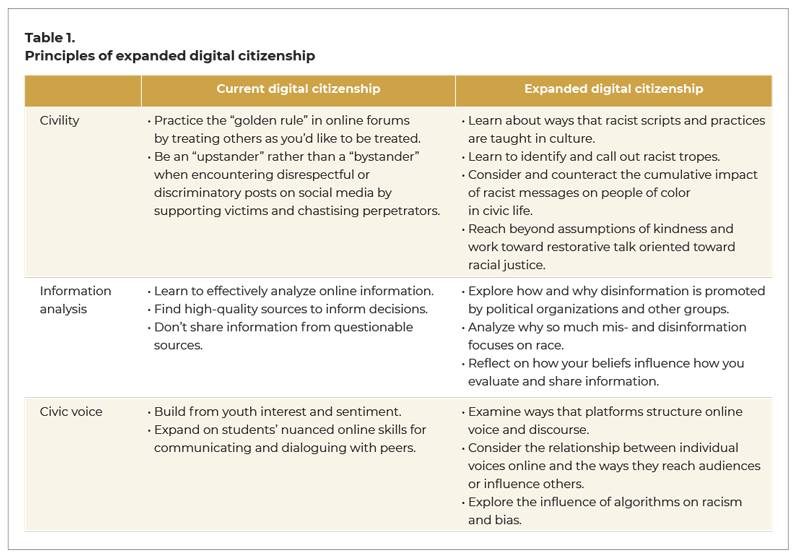
The three principles noted above offer a starting place, showing how teachers can expand lessons on civility, information analysis, and civic voice to give greater attention to the ways in which cultural, political, and institutional factors influence what students encounter online. (See Table 1 for a summary of how the current digital citizenship curricula could be expanded.) It’s not sufficient to teach young people to be more polite and careful online. They should also be taught to take a deeper look at how the digital world works, including how and why racism, sexism, homophobia, and other prejudices remain so prevalent online; why so much online content reflects partisan biases; and why so much of that content aims to promote distrust of and disrespect for others.
The need for systemwide support
Online prejudice, bullying, and disinformation cannot be overcome by piecemeal approaches in individual classrooms across this country, and teachers cannot and should not be expected to address such challenges on their own. Systemic problems require systemwide responses. Indeed, if we want to provide quality digital citizenship education at scale, then we will need to take action on many levels at once, including standards and curriculum development, professional learning, and more. We will also need to ensure that educators at every level receive sustained training about how to engage in conversations about systemic inequality with young people in ways that do not create further harm.
Thus, we are encouraged to see many organizations working to create model units and share resources related to digital citizenship. For instance, the National Council of Teachers of English has developed reports, policy briefs, and webinars focused on critical media literacy that can be leveraged for planning at the district and classroom level (see https://ncte.org/critical-media-literacy). Similarly, the National Council of Social Studies has issued position statements on both Media Literacy and Youth, Social Media and Digital Civic Engagement (see www.socialstudies.org/advocacy/ncss-position-statements), and a number of school districts are now compiling teaching resources in these areas.
However, school and district leaders — and the broader education community — must make greater investments in this work, and they must provide firm support for the teaching of digital citizenship in the face of efforts now underway, in many states, to curtail discussions of challenging topics (related to race in particular) in schools. Nothing about this challenge strikes us as easy. But if schools are to remain a foundational support for a democratic society, then such support will be vitally important.
References
DiGiacomo, D., Hodgin, E., Taylor, C., Alkam, S., & Kahne, J. (2021). State level education policies on digital civic engagement. (Working paper).
English, D., Lambert, S.F., Tynes, B.N., Bowleg, L., Zea, M.C., & Howard, L.C. (2020, January-February). Daily multidimensional racial discrimination among Black U.S. American adolescents. Journal of Applied Developmental Psychology, 66.
Gaffney, H., Farrington, D.P., Espelage, D.L., & Ttofi, M.M. (2019). Are cyberbullying intervention and prevention programs effective? A systematic and meta-analytical review. Aggression and Violent Behavior, 45, 134-153.
McGrew, S. (2020). Learning to evaluate: An intervention in civic online reasoning. Computers & Education, 145.
Sullivan, M. (2021, April 20). By bearing witness — and hitting ‘record’ — 17-year-old Darnella Frazier may have changed the world. The Washington Post.
Timberg, C. & Stanley Becker, I. (2020, August 26). Black voters are being targeted in disinformation campaigns, echoing the 2016 Russian playbook, The Washington Post.
Tynes, B.M., Stewart, A., Hamilton, M., Willis, H.A. (2021). From Google searches to Russian disinformation: Adolescent critical race digital literacy needs and skills. International Journal of Multicultural Education, 23 (1).
U.S. Senate Select Committee on Intelligence. (2020). Russian active measures campaigns and interference in the 2016 U.S. election, Volume 2: Russia’s use of social media with additional views. (Report 116-290). U.S. Government Printing Office.
Wineburg, S., Breakstone, J., Smith, M., McGrew, S., & Ortega, T. (2019). Civic online reasoning: curriculum evaluation (Working paper 2019-A2). Stanford History Education Group, Stanford University.
This article appears in the February 2022 issue of Kappan, Vol. 103, No. 5, pp. 31-35.

ABOUT THE AUTHORS

Nicole Mirra
Nicole Mirra is an assistant professor at Rutgers University, New Brunswick, NJ, and the author of Educating for Empathy: Literacy Learning and Civic Engagement.
Sarah McGrew
Sarah McGrew is an assistant professor at the University of Maryland College of Education, College Park.
Joseph Kahne
Joseph Kahne is a professor of education at the University of California, Riverside.
Antero Garcia
Antero Garcia is an assistant professor in the Graduate School of Education at Stanford University, Stanford, California.
Brendesha Tynes
Brendesha Tynes is a professor of education and psychology at the University of Southern California, Los Angeles.