Makerspaces have great potential for enhancing learning, but only if educators attend to the practicalities of integrating making into their classrooms.
“We need a higher vertex!” a student in a Texas middle school calls out. Across the classroom, her partner nods, adjusting the arm length of the miniature catapult they’ve built before launching another test shot along its new parabolic path. Hundreds of miles away, in a Philadelphia high school, students cluster around a video editing dock to watch a clip from their classmate’s short film about religious freedom. On the surface, these scenes don’t have much in common. But they share a connecting thread: Both involve learning in school makerspaces.
Makerspaces are places where participants (or “makers”) design or create (or “make”) projects using a variety of physical and digital tools. Popularized in 2005 with the publication of Make magazine, the concept has, in recent years, captured the imaginations of education leaders and grassroots educators who saw similarities between making and other forms of project-based learning. This relationship was solidified in 2014, when the Obama administration introduced its Nation of Makers initiative, which promoted educational makerspaces as a resource for empowering students “to be makers of things, not just consumers of things” (White House, 2014). Since then, many school leaders have continued to cultivate such spaces, equipping students for hands-on learning through imaginative tinkering and play (Kim et al., 2018).
Yet for all the excitement makerspaces inspire, meaningfully integrating them into schools can be challenging. In our research, we’ve seen administrators build expensive, high-tech makerspaces that sit unused because students and teachers are uncertain about how or why to use them. We’ve also met teachers who are passionate about making but have had difficulty aligning it with their standards and pacing guides.
While studies demonstrate that makerspaces often empower students to take ownership of and find joy in their learning (Sheridan et al., 2014), much of this research takes place in out-of-school contexts like museums and libraries — places that are free from the day-to-day demands of standards, curricula, and assessments. There is less research and fewer resources related to reconciling the informal learning that takes place in makerspaces with the formal objectives of school. In other words, there is strong evidence for the possibilities that makerspaces hold for learning, but the practicalities of what this looks like in schools are less clear.
Our own experiences as educators in and researchers of school makerspaces have shown us how teachers can align making projects and school curricula in ways that empower students to bring their interests and identities into content-area learning. We have also considered some of the challenges teachers might face in integrating making into their own classrooms and how educators can surmount those challenges.
Principles of makerspaces
While the term makerspaces is relatively new, the principles that animate making have been around a long time. Making’s emphasis on “learning by doing,” for example, aligns with traditions of experiential education that extend back to John Dewey and earlier. Likewise, its focus on creative problem-solving and tinkering is closely aligned with Jean Piaget’s constructivist learning theories. Makerspaces, then, might be understood less as a new educational trend than as a recent iteration of well-established instructional principles. At its core, making is about empowering students to take ownership of their learning by giving them opportunities to solve meaningful problems and create worthwhile projects. In this way, it shares similarities with other learning theories (e.g., connected learning, 21st-century learning) and stand-alone activities (e.g., genius hour, passion projects) that are currently popular in schools.
While the term makerspaces is relatively new, the principles that animate making have been around a long time.
While there is no singular framework for thinking about makerspaces, we find the ideas of Mitchel Resnick, founder of the Lifelong Kindergarten lab at MIT, to be especially instructive. For Resnick, the principles of robust making experiences can be summarized by Four Ps: projects, passion, peers, and play (Resnick, 2017). These principles can serve as guideposts for educators interested in merging making with content-area learning. Their lessons should include opportunities for projects whose requirements are broad enough that students can make them their own. This opens space for students’ passion to drive their making, as they bring their interests and identities to their work. Students should also have opportunities to engage with peers, so they can learn with and from others. And finally, this entire process should be driven by a sense of play — where students have flexibility to tinker and experiment without fear of making mistakes. According to Resnick, teachers who are mindful of these Four Ps can nurture making-oriented environments that cultivate students’ creativity while meeting content-area objectives.
Makerspaces in practice
Resnick’s Four Ps provide a helpful guide for bringing making into the classroom, but what does it look like in practice? How do teachers actually merge making with formal learning goals in schools? Two cases from our research — a middle school math class and a high school humanities class — show how teachers have used making to empower student learning across age groups, content areas, and school contexts.
Making projects in middle school math
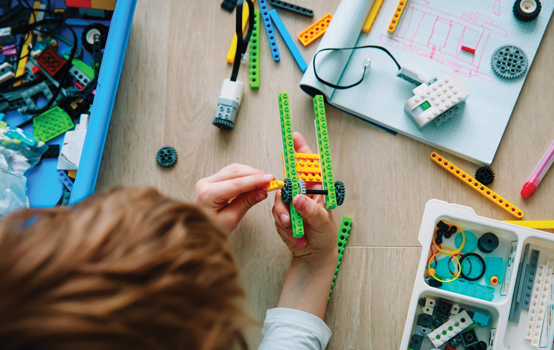
Since makerspaces first gained traction in community hubs like museums and libraries, it makes sense that their integration in many schools has started in the library. At a middle school in Texas where Kurt is an administrator, school leaders used technology funds from a school bond to repurpose part of their library into a makerspace. The transformation made available a range of exciting tools: a 3D printer, touch-screen laptops, video equipment, craft and robotics supplies, and moveable furniture. Most of the teachers and staff were enthusiastic about the possibilities this makerspace offered, but they remained unsure about how to fold making into their curricula. The school’s math faculty decided to take on this challenge by reimagining an existing quadratics project into something more aligned with the principles of making.
In the past, this quadratics project had involved building a catapult using a given set of instructions and collecting data based on trials firing a projectile. It was enjoyable and informative, but because students all followed the same instructions to build their catapults, the results of each project were nearly identical. Teachers redesigned the project to provide more opportunities for student decision making and empowerment. Students would now work in teams to build the farthest-firing catapult of their own design, with few parameters (i.e., it could only cost so much, could only be so big, and couldn’t use electricity). With each iteration of the catapult, students used video and digital graphing applications to record results and calculate changes in the quadratic equation that modeled the path of their projectile.
This reorientation of the quadratics project followed the school’s Making Process model: challenge, collaborate, and innovate. It also supported curricular goals for developing and demonstrating mathematical discourse and reasoning while enabling students to merge their creative energies with content-area learning.
We can see, in this example, Resnick’s Four Ps at work: students were given a challenging and engaging project, which was open-ended enough that students could bring their passions, curiosities, and hypotheses into their work. They also collaborated with peers as they constructed and tested both catapults and mathematical understandings. And, crucially, all of these activities were supported by an environment of play, where students could tinker with applications of mathematical concepts without fear of failure.
Making curriculum in high school humanities
Importantly, making is not limited to those schools with well-resourced makerspaces and high-tech gadgets; it can also be folded into existing school structures. This is because, at its core, making isn’t about the space or the tools, but is an orientation toward empowered learning and creative problem-solving — what Dale Dougherty, founder of Make magazine, calls “the maker mindset.” In a Philadelphia public high school, where Philip managed a multiyear university-school partnership, humanities teachers helped students develop this mindset by integrating making into their curriculum design, reorganizing inquiry-based units to allow flexibility in how students navigated them.
Making can be transformative for classrooms, which means it may also be disorienting for some students.
To do this, educators restructured each unit into a “playlist” of activities, organized around phases of the school’s design process: discover, define, design, develop, deliver. Discover activities exposed students to the histories and controversies that related to the unit theme. Define assignments introduced the unit’s standards-aligned content. The Design, Develop, and Deliver phases involved creating a project that demonstrated students’ grasp of the subject matter. Students could work through this playlist asynchronously, in whatever order best served them. Teachers circulated through the room during class time, supporting students as they navigated the playlist, allowing projects to inform content-area learning and vice versa.
For example, in a unit on religious freedom, some students worked sequentially, reflecting on their own religious histories or analyzing poetry and essays associated with religious identity. Others began with the project — turning to Discover and Define activities for inspiration, as needed. For example, one Muslim student, Kiara, partnered with Miguel, a skilled filmmaker, to create a short film about Muslim experiences after the 2016 election. The two used the Discover and Define activities to ground their work in the unit’s content standards, then they worked through the remaining phases to produce their video. Unlike in the prior year, when most students had written essays, students leveraged the flexibility of this new approach to meet the standards by creating a range of products, such as videos, podcasts, infographics, and narrative poetry.
By folding making into the curriculum, teachers transformed their existing classrooms into makerspaces, empowering students to design projects that were meaningful, creative, and enjoyable. Although some students used technology to complete their projects, these activities did not require a high-tech makerspace. What’s important is that they followed Resnick’s Four Ps: Students had space for creative projects that aligned their passions with content-area expectations while the asynchronous structure gave them leeway to intermix play with disciplinary learning. And as Kiara’s video demonstrates, there were opportunities for peer collaboration — neither she nor Miguel could have completed their project without the other. Taken together, this illustrates how making can create openings for students to carve their own trajectories through the school curriculum.
Cautions and takeaways
As we have highlighted, there are exciting possibilities for educators to weave making into instruction, but we should be careful not to paint too rosy a picture. We do not want to suggest, for example, that the schools we have spotlighted faced no difficulties integrating makerspaces into their daily practice — or that doing so magically resolved challenges with student motivation or achievement. The truth is, there are no silver bullets in education, and makerspaces — like any innovation in schools — take planning and hard work if they are to live up to their potential. So when thinking about how makerspaces can be built and sustained in ways that empower students to take ownership of their learning, educators would do well to consider these takeaways from our own research and experiences.
It’s not about the space or tools
Contrary to popular perceptions, the power of makerspaces is not the space itself or the expensive tools that can be part of those spaces. The promise of making is its orientation toward empowering students to bring their interests, curiosity, and creativity to bear in content-area learning. While it is true that certain spatial configurations or technological resources can help foster cultures of making in schools, the culture is far more important than the space or tools. Getting this backward is among the most common pitfalls educators face when bringing making into schools.
As our examples show, making can occur in a standard humanities classroom as easily as in a resource-rich library makerspace. And the projects that took place in the library could be readily adapted for less high-tech environments. When integrating making into schools, then, it’s important to begin with the context by asking, “What might making mean and look like here, in this school, with these resources, for these students?” This helps focus attention on making’s greatest potential — empowering students to make learning their own.
Consider student comfort levels
Making can be transformative for classrooms, which means it may also be disorienting for some students. Those accustomed to concrete instructions, for example, may be overwhelmed by the open-endedness of making projects. In the Philadelphia high school, some students continued gravitating toward familiar essay-based assignments because they felt intimidated by the idea of meeting standards using videos or infographics.
For educators interested in makerspaces, then, it’s important to find ways to ease students into becoming confident makers. This could mean first introducing making through single projects (like the catapult activity) or providing structured options to ease students into open-ended making over time. Additionally, teachers might also reflect on what infrastructures they require to provide such support. In both of our cases, teachers needed collaborative planning time to create materials, lessons, and scaffolding resources. Because merging making with content-area learning is hard work, for students and educators, building infrastructures to make the work less overwhelming is vital to the sustained success of school makerspaces.
Rethink assessment
Finally, an enduring challenge for educators in reconciling principles of making with the objectives of school is the measurement of learning outcomes. Open-ended projects do not lend themselves to standardized evaluations; therefore, they open educators to reflection about how else we might understand students’ learning. In our experience, this can actually create possibilities for alternate assessments that give teachers clearer pictures of student learning than more conventional measures.
For instance, after the catapult project, students wrote reflections that linked mathematical problem solving with their own iterative designs. They then applied those understandings to a new data set provided by their teacher. This assessment allowed teachers to see not just how students applied a mathematical concept to their design work but how they imagined it would work in the real world with different data. With this information in hand, teachers could adapt instruction to best meet students’ needs in subsequent lessons.
Meaningful making
Integrating making with content-area learning is not easy work: Merging the informal learning of making with the formal objectives of schooling takes patience, planning, and flexibility — from both teachers and students. However, when educators focus on the principles of making and put in place the infrastructures and assessments that will support such practices, makerspaces offer powerful possibilities for learning. It is our hope that such spaces continue to empower students to bring their creativity and passions into meaningful projects in schools.
References
Kim, Y., Eduard, K., Alderfer, K., & Smith, B. (2018). Making culture: A national study of educational makerspaces. Philadelphia, PA: Drexel ExCITe Center.
Resnick, M. (2017). Lifelong kindergarten: Cultivating creativity through project, passion, peers, and play. Cambridge, MA: MIT Press.
Sheridan, K., Halverson, E., Litts, B., Brahms, L., Jacobs-Priebe, L., & Owens, T. (2014). Learning in the making: A comparative case study of three makerspaces. Harvard Educational Review, 84 (4), 505-531.
White House (2014, June 18). President Obama to host first-ever White House Maker Faire [Press release]. https://obamawhitehouse.archives.gov/the-press-office/2014/06/18/fact-sheet-president-obama-host-first-ever-white-house-maker-faire
ABOUT THE AUTHORS

Kurt Salisbury
Kurt Salisbury is an assistant principal at Midway Middle School, Hewett, TX, and a PhD candidate at Baylor University.
T. Philip NIchols
T. Philip Nichols is an associate professor in the Department of Curriculum & Instruction at Baylor University, Waco, Texas.